The Employer RPL Playbook: How to Identify Which Staff Need RPL Qualifications Before an Audit Does
Most employers discover under-credentialed staff during audits — not before. This playbook shows how to identify which staff need RPL qualifications before it becomes a problem.
By RPL it Australia9 min read

The pattern every compliance manager recognises (but rarely talks about)
You have seen this before. Most employers have. A compliance audit lands on the desk. A tender application goes in. A regulator asks for paperwork. And somewhere in that process, a name comes up — a capable, experienced person who has been doing the job well for years — and the file does not match what they actually do.
The qualification code is missing. Or it is outdated. Or it was never formally obtained in the first place, because when they started, nobody asked for it.
This is not a story about incompetent staff. It is a story about how Australian workforces grow. People are promoted based on performance. Roles evolve. Responsibilities expand. And the formal qualification record — the thing an auditor or tender panel actually looks at — quietly falls behind.
The pattern is predictable. It is also preventable. But most employers only discover it reactively, when the cost of discovery is highest.
This playbook is for employers who want to find the gap before someone else does.
Why experienced staff and formal qualifications keep falling out of sync
Australia's vocational qualification system — the Australian Qualifications Framework — defines what competency looks like at each level of a qualification. A Certificate IV, a Diploma, an Advanced Diploma: each carries a defined set of skills, knowledge, and performance standards that a qualified person is expected to demonstrate.
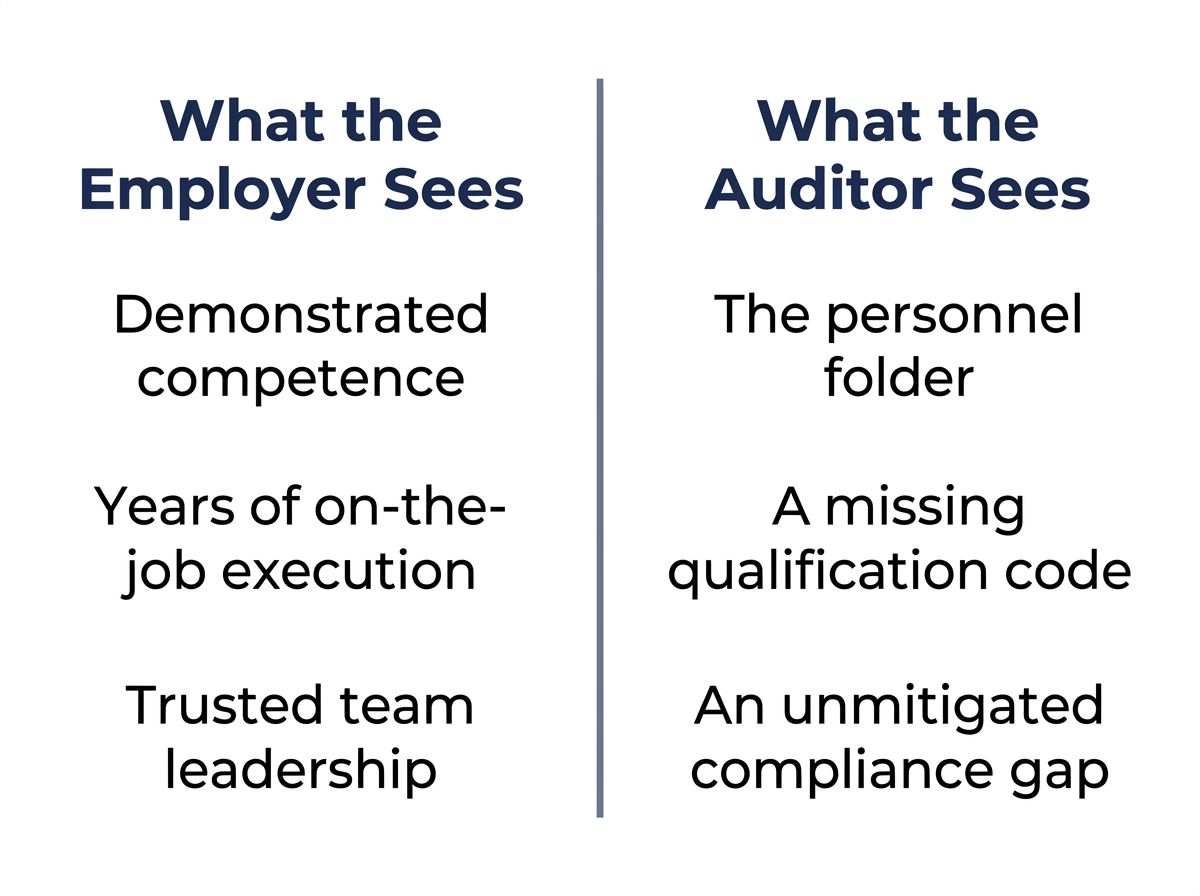
The problem is that workplaces do not promote people based on qualification codes. They promote people based on what they can do. A site supervisor earns their role by running sites well. A WHS officer earns their seniority by managing safety outcomes. A logistics coordinator earns their position by keeping operations moving.
None of that requires a formal qualification to happen. It just requires demonstrated performance over time.
Your supervisor runs the site. The audit sees a gap. Your safety officer manages the risk register. The tender panel sees an unqualified employee. Your senior IT lead architects the system. The compliance register shows no Advanced Diploma.
The worker is capable. The evidence is real. But in the eyes of a formal system — an auditor, a regulator, a procurement officer — invisible expertise is no expertise at all.
This is the same pattern that affects WHS officers performing the role without the formal Certificate IV — a credential gap that only becomes visible when someone asks for the paperwork.
It is also the pattern behind senior IT staff whose capability exceeds their credential — experienced professionals whose file simply hasn't kept pace with what they actually do.
The four trigger events that force reactive discovery
Employers rarely discover credential gaps through proactive review. They discover them through four specific trigger events — each more disruptive than the last.
- 1. Compliance audits. A regulatory body, industry certifier, or internal audit function reviews staff qualifications against role requirements. Gaps are flagged. Remediation is required. The business is exposed until the gap is closed.
- 2. Tender applications. A government or major commercial tender requires evidence that staff hold specific qualifications at defined AQF levels. A gap in the workforce means either withdrawing from the tender or scrambling to address the credential shortfall before the submission deadline.
- 3. Regulatory inspections. A licensing authority, workplace safety regulator, or industry body inspects the business and asks for qualification evidence for specific roles. Staff performing regulated work without the required credential creates immediate compliance risk.
- 4. Incident investigations. Following a workplace incident, investigators examine whether staff involved held appropriate qualifications for the work they were performing. A credential gap at this point carries the most serious consequences — legal, financial, and reputational.
Each of these trigger events shares a common feature: the employer is in a reactive position. The gap already exists. The cost of closing it — in time, disruption, and risk exposure — is higher than it would have been if the gap had been identified and addressed earlier.
Understanding what WHS auditors actually check for is a useful starting point for any employer in a regulated industry — the qualification requirements are more specific than most assume.
In construction, the pattern of site supervisors operating without the formal licence is one of the most common examples of reactive discovery — and one of the most preventable.
The employer RPL diagnostic: a workforce scan you can run this week
Here is a practical framework for identifying which staff are most likely to have a credential gap. Work through these questions for each role in your workforce that sits in a regulated, licensed, or tender-relevant function.
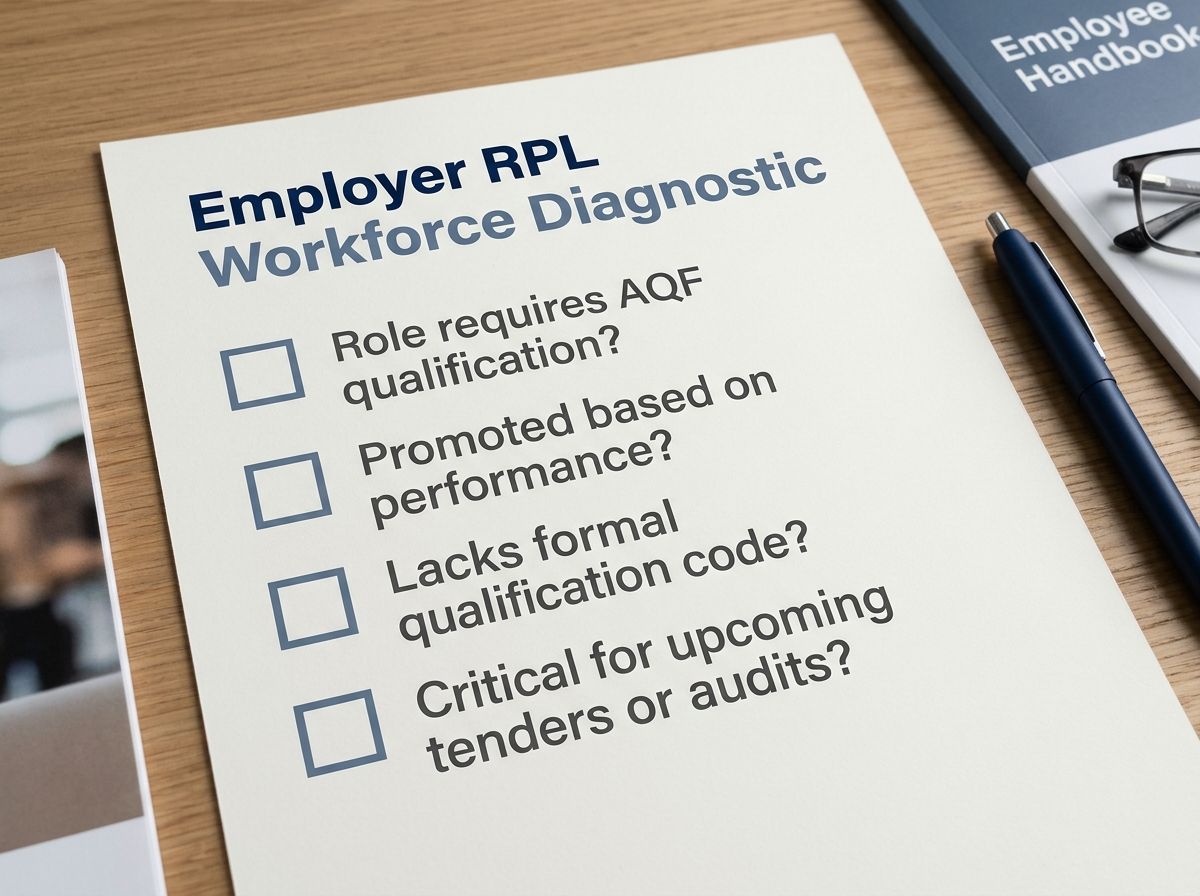
- Does this staff member perform a role that requires a specific AQF-level qualification — and does their file confirm they hold it?
- Has this person been promoted into their current role based on demonstrated performance, without a corresponding qualification upgrade?
- Does this role appear in tender documents, licensing requirements, or audit checklists as requiring a formal qualification?
- Has this person been doing this work for two or more years without anyone formally verifying their credential status?
- If a regulator or auditor asked for qualification evidence for this role tomorrow, would you be confident the file is complete?
- Are there staff in your team who trained informally, on the job, or overseas — and whose experience has never been formally assessed against an Australian qualification?
If you answered yes to any of these questions for one or more staff members, you have identified a potential credential gap. That gap may be closable through Recognition of Prior Learning — a formal assessment process where a registered training organisation evaluates the staff member's existing experience and knowledge against the requirements of the relevant qualification.
RPL is not a shortcut. It is a rigorous assessment pathway. But for staff who already have the experience, it is the appropriate pathway — one that recognises what they have already achieved rather than requiring them to repeat it.
Which roles and qualifications are most commonly affected
Not every role carries the same credential risk. Some industries and qualification types appear more frequently in audits, tender requirements, and regulatory inspections. The role categories below are among the most commonly affected in Australian workplaces.
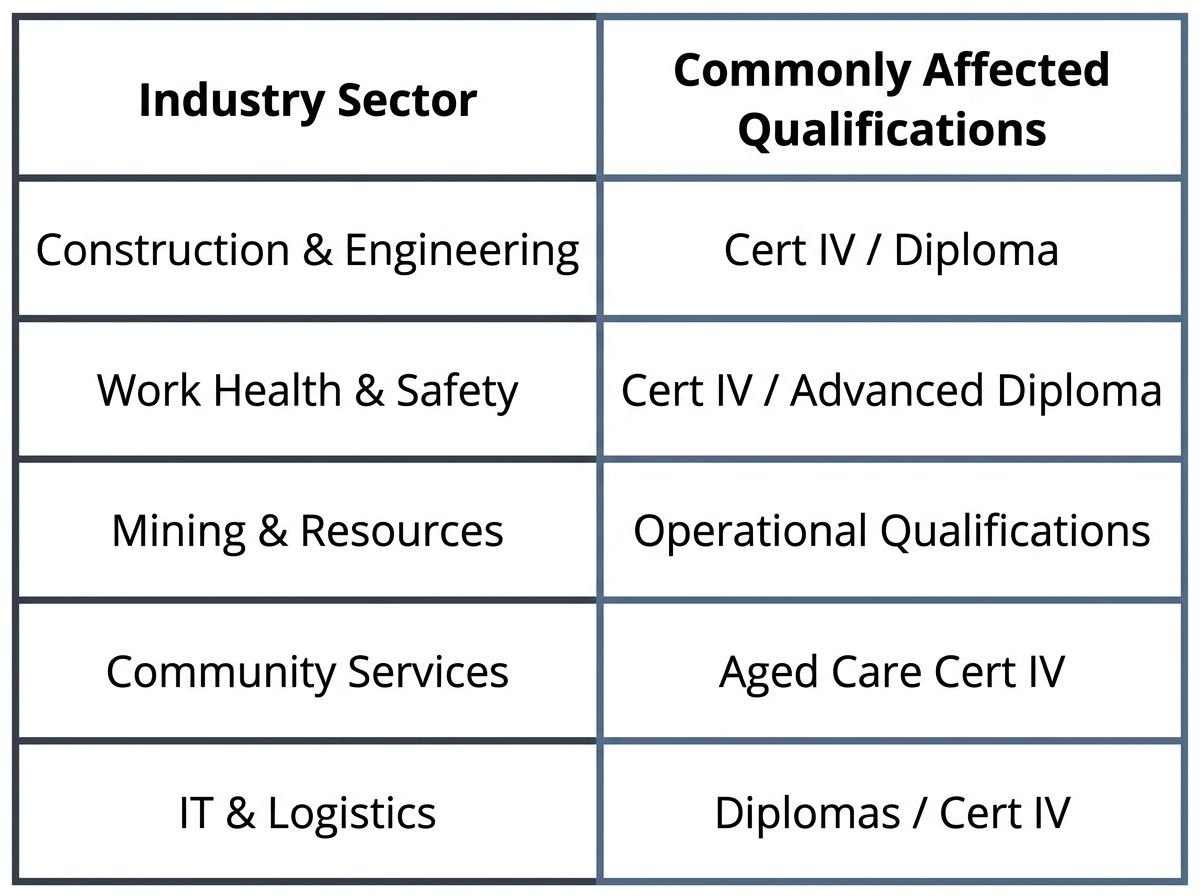
Construction and engineering
Site supervisors, project managers, and senior tradespeople frequently hold roles that require formal qualifications — including the Certificate IV in Building and Construction, state-based construction supervisor licences, and trade licences in plumbing, electrical, and related disciplines. Staff promoted from the tools into supervisory roles without a corresponding qualification upgrade are a common source of credential gaps in this sector.
Work health and safety
WHS officers, safety managers, and HSE coordinators performing duties consistent with the Certificate IV in Work Health and Safety or the Advanced Diploma of Work Health and Safety are frequently found to hold qualifications that do not reflect their actual role level. This is particularly common in organisations that have grown their safety function internally over time.
Mining, resources, and utilities
Roles in surface and underground mining operations, drilling, and utilities often carry specific qualification requirements tied to licensing and safety legislation. Staff who have progressed through operational roles without formal qualification upgrades are at risk of credential gaps that become visible during regulatory inspections or major contract reviews.
Community services and aged care
The Certificate IV in Ageing Support and related community services qualifications are frequently required for funded service delivery. Staff who have worked in the sector for years — often with significant practical competency — may not hold the formal credential required by funding bodies or regulatory frameworks.
Transport, logistics, and supply chain
Logistics coordinators, supply chain managers, and transport operations staff often perform roles consistent with the Certificate IV in Supply Chain Operations or the Diploma of Logistics without holding the formal qualification. This gap becomes visible when businesses pursue government or major commercial contracts that specify qualification requirements.
Information technology
Senior IT professionals, systems architects, and technical leads frequently operate at a level consistent with the Diploma or Advanced Diploma of Information Technology without holding the formal credential. In government contracting and regulated environments, this gap can affect both tender eligibility and compliance standing.
For WHS staff operating above their formal qualification level, the gap between what they do and what their file says is one of the most common — and most addressable — credential mismatches in Australian workplaces.
What proactive RPL actually looks like for an employer
Proactive RPL is a structured process, not a bureaucratic exercise. Here is what it typically involves for an employer.
First, you identify the staff members who are likely to have a credential gap — using the diagnostic framework above, or through a guided skills review. RPL it's Free Skills Review is designed specifically for this step: it gives you an honest assessment of which staff are likely eligible for RPL, and for which qualifications, before any commitment is made.
Second, eligible staff are guided through the evidence-gathering process. This involves documenting their existing experience — through work samples, references, logbooks, third-party reports, and other forms of evidence — in a format that a registered training organisation can assess against the relevant qualification's competency standards.
Third, a registered training organisation conducts the formal assessment. It is the RTO — not RPL it — that assesses competency and issues the qualification. RPL it guides candidates and employers through the process; the RTO makes the determination.
If gaps are identified during assessment — areas where the staff member's evidence does not fully meet the qualification's requirements — gap training is provided to address those specific areas. This is included in the process.
Assessment timeframes vary depending on the qualification and the evidence available. The process is designed to work around existing work commitments — staff do not need to leave the job site to participate.
For construction firms with unlicensed capability, the process of formalising that experience through RPL is more straightforward than most assume — and the compliance benefit is immediate once the qualification is issued.
The cost of waiting vs. the cost of acting
The cost of proactive RPL is predictable. You know what qualifications are needed, you know which staff are involved, and you can plan the process around your operational calendar.
The cost of reactive discovery is not predictable. A failed audit may require immediate remediation and carry regulatory consequences. A lost tender represents revenue that cannot be recovered. A regulatory notice may require operational changes while the credential gap is addressed. An incident investigation involving an under-credentialed staff member carries legal and reputational risk that extends well beyond the qualification itself.
The calculation is straightforward. Proactive RPL is a planned investment in compliance standing. Reactive discovery is an unplanned cost with an unknown ceiling.
There is also a workforce dimension that is often overlooked. Formalising the qualifications of experienced staff through RPL recognises what they have already achieved. It does not require them to start over. It does not disrupt their work. And it signals to the workforce that experience is valued — not dismissed.
The concern that formalising qualifications will drive staff to leave for competitors is a common one — but the evidence consistently points the other way. Formalising qualifications increases retention, not turnover.
Start with a free skills review — no commitment required
You have the experience in your workforce. The question is whether the formal record reflects it.
The first step is understanding where the gaps are and which staff are likely eligible for RPL. That is exactly what RPL it's Free Skills Review is designed to provide — a clear, honest assessment of your workforce's RPL eligibility, at no cost and with no obligation to proceed.
If RPL is the right pathway for your staff, we will guide you through it. If it is not, we will tell you that too. Honest suitability guidance before any commitment is made — that is how the process works.
Experience can be evidence. Your staff have the experience. The decision about what to do with it is yours.
General information only, current at the date shown. Licensing rules change, so check the current requirements with the relevant regulator before you rely on them. RPL it Australia is a student support service, not a Registered Training Organisation; qualifications are assessed and issued by our partner RTOs.