Your IT team already has the skills, but your compliance register doesn't show it
Bridge the credential gap on your IT compliance register. Qualify your experienced team members through RPL without pulling them off the job.
By RPL it Australia7 min read

The pattern every IT manager recognises (but rarely names)
You have decades of deep technical experience across your team. The lead professional managing your network infrastructure has likely been doing this work since before your junior technicians finished school. Your systems analyst routinely coordinates complex migrations that exceed typical classroom examples. Your IT manager has designed robust security frameworks from scratch, negotiated terms with global vendors, and maintained operational continuity through system incidents that never required a board report.
Yet when you open the compliance register, what does it say next to their names?
Perhaps a Certificate III in Information Technology from 2008, or nothing at all.
This pattern represents a documentation issue rather than a performance or training gap, and it is far more common in Australian organisations than many technical leaders realise. The register reflects a person's historical credentials rather than their actual current capability. In a commercial environment where compliance audits, public procurement, and service eligibility depend heavily on these records, this documentation gap carries significant business consequences.
Recognition of Prior Learning (RPL) exists to close this gap. To fix the issue, you must first understand how this pattern develops across three distinct stages.
Stage 1: the capability is real, but the credential is missing
The Advanced Diploma of Information Technology is an upper-level professional qualification. It explicitly covers the responsibilities that your senior IT staff manage daily, including designing robust ICT systems, executing complex projects, implementing cybersecurity frameworks, leading technical teams, and evaluating new technologies for organizational compatibility.
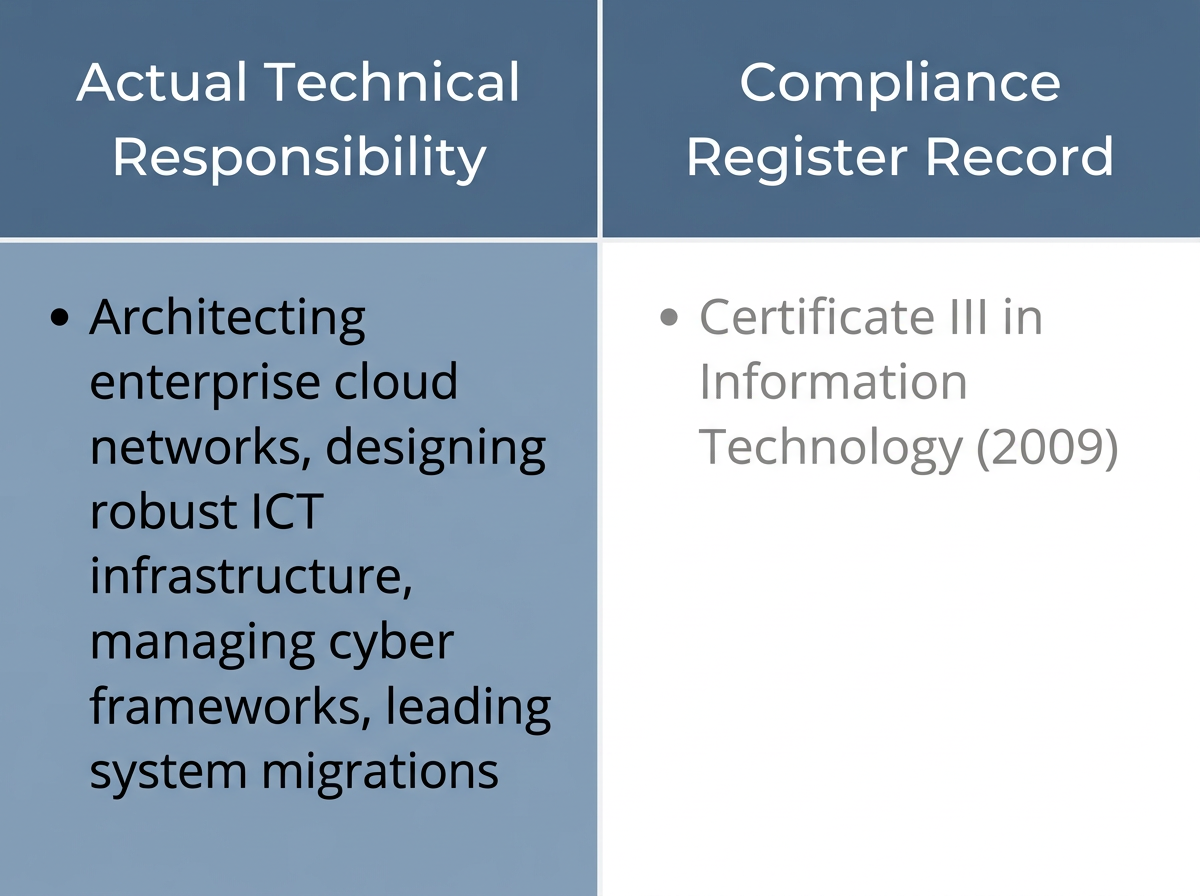
If you review the job descriptions of your senior network engineers, your IT operations managers, or your infrastructure leads, you will find that their daily tasks align with the performance criteria of the Advanced Diploma. The practical work they perform every week is the qualification itself; it simply has not yet been formally documented on their records.
This occurs for a simple reason. Most senior IT professionals developed their careers through years of hands-on project experience, vendor-specific certifications, self-directed study, and real-world troubleshooting that classroom environments cannot replicate. Formal vocational qualifications were rarely the standard entry point into the sector, and for many veteran practitioners, they remain secondary to direct project delivery.
The result is an engineering workforce operating at a highly advanced level while the internal database records outdated or entry-level qualifications. Because these registers track formal paper credentials rather than actual operating capabilities, a deep mismatch occurs. In the current regulatory market, that specific distinction carries far more weight than it did in the past.
Stage 2: when the compliance register becomes a liability
For a long time, this qualification gap remained hidden. Your team delivered projects, clients stayed satisfied, and the compliance register sat as an unexamined administrative spreadsheet.
That is no longer the case.
Government departments and large corporate clients now routinely demand that technical staff working on their systems hold formal qualifications at specified levels. Invitation to tender documents, particularly within the public sector, regularly include mandatory clauses requiring key delivery personnel to hold relevant tertiary or vocational credentials. When your internal records show a qualification gap, that missing paperwork can prevent your company from submitting bids or securing contracts.
The commercial frustration caused by this gap is highly justified. Your team did not lose the contract because they lacked the technical capability to deliver; they lost it because your official records failed to document that capability. Your most capable engineer, who could easily manage the contract requirements, remained invisible to the client's automated procurement system because their professional expertise existed in the wrong format.
This is the core liability of an unmapped team. The issue is not one of operational competence, but of formal documentation. Fortunately, it is straightforward to resolve.
Stage 3: why retraining is not the right response
When a qualification gap is suddenly exposed by a missed tender opportunity, a compliance audit, or a strict contract renewal clause, the typical corporate reaction is to enrol staff in external training programs. Managers rush to sign senior personnel up for an Advanced Diploma course in an attempt to quickly update the registry.
This response treats experienced professionals as though they are entry-level candidates. They are not.
Completing an Advanced Diploma of IT via standard classroom instruction requires a significant commitment, often taking a year or more depending on the provider. It forces your senior staff to attend lectures, complete academic assessments, and prove practical competencies they have already mastered through years of industry practice. This process removes key personnel from active projects. For senior professionals, repeating training on systems they manage daily is highly inefficient and frustrating.
This challenge exists across all technical industries. While the credential gap is real, forcing experienced personnel to retrain is rarely the correct solution.
A better approach exists. You can recognize what your team already knows rather than requiring them to start from scratch.
How RPL works for an IT team
Recognition of Prior Learning (RPL) is the official assessment pathway where your team's existing technical skills, knowledge, and workplace experience are evaluated against national qualification standards. For your experienced IT professionals, this means their years of active work are compiled and mapped as direct evidence to meet the specific competency units of the Advanced Diploma of Information Technology (ICT60220).
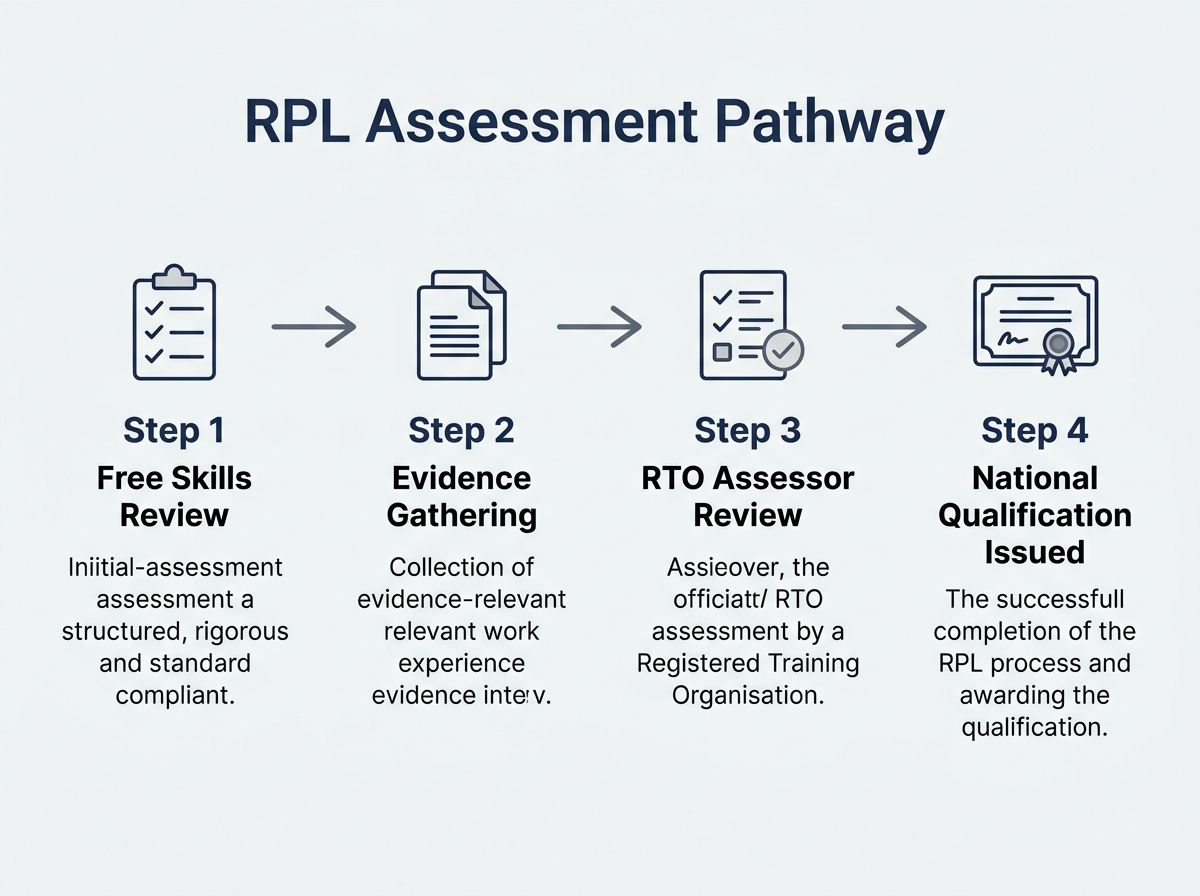
The qualification is awarded by assessing existing expertise, avoiding the need to retrain in skills already mastered.
The formal RPL process for an IT qualification follows four distinct stages. First, a preliminary skills review evaluates whether the candidate's experience profile matches the target qualification. Second, the candidate compiles physical evidence of their daily work, which includes project management plans, system designs, configuration records, employer letters, and reference statements demonstrating competency across the units. Third, an assessor from a Registered Training Organisation (RTO) reviews this evidence portfolio against national training benchmarks. Finally, when the assessor confirms all performance criteria have been successfully met, the RTO issues the national qualification.
It is critical to clarify what RPL does not represent. It is not a shortcut or a method to bypass proper educational standards. Every assessment is overseen by a certified RTO assessor, applying the same rigorous benchmarks used for traditional students. If specific knowledge gaps are uncovered during this evaluation process, targeted gap training is structured to address them, which reputable providers include within their standard service.
RPL simply eliminates the need to repeat training for skills already used on the job. For an experienced IT professional, this saves substantial time.
Updating the compliance register through RPL
Once the RPL assessment is successfully completed, your compliance register reflects your team's genuine capabilities. The Advanced Diploma of Information Technology (ICT60220) is a fully accredited national qualification, issued by a registered training organisation and assessed strictly against the standards set by the Australian Qualifications Framework.
This credential satisfies the qualification standards listed in commercial tenders, government procurement matrices, and enterprise service agreements. It is identical to the qualification earned through a classroom course because it relies on the same national curriculum and assessment standards. While the preparation pathway is different, the resulting qualification is completely equivalent.
Your team has always possessed the capability. The RPL process simply documents it so that procurement and compliance systems can verify it.
Because the assessment process is thorough, the resulting qualification is highly credible. Procurement panels, external auditors, and enterprise clients recognize it as a valid measure of professional competence.
Determining if your IT team is ready for RPL
Not all IT professionals suit an Advanced Diploma RPL pathway. Honest advice at the start prevents wasted time and effort. A reliable RPL provider will assess suitability before you commit to the process.
Suitable candidates generally possess extensive hands-on experience in senior technical roles, such as managing enterprise networks, directing complex system migrations, or making strategic engineering decisions at an organisational level. They must have direct access to records of their work, including network topology maps, project logs, or formal employer references. Their practical experience must align with the competency units defined in the national training package.
Personnel who are early in their careers, or whose technical skills are highly specialized, may find that their evidence covers some competencies rather than the full qualification. In these situations, targeted gap training can be completed to bridge any remaining units. This is a routine component of professional development rather than a failure of the process.
The most practical next step is to initiate a preliminary skills review before allocating any budget. This initial review is free, carries no obligation, and provides a clear assessment of whether RPL is the correct pathway for your personnel before you commit time or resources to the formal program.
Your team already performs at this senior level. The task now is ensuring your compliance records accurately reflect that capability.
General information only, current at the date shown. Licensing rules change, so check the current requirements with the relevant regulator before you rely on them. RPL it Australia is a student support service, not a Registered Training Organisation; qualifications are assessed and issued by our partner RTOs.