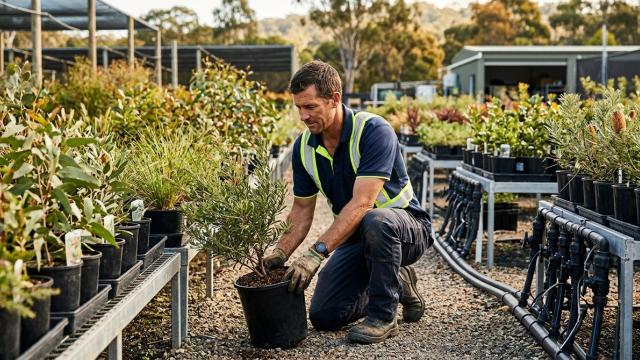
What AHC30722 actually assesses for experienced horticulture workers
AHC30722 is the Certificate III in Horticulture. Learn what it assesses and how experienced grounds and nursery workers map their work to its units.
By RPL it Australia10 min read
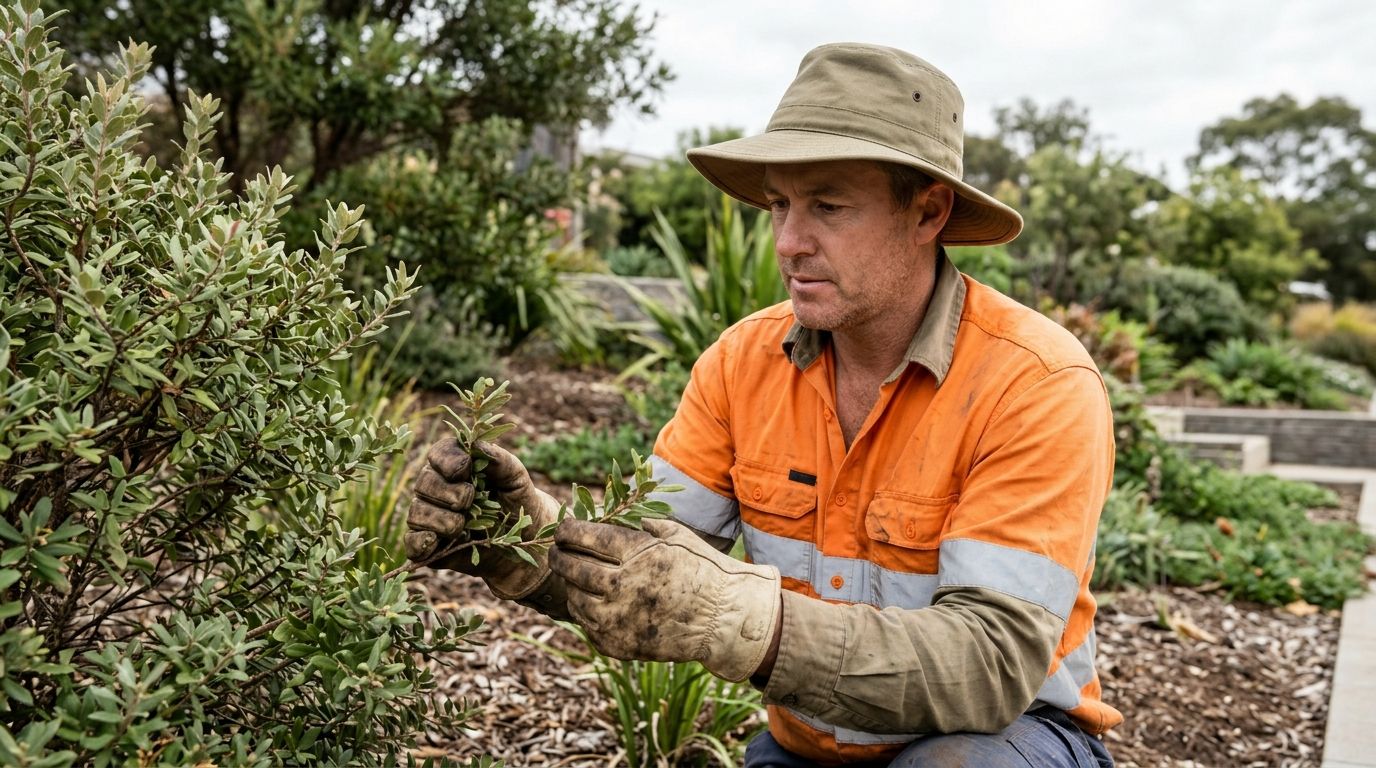
What AHC30722 is, and why experienced workers are looking it up
You have the experience. The main question is whether the qualification code on a job ad, a tender requirement, or an employer's checklist matches what you already do on the job.
AHC30722 is the qualification code for the Certificate III in Horticulture, a nationally recognised vocational qualification under the Australian Qualifications Framework. It sits within the Agriculture, Horticulture and Conservation and Land Management Training Package. Most people searching for this code are not starting from scratch. They have been told they need the paper, and they want to know what it covers and whether their years of hands-on work already match the requirements.
This article acts as a decoder. It maps what AHC30722 actually assesses to the daily tasks of experienced horticulture workers, helping you see whether your existing experience counts before you commit to an enrollment.
If you have already read about the frustration of being trusted with valuable grounds but excluded from roles because you lack a formal credential, we cover those challenges in a companion piece. This article is the practical breakdown: what the qualification measures, how your work maps to it, and the evidence you likely already have.
The core assessment domains: What AHC30722 actually measures
AHC30722 is not a textbook test. It assesses practical competency, meaning your ability to perform real horticulture work to a defined standard. Assessment is structured around units of competency, which describe specific tasks. The qualification includes both core units, which are required for everyone, and elective units chosen to match your specific daily work.
The major competency areas covered by AHC30722 typically include the following fields. Note that the specific unit codes and titles should be verified against the current training.gov.au qualification page, as training packages change over time.
- Plant health and pest management: recognising stressed plants, identifying pests and diseases, selecting and applying treatments, and documenting your work.
- Soil health and preparation: understanding soil types, preparing growing media, applying fertilisers and soil amendments, and maintaining soil condition.
- Irrigation and water management: operating and maintaining systems, scheduling watering based on seasonal needs, and finding faults or inefficiencies.
- Plant propagation and establishment: propagating plants using cuttings, seeds, or division, establishing new plantings, and monitoring their growth.
- Workplace health and safety: working safely with machinery and chemicals in outdoor environments, following safe work procedures, and reporting hazards.
- Chemical handling and application: holding or working towards relevant chemical certification, and applying pesticides, herbicides, and fertilisers safely under label requirements.
- Equipment operation and maintenance: operating and servicing common horticulture equipment like mowers, trimmers, blowers, and irrigation controllers.
- Environmental and sustainability practices: managing green waste, conserving water, protecting soil and plant health, and working within local environmental guidelines.
If you have been working in horticulture for several years, most of these areas will sound familiar. That is the point of recognition. AHC30722 describes the work you do, and your job during RPL is to demonstrate that you have been doing it consistently.
The self-assessment: Does your work already cover this?
This is the recognition tool at the heart of this article. Work through the following questions honestly. They do not form a formal assessment, but act as a practical tool to help you see where your experience sits relative to the requirements of AHC30722.
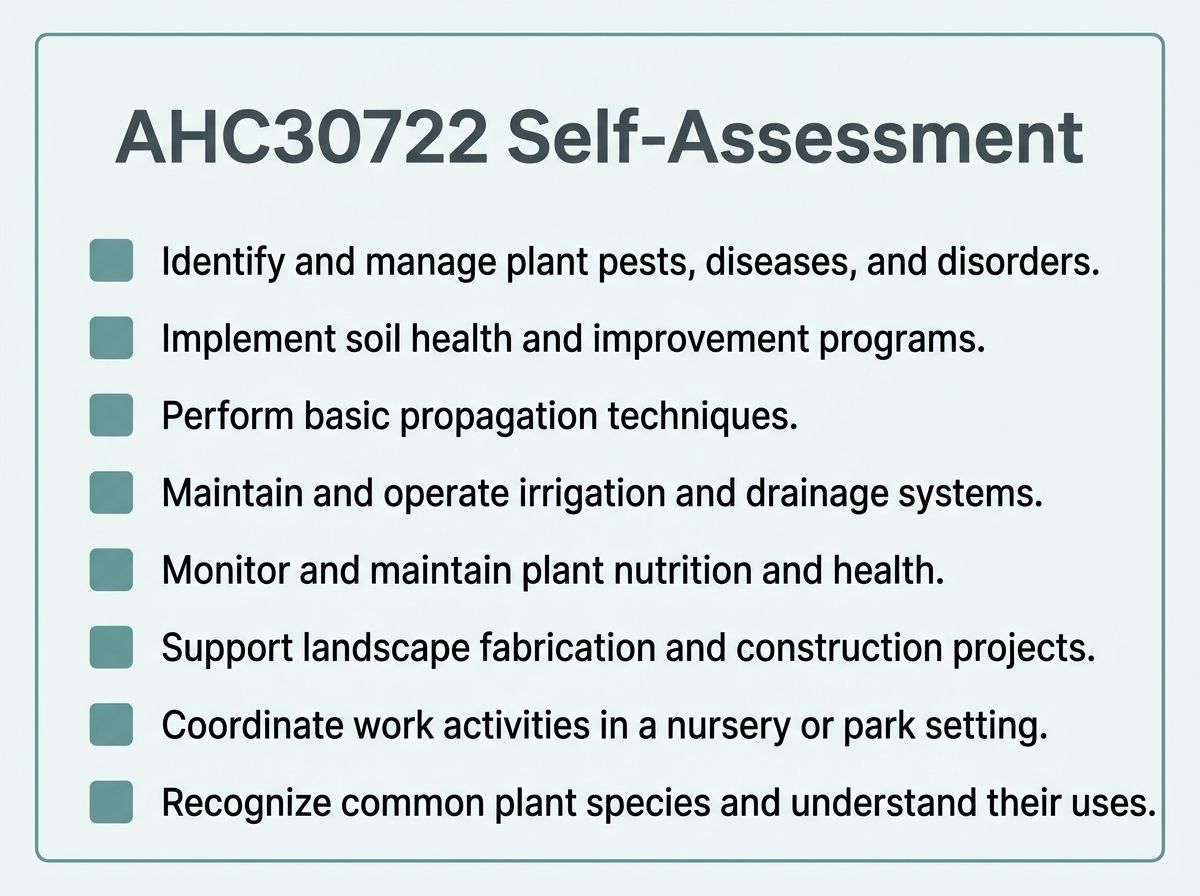
For each question, think about your regular work over the past few years. Consider your consistent practice, not just a single project.
- Do you regularly identify and treat plant pests, diseases, or disorders on site, and do you document what you found and how you treated it?
- Do you prepare or maintain soil for planting, including selecting and applying fertilisers, mulches, or soil amendments based on plant needs?
- Do you operate and maintain irrigation systems, including scheduling, troubleshooting, and adjusting for seasonal or plant-specific requirements?
- Do you propagate plants from cuttings, seed, or division, or establish new plantings and monitor their progress?
- Do you hold a chemical handling certificate like ChemCert, or do you apply pesticides and herbicides as part of your regular work?
- Do you operate and maintain horticulture equipment, including mowers, trimmers, blowers, and irrigation controllers, as a routine part of your role?
- Do you follow safe work procedures for outdoor work, chemical handling, and equipment operation, and do you report hazards or incidents when they occur?
- Do you manage green waste, water use, or other environmental considerations as part of your day-to-day work?
If you answered yes to most of these questions, your daily work likely covers the core competency areas of AHC30722. The gap between what you do and what the qualification requires is often smaller than it seems. The main task is simply presenting your experience as evidence in a format an assessor can evaluate.
If you answered yes to some but not all, that is also useful information. It tells you where your experience is strong and where you may need to show additional competency, either through evidence you have not yet gathered or through targeted gap training if required.
What counts as evidence for AHC30722, and what experienced workers usually already have
Most experienced horticulture workers already hold more evidence than they realise. RPL assessment is built around real work, and real work leaves a practical paper trail.
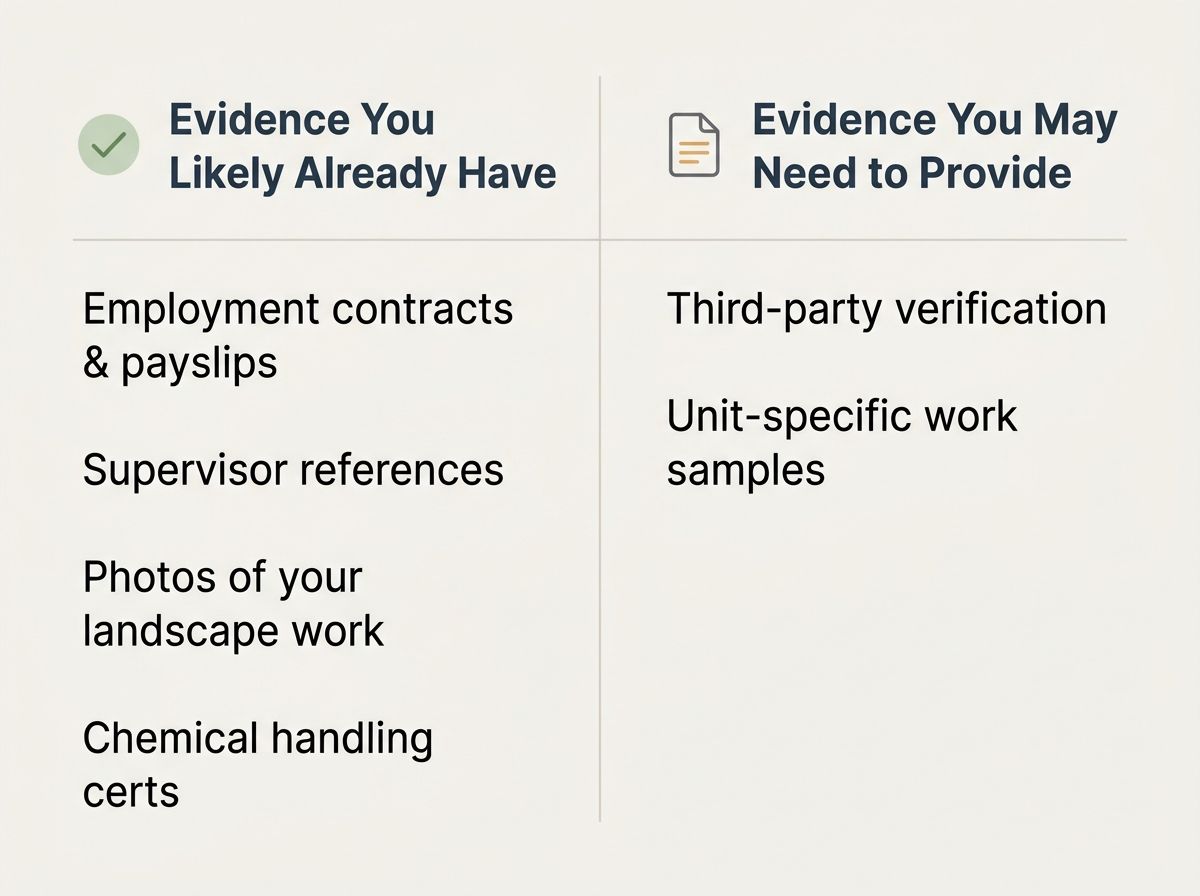
Evidence for AHC30722 RPL assessment needs to be valid (relating to the units being assessed), sufficient (proving consistent competency), authentic (genuinely your own work), and current (reflecting recent practice). These are standard RPL principles applied across all vocational qualifications.
Common evidence types that experienced horticulture workers typically hold include:
- Payslips and employment records: confirming your job title, employer details, and length of employment in horticulture.
- Employer or supervisor references: written statements from employers describing your day-to-day responsibilities, tasks, and competency level.
- Chemical handling certificates: ChemCert, Responsible Use of Pesticides, or equivalent state-based certification confirming your authority to handle chemicals.
- Site maintenance records, work orders, or job logs: documentation of completed tasks like plant treatments, irrigation maintenance, and equipment servicing.
- Photos of your work: before-and-after images of planting projects, pest treatment results, irrigation installations, or general site maintenance.
- Training records: any in-house training, safety inductions, or professional development you completed that relates to horticulture.
- Third-party verification: a statement from a supervisor, colleague, or client confirming they have seen you perform specific tasks to an industry standard.
Specific evidence requirements can vary between RTOs and between individual units within AHC30722. Some units require third-party verification or direct observation by an assessor, even when other evidence is strong. An honest skills review will identify these requirements before you commit to the process.
Grounds workers vs nursery workers vs parks staff: Does your role map to AHC30722?
AHC30722 is broad enough to cover multiple horticulture environments, though the work looks different depending on your role. Understanding which parts of the qualification your specific work covers directly helps you approach the self-assessment with more clarity.
Grounds maintenance workers who maintain turf, garden beds, trees, and irrigation on commercial or residential sites typically have strong coverage across plant health, pest management, irrigation, equipment operation, and workplace safety units. If your work involves regular chemical application, you will also likely cover the chemical handling units.
Nursery workers involved in propagation, plant production, potting, and retail or wholesale plant supply typically have strong coverage across propagation, plant establishment, soil preparation, and plant health. Depending on the nursery's operations, irrigation and chemical handling coverage may also be strong.
Parks and gardens staff working in public green spaces, botanical gardens, or council parks typically have broad coverage across most AHC30722 domains, often including environmental and sustainability practices that grounds and nursery workers may encounter less frequently.
The elective units within AHC30722 can be chosen to reflect your specific work context. This means the qualification is structured around what you actually do, rather than requiring you to demonstrate competency in areas outside your role. This flexibility makes RPL well-suited to experienced horticulture workers, as the assessment matches your work history rather than a generic curriculum. Confirm elective availability with your RTO, as assessment approaches vary.
What happens after the self-assessment: The RPL pathway for AHC30722
If the self-assessment above mapped closely to your work, and you recognized your daily tasks in the competency areas, the next step is to have that self-assessment validated by someone who understands the qualification.
The RPL pathway for AHC30722 typically involves a skills review to assess suitability, guided evidence gathering to compile your documents, formal assessment by a qualified assessor from the delivering RTO, and, if competency is proven, issuance of the qualification. If gaps are identified during assessment, gap training is provided. This is standard practice and does not mean the process has failed.
RPL it guides candidates through this process, helping you present your experience as evidence and navigate the assessment pathway. The assessment itself is conducted by a qualified assessor from a registered training organisation (RTO), and the qualification is issued by that RTO rather than RPL it. This distinction is important: your qualification is nationally recognised because it is assessed and issued by a registered body.
Not everyone who completes a self-assessment is suitable for RPL. That is not a failure, but honest guidance. The purpose of a skills review is to determine suitability before you commit to anything, rather than enrolling everyone who enquires.
Frequently asked questions about AHC30722 assessment
What is AHC30722?
AHC30722 is the qualification code for the Certificate III in Horticulture, a nationally recognised vocational qualification under the Australian Qualifications Framework. It sits within the Agriculture, Horticulture and Conservation and Land Management Training Package, covering practical competency in plant health, soil management, irrigation, propagation, chemical handling, and workplace safety.
Is AHC30722 the same as AHC30616?
AHC30722 is the current version of the Certificate III in Horticulture. Earlier versions of this qualification carried different codes, including AHC30616. If your employment history or documentation references an older code, this does not disqualify your experience. RTOs assessing AHC30722 RPL applications can consider experience gained under previous versions of the qualification. Confirm this with your RTO when you begin.
Can I use overseas horticulture experience for AHC30722 RPL?
Yes, overseas horticulture experience can be used as evidence for AHC30722 RPL, provided you can supply appropriate documentation like employer references, payslips, work records, or evidence of chemical handling certification. The main requirement is that the evidence is verifiable and relates to the competency units being assessed. Discuss your situation with an RPL guide before assuming your overseas experience is sufficient.
Does AHC30722 RPL require any practical demonstration?
RPL assessment for AHC30722 is primarily evidence-based, drawing on your work history, documentation, and third-party verification. However, some units or RTOs require direct observation or practical demonstration as part of the assessment, even when other evidence is strong. This varies between RTOs and assessment contexts. A skills review will clarify what is required for your situation before you commit.
What happens if gaps are identified during AHC30722 RPL assessment?
If gaps are identified where your evidence does not fully demonstrate the required competency, gap training is provided to address them. This is a standard part of the RPL process and does not mean the assessment has failed. Gap training is targeted to the specific units where additional evidence or demonstration is needed, rather than requiring you to repeat work you already know.
Is AHC30722 nationally recognised across all Australian states and territories?
Yes. AHC30722 is a nationally recognised qualification under the Australian Qualifications Framework, meaning it is recognised by employers, licensing bodies, and institutions across all Australian states and territories. The qualification is issued by a registered training organisation (RTO), which is the basis for its national recognition.
Your experience is real. The question is whether it maps.
You have been doing this work. The plant health assessments, irrigation scheduling, chemical applications, and equipment maintenance are not theoretical concepts. They represent demonstrated competency, built over years of real work.
AHC30722 describes that work in formal language. The RPL pathway exists to translate your demonstrated competency into a nationally recognised qualification, assessing what you have already achieved rather than asking you to start over.
The self-assessment in this article is a starting point, not a final answer. A Free Skills Review is the next step: an honest, no-cost conversation about whether your experience maps to AHC30722, before you commit to anything.
General information only, current at the date shown. Licensing rules change, so check the current requirements with the relevant regulator before you rely on them. RPL it Australia is a student support service, not a Registered Training Organisation; qualifications are assessed and issued by our partner RTOs.