Why site safety expertise is not enough for board-level strategy
Your safety officers know the site, but can they influence the board? Learn how the Advanced Diploma of WHS bridges the gap to strategic governance.

The safety leadership gap: Operational strength vs boardroom influence
Many organisations promote their top safety officer into a senior role, only to find that WHS strategy struggles to gain traction at the executive level. This is rarely a matter of competence. The individual in that role has usually spent years managing hazards, conducting toolbox talks, investigating incidents, and maintaining site safety. They know the daily work and they know the risks. However, when they need to influence board decisions, shape governance frameworks, or translate safety risks into financial exposure, their practical experience does not automatically translate into executive influence.
The gap is not a lack of experience, but a difference in qualification design. Operational work and strategic governance require different kinds of formal recognition. In many Australian organisations, these two distinct skill sets are conflated, which leads to structural challenges.
What boards require from safety leadership
Board-level WHS accountability is a function of governance, not operations. Under section 27 of the model Work Health and Safety Act, officers—including directors and senior executives—must exercise due diligence to ensure the organisation meets its WHS obligations. According to Comcare's guidance on officer due diligence, this includes acquiring and keeping up to date with knowledge of WHS matters, understanding the operations of the business and the hazards and risks associated with those operations, and ensuring the organisation has appropriate resources and processes to eliminate or minimise health and safety risks.
Safe Work Australia's interpretive guide on the officer duty states that an officer can only comply by taking an active and inquisitive role in WHS, and that due diligence relies on the officer's knowledge and understanding of WHS matters. This is an active obligation rather than a passive one. It requires structured, verifiable engagement, which a formally qualified safety leader is better positioned to provide and document.
What boards require from a safety leader is someone who can translate hazard and risk into the language of governance: financial exposure, regulatory liability, due diligence documentation, and safety management system design. These are learnable, documentable competencies. They do not develop automatically through years of operational experience alone, and they are the specific areas that the Advanced Diploma of Work Health and Safety (BSB60619) formalises.
Comcare's guidance on exercising due diligence outlines the specific requirements of the officer duty under section 27 of the WHS Act, including the mandate to acquire and maintain WHS knowledge and ensure appropriate organizational resources.
The assumption that costs governance credibility
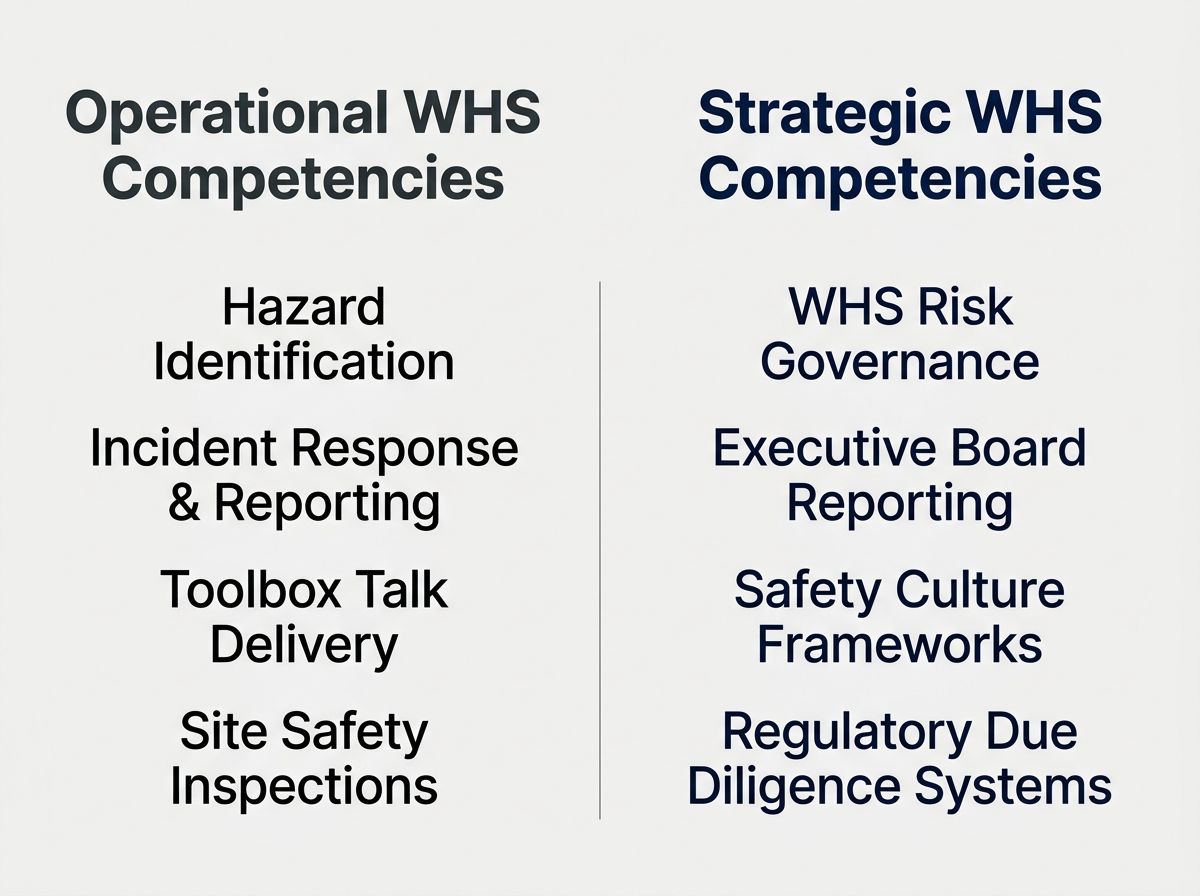
Most organisations operate on a reasonable but incomplete assumption: that time spent on site equals readiness for strategic safety leadership. It is a logical inference. If a professional has managed safety on major projects for fifteen years, they certainly understand safety operations thoroughly. But operational mastery—encompassing hazard identification, incident response, toolbox talks, and site inspections—is not the same as strategic mastery, which requires risk governance, board reporting, safety culture design, and regulatory due diligence architecture.
Australia's national WHS Strategy 2022–32 identifies health and safety leadership as one of five system enablers, alongside information and awareness, compliance and enforcement, and data and intelligence gathering. The Strategy positions leadership as a shared responsibility across governments, industry, organisations, and individuals, noting that PCBUs can invest in organisational capability to manage and prevent WHS incidents. Leadership, in this framework, is not merely about floor operations; it is a system-level function.
Research funded by SafeWork NSW and published in 2024 suggests a potential gap between how business leaders perceive the maturity of their safety arrangements and the underlying reality. The same research noted that evidence regarding what drives WHS prioritisation by business leaders is limited and largely focused on the role of governance. The implication is significant: organisations may believe their safety leadership is operating at a strategic level when the formal structures to support that work are not yet in place.
The national WHS Strategy 2022–32, published by Safe Work Australia, identifies health and safety leadership as a national WHS system enabler and outlines shared responsibility across organisations, governments, and individuals.
What the Advanced Diploma of WHS formalises
The BSB60619 Advanced Diploma of Work Health and Safety is listed on the national training register as a current qualification. According to training.gov.au, this qualification reflects the role of individuals who apply advanced practical knowledge and skills to coordinate, facilitate, and maintain a work health and safety program. It is designed for those who possess significant WHS skills and wish to consolidate their experience while building pathways to further education and employment.
The qualification consists of 11 units: 5 core and 6 elective units. The five core units focus on WHS culture development and implementation, organisational WHS performance evaluation, WHS audit conduct, safe design principles for risk control, and ergonomics-based risk management. Elective options include units focused on compliance management systems, organisational leadership, psychosocial safety, and occupational hygiene, along with units covering organisational strategy, change management, and stakeholder engagement.
We should be precise about what this qualification represents. It does not instantly make a safety officer a corporate strategist. Instead, it maps existing strategic capability—the kind that experienced safety professionals have often exercised informally for years—to nationally recognised competency standards. For organisations, this means their documentation can demonstrate that their senior safety leader's governance competencies meet a documented national benchmark. That is a different proposition from relying on operational experience alone.
The BSB60619 Advanced Diploma of Work Health and Safety details, packaging rules, and unit listings are available on the national training register at training.gov.au.
Currently, the national register records no licensing, legislative, or certification requirements applying to BSB60619. Entry to the qualification requires the core units of the Diploma of Work Health and Safety (BSB51319) or equivalent competencies. Elective availability varies by registered training organisation, and elective units must be relevant to the work environment while maintaining the integrity of the Australian Qualifications Framework alignment.
RPL: Formalising safety skills without operational disruption
The practical objection to formalising a senior safety leader's qualification is operational disruption. Block-release study, extended course attendance, and the cost of backfilling a senior role are real business considerations. Recognition of Prior Learning (RPL) addresses this challenge directly. RPL is a formal assessment pathway that evaluates existing competency against the qualification's requirements, using documented evidence of what the safety leader already does, rather than requiring them to repeat training they have already mastered.
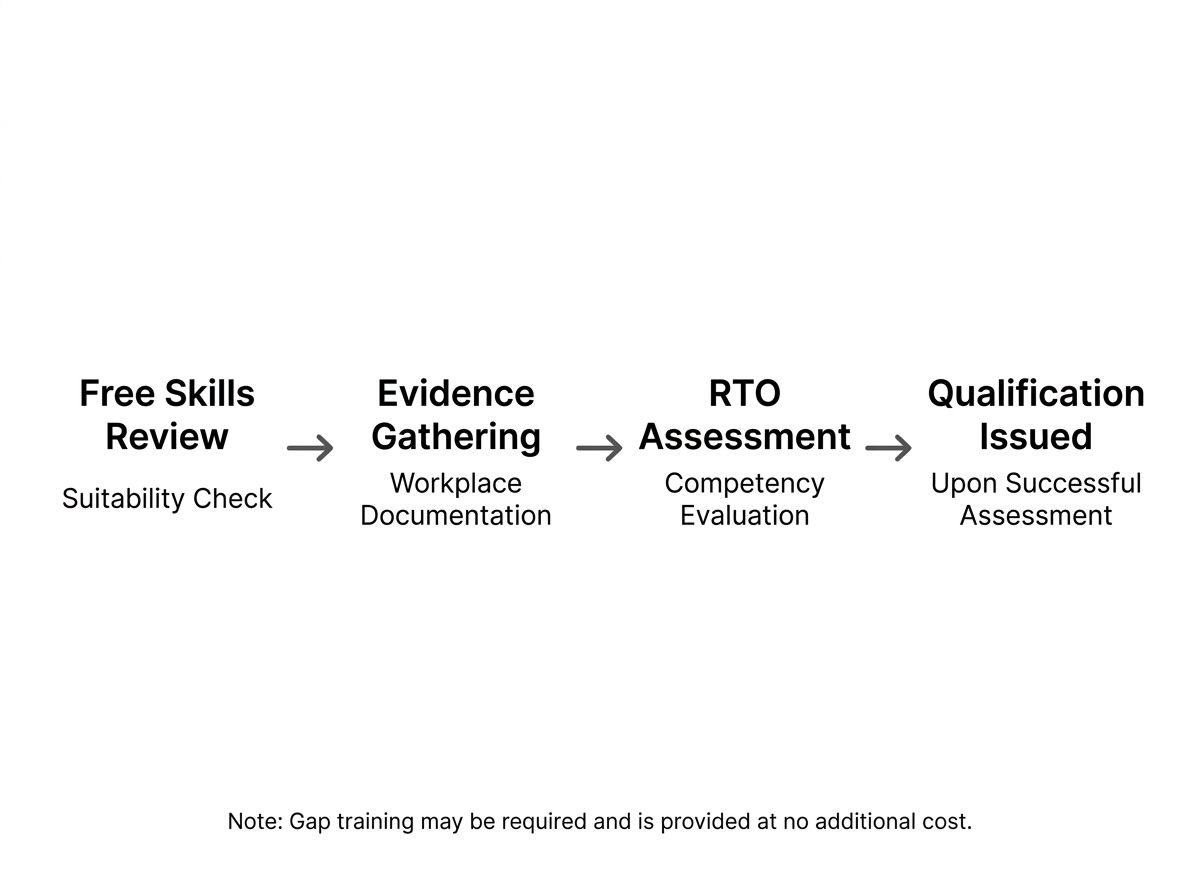
The RPL process for BSB60619 typically involves a suitability assessment, evidence gathering from existing work—such as performance reviews, project documentation, safety management system records, and reports—followed by assessment by a registered training organisation (RTO). If gaps are identified during assessment, targeted gap training is provided. The qualification is issued by the RTO upon successful assessment of competency. RPL it guides candidates and organisations through this preparation process; the partner RTO conducts the formal assessment and issues the qualification.
We must be clear about what RPL involves. It is a genuine assessment process, not an administrative rubber stamp. The evidence gathering stage requires structured effort, and the timeline varies depending on the candidate's experience, the completeness of their documentation, and the specific units being assessed. What RPL does is ensure that the effort is proportionate to what the candidate already knows, rather than forcing them to learn known material from scratch.
The business case for formalising safety leadership
For executives evaluating this decision, the question is rarely whether their safety officer can perform the job. They clearly can. The real question is whether the organisation can demonstrate to regulators, insurers, and the board that its safety leadership meets a recognised governance standard. These are different questions, and only the second is resolved by a formal qualification.
The officer due diligence obligation under section 27 of the model WHS Act requires officers to take reasonable steps to acquire and maintain WHS knowledge, understand operations and associated risks, and ensure appropriate resources and processes are in place. A formally qualified safety leader—one whose strategic competencies have been assessed against a national standard—is better positioned to support the organisation's demonstration of those reasonable steps. This is not a guarantee of compliance. Due diligence is assessed in context, and requirements vary by role, organisation, and jurisdiction. But the credential provides documented evidence of capability that informal experience alone cannot match.
Safe Work Australia's research notes a lack of consensus on the strategic value derived from WHS initiatives, linked in part to limited insight into establishing effective performance measures for a comprehensive safety management system. A formally qualified safety leader is equipped to address that gap, helping to design measurement systems, report clearly to the board, and present the strategic case for WHS investment in terms that governance frameworks recognise.
The Advanced Diploma of WHS converts demonstrated capability into documented evidence, which is what governance frameworks require. The decision to formalise your safety leadership team's qualifications remains yours, but the case for doing so is grounded in regulatory obligations, national safety strategy, and the practical demands of board-level accountability.
Next steps: Verify your safety leader's RPL eligibility
The first step is a suitability assessment rather than enrolment. RPL is not appropriate for every candidate, and honest guidance before any commitment is the foundation of the process. A Free Skills Review identifies whether your safety leader's existing experience maps to the BSB60619 requirements, before any cost or obligation is incurred.
Your safety officer knows the site. The Advanced Diploma of WHS ensures the board recognizes that capability. The decision is yours.
Ready to Get Recognised?
Start with a free skills review to find out if RPL is right for you.