Your Safety Officer Has Been Doing WHS Work for Years — Does Their Qualification Match?
If your safety officer manages WHS duties without a Certificate IV in Work Health and Safety, your business may carry legal and tender risk. Here's the pattern — and the fix.
By RPL it Australia6 min read

The pattern most employers don't notice until it's too late
Your safety officer is good at their job. They manage hazard identification, conduct risk assessments, oversee incident investigations, and keep your WHS management system running. You promoted them because they earned it. And for years, that has been enough.
But there is a pattern that plays out across Australian workplaces — in construction, mining, utilities, government contracting, and manufacturing — that most employers never name until something forces them to. An experienced, capable safety officer is performing duties that map directly to Certificate IV in Work Health and Safety (BSB41419). And their credential file does not reflect that.
This is not a story about incompetence. It is a story about how safety roles grow faster than the paperwork that should accompany them. The person grows into the role. The credential never catches up. And the gap stays invisible — until it doesn't.
Stage 1: The informal appointment — competence without credentials
In most organisations, WHS responsibilities are not assigned through a formal credential check. A capable employee demonstrates safety awareness. They get trusted with incident reports. Then hazard audits. Then the full WHS management system. The appointment is merit-based. The credential question is never asked — because the person is clearly doing the job well.
This is how it should work, in many respects. Demonstrated competence is a legitimate basis for trust. The problem is not the appointment. The problem is that Australian workplaces have a formal qualification framework — the Australian Qualifications Framework — that exists to document and recognise that competence. When the documentation is missing, the competence becomes invisible to anyone outside the organisation.
Your safety officer has the experience. What they may not have is the evidence — in the form that formal systems recognise.
Stage 2: The credential gap widens — duties expand, paperwork doesn't
Over time, the WHS officer's responsibilities expand. Consider what a typical experienced safety officer does in a week. They manage contractor inductions. They conduct workplace risk assessments. They write or review safe work method statements. They advise managers on legislative compliance obligations. They investigate incidents and prepare reports. They coordinate WHS training.
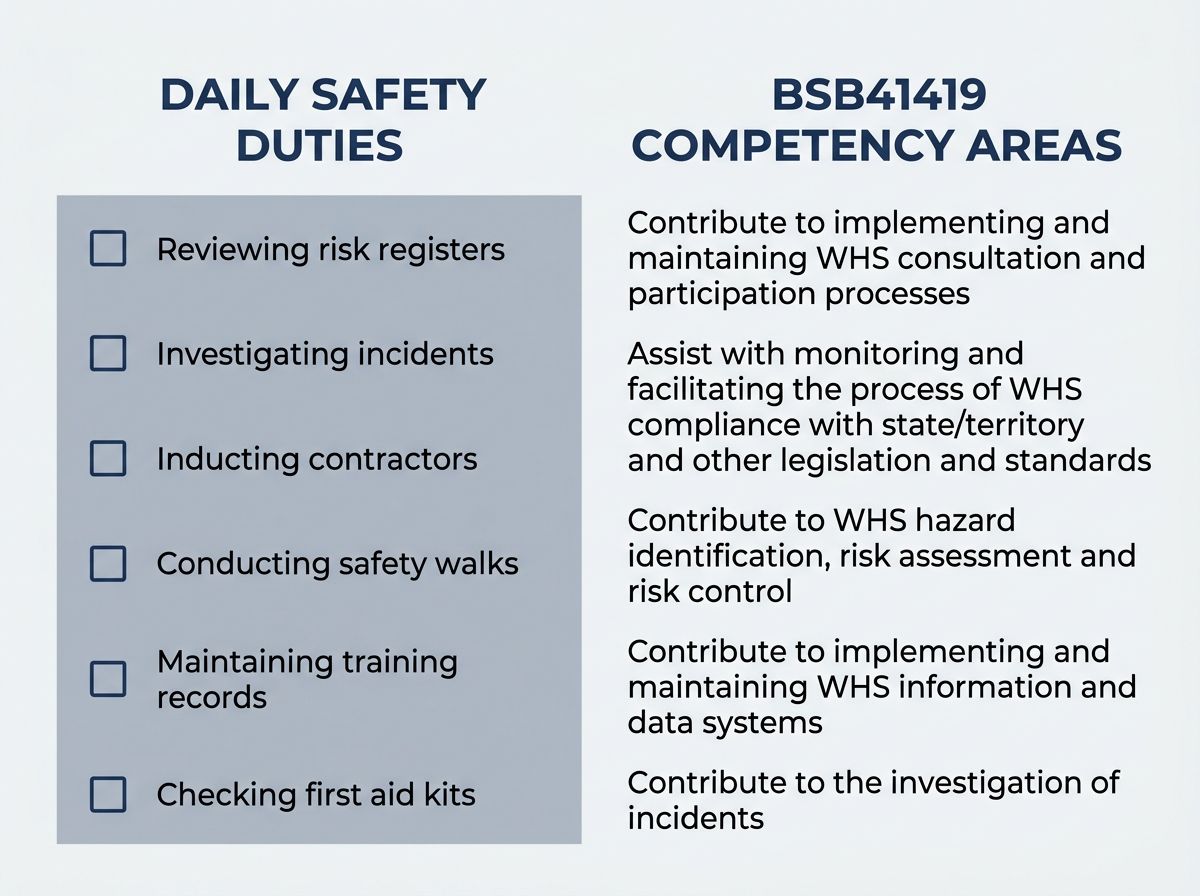
Every one of those duties corresponds to a competency area within the Certificate IV in Work Health and Safety (BSB41419). The qualification is structured around practical workplace competencies — not theoretical study. It was designed to reflect exactly what an experienced WHS practitioner does.
But the credential file still shows whatever the officer held when they were first appointed. Or nothing at all. The gap between what they do and what their paperwork says has been widening — quietly, without anyone noticing — for years.
Stage 3: The exposure moment — when the gap becomes a problem
The credential gap stays invisible until one of three things happens.
- A WHS audit or regulator inspection asks for evidence that the person managing your safety systems is formally qualified to do so. Demonstrated competence is harder to evidence in that moment than a qualification certificate.
- A tender submission requires proof of qualified WHS personnel. Many government and major private sector tenders specify that WHS roles must be filled by formally qualified practitioners. Without BSB41419 or equivalent, your safety officer may not satisfy the requirement — regardless of their actual capability.
- A workplace incident triggers scrutiny of whether the person responsible for managing safety was formally qualified to hold that responsibility. In that context, years of demonstrated competence may not carry the weight that a formal qualification would.
Under the Work Health and Safety Act 2011 (Cth) and its state and territory equivalents, persons conducting a business or undertaking (PCBUs) carry a duty to ensure that persons performing safety-critical functions are competent to do so. Formal qualifications are among the most defensible forms of evidence of that competency. Where a qualification is absent, the burden of demonstrating competency through other means falls on the organisation — and that burden is heavier than most employers anticipate.
The exposure is not hypothetical. It is a structural feature of the credential gap. And it grows with every year the gap remains unaddressed.
Stage 4: The recognition gap — why retraining isn't the answer
The instinctive response to discovering the credential gap is to enrol the safety officer in a Certificate IV course. It feels like the obvious fix. But it creates a second problem: the person already knows the material.
Sending an experienced WHS officer back to study what they have been practising for years is expensive, disruptive, and — from the officer's perspective — a poor reflection of how their demonstrated competence is valued. They are not a student. They are a practitioner. The course content will cover ground they have already covered, in workplaces, under real conditions, with real consequences.
Recognition of Prior Learning (RPL) exists for this situation. Rather than requiring the safety officer to repeat learning they have already completed through experience, RPL assesses what they already know and do — against the formal units of competency in BSB41419. The evidence is their existing work: incident reports, risk assessments, WHS management system documentation, training records, supervisor references.
If your safety officer's experience already covers Certificate IV-level WHS duties, a Free Skills Review can confirm whether RPL is the right pathway — at no cost and with no obligation.
For organisations thinking beyond operational compliance — about how WHS qualifications connect to strategic safety leadership at a senior level — this article on the Advanced Diploma of Work Health and Safety is worth reading.
What BSB41419 RPL actually looks like for an experienced WHS officer
RPL for BSB41419 is an evidence-based assessment process. It is not a shortcut. It is a rigorous evaluation of whether an individual's existing experience meets the competency standards set out in the qualification — conducted by a qualified assessor from a registered training organisation (RTO).
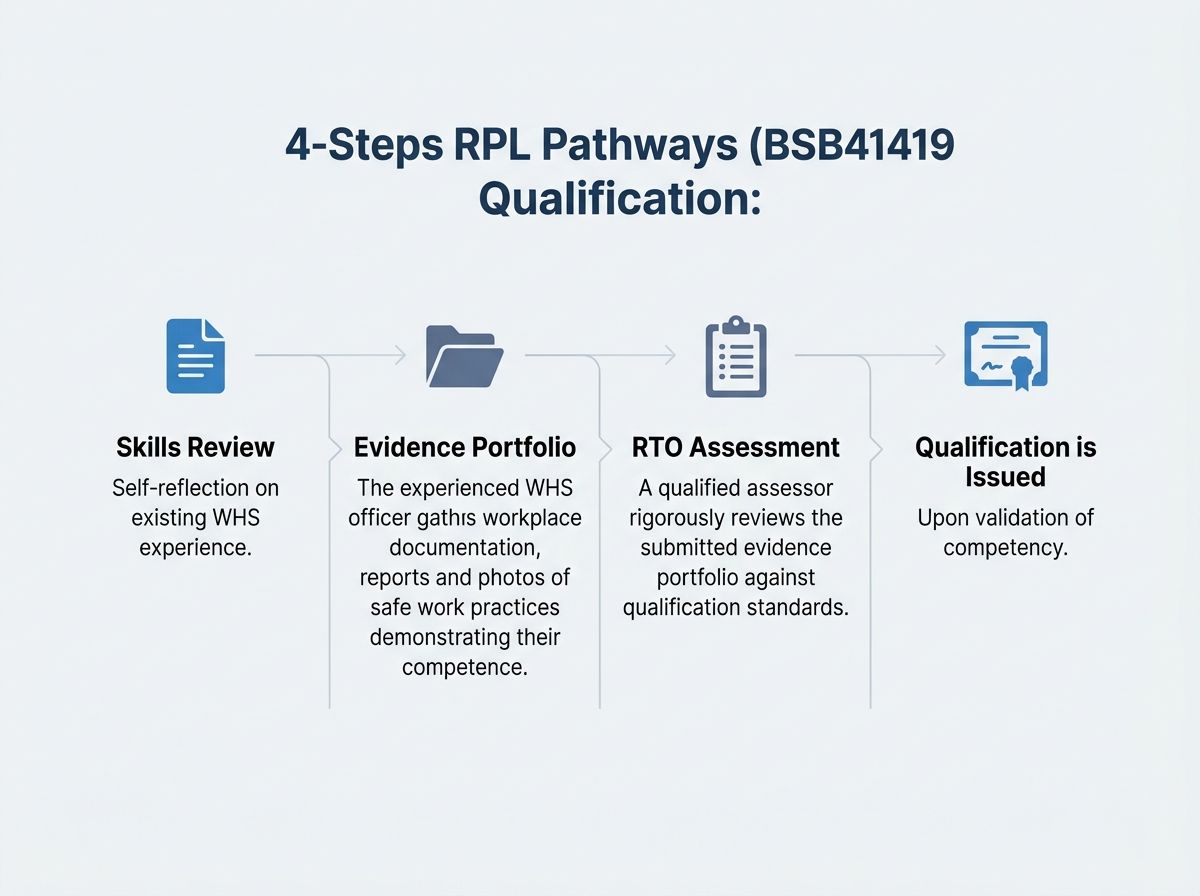
The process typically works like this. First, a skills review establishes whether the safety officer's experience is likely to be sufficient to support an RPL application. This is the step where honest suitability guidance matters most — RPL is not appropriate for everyone, and a credible provider will say so upfront.
If the skills review indicates suitability, the safety officer compiles an evidence portfolio. This draws on their existing work: incident investigation reports, risk assessment documentation, WHS management plans, records of training they have delivered or coordinated, and references from supervisors or colleagues who can attest to their practice.
The RTO assessor then evaluates the portfolio against the units of competency in BSB41419. Where the evidence demonstrates competency, the unit is recognised. Where minor gaps exist, targeted gap training is provided — this is standard practice in RPL, and reputable providers include gap training at no additional cost.
The outcome, where competency is demonstrated, is a nationally recognised Certificate IV in Work Health and Safety (BSB41419) — the same qualification issued through traditional study, carrying the same standing with regulators, auditors, and tender evaluators.
Learn more about the Certificate IV in Work Health and Safety (BSB41419) and the RPL pathway available through RPL it.
The compliance question your WHS risk register should already be asking
If your safety officer is performing Certificate IV-level WHS duties without BSB41419, the question is not whether to act. It is how to act in a way that respects their demonstrated competence and closes the compliance gap without unnecessary disruption.
RPL is not the right pathway for every safety officer. That is why the first step is a Free Skills Review — an honest assessment of whether the officer's specific experience is likely to support an RPL application. It takes less than a business day. It costs nothing. And it gives you a clear answer before any commitment is made.
Your safety officer has the experience. The question is whether your compliance register reflects it. The decision is yours.
General information only, current at the date shown. Licensing rules change, so check the current requirements with the relevant regulator before you rely on them. RPL it Australia is a student support service, not a Registered Training Organisation; qualifications are assessed and issued by our partner RTOs.