Why smart employers use RPL to close compliance gaps, not just help staff get ahead
Most employers view RPL as a benefit for workers. Smart businesses use it to close licensing gaps, win contracts, and retain senior staff.
By RPL it Australia9 min read

The framing everyone gets wrong about RPL
Recognition of Prior Learning—commonly known as RPL—is almost always presented as a pathway that workers pursue on their own initiative. Think of a tradesperson who wants their years of experience formalised on paper, a community services worker who has been doing the job for a decade without the formal credential, or an IT professional whose actual skills exceed their qualification level. The marketing, the messaging, and the wider industry conversation are almost exclusively aimed at the individual.
That framing is incomplete. The employers who have figured this out are using RPL qualifications in a fundamentally different way to protect and grow their businesses.
For a growing number of organisations across construction, community services, IT, transport, and utilities, RPL is a core compliance instrument rather than a staff perk. It functions as a key tender eligibility tool and a practical mechanism for retaining highly experienced people who are blocked from promotion by a credential gap that should not exist. The companies using it most strategically are not doing so out of generosity. They are doing it because the alternative is regulatory exposure, lost contract opportunities, and preventable staff turnover.
This guide is not written for the individual worker trying to get their experience recognised. It is written for the person who manages the workforce, owns the compliance register, or signs off on the final tender response. If you are responsible for those areas, the following details are worth your time.
Use case 1: closing licensing gaps before they become a liability
In highly regulated industries, the gap between what staff are doing and what their personnel file says they are qualified to do is more common than most employers care to admit. This is rarely a sign of negligence. It is simply the natural result of people learning on the job, being promoted because they are good at what they do, and accumulating years of genuine competence while their formal credentials remain stuck in the past.
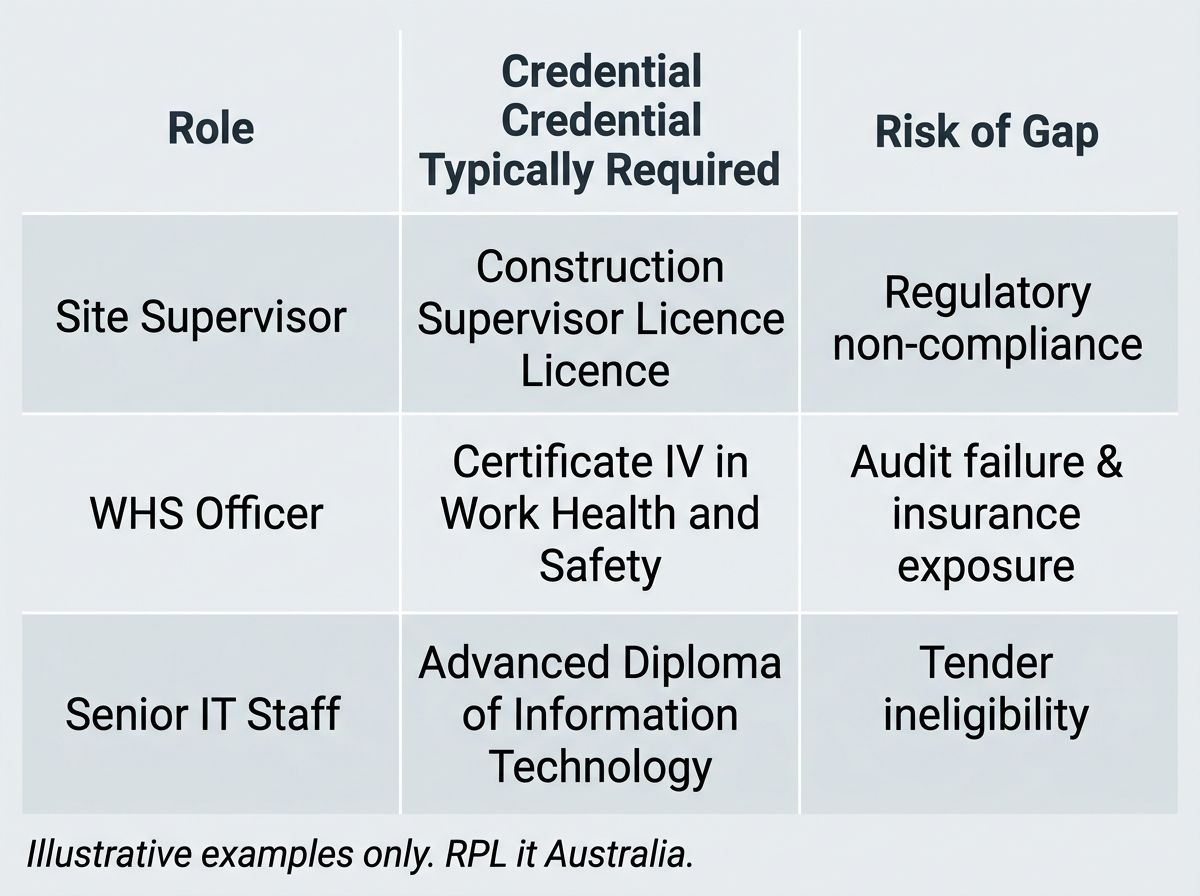
Consider a site supervisor who has been running major construction sites for eight years without holding a formal Construction Supervisor licence. Or a WHS officer who has been managing safety systems, conducting site audits, and advising on risk for a decade without a Certificate IV in Work Health and Safety. Perhaps a senior electrician whose practical knowledge exceeds the standard qualification but whose file does not reflect it. These are not rare exceptions; they are common industry patterns.
The exposure created by this situation sits squarely with the employer, not the employee. In regulated sectors, licensing and qualification requirements exist for legal and safety reasons. When these requirements are not met, the business carries the liability regardless of how capable the individual worker is. Insurance coverage, regulatory compliance, and audit outcomes all depend on what is documented on the file, not what the person can do in practice.
RPL provides a legitimate, streamlined pathway to close that gap using the experience that already exists in your team. The worker does not have to start from scratch, and they do not have to sit through training they do not need. Their existing competence—demonstrated through work records, project files, supervisor statements, and structured assessments—is evaluated against the formal qualification standard. If specific gaps are identified, targeted training addresses them. Where competence is proven, the qualification is issued.
The work is being done every day, but the formal credential is not on file. That gap is ultimately the employer's risk to manage.
Use case 2: winning tenders that require qualified workforces
Many government and enterprise tenders, particularly in construction, community services, IT, and security, require demonstrated workforce qualifications as an absolute condition of eligibility. They do not ask for general capability statements or informal lists of experience. They require formal, nationally recognised qualifications, listed on a compliance schedule and verifiable against a national register.
A business with experienced staff but incomplete credential files will lose tenders it should otherwise win. The capability is there, and the track record is proven, but the paperwork is missing. In competitive procurement processes, the paperwork is exactly what gets evaluated and scored.
This is a commercial problem, not an administrative one. Every tender lost to a competitor whose workforce holds the same practical capability but has the formal credentials on file is revenue that should not have been lost. The qualification gap is the critical variable, and RPL is the mechanism that addresses it.
Employers who sponsor RPL for their workforce are investing in tender eligibility, not redundant training. The qualification that results from a successful RPL assessment is nationally recognised, issued by a registered training organisation, and carries the same weight in a tender response as a qualification earned through classroom study. This is because it is the exact same qualification.
The key question to ask before your next tender deadline is simple: which of your staff have the practical experience to support a qualification, and which qualifications appear on the compliance schedules you need to meet?
Use case 3: retaining experienced staff who are blocked from promotion
Experienced workers who cannot be promoted because they lack a formal credential represent a retention risk that most employers underestimate. These are rarely disengaged staff. They are often the most capable people in your team—the ones who have been doing the senior work informally for years, who train new hires, and whom the business would struggle to replace.
They know they are capable, and they know the credential is the only remaining barrier. If their current employer does not help them solve that problem, a competitor eventually will. This conversation is not theoretical. It happens the moment a capable worker is passed over for a promotion they deserve because the role requires a specific qualification, leading them to look elsewhere.
Sponsoring RPL for these team members is not an unnecessary training cost. It is an investment in retention that simultaneously closes a compliance gap. The worker receives the formal recognition their experience deserves, while the employer secures a qualified staff member on file, retains a loyal team member with deep business knowledge, and resolves an open compliance risk.
They already have the experience. The credential is the only remaining barrier, and you have the power to remove it.
What RPL actually involves for an employer-sponsored workforce
Employers who sponsor RPL for staff are not enrolling them in a traditional course. Instead, they are starting a structured evidence-gathering and assessment process. The worker's actual job performance, work history, and demonstrated competency are evaluated against national qualification standards by a qualified assessor from a registered training organisation. The RTO conducts the assessment and issues the qualification, while RPL it guides candidates through the process of preparing and presenting their evidence.
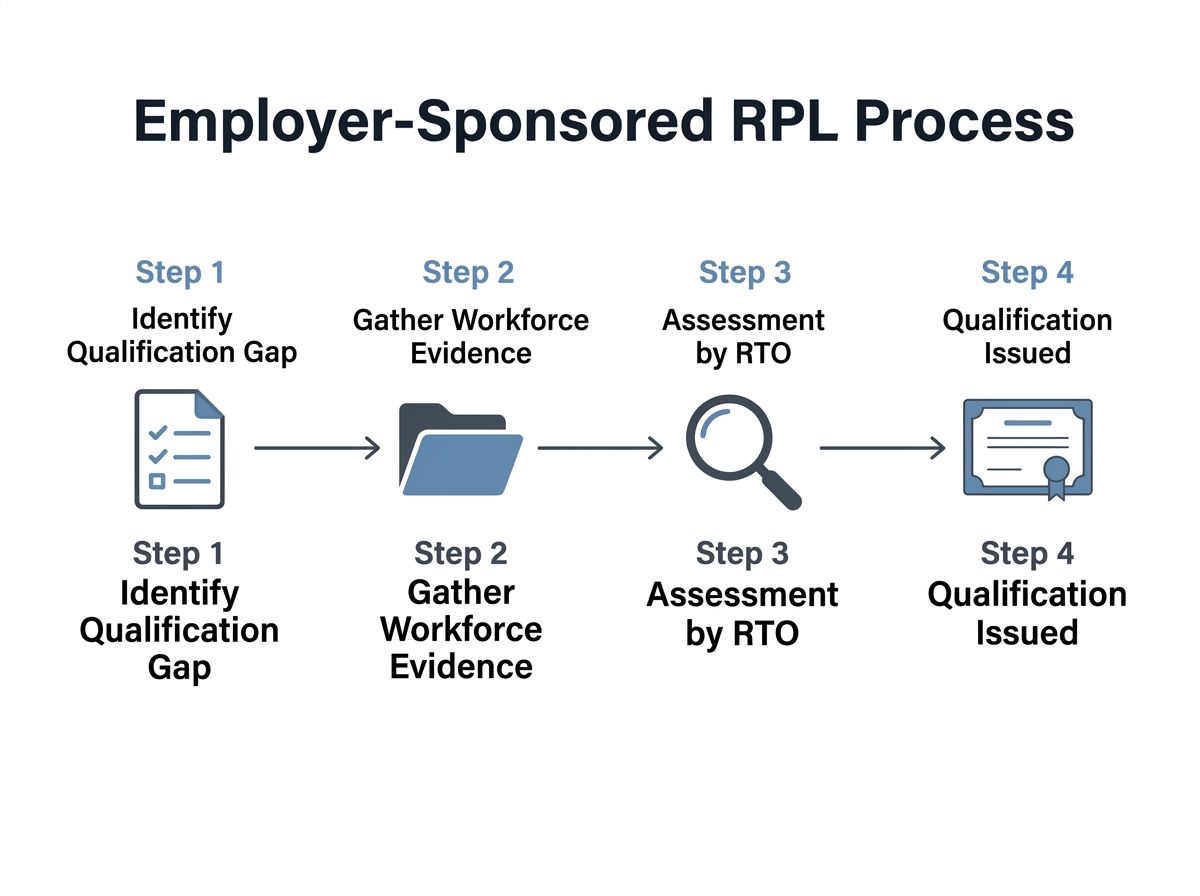
The evidence used in an RPL assessment usually consists of documents the employer already holds or can easily access. This includes project records, timesheets, position descriptions, performance reviews, supervisor statements, and practical samples of work completed. The employer's primary role is to facilitate access to this evidence, rather than funding classroom hours.
We should be direct about two things here. First, not every worker will be suitable for RPL. Suitability depends entirely on the depth and relevance of their experience compared to the specific qualification standard. A skills review is the correct starting point because it confirms whether the experience base is sufficient before any commitment is made. Second, gap training may be required for certain units where the evidence does not fully demonstrate the standard. Where gap training is needed, it is provided as part of the process at no extra cost.
The process is rigorous because the outcome is a genuine qualification. A credential issued through RPL carries the exact same national recognition as one earned through classroom study, because the assessment standards are identical. That is what makes it useful in compliance audits, tender responses, or promotion decisions.
The industries where employer-sponsored RPL is already working
RPL is not a niche mechanism confined to one or two sectors. It is actively used across a broad range of industries where formal qualifications are required for regulatory compliance, licensing, or tender eligibility, and where experienced workforces have built genuine competence through years of on-the-job work.
- Construction and engineering: site supervision, building, plumbing, electrical, and civil construction
- Work health and safety: WHS officers and safety managers across all regulated industries
- Information technology: senior technical staff, systems architects, and IT managers
- Community services: aged care, disability support, and child and family services
- Transport and logistics: operations managers, logistics coordinators, and supply chain roles
- Hospitality: kitchen management, venue operations, and food safety
- Public safety and defence: emergency management and community safety roles
- Mining and resources: site operations, drilling, and resource processing
The pattern across all of these industries is consistent. You find highly experienced workforces, credential gaps that have accumulated over years of promotion, and a faster, evidence-based path to qualification that does not require pulling key staff off the job for months of classroom training.
How to find out if your workforce has gaps worth closing
The first step is not enrolment; it is a suitability assessment. Before an employer commits budget or staff time, the critical question to answer is which of your people have the experience to support RPL, and for which qualifications?
That question does not have to be answered by guesswork. The Free Skills Review is a no-cost, no-obligation starting point for employers who want an honest assessment of whether RPL is a realistic fit for specific staff members. It is a diagnostic conversation, not a sales pitch. If their experience base is not sufficient to support an RPL assessment, we will say so. If it is, we will explain what the pathway looks like and what is involved.
The final decision is yours, but the information you need to make it is readily available and costs nothing to access.
General information only, current at the date shown. Licensing rules change, so check the current requirements with the relevant regulator before you rely on them. RPL it Australia is a student support service, not a Registered Training Organisation; qualifications are assessed and issued by our partner RTOs.