Stop Thinking Like a Subbie and Start Thinking Like a Licensed Contractor
If you have been swinging a hammer for years but still work under someone else's licence, RPL carpentry can turn your experience into evidence.
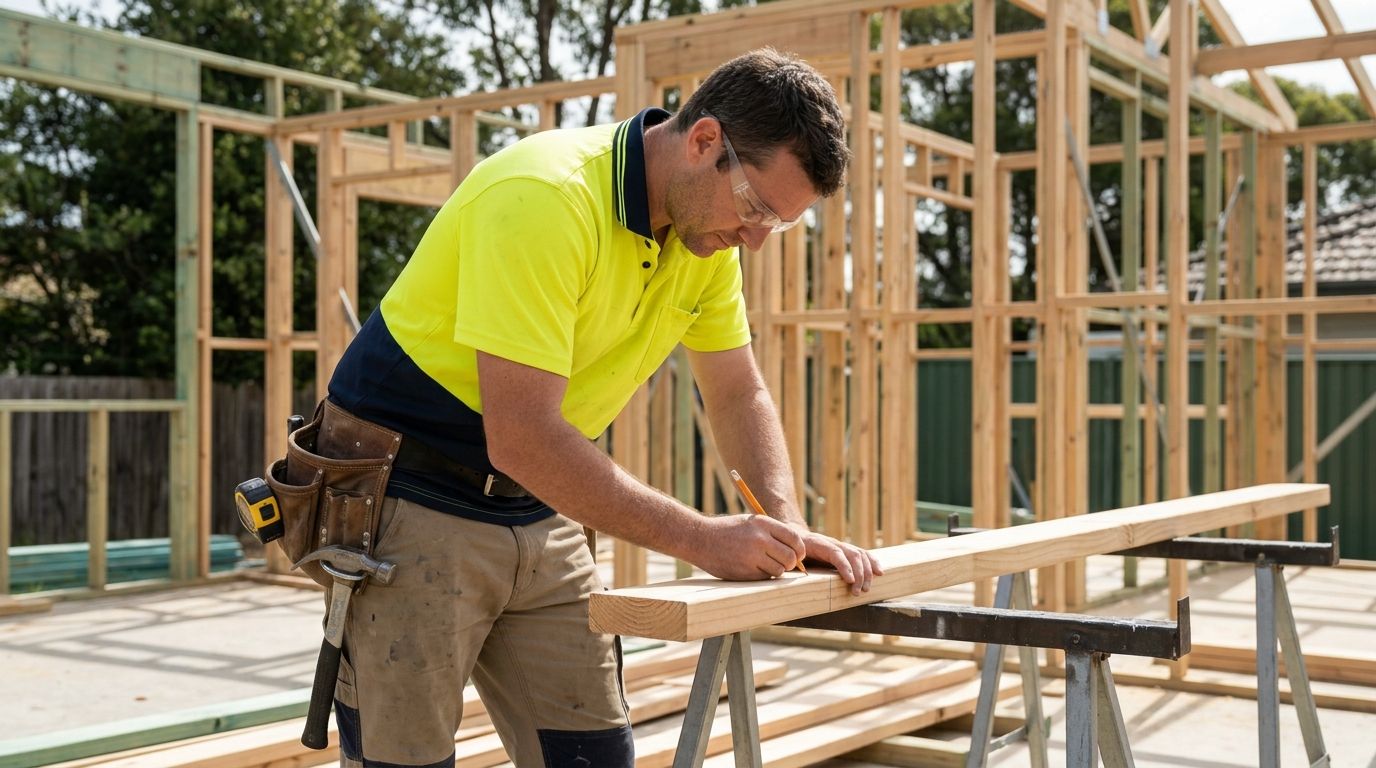
You already know how to build. The system just doesn't know it yet.
You've been doing this work for years. Framing walls, setting out, reading plans, fitting windows and doors—you know the full scope of residential and commercial carpentry. You know the trade well. The problem is not your skill. The problem is that formal systems cannot see it because it is not documented in the right format.
Australia's construction industry employs around 1.3 million people, with most construction services work flowing through tradespeople and subcontractors. According to the Australian Bureau of Statistics, construction services tradies generated more income through subcontracting arrangements than through primary contracting in 2023-24. This structural reality shows how the industry actually works. Most of the skilled labour is done by people who do not hold the licence.
IBISWorld estimates around 97,700 people were employed in formal carpentry services businesses in Australia as of 2025. But the number of people doing carpentry work—on residential sites, in commercial fit-outs, or as subbies under someone else's ticket—is much broader than any single industry classification captures.
If you are one of them, this article is for you. You do not need to learn carpentry. You already know it. Instead, this is about the pathway that lets the formal system finally recognise what you already know.
The subcontractor trap: skilled work, someone else's margin
Here is the situation many experienced carpenters find themselves in. You do the work. You carry the tools. You solve the problems on site. But the person whose name is on the contract—the one who signs off on the job, who tenders for the next one, and who keeps the primary margin—holds the licence. You do not.

This does not reflect your competence. It reflects a credential gap. The licence is not a measure of skill; it is a legal permission to operate independently. Without it, you are structurally dependent on whoever holds it, regardless of how well you do the actual work.
In New South Wales, for example, a contractor licence is required to carry out residential building or trade work, including carpentry, valued at more than $5,000 in labour and materials. Doing that work without a licence can attract fines of up to $22,000 for an individual. That is the regulatory reality. It is not unique to NSW; every state and territory has its own licensing framework, and CPC30220 (the Certificate III in Carpentry) is the nationally recognised qualification that underpins most of them.
The credential is the gate. Recognition of Prior Learning (RPL) is a legitimate pathway through it.
The old mental model: 'I'd have to go back to school'
Most experienced carpenters who have not formalised their qualifications are not avoiding it because they do not care. They avoid it because their mental model tells them it would mean months or years off the tools, sitting in a classroom, repeating things they already know, and losing income they cannot afford to lose.
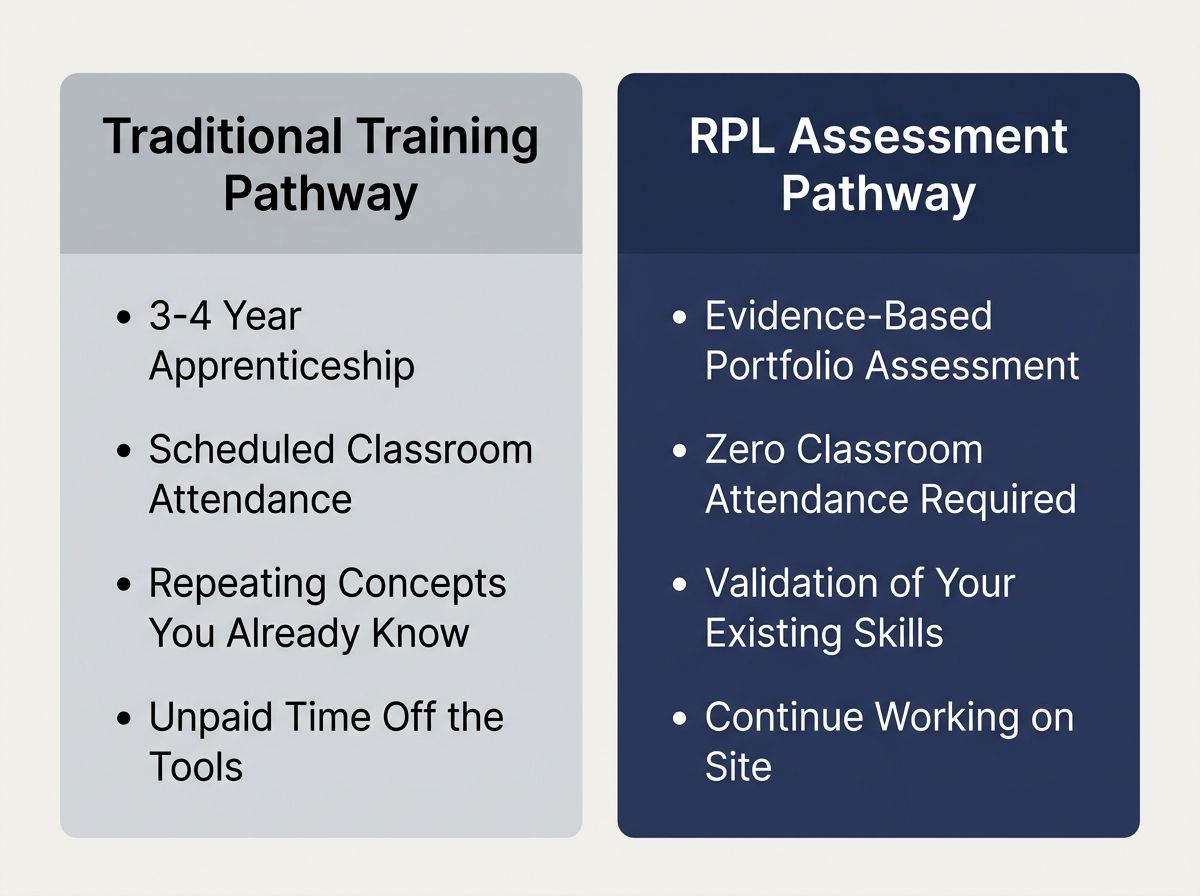
That belief is logical. For traditional training pathways, it is also largely accurate. A Certificate III in Carpentry delivered through an apprenticeship typically takes three to four years. Full-time institutional study can take around two years, and part-time study can extend further. One provider, Charles Darwin University, notes that their CPC30220 program runs over three years full-time, with part-time options extending up to six years.
For someone who has been doing carpentry work for a decade, the idea of spending years in structured study to prove competency they already have is understandably a non-starter.
But this mental model is based on a misunderstanding of how RPL actually works. That misunderstanding is worth correcting.
The new mental model: RPL carpentry is an assessment, not a course
RPL carpentry is not a training program. It is a formal assessment of skills you already have, measured directly against the national standard.
The Certificate III in Carpentry (CPC30220) is a nationally recognised qualification that defines what a competent carpenter can do. According to training.gov.au, the qualification comprises 34 units of competency: 27 core units and 7 electives. The core units cover a broad range of carpentry knowledge and practice, including WHS and construction induction, reading and interpreting plans, measurements and calculations, using carpentry tools and equipment, setting out, wall and ceiling framing, roof trusses and pitched roofs, eaves, windows and doors, lining, stairs, exterior cladding, formwork, and demolition.
The RPL process asks a different question from traditional training. Instead of asking if we can teach you these things, it asks if you can demonstrate that you already meet these standards.
Your years on site, your project history, and your problem-solving under real conditions are not background noise. They are potential evidence. The RPL assessment process evaluates whether that evidence, properly gathered and presented, is sufficient to demonstrate competency against each unit of the qualification.
According to guidance from the Master Builders Association of NSW, an RTO that offers CPC30220 RPL, accepted evidence can include video footage of the applicant performing tasks on site, time-lapse photos, certificates already gained, and project management documentation. Practical assessment may also involve demonstrating defined carpentry tasks such as constructing wall frames, installing windows and doors, erecting scaffolding, and carrying out setting out and formwork.
Evidence requirements vary by RTO and by the specific units being assessed. The principle, however, is consistent: evidence must be authentic, sufficient, and current. For trade photos or videos, you must be shown performing the tasks yourself.
Experience can be evidence. That is the shift. It is not about learning something new, but demonstrating that you already know it.
What changes when you think like a licensed contractor
The certificate itself is not the goal. What the qualification enables is the goal.
In most Australian states and territories, the Certificate III in Carpentry (CPC30220) is the nationally recognised trade qualification that underpins carpentry contractor licensing. It is the qualification that licensing authorities look for when assessing applications for a contractor licence or trade licence. Without it, or an equivalent, the pathway to independent contracting remains blocked.
In New South Wales, unlicensed carpentry work above the $5,000 threshold is a significant legal risk rather than just a commercial limitation. Fines for unlicensed work can reach $22,000 for an individual. The credential is not a bureaucratic exercise; it is the legal basis for operating independently.
When you hold the qualification, you can pursue a contractor licence in your state or territory. You can tender for work in your own name, sign off on your own jobs, and carry your own insurance as a licensed contractor. You stop being structurally dependent on whoever holds the licence above you.
The ABS data on Australia's construction services sector illustrates this structural dynamic. In 2023-24, construction services businesses earned $116.6 billion through subcontracting arrangements compared to $71.4 billion through primary contracting income. While the subcontracting model is how most skilled trade work gets done, the primary contracting margin flows to whoever holds the licence and the contract.
Licensed contractors typically have access to higher-margin work and independent tendering opportunities. The specific financial difference will vary by market, project type, and individual circumstances, but the structural access is real, and it begins with the credential.
The risks of operating without the right credentials are real and vary by state. Understanding them is part of making an informed decision.
The NSW Government sets out clearly what carpentry work requires a contractor licence and what the penalties for unlicensed work are. It is worth understanding the regulatory requirements in your own state.
Is your carpentry experience enough to get recognised?
Not every experienced carpenter will have sufficient evidence for a full RPL assessment. You should know this before you start, which is why an honest suitability check matters.
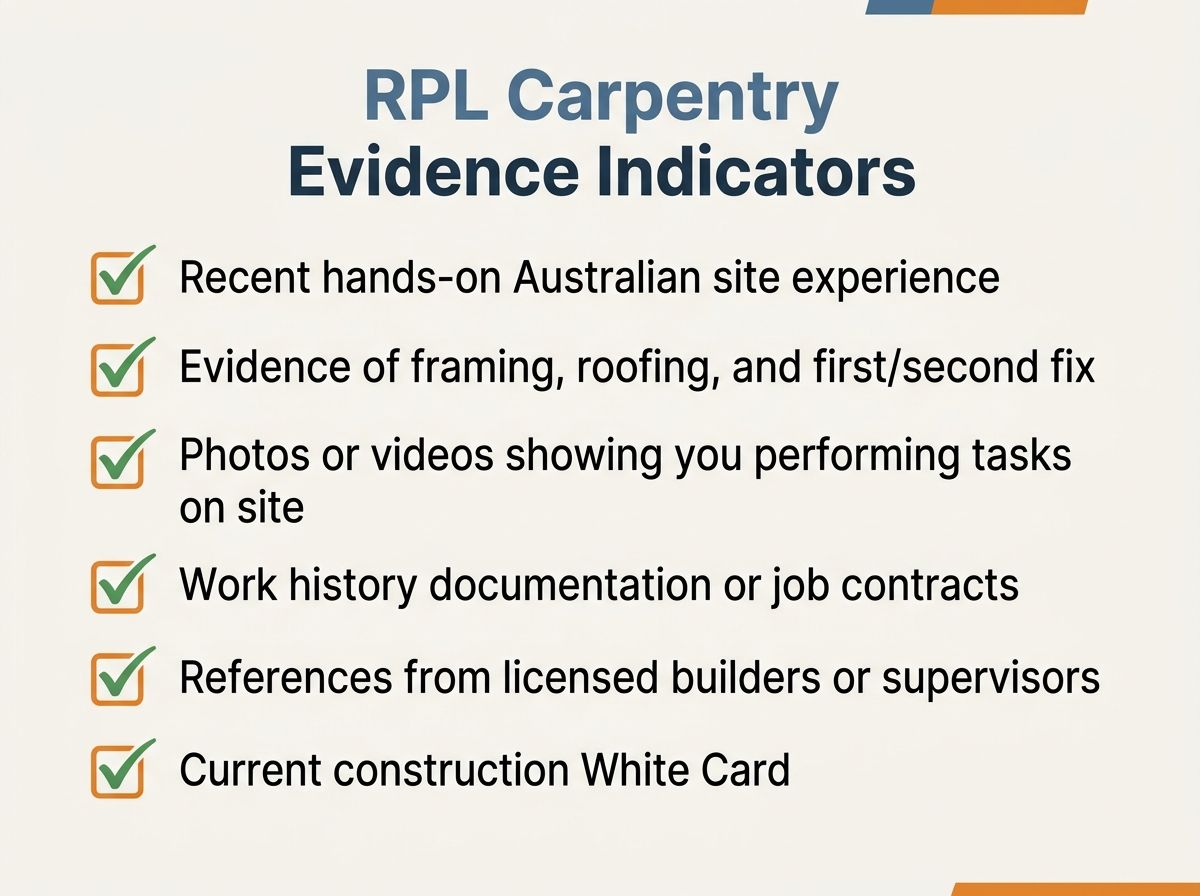
RPL eligibility expectations vary by RTO. As a general guide, RTOs offering CPC30220 RPL typically look for candidates with recent, hands-on carpentry experience across a range of the qualification's competency areas. Builders Academy indicates around five years of carpentry experience as a general guide for their RPL process, while Master Builders NSW requires a minimum of three years of full-time equivalent experience within the last ten years. These are RTO-specific thresholds, not a national standard, but they show the experience profile that tends to support a strong application.
A strong RPL application for CPC30220 typically involves evidence across multiple competency areas: framing, roofing, first and second fix, formwork, and WHS compliance. It also typically requires third-party verification, such as references from direct supervisors who are licensed or qualified in carpentry and have worked with you for a meaningful period.
What happens if gaps are identified? RPL assessment is evidence-based, and assessors make judgements against each unit of competency. Where evidence is insufficient for particular units, some RTOs offer gap training to help candidates meet the full requirements. Availability, format, and cost of gap training vary by provider; some RTOs include it at no additional charge, while others require face-to-face attendance at specific facilities. It is important to confirm gap training arrangements with any RTO before enrolling.
You should also know that RPL does not automatically result in a full qualification. Where a candidate gains RPL for some but not all units, they may be issued a Statement of Attainment for the units recognised rather than the full Certificate III. Gap training, where available, provides a pathway to complete the remaining units.
This is why an honest suitability assessment before committing to a pathway matters. The goal is recognition of what you genuinely know, not enrolment in something that does not fit your situation.
The official CPC30220 qualification on training.gov.au sets out the full unit structure and packaging rules. It is the authoritative reference for what the qualification actually requires.
The next step: find out if your experience qualifies
You've been doing the work. The question is whether your experience, properly documented and assessed, is sufficient to support formal recognition through an RPL pathway.
The honest way to find out is a Free Skills Review, which is a no-obligation conversation about your experience, the evidence you have available, and whether an RPL assessment for the Certificate III in Carpentry is a realistic pathway for you.
This is about recognition, not repetition. The decision is yours.
Ready to Get Recognised?
Start with a free skills review to find out if RPL is right for you.