Stop Thinking Like an Apprentice: Your Site Experience Is Already Enough for a Builder Licence
Think getting a NSW builder licence means going back to school? It doesn't. If you've been running sites, you may already meet the requirements. Here's what counts.
The assumption that's keeping experienced builders unlicensed
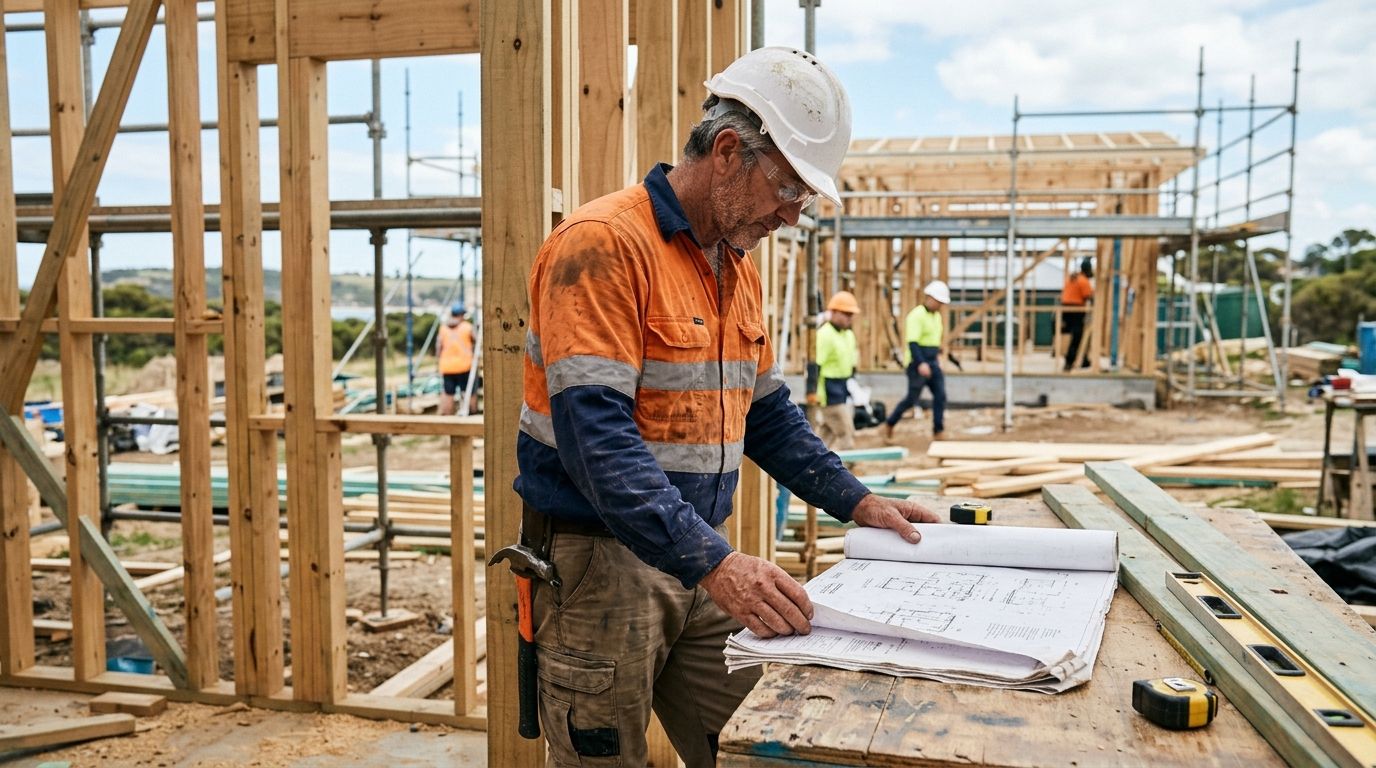
You've been running sites for years. You know how to read plans, manage subcontractors, handle defects, and keep a build moving when things go sideways. You've done the real work — the kind that most people with a builder licence have only done on paper.
And yet, when someone mentions getting your builder licence, your first thought is probably: 'I can't afford to stop working for months to sit in a classroom learning things I already know how to do.'
That assumption is understandable. It's also the single biggest reason capable, experienced builders remain unlicensed. Because the assumption is wrong.
Getting a NSW builder licence is not primarily an education exercise. For someone with genuine site experience, it's an evidence exercise. That distinction matters — and once you understand it, the whole pathway looks different.
If you've been through this with a plumbing licence, the same logic applies here.
What a NSW builder licence actually requires
To get a contractor licence for building work in NSW, you generally need to satisfy three things: a qualifying qualification, documented relevant experience, and identity, financial, and character checks. The licensing authority in NSW is Building Commission NSW (formerly NSW Fair Trading).
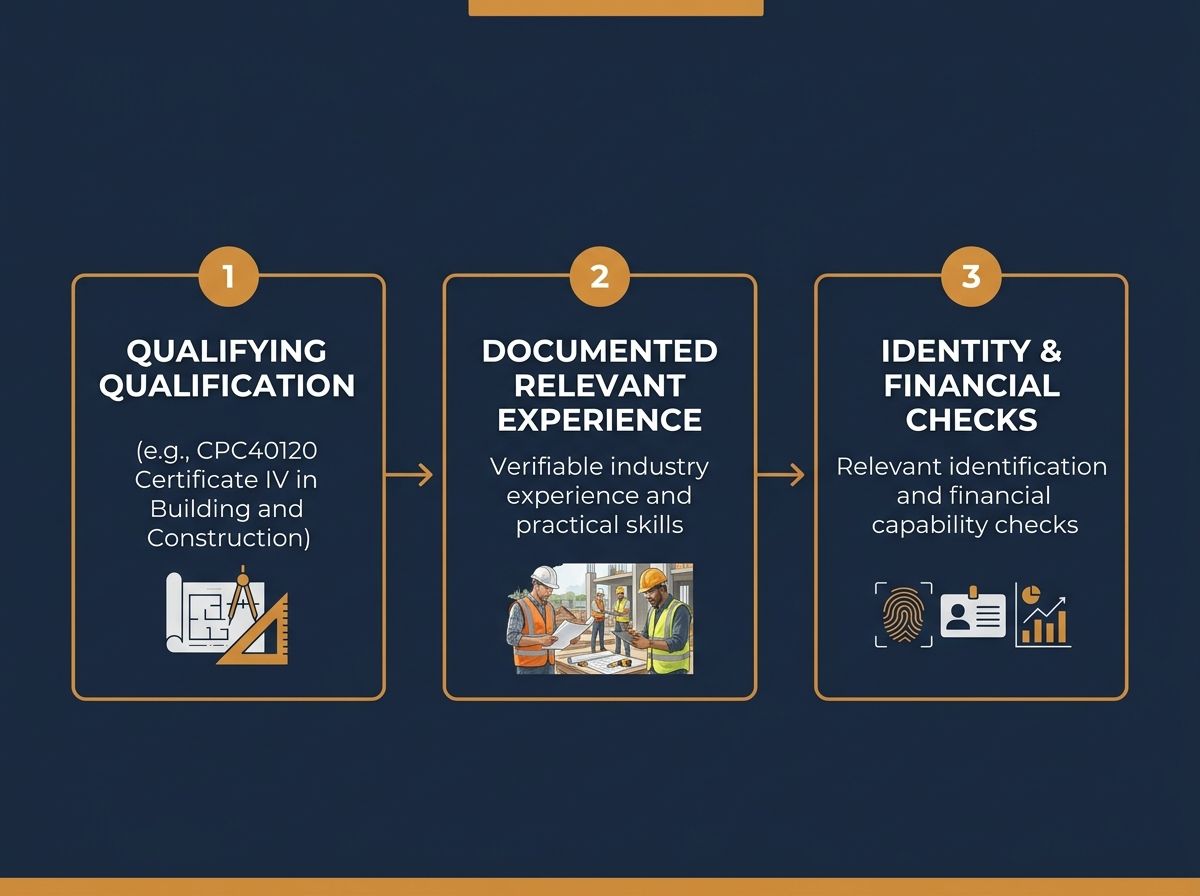
The qualifying qualification most commonly referenced for a NSW builder licence is the Certificate IV in Building and Construction (Building) — CPC40120. According to Master Builders NSW, their CPC40120 course is designed to meet part of the Building Commission NSW criteria for a building licence, with Building Commission NSW determining the full eligibility requirements.
Industry training providers such as Builders Academy also describe CPC40120 — or an equivalent qualification — as the entry-level qualification covering building regulations, contract administration, and site management for domestic builder licences in NSW.
Previous versions of building qualifications may also be accepted, and because individual circumstances vary, applicants should contact Building Commission NSW directly to confirm which pathway applies to them.
In NSW, a contractor licence for building work is required before an individual can contract, subcontract, or advertise to carry out residential building or trade work where the reasonable market value of labour and materials for the total job is over $5,000 (including GST).
The Australian Business Licence and Information Service (ABLIS) confirms the NSW contractor licence threshold and requirements for both individuals and companies.
You can find more detail on the NSW builder licence pathway on our dedicated product page.
The difference between learning a trade and proving you know it
Recognition of Prior Learning — RPL — is a formal assessment process within the Australian Qualifications Framework that recognises what you already know, rather than teaching you from scratch. An apprentice learns. An experienced builder proves.
RPL is not a shortcut. It is a different kind of rigour. Instead of sitting in a classroom completing assignments, you work with a qualified assessor to demonstrate that you already meet the competency standards — through the evidence of your actual work.
For CPC40120, the qualification comprises 19 units of competency — 11 core and 8 elective. Each unit maps to a specific area of building practice: contract administration, site safety, structural principles, building codes, and more. If you've been doing this work on site, you've been demonstrating these competencies every day. The RPL process makes that demonstration formal.
Where an assessor determines that evidence is insufficient for certain units, gap training may be required. This is a normal part of the process, not a failure. It simply means those specific units need additional demonstration. Reputable RTOs typically provide gap training as part of the RPL program.
Your skills speak. The RPL process helps them be heard — formally, and in the language the licensing system requires.
What 'site experience' actually counts as evidence
Most experienced builders dramatically underestimate the evidential value of their daily work. Here's what RPL assessors for CPC40120 can work with:
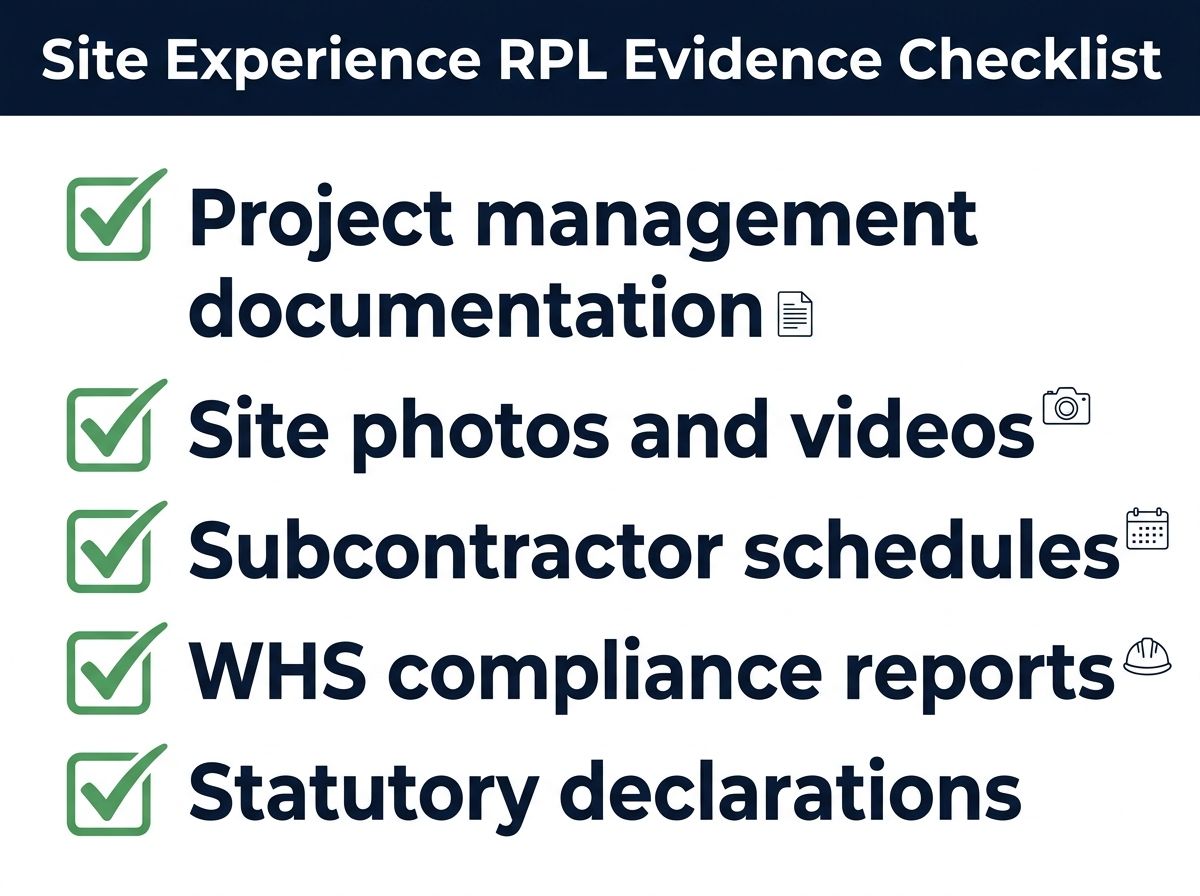
- Video footage or time-lapse photos of tasks on site
- Existing certificates and licences
- Project management documentation — contracts, schedules, variation orders
- Statutory declarations from qualified builders or supervisors
- Third-party reports from clients, architects, or engineers
- Evidence of compliance management — WHS records, inspection reports
- Documentation of subcontractor coordination and supervision
Master Builders NSW notes that RPL evidence for CPC40120 can include video footage of tasks on site, time-lapse photos, existing certificates, and project management documentation. Assessors review the submission and may ask for clarification if more information is needed.
The RPL practical assessment can also require access to your workplace, a variety of job tasks, and the tools, equipment, and materials used to carry them out. This is assessment in your environment — not a classroom.
If you've managed a residential build, coordinated trades, handled a defect notice, or supervised a concrete pour — that counts. The question isn't whether you've done the work. It's whether you can show you've done it.
Why putting it off costs more than the licence itself
Every day operating without a builder licence in NSW is a day of compounding exposure. The risks are real, and they're worth understanding clearly.
Under NSW law, carrying out residential building work without the required contractor licence can result in significant penalties. NSW government guidance indicates that unlicensed individuals can face fines, and the Home Building Act 1989 sets out the penalty framework for non-compliance. Verify current penalty amounts with Building Commission NSW or the NSW legislation website, as these figures are subject to change.
Beyond fines, there is the insurance dimension. In NSW, residential building work valued over $20,000 requires Home Building Compensation Fund (HBCF) cover by law — unless a specific exemption applies. HBCF cover is not available to unlicensed builders. To even apply for HBCF eligibility, you need a valid contractor licence and an ABN or ACN.
icare NSW explains that all licensed builders and contractors must meet eligibility requirements before they can take out HBCF cover for a project, with eligibility assessed by icare and specified in a Certificate of Eligibility.
It's worth being clear about what eligibility means: a Certificate of Eligibility is not the same as a Certificate of Insurance. Eligibility means you can apply for HBCF cover. A Certificate of Insurance is issued separately for each building project.
HBCF cover is not required when a builder subcontracts work from another licensed contractor, or when the contract price or market cost of labour and materials is less than $20,000 including GST. Outside those situations, the cover is mandatory — and without a licence, it is inaccessible.
There is also the tendering dimension. Many commercial and government contracts require a valid builder licence as a condition of tendering. Without it, the work is simply unavailable — regardless of your capability.
How the RPL pathway works for a builder licence in NSW
Here is what the RPL pathway to a NSW builder licence typically looks like — honestly, without oversimplification.
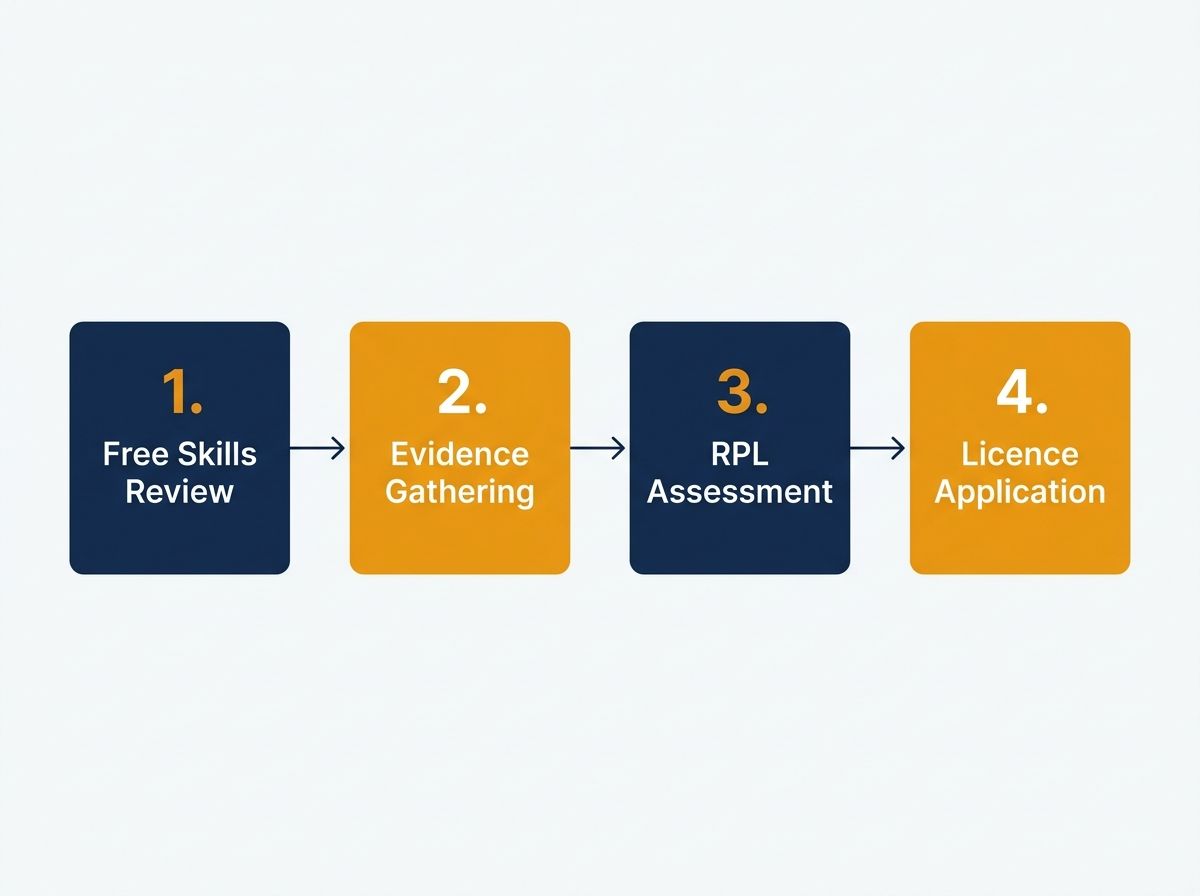
- Step 1 — Free Skills Review: A guided conversation to assess whether your experience is likely to support an RPL application. No commitment required. This is where you find out where you stand before anything else happens.
- Step 2 — Evidence Gathering: Working with your RPL guide to identify, collect, and organise the documentation that demonstrates your competency across the 19 units of CPC40120. This is the substantive work of the process.
- Step 3 — RPL Assessment: A qualified assessor from the delivering RTO reviews your evidence, may conduct a professional conversation or workplace observation, and determines competency unit by unit. Where gaps are identified, gap training is provided.
- Step 4 — Qualification Issued: On successful completion of assessment, the RTO issues the CPC40120 Certificate IV in Building and Construction (Building). This qualification can then be used as part of your NSW builder licence application to Building Commission NSW.
- Step 5 — Licence Application: You apply to Building Commission NSW with your qualification, experience documentation, and other required materials. The licence decision rests with Building Commission NSW.
Timelines for RPL assessment vary by provider and by the depth and organisation of your evidence. Master Builders NSW designs its CPC40120 RPL program to be completed within six months, with knowledge-based assessment targeted in the first two months and all evidence submitted within five months — recommending around 10–15 hours per week of engagement.
Other RTOs describe their RPL pathway as taking between two and eight weeks, depending on the applicant's experience and the completeness of their evidence.
These are provider-specific estimates, not guaranteed timeframes. What is consistent across providers is the structure: evidence in, assessment out, qualification issued. The RPL it team does not conduct assessments or issue qualifications — that is the role of the registered training organisation. We guide you through the process so your evidence is presented clearly and completely.
Master Builders NSW outlines their CPC40120 RPL pathway, including entry requirements and evidence expectations, on their course page.
The question every experienced builder should ask before assuming they're not ready
Most experienced builders rule themselves out before they even look into it. They assume the process requires years of study, or that their experience won't count, or that the timing is never quite right.
The right question is not 'do I have a qualification?' It is 'can I demonstrate what I already know?'
A free skills review answers that question — honestly, without obligation. It tells you whether your experience is likely to support an RPL application for CPC40120, what evidence you'd need to gather, and whether the pathway makes sense for your situation. If it doesn't, we'll tell you that too. We would rather guide someone to the right pathway than enrol them in the wrong one.
You have the experience. The question is whether it's been documented in the right form. That's what a free skills review tells you.
Ready to Get Recognised?
Start with a free skills review to find out if RPL is right for you.