Why some QLD builders wait years longer than they need to for their licence
Many experienced QLD builders already meet the QBCC experience threshold, but delay applying because they assume the process is harder than it is.
By RPL it Australia7 min read

The builders who wait the longest already qualify
Here is the counterintuitive part. The QLD builders who spend the most time without a licence are not, in most cases, the ones who lack the experience. They are the ones who have it, but have quietly assumed that the process of formalising it is more complex, more disruptive, or more uncertain than it actually is.
They have been on the tools for years. They have supervised crews, managed subcontractors, and delivered projects. They know the trade. Somewhere along the way, they formed a picture of what getting licensed would involve, and that picture was harder than the reality. So they kept working, and the licence stayed unclaimed.
The delay does not come from the process itself. It comes from assumptions about the process.
What the QBCC actually requires, and why many experienced builders already have it
The Queensland Building and Construction Commission (QBCC) requires applicants for a builder licence to demonstrate a combination of relevant experience and, depending on the licence category, a formal qualification. The experience component is what most experienced site workers already have, and it is also the part that is most commonly misunderstood.
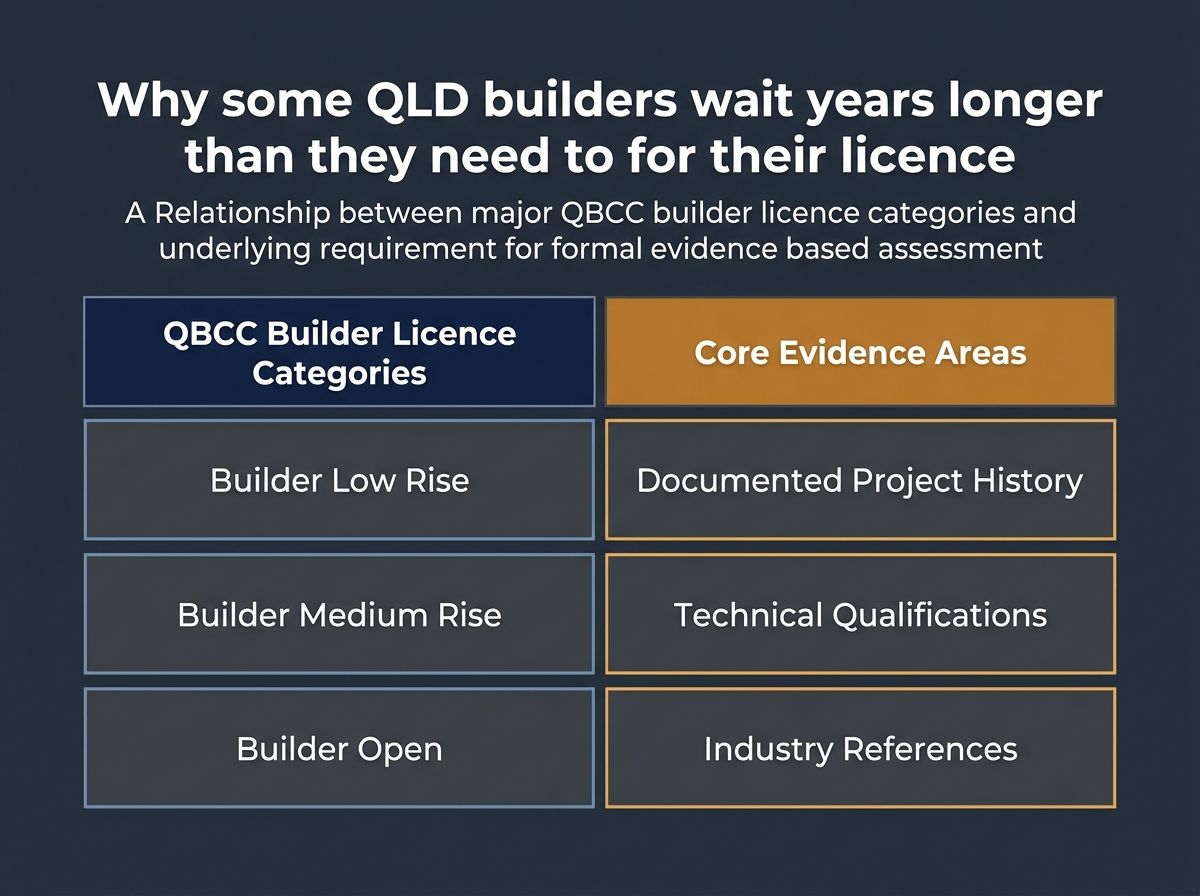
QBCC issues builder licences across several categories, including Builder Low Rise, Builder Medium Rise, and Builder Open. Each category has its own experience and qualification requirements. For the Builder Low Rise licence, which covers residential construction up to three storeys, the experience threshold centres on demonstrated, relevant site experience in a supervisory or leading capacity.
Many builders who have been working in Queensland construction for five, eight, or ten years have accumulated far more relevant experience than the minimum threshold requires. The main challenge is whether that work has been documented in a way that can be presented as evidence, rather than whether they have done the work.
That distinction matters. Experience that exists but has not been captured through employment records, references from licensed builders, statutory declarations, or documented project history cannot be assessed. The RPL pathway is designed to help candidates gather and present that evidence in the form the assessment process requires.
A formal qualification is typically required alongside the experience component for most QBCC builder licence categories. For candidates who have relevant experience but not the formal qualification, Recognition of Prior Learning (RPL) through a registered training organisation (RTO) can be the pathway to obtaining that qualification. This uses existing work history as the evidence base, rather than requiring you to complete a full course from scratch. Readers should verify current QBCC requirements directly with QBCC or a qualified adviser, as requirements can change.
The three assumptions that keep qualified builders waiting
The delay is rarely caused by a single obstacle. It is usually caused by one of three assumptions, each of them understandable and worth examining.
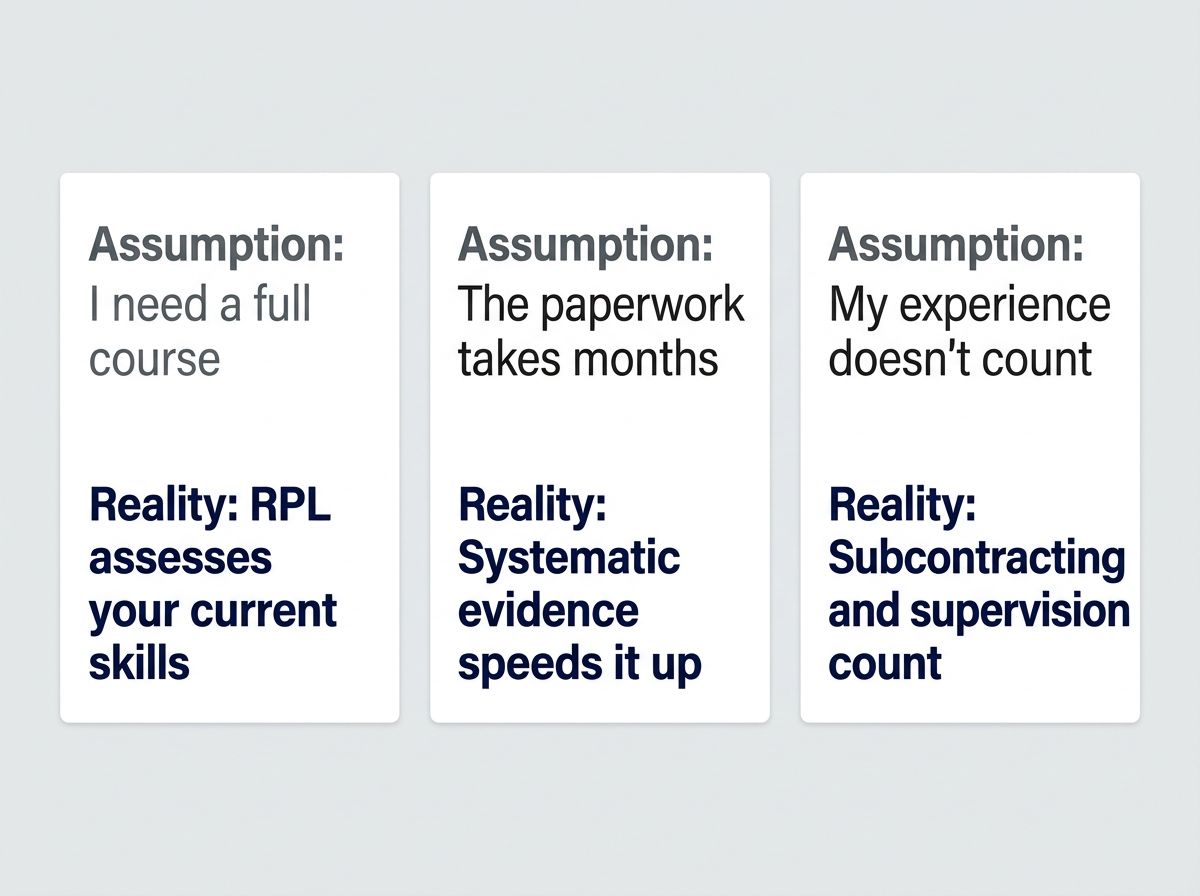
Assumption 1: 'I need to do a full course first'
This is the most common one. Many experienced builders assume that getting licensed means returning to formal study. They expect to sit through units they mastered on the job years ago, in a classroom, at a pace designed for people who are learning the trade for the first time.
For candidates with sufficient relevant experience, RPL offers a different pathway. Instead of completing a qualification from scratch, the candidate's existing work history is assessed against the qualification's competency requirements. Where the evidence demonstrates competency, units are recognised. Where gaps exist, targeted gap training addresses them. The process focuses entirely on what the candidate already knows.
Assumption 2: 'The paperwork will take months and I can't afford to stop working'
The image of a licence application as a months-long administrative ordeal of forms, waiting periods, and bureaucratic back-and-forth is a significant deterrent. This is not entirely without basis, as some applications do take time.
But for a candidate who already meets the experience threshold and has their evidence in order, the process is more structured and straightforward than most builders expect. The RPL assessment can typically be conducted while the candidate continues working. The documentation phase, which involves gathering employment records, references, and project evidence, is the most time-intensive part, but a guided process makes it significantly more manageable.
Assumption 3: 'I probably don't have the right type of experience'
This one is subtler. Some builders discount their own experience because it does not fit their picture of what counts. Perhaps they worked as a subcontractor instead of a direct employee, managed projects informally without a formal supervisory title, or built their experience across multiple employers rather than in a single long-term role.
The reality is that relevant experience takes many forms. What matters is whether the work demonstrates the competencies the qualification requires, regardless of the specific employment arrangement. A skilled assessor can help a candidate map their actual work history against the competency framework and identify what is usable as evidence. Many builders are surprised by how much of their history qualifies.
What the process actually looks like for someone who already has the experience
For a builder who already meets the experience threshold, the pathway to a QBCC builder licence is a documentation and assessment process rather than a standard course. It is designed to be conducted alongside your daily work, so you do not have to put your business on hold.
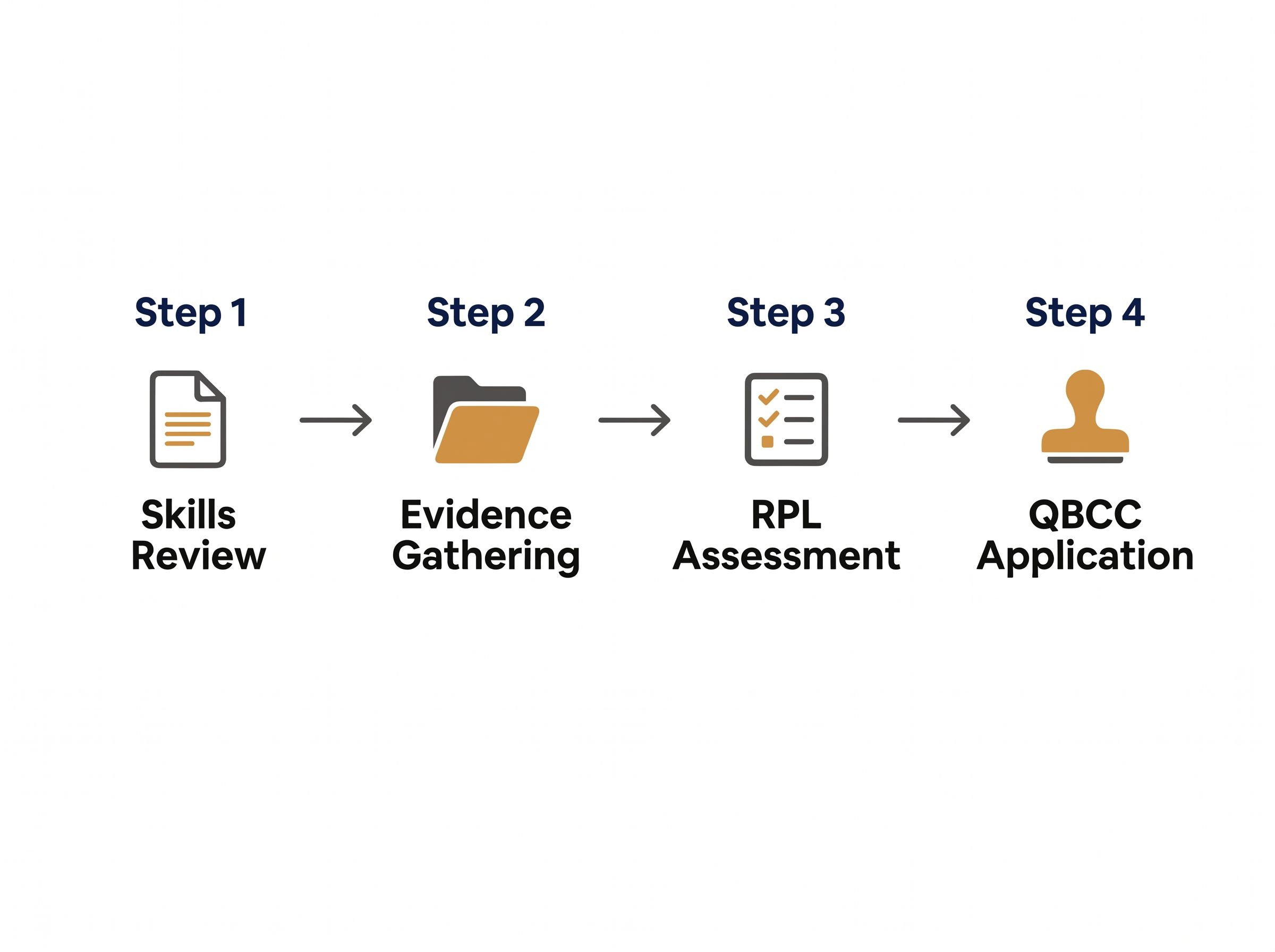
The process typically begins with a skills review. This is the step where a qualified adviser assesses your work history against the requirements of the relevant qualification and QBCC licence category. This step identifies what evidence you already have, what gaps exist, and what the realistic pathway looks like for your specific situation.
If the skills review confirms that your experience is sufficient, the next phase involves gathering and organising your evidence. This includes employment records, references from licensed builders or supervisors, statutory declarations, and documentation of completed projects. For many experienced builders, this evidence already exists and simply needs to be located and structured.
The RPL assessment is then conducted by a qualified assessor from a registered training organisation. The assessor reviews the evidence against the qualification's competency requirements. Where competency is demonstrated, units are recognised. Where gaps are identified, targeted gap training is provided, which is typically included at no additional cost through the RTO.
Once you obtain the qualification, the QBCC licence application can proceed. The application itself is a separate process managed through the QBCC, and the timeline will depend on their current processing times.
The key point is that for a candidate who already meets the experience threshold, the process is finite, structured, and straightforward. Instead of returning to study or starting a new course, you are receiving formal recognition for work you have already completed.
The cost of waiting when you already qualify
Every year without a QBCC builder licence is a year of constrained options. Without the licence, a builder cannot operate as a principal contractor on licensable building work in Queensland. That means you cannot tender independently for projects that require a licensed principal contractor. Instead, you are forced to work under someone else's licence, on their terms, and at their margin.
It also means exposure. Operating on licensable work without the appropriate licence carries regulatory risk that affects both the builder and the clients or projects involved.
The cost of waiting is not zero. It accumulates quietly, year by year, in the gap between what an experienced builder can do and what they are formally permitted to do independently. For builders who already meet the experience threshold, that gap does not reflect their capability. It simply represents an administrative step that has not yet been taken.
Experience is the evidence, and the licence is the recognition. While they are separate things, for builders who already have the experience, that recognition is much closer than they realize.
How to find out if you already meet the threshold without committing to anything
The first step does not require an application, a course enrolment, or a commitment of any kind.
It is a free skills review, which provides an honest assessment of your work history against the requirements of the QBCC builder licence pathway. The purpose is to show you clearly where you stand, including whether your experience is likely to be sufficient, what evidence you would need to gather, and what gaps exist.
If the review shows that you are well-positioned, you will know what the next steps look like. If it identifies gaps, you will know what they are and what addressing them would involve. Either way, you will have clarity, which is exactly what most experienced builders are missing when they delay.
You have the experience. The question is whether it has been formally recognised. A free skills review is how you find out.
General information only, current at the date shown. Licensing rules change, so check the current requirements with the relevant regulator before you rely on them. RPL it Australia is a student support service, not a Registered Training Organisation; qualifications are assessed and issued by our partner RTOs.