The Monday Morning Knockback: When 10 Years of Plumbing Experience Can't Get You on Site
Turned away from a commercial site despite years of plumbing experience? RPL for plumbing evaluates what you already know. Find out if your experience qualifies.
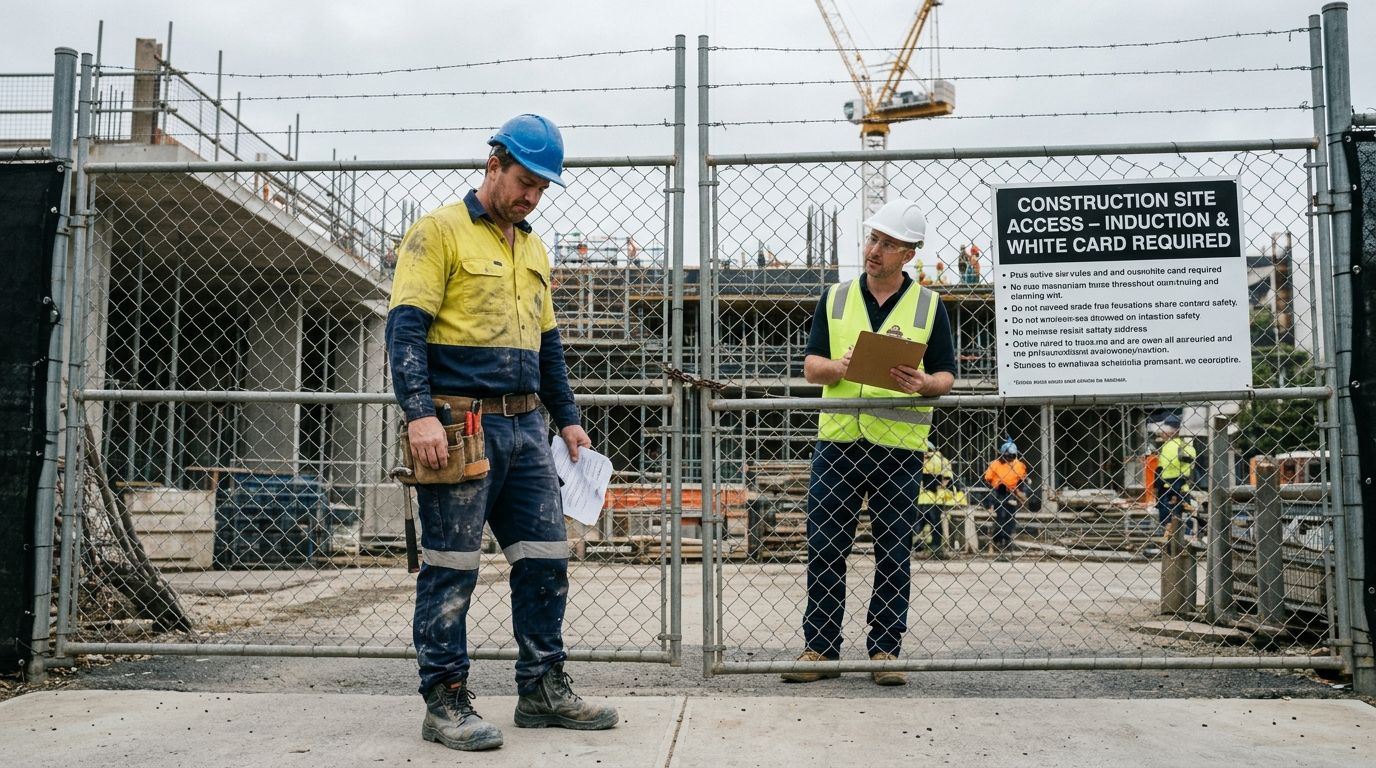
Monday Morning, Tools in Hand, Turned Away at the Gate
You have done this work for ten years. You have roughed in drainage on commercial fit-outs, traced faults in pressurised systems, supervised apprentices, and fixed the jobs that other plumbers left behind. You know the trade. You arrive on a Monday morning, tools in the ute, ready to start a new commercial project.
Then you hit the induction desk.
The site coordinator runs through the checklist. White Card — tick. PPE — tick. Plumbing licence or formal qualification — silence. The system flags it. The gate stays closed. You drive home with your tools still in the ute.
That moment is not about your ability. It never was. It is about a credential the system can read — and the fact that yours does not exist on paper.
The Compliance Check Does Not Care How Good You Are
Every state and territory in Australia requires plumbers to hold appropriate licensing before working on water supply systems or gas fittings. In New South Wales, that is NSW Fair Trading. In Queensland, it is the QBCC. Victoria has the Victorian Building Authority. South Australia has Consumer and Business Services. Each state runs its own system, with its own licence types and requirements.
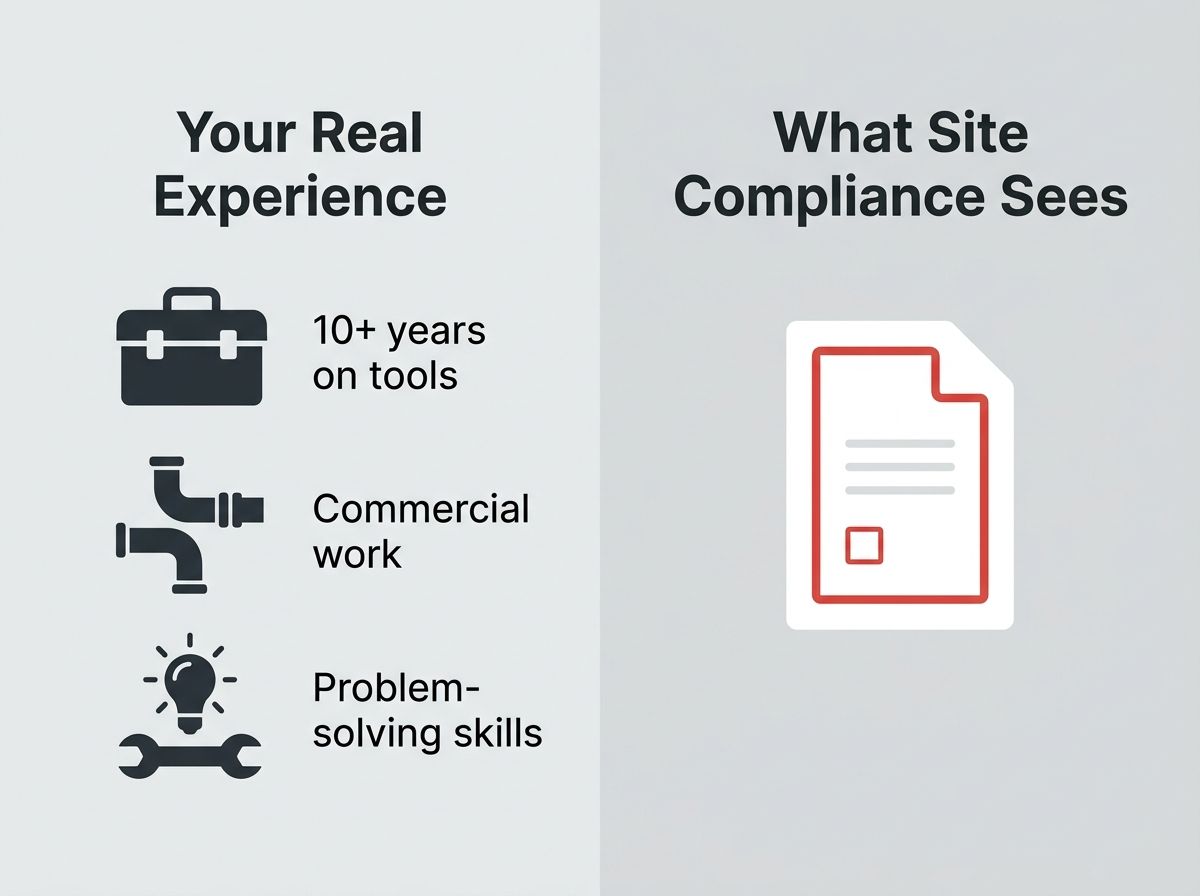
Commercial construction sites operate within those frameworks. When a site coordinator checks your credentials at induction, they are looking for something verifiable — a licence number, a qualification code, a registered training outcome. The process varies between sites and states; some use digital compliance systems, others use manual induction checks, many use a combination. What does not vary is the outcome when nothing comes up: you cannot proceed.
Working without the appropriate licence is not a grey area. In some states, penalties for unlicensed plumbing work can exceed $50,000, and the absence of a licence can leave you personally liable for damage and without insurance cover.
The compliance check is not questioning your competence. It cannot assess competence. It can only read a credential. If that credential does not exist, the gate stays closed — regardless of how many years you have been doing the work.
A White Card gets you onto a construction site. A plumbing licence or formal qualification gets you to the work. Both are gatekeeping steps, and both require a verifiable credential — not a demonstration of skill on the spot.
Ten Years of Work That the System Cannot See
You have diagnosed problems that stumped other tradespeople. You have completed drainage systems on multi-storey commercial builds. You have managed apprentices, read plans, and made calls under pressure. That expertise is real. It is deep. It has been earned on the job, one problem at a time.
But in the formal system, it is invisible.
Not because it does not exist. Because it was never documented in the language that formal systems recognise. Your experience lives in completed jobs, in the memory of supervisors, in the confidence you carry onto every site. It does not live in a qualification code on a national register.
That is the gap. Not a gap in your skills. A gap between what you know and what the system can see.
Your work deserves to be counted. The question is how to make it visible.
What RPL for Plumbing Actually Evaluates
Recognition of Prior Learning — RPL — is a formal assessment process that evaluates your existing on-the-job experience against national competency standards. You do not re-learn the trade. You demonstrate that you already meet the standard.
For experienced plumbers, two qualifications are commonly referenced as available through RPL pathways: CPC32420 Certificate III in Plumbing and CPC40920 Certificate IV in Plumbing and Services. The Certificate III is the foundational trade qualification. The Certificate IV is generally a post-trade qualification for experienced plumbers or those looking to move into contracting or supervisory roles — it typically requires either a Certificate III in Plumbing or authorisation from a relevant Australian regulator.
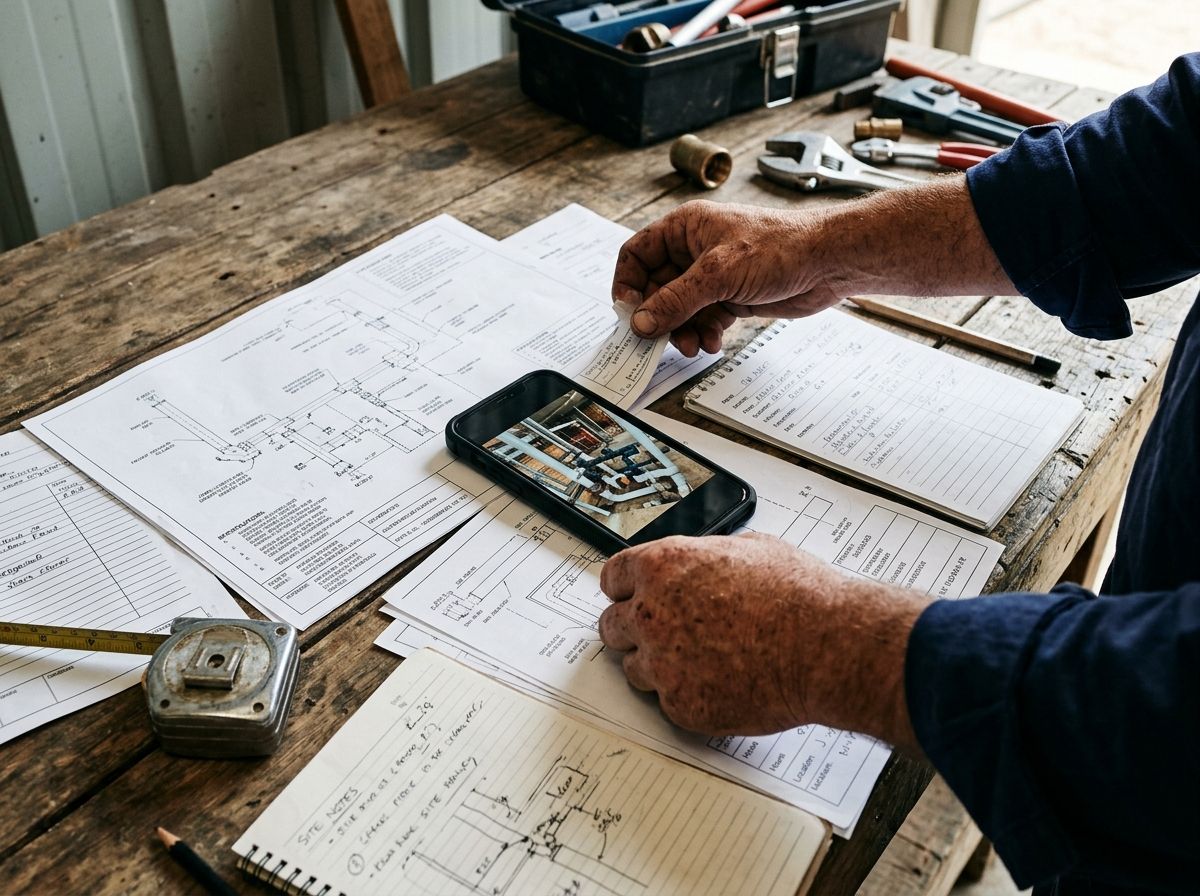
RPL assessment for these qualifications is evidence-based. Rather than sitting through a curriculum you already know, you present evidence of what you have already done. That evidence can include records of completed work, references from supervisors or employers, photographs of installations, logbooks, and in some cases a practical demonstration or structured interview with an assessor. The specific evidence requirements vary between registered training organisations (RTOs), and gap training may be required if certain competencies cannot be demonstrated through prior experience alone.
TAFE NSW, for example, describes non-apprenticeship RPL pathways for CPC32420 that require applicants to be at least 21 years old, have at least two years of relevant work experience, and be currently employed in the industry. These are one provider's requirements — they illustrate the kind of eligibility conditions that apply, but requirements vary between RTOs and states.
Victoria University confirms that CPC40920 Certificate IV in Plumbing and Services is nationally recognised training that can be accelerated through RPL for eligible candidates.
RPL is not a rubber stamp. It is a genuine assessment. The assessor's job is to confirm that your experience meets the national standard — not to wave you through. But it starts from where you already are, not from zero.
The Difference Between Starting Over and Being Recognised
When most experienced tradespeople hear the word 'qualification', they picture a classroom. Sitting through content they already know. Paying for training they do not need. Taking time away from work to prove something they have been doing for a decade.
That is traditional study. It starts from zero.
RPL starts from where you are.
Traditional study asks you to learn what you already know. RPL asks you to show what you have already done. The destination is the same — a nationally recognised qualification. The route is different. One assumes you have nothing. The other starts by recognising what you have built.
That distinction matters practically. RPL assessment timeframes vary between RTOs and depend on the evidence you can provide. What does not vary is the starting point: your existing experience is the foundation of the assessment, not an obstacle to it.
It is worth being clear about what RPL is not. It is not a shortcut. It is not a way to bypass legitimate assessment. The qualification you receive through RPL is the same nationally recognised qualification as one earned through traditional study — because the assessment is genuine. The difference is that you are not required to repeat a journey you have already made.
How to Find Out Whether Your Experience Qualifies
The first step is not enrolment. It is not a commitment of any kind. It is a conversation about whether your specific experience is likely to support an RPL pathway.
A free skills review does exactly that. It looks at what you have done, how long you have been doing it, and whether that experience maps to the competency standards required for the qualification you are working towards. If it does, you have a clear pathway. If there are gaps, you will know what they are before you commit to anything.
Every state and territory in Australia requires plumbers to hold appropriate licensing — understanding what credential your experience can support is the practical first step toward meeting that requirement.
You have the experience. The question is whether it qualifies. That answer is free to find out.
Ready to Get Recognised?
Start with a free skills review to find out if RPL is right for you.