Operating without a builder licence NSW? The crisis moment every unlicenced tradie dreads
NSW Fair Trading runs regular compliance sweeps. If you are operating without a builder licence NSW, here is what you are risking and how to fix it.
The moment you have been dreading
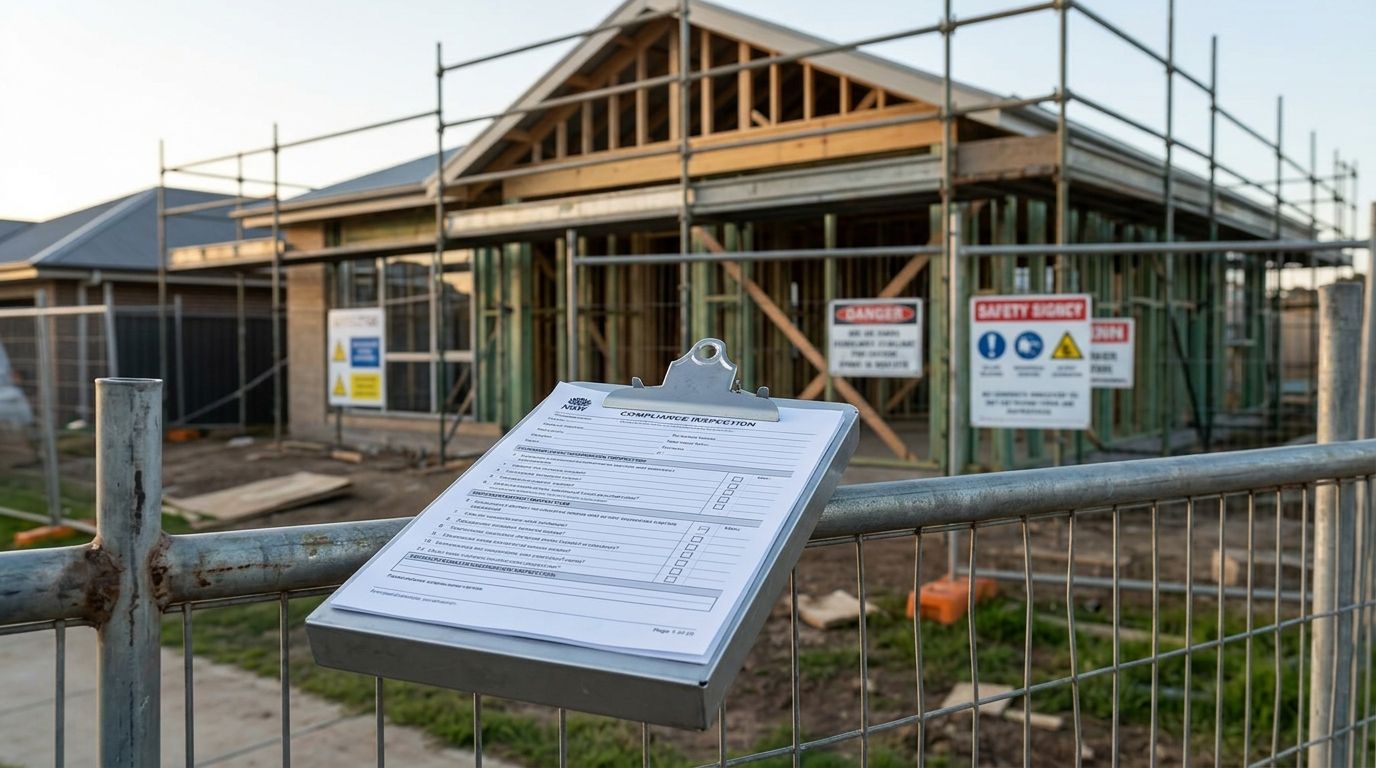
You are on site and the work is going well. Then a vehicle pulls up, someone steps out with a clipboard, and they ask to see your contractor licence number. In that moment, everything stops.
For experienced builders operating without a current NSW builder licence, this is the scenario that sits at the back of every single working day. This is not hypothetical. NSW building regulators conduct proactive compliance sweeps specifically designed to check whether tradespeople on residential sites hold the required credentials.
In August 2023, NSW Fair Trading ran a five-day compliance operation across north-west NSW, with inspectors visiting up to 45 residential building sites in Tamworth, Armidale, and Gunnedah. They checked licences, signage, and insurance. Assistant Building Commissioner Matthew Whitton confirmed at the time that Fair Trading was taking a proactive approach to ensure building projects are appropriately licenced. This followed earlier sweeps that same year to regions including Sydney, Albury, the Hunter Valley, Port Macquarie, Wagga Wagga, and Wollongong.
That operation is just one example. Building Commission NSW states that it conducts regular programs to test compliance with the Home Building Act. These compliance programs are designed to detect and deter unlicenced contractors. The enforcement machinery is real, and it is active.
What NSW law actually says about operating without a builder licence
Under the Home Building Act 1989 (NSW), a contractor must not carry out, advertise, or contract for residential building work unless they hold the appropriate contractor licence, or are an employee of someone who does. This is not a technicality. It is a core legal requirement that applies to the work most experienced builders do every day.
The threshold triggering the licensing requirement is residential building work valued at more than $5,000 in labour and materials, including GST. That figure covers the reasonable market value of the total job, not just the labour component. Kitchen renovations, bathroom renovations, structural landscaping, swimming pool construction, and general residential trade work all fall within this scope once that threshold is crossed.
One important exception exists: specialist work. This includes electrical work, plumbing, draining, gasfitting, and air conditioning and refrigeration. These specialist trades require a licence or certificate regardless of the cost of the work. There is no dollar threshold.
If you do residential building work in NSW valued above $5,000 in labour and materials, you are legally required to hold a contractor licence. The question is not whether the rule applies to you. The question is whether you currently hold the credential it requires.
The penalties: What NSW Fair Trading can actually do to you
The Home Building Act 1989 (NSW) sets out the maximum penalties for unlicenced residential building work. Under section 12 of the Act, the maximum penalty is 1,000 penalty units for a corporation and 200 penalty units in any other case. Penalty unit values are set separately under NSW law and change over time. You should check the current rate with NSW Fair Trading or read the legislation directly before relying on any dollar figure you read online.
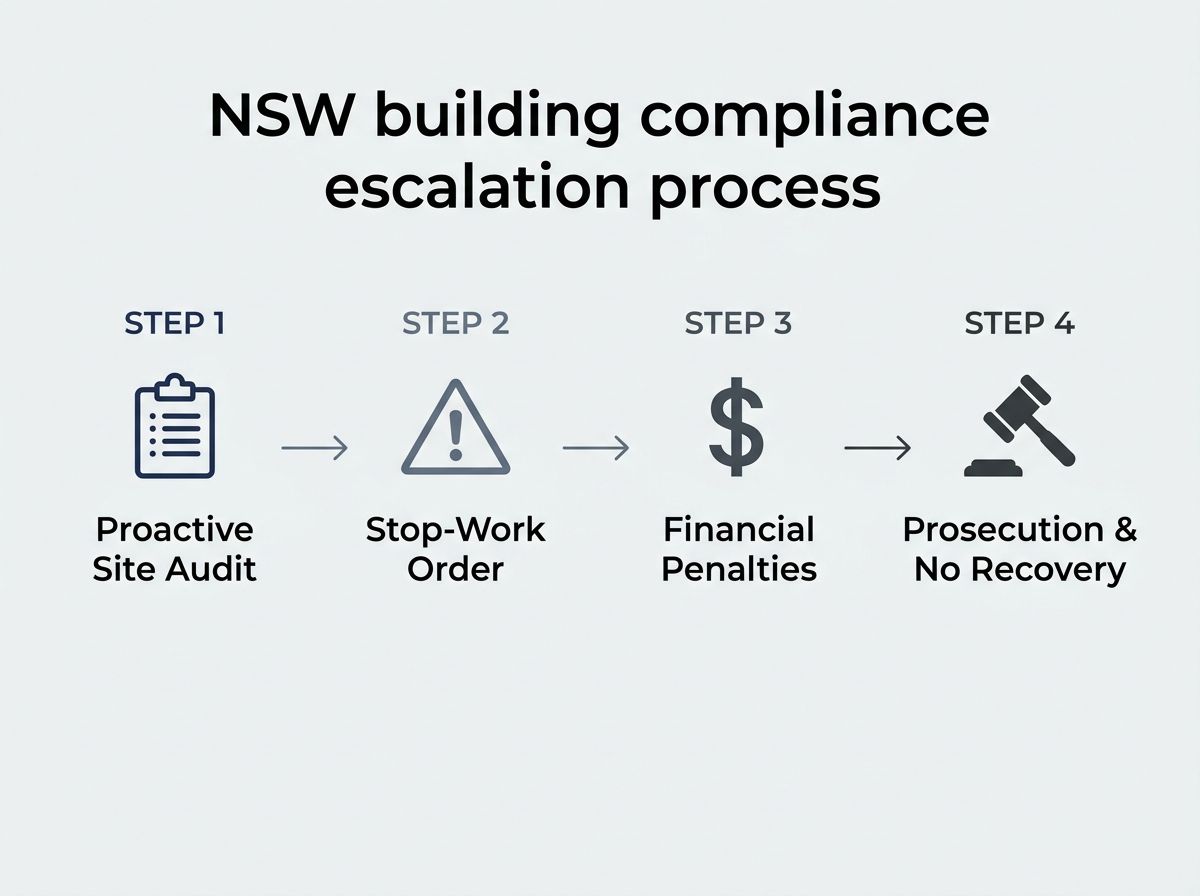
Beyond financial penalties, Building Commission NSW has a range of enforcement options available. These include penalty notices, prosecution through the Local Court, injunctive action in the NSW Supreme Court, and disciplinary action. The regulator does not need to choose just one path.
There is also a provision in the Home Building Act that restricts a contractor's ability to recover payment for work done without the required insurance. The Act states that a contractor who performs work without the required contract of insurance is not entitled to recover money for that work under any other right of action, including a quantum meruit. This is a significant financial exposure that sits alongside the penalty risk, not instead of it.
The Building Commission NSW compliance and enforcement page sets out the full range of regulatory options available to the regulator for breaches of the Home Building Act.
The consequences nobody talks about: Insurance, contracts, and your reputation
The penalties in the Act are the visible consequences. There are other consequences that are less obvious but equally serious.
Insurance is one of those consequences. Queensland's workplace safety regulator has noted that unlicenced and DIY work does not provide the protections that come with licensed contractor insurance requirements. In Australia, professional indemnity policies commonly include exclusions for work performed without the required licensing or registration. Public liability policies vary, but policy wording often includes conditions tied to compliance with legal requirements. If you are operating without the required licence and something goes wrong on site, your insurer may have grounds to decline the claim. The specific terms of your policy matter, but the risk is real enough to take seriously.
Reputation is another consequence that does not appear in any penalty schedule. In a trade where word travels fast and principal contractors run licence checks before awarding work, compliance action is a permanent mark. Your ability to tender for commercial work, to subcontract to tier-one builders, and to grow a business depends on a clean compliance record. That record is difficult to rebuild once it is damaged.
The dynamics of operating under someone else's licence, and what happens when a site inspection catches up with you, are explored in detail in this related article about the plumbing equivalent of this situation.
Why so many skilled builders are still operating without the licence
Most unlicenced builders do not operate in bad faith. They came up through the tools. They learned the trade by doing it. They know how to read a site, manage a subcontractor, and deliver a job on time and on budget. The licence was never the point; the work was.
The barrier is rarely skill. It is the lack of a clear pathway. Many experienced builders assume that getting licenced means going back to TAFE, sitting through courses designed for apprentices, and spending months away from work they are already doing competently. That assumption is understandable, but for many people, it is incorrect.
You have the experience. The system just has not documented it yet. The credential is not a measure of your competence; it is the formal record of it. There is a structured, legitimate pathway designed specifically for people in this position.
If the idea of going back to school is the main thing holding you back, this article on why your site experience is already enough for a builder license addresses that directly.
The RPL pathway: How experienced builders get their NSW licence without starting over
Recognition of Prior Learning, or RPL, is a formal assessment pathway under the Australian Qualifications Framework. It allows experienced workers to have their existing skills and knowledge assessed against the requirements of a nationally recognised qualification, without repeating training they have already effectively completed through years of practice.
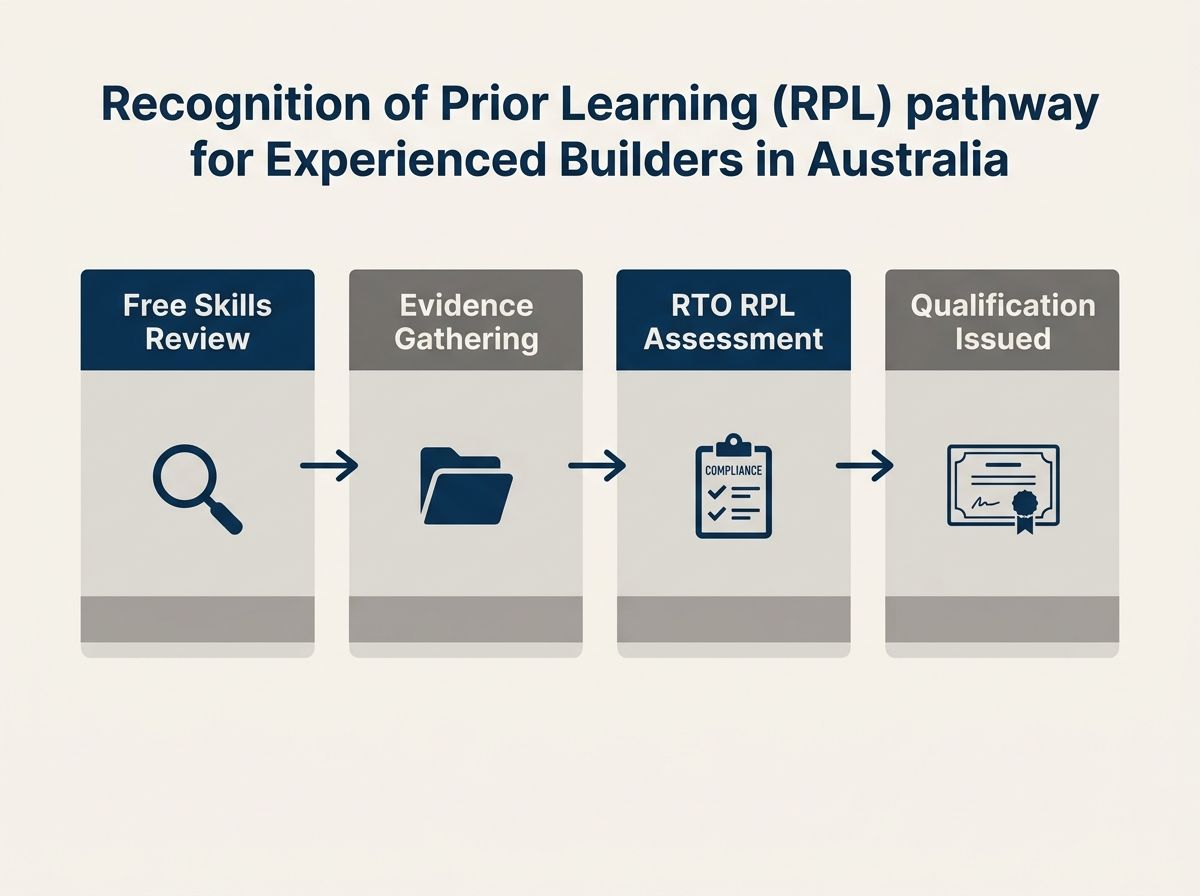
For a NSW builder licence, the qualification pathway typically involves a Certificate IV in Building and Construction. To apply for a contractor licence, you will also need to meet NSW Fair Trading's experience requirements and pass identity, financial, and character checks. The qualification is one component of the licence application, but it is the component that RPL addresses directly. Before committing to any RPL pathway, confirm the current qualification requirements directly with NSW Fair Trading or Building Commission NSW, as requirements can change.
An RPL assessment for a building qualification is conducted by a registered training organisation (RTO). The RTO assessor reviews evidence of your existing skills and knowledge against the units of competency in the qualification. Evidence commonly used in RPL applications includes resumes, employer references, photos or videos of completed work, job descriptions, work samples such as project plans or contracts, and certificates from prior training.
For trade qualifications, RPL assessments may also involve knowledge questions and practical projects, as well as a record of previous employers and work experience that can be verified by references. Some assessments include a practical component on a worksite, using the tools of the trade, where the assessor observes your work directly.
Indicative timeframes vary. Some RTOs advertise assessment periods of two to eight weeks for well-prepared candidates. The actual time depends on the completeness of your evidence, the complexity of the qualification, assessor availability, and whether any gap training is required. Industry bodies caution against providers that promise qualifications in very short timeframes with minimal evidence. A rigorous assessment takes time.
Gap training is a possibility worth understanding honestly. If an assessor determines that certain learning outcomes have not been demonstrated through your existing evidence, they may recommend gap training to address those areas. This is not a failure; it is the assessment process working as it should. Gap training is typically provided at no additional cost by the delivering RTO.
The qualification issued through RPL is nationally recognised under the Australian Qualifications Framework. It carries the same standing as a qualification achieved through traditional study, because the assessment standard is the same. The RTO issues the qualification, and RPL it guides you through the process of preparing and presenting your evidence.
The Master Builders Association of NSW describes the RPL process for trade qualifications, including the evidence types and practical assessment components that candidates can expect.
What happens if you wait
Every day without the licence is another day of exposure. The compliance programs are running. The penalties are real. The insurance risk is real. The contracts you cannot enforce are real.
None of that changes by waiting. What changes is the window of time in which you can resolve it on your own terms, rather than in response to a notice or a site inspection.
The RPL pathway exists specifically for people who have spent years doing the work. It is not a shortcut; it is a structured assessment of what you have already achieved. The decision about whether to start is yours.
Ready to Get Recognised?
Start with a free skills review to find out if RPL is right for you.