Your project managers are running multi-million dollar builds without the CPC60220 to prove it
Experienced project managers running large builds without the CPC60220 Advanced Diploma expose your business to tender and compliance risk. Here is why.
By RPL it Australia7 min read

The pattern plays out the same way on every large site
You hired the right person. You know it. The site knows it. The builds prove it.
Your project manager has been running large construction projects for years. They manage subcontractors, control budgets, keep programs on track, and navigate complex compliance obligations. The work gets done. The clients are satisfied. The business grows.
Then a tender lands. Or a contract renewal triggers a key personnel check. Or a client's procurement team asks for qualification evidence against nominated managers.
That is when the CPC60220 gap surfaces.
The Advanced Diploma of Building and Construction (Management) (qualification code CPC60220) is the nationally recognised credential for senior construction management roles in Australia. It is the formal qualification that shows, in the exact terms procurement teams and licensing bodies require, that a manager is qualified to lead complex projects.
Your manager has the hands-on experience, but the file does not reflect it. As a result, your business carries the exposure.
This is not a failure of business planning. It is an industry-wide pattern that plays out with remarkable consistency across commercial and residential construction businesses of every size.
What the CPC60220 covers and why it maps to what your managers already do
The Advanced Diploma of Building and Construction (Management) is not a theoretical qualification designed for people who have never set foot on a job site. Its competency framework maps directly to the practical work experienced construction managers perform every day.
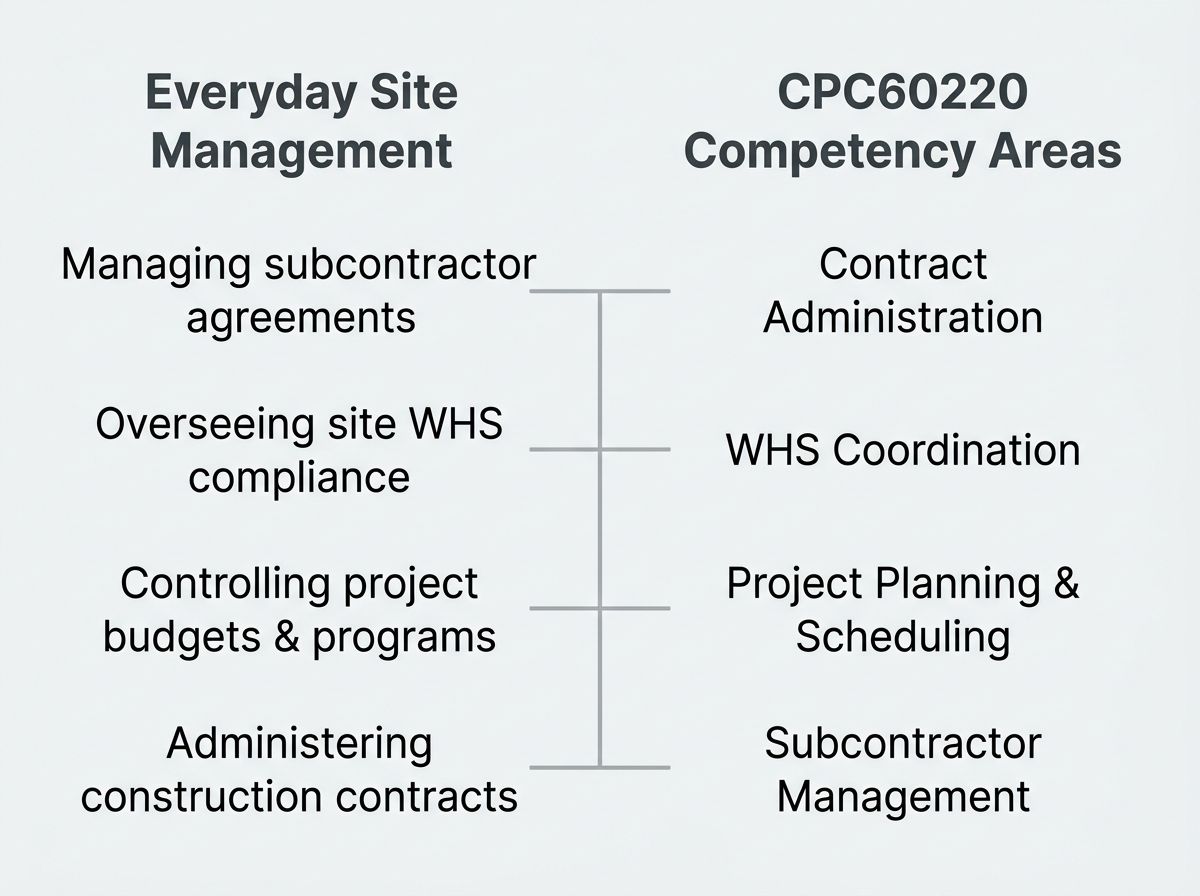
The qualification addresses the management of construction projects at a senior level, covering contract administration, subcontractor coordination, project planning and scheduling, work health and safety obligations, and the financial and legal dimensions of construction project delivery.
For a manager who has spent years running commercial or civil builds, these competency areas will feel highly familiar. This is not because the qualification is easy—it is a rigorous, nationally recognised Advanced Diploma—but because the work they perform daily is the exact work the qualification describes.
The formal credential does not teach experienced construction managers new skills. It provides the documented, assessor-verified evidence that the skills they already hold meet the national standard.
Note for readers: The specific unit codes and competency names within CPC60220 are published on the Australian government's training registry at training.gov.au. If you are assessing your manager's experience against the qualification, that is the authoritative source for the current unit structure.
The tender risk no one talks about until it is too late
The CPC60220 gap becomes a business problem—and not just an individual issue—when a tender explicitly requires nominated project managers to hold formal qualifications.
Government and large commercial procurement frameworks in Australia commonly assess the qualifications of key personnel as part of prequalification and tender evaluation. A manager who has successfully delivered multi-million dollar builds may be ineligible to be listed as key personnel on a bid if this formal credential is absent from their file.
This is not a hypothetical risk. It is a recurring pattern in Australian construction procurement, one that surfaces at the worst possible moment when a significant contract is within reach and the qualification gap becomes the reason a business cannot proceed.
Licensing requirements for construction management roles also vary by state and territory. Whether the CPC60220 is referenced in specific licensing pathways in your state is worth confirming with the relevant licensing authority, as requirements differ across jurisdictions and are updated periodically.
The cost of the gap is rarely visible until a tight deadline makes it impossible to ignore. That is the nature of the pattern.
Why experienced managers do not have the qualification: four reasons the gap persists
The CPC60220 gap is not caused by incompetence or negligence. It persists for four predictable reasons that have nothing to do with the quality of the work being delivered on site.
- They entered the industry through trade or site roles before formal management qualifications were widely required. Many of Australia's most experienced construction managers started in carpentry, concreting, or site supervision, building deep practical knowledge without a formal management credential.
- You hired for demonstrated capability, not a piece of paper. The manager could do the job, and the job needed doing. The qualification question was deferred because the daily work spoke for itself.
- The assumption that 'we will sort it out later' deferred the issue indefinitely. That later date arrived when a critical tender landed or a contract renewal triggered a key personnel check.
- The belief that getting the qualification requires returning to full-time study. This assumption—that the only path to the CPC60220 is a classroom—keeps the gap open longest, and it is the exact assumption that Recognition of Prior Learning directly challenges.
None of these reasons reflect poorly on the manager or the business. They reflect the way the construction industry has historically developed its management workforce, relying on experience, mentorship, and demonstrated performance rather than formal credentials.
The problem is not the past. The problem is that modern systems—procurement frameworks, licensing bodies, and contract requirements—increasingly require the credential to be on file, regardless of how capable the person holding the role is in practice.
RPL is how the gap gets closed—without taking your manager off site
Recognition of Prior Learning (RPL) is the formal assessment pathway that allows experienced construction managers to have their existing skills and knowledge assessed against the CPC60220 competency standards.
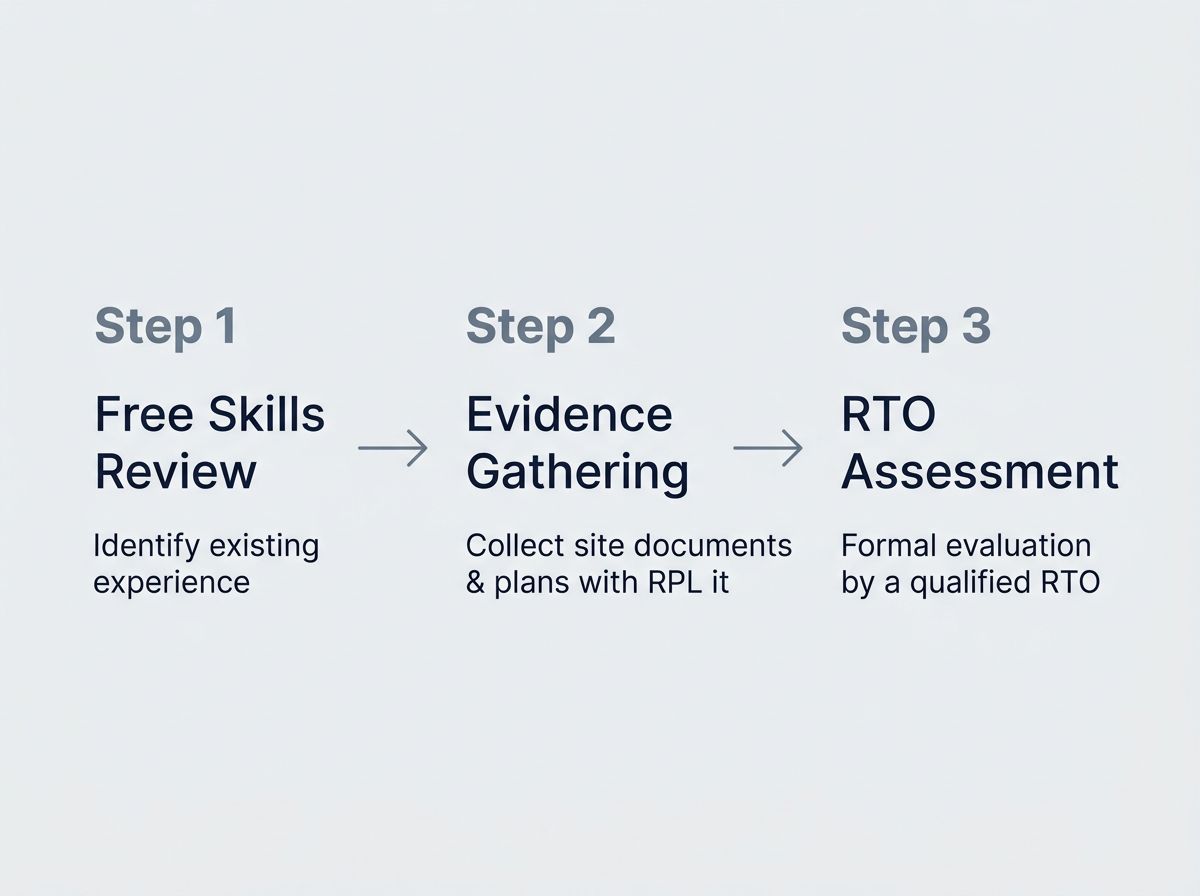
RPL is not a shortcut or a workaround. It is a nationally recognised assessment pathway under the Australian Qualifications Framework, conducted by a qualified assessor from a registered training organisation. The qualification issued through RPL carries the exact same national recognition as one issued through classroom study.
What makes RPL different from traditional study is the evidence base. Instead of completing coursework, the manager presents evidence of their existing competency, such as project documentation, contracts they have administered, site records, WHS management records, references from clients, and a professional conversation with the assessor.
The work they have already completed becomes the evidence. The assessor's role is to evaluate whether that evidence demonstrates competency against the CPC60220 standards.
The assessment timeline depends on the evidence available and the RTO's assessment schedule. This varies by candidate and provider, but the process does not require your manager to leave the site for months of classroom study.
If the assessment identifies areas where the evidence does not fully demonstrate competency, gap training is available to address those specific units. This is part of an honest assessment process—not a failure, but a targeted response to a specific gap.
RPL it guides construction managers and their employers through the evidence-gathering and documentation process. The formal assessment is conducted by a qualified assessor from the delivering RTO. The qualification is issued by the RTO.
What to do if your construction manager does not have the CPC60220
The practical next step is straightforward.
A Free Skills Review is a no-obligation assessment of whether your manager's experience supports an RPL pathway to the CPC60220. It is not an enrolment or a commitment. It is an honest suitability check, conducted before any formal process begins, that tells you whether the experience base is sufficient to proceed.
If the experience supports an RPL pathway, you will know what the next steps look like. If it does not, or if there are specific gaps that need to be addressed first, you will know that too. Honest guidance before commitment is how this process works.
Your manager has the experience. The question is whether that experience can be presented as valid evidence against the CPC60220 standard. That is what the Free Skills Review is designed to answer.
The decision is yours.
General information only, current at the date shown. Licensing rules change, so check the current requirements with the relevant regulator before you rely on them. RPL it Australia is a student support service, not a Registered Training Organisation; qualifications are assessed and issued by our partner RTOs.