Why your overseas nursing degree isn't enough for Australian wards (and what to do about it)
Your overseas nursing degree proves your knowledge, but Australian wards require local compliance. Learn how the Certificate III in HSA bridges the gap.

You didn't come here without skills; you came without the right Australian paperwork
You have the experience. You have years of clinical practice in patient assessments, medication administration, and ward routines. This is knowledge that takes a decade to build and cannot be faked. You arrived in Australia with a nursing degree from a recognised institution, a record of genuine service, and a reasonable expectation that your qualifications would carry weight here.
They do not. At least, not in the format you brought them.
This is not a judgment of your competence. It is a structural reality of how the Australian healthcare system recognises qualifications. Understanding the difference between these two points is where your approach changes.
Many overseas-trained healthcare professionals find themselves in this position. They are capable and experienced, yet invisible to the formal system. If you want to understand the broader pattern, read about why skilled migrants working below their capacity in Australia is a documented, systemic issue, not a personal failure.
The assumption that keeps skilled nurses stuck
The assumption goes like this: a nursing degree from a reputable overseas institution, combined with years of clinical experience, should be enough to work in Australian healthcare. It is a logical assumption. It is also wrong. Understanding why is the first step toward fixing it.
The Australian healthcare system does not question your medical knowledge. It requires evidence that your practice aligns with local standards and compliance rules. These are not the exact same thing. A nursing degree from another country demonstrates that you were trained. It does not, on its own, prove that your training maps to the specific competency standards that Australian regulators and employers use.
For nurses seeking registration to practise as a registered nurse in Australia, the pathway runs through the Nursing and Midwifery Board of Australia. That process has its own requirements, which can include skills assessments, English language testing, and sometimes supervised practice or bridging programs. It is a separate and often long process.
But here is what many overseas-trained nurses do not expect. Even before registration is complete, and even while working in a support role on an Australian ward, a separate qualification requirement applies. And it is not your nursing degree.
The administrative barrier that stops overseas healthcare workers from entering the Australian workforce is well-documented. Understanding the regulatory structure behind it helps shift the frustration from a personal level to a systemic one, which is where it belongs.
What Australian wards actually require, and why it is not what you think
Many ward-based support roles in Australian healthcare settings require the Certificate III in Health Services Assistance (HLT33115), regardless of your overseas nursing qualifications. This is not a hospital-by-hospital policy. It is a nationally recognised vocational qualification that defines the competency standard for health services assistant roles across the Australian healthcare sector.
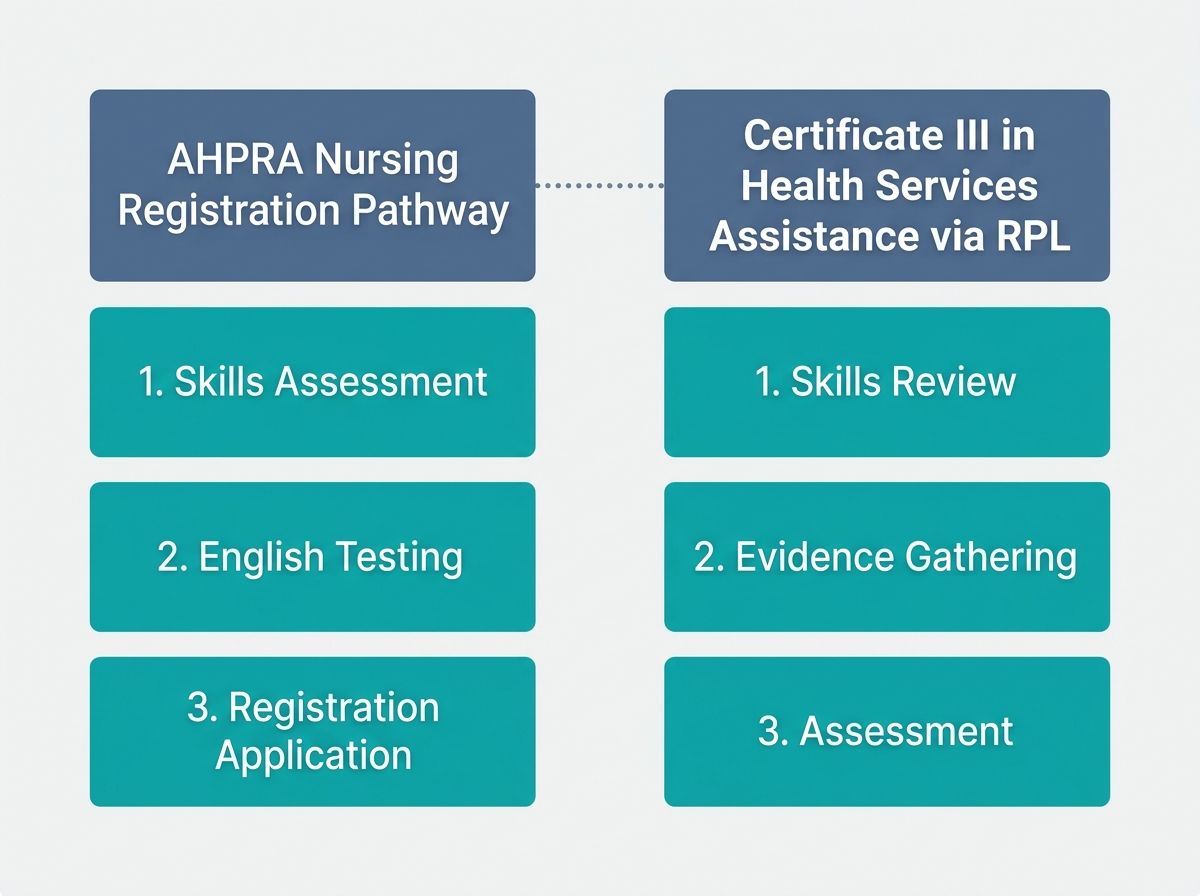
The Certificate III in Health Services Assistance covers competencies such as patient support, infection control, workplace safety, and assisting with clinical care under supervision. These are not abstract concepts for an overseas-trained nurse; they are things you have done daily. But the Australian system needs them documented and assessed against its own framework, rather than assumed from a foreign credential.
For overseas-trained nurses who are working in Australia while their registration application is processed, or who are looking at ward-based roles as a pathway into the Australian healthcare system, the Certificate III in Health Services Assistance is often the qualification that opens the door. It does not replace your nursing knowledge; instead, it translates your skills into a form the Australian system can formally recognise.
This distinction is important. The qualification is not a demotion. It is a compliance bridge, and your clinical background is exactly the kind of evidence that an assessment for this qualification is built on.
The contrarian truth: your nursing degree is evidence, not the problem
Your nursing degree is not being rejected. The form of your evidence is what needs adjusting.
This is the main point. The Australian system is not saying your clinical knowledge is insufficient. It is saying that your overseas qualification, on its own, is not the correct document for this specific local requirement. Those are very different statements, and confusing them is what keeps skilled nurses stuck.
Recognition of Prior Learning (RPL) is the formal mechanism that changes this. RPL is an assessment pathway within the Australian vocational education and training system. It evaluates what you already know and can do, rather than requiring you to study content you have already mastered. For the Certificate III in Health Services Assistance, an RPL assessment draws on evidence of your existing competence, such as clinical records, employer references, documentation of your overseas training, and proof of your skills.
Your overseas nursing experience is not a liability in this process. It is the foundation the assessment is built on. Experience is not worth less than classroom education. It is simply a different form of evidence, and RPL is the process that presents it in a format the Australian system can formally evaluate.
Recognition, not repetition. That is what RPL is designed to achieve.
What the RPL pathway looks like for overseas-trained nurses
RPL is a genuine assessment process. It is not a mere formality, nor is it a shortcut. For someone with your background, it is a structured way to present what you already know to a qualified assessor, so that your competence can be formally recognised against the Australian standard.
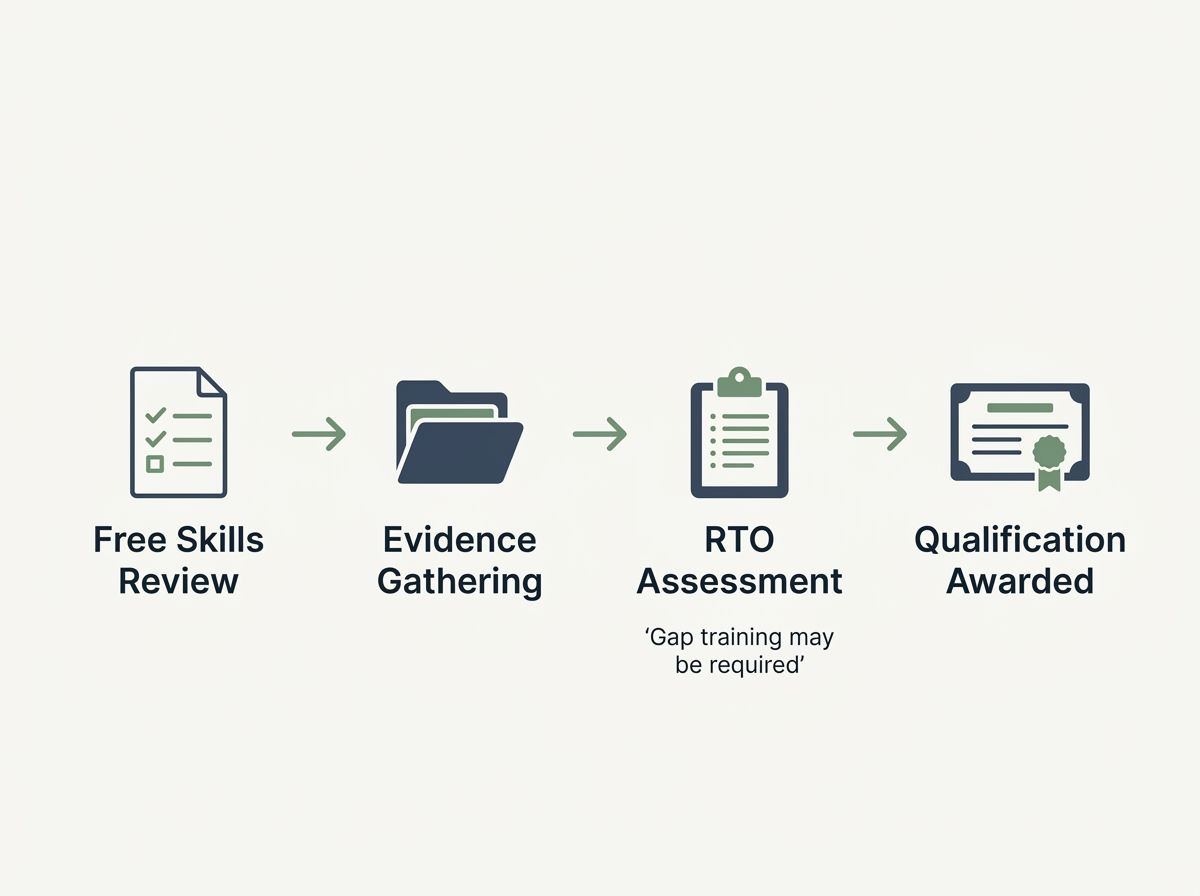
The process typically involves several steps. First, you undergo a skills review. This is an honest conversation about your background, your experience, and whether RPL is likely to be suitable for your situation. This happens before any commitment is made. It is the stage where you find out whether this pathway makes sense for your career.
If the skills review indicates suitability, the next stage is evidence gathering. This is where your clinical history becomes the material of the assessment. You will collect records of your overseas training and qualifications, documentation of your work experience, references from supervisors, and other evidence that demonstrates your competence against the units of the Certificate III in Health Services Assistance.
That evidence is then assessed by a qualified assessor from a Registered Training Organisation, which is the RTO that delivers the qualification. The assessor's role is to evaluate whether your evidence demonstrates competency against each unit of the qualification. RPL it guides you through the documentation and preparation process, while the assessment itself is conducted independently by the partner RTO.
If gaps are identified during assessment, which are areas where your evidence does not fully demonstrate competency, gap training is provided. This is a normal part of the process and not a failure. It means the assessment is genuine, and the qualification, when awarded, reflects real competence.
The qualification awarded is the Certificate III in Health Services Assistance (HLT33115), a nationally recognised credential that carries the same standing regardless of how it was obtained.
If you have been working in healthcare for years without the formal credential to show for it, the process of having your work finally recognised is worth understanding. Read about how the Certificate III recognises what you have already done.
For an overview of the Certificate III in Health Services Assistance and what the RPL pathway involves, visit the qualification page directly.
Is this the right pathway for you? What to check before you start
Not everyone with an overseas nursing degree will be suitable for RPL of the Certificate III in Health Services Assistance. This is an honest statement, and it is important.
RPL suitability depends on the nature and depth of your existing experience. If your clinical background includes direct patient support, infection control, and working within a supervised healthcare team, you are likely to have relevant evidence. If your overseas experience was primarily in a different clinical context, or if you have been out of healthcare practice for a long period, there may be gaps that affect your suitability.
The right first step is not enrolment. It is a skills review. This is an honest, no-commitment conversation about your background and whether RPL is the right pathway for your specific situation. We would rather guide someone toward the correct pathway than enrol them in the wrong one. This is not a marketing stance. It is how the process works when it is done properly.
If RPL is not the right fit, a skills review will tell you that, and point you toward what is. If it is, you will know what evidence to gather and what the process involves before you commit to anything.
Your skills speak. The question is whether they are being presented in a form the Australian system can recognise. The decision about what to do next is yours.
Ready to Get Recognised?
Start with a free skills review to find out if RPL is right for you.