What a WHS Diploma Audit Actually Checks: Beyond Years of Experience
Years of experience does not automatically satisfy a WHS diploma audit. Learn what assessors verify and how RPL bridges the documentation gap.
By RPL it Australia8 min read
The assumption that gets experienced safety managers into trouble
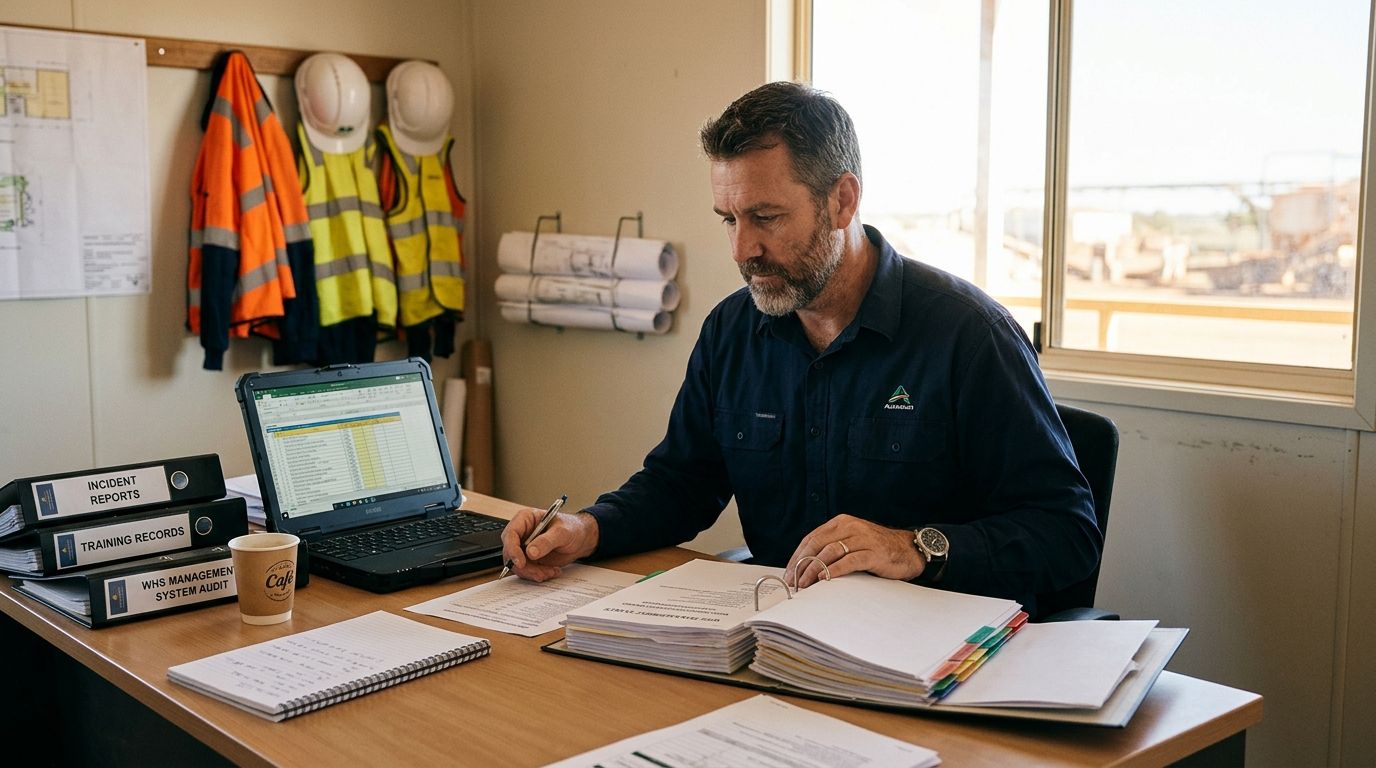
You have managed WHS programs for many years. You have investigated workplace incidents, updated risk registers, led safety committees, and kept people safe on site. If someone asked you to demonstrate your WHS competency, you could easily fill a room with the evidence.
When a diploma-level audit occurs, whether for a new contract, a compliance review, or a high-value tender requirement, the natural assumption is that your extensive track record speaks for itself.
That assumption is precisely where many experienced safety managers run into professional trouble.
A WHS diploma audit does not simply look at your career track record. It checks whether your experience is documented against specific competency units in a format an assessor can systematically evaluate. Years of physical safety work remain invisible to a formal assessment process unless they are translated into the correct evidence files. The gap is not one of competence, but of documentation format.
What the Diploma of Work Health and Safety actually covers
The Diploma of Work Health and Safety (BSB51319) is not simply an advanced version of the Certificate IV. The distinction between the two is significant, which is why experience that satisfies a Certificate IV audit often falls short during a diploma-level review.
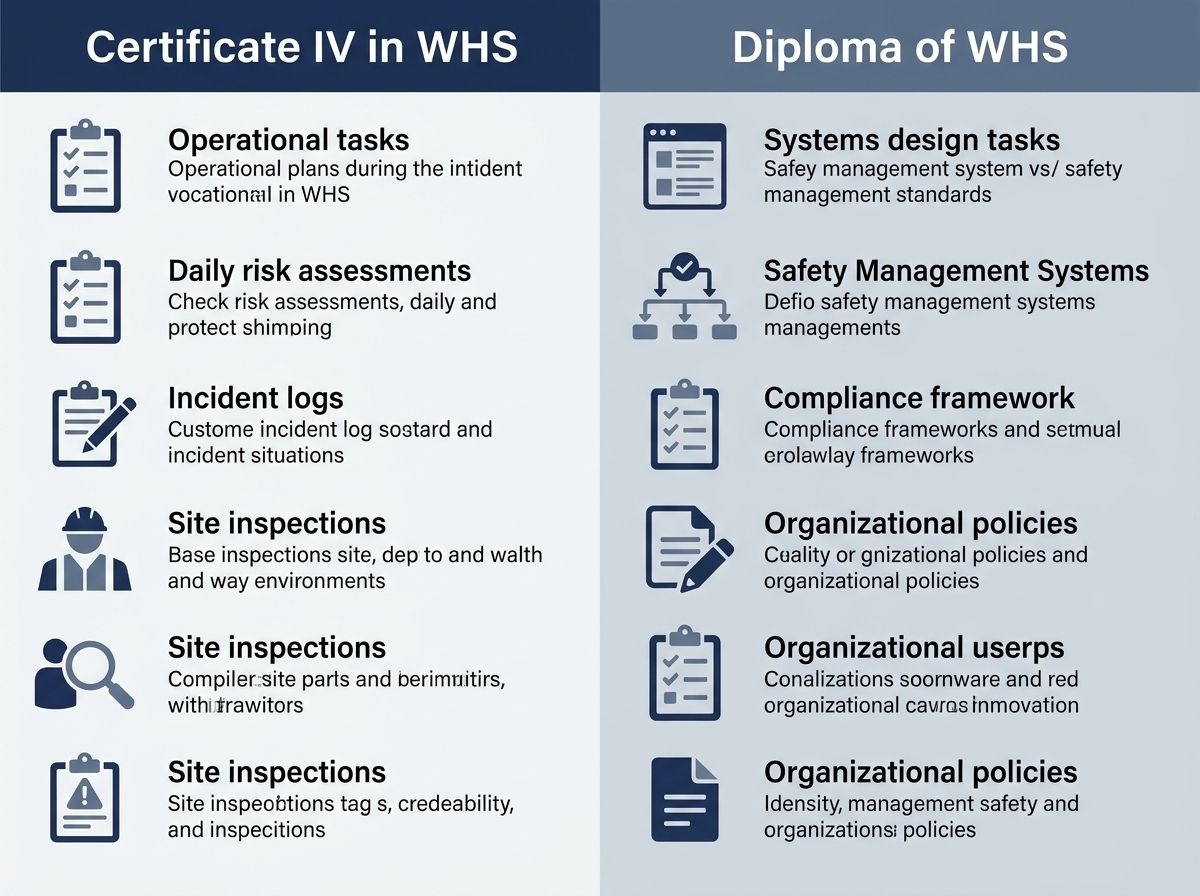
At the Certificate IV level, the operational focus is dominant. Candidates must show they can conduct regular risk assessments, implement WHS procedures, respond to workplace incidents, and support a safety management system designed by others. This work is practical and valuable, but it represents operational, task-level competency.
At the diploma level, the focus shifts entirely to system design and strategy. The qualification requires candidates to prove they have designed, implemented, and evaluated WHS management systems, rather than simply working within them. The competency units cover organisational-level risk management, compliance frameworks, policy contribution, and leading safety consultation and communication across the entire business.
This distinction regularly catches experienced safety professionals off guard. You may have managed safety systems for years rather than simply operating within them. However, a formal audit does not rely on what you did in practice; it requires physical, documented evidence mapped directly to specific competency requirements.
The five categories a diploma-level WHS audit actually checks
Whether the assessment is conducted by a partner Registered Training Organisation for RPL or by a compliance auditor verifying staff qualifications, diploma-level assessment evaluates evidence across five categories. These are not arbitrary; they reflect the official competency structure and the strategic scope of the qualification.
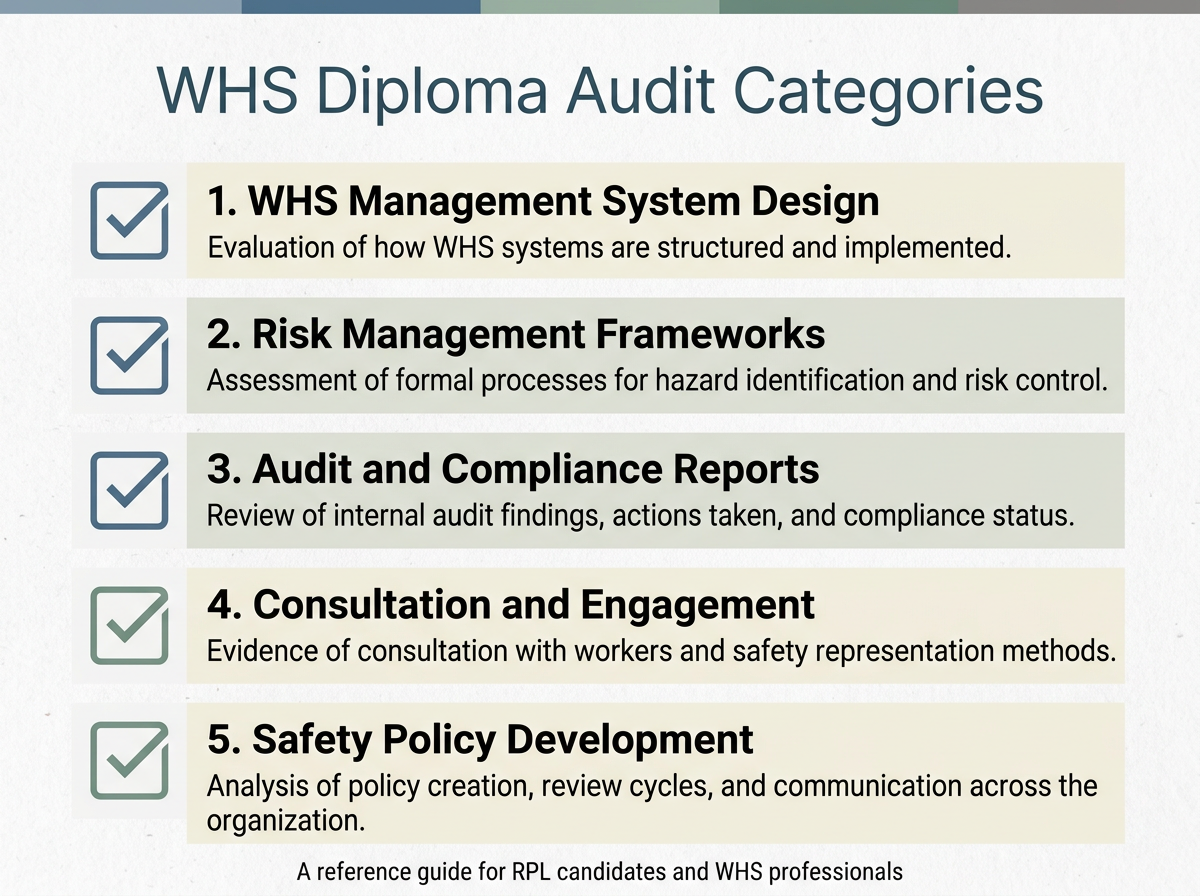
- WHS management system design and contribution. Evidence that you designed, contributed to, or led the development of a safety management system instead of just following an existing one. This includes WHS management plans, system files you authored, or records showing your role in establishing these safety frameworks for a business or project.
- Strategic risk management at an organisational level. Evidence of risk management that goes beyond individual site assessments to cover organisational risk strategy. This includes risk registers you developed or managed, risk frameworks you designed, or documented evidence of how you identified and managed safety risks across a business unit or organisation.
- WHS compliance management. Evidence that you managed legislative compliance rather than simply keeping up with the rules. This includes documentation of compliance audits you led, records of how you monitored legislative updates, and proof of your role in ensuring organisational compliance with all safety obligations.
- WHS leadership and consultation. Evidence of how you led consultation processes, managed safety communication across the business, and engaged workers, management, and other stakeholders in decision-making. Meeting minutes, formal consultation frameworks, and documented outcomes of those safety processes are highly relevant here.
- Evaluation and continuous improvement of safety systems. Evidence that you evaluated safety systems and drove improvements rather than just maintaining the status quo. This includes safety audit reports you produced, documented improvement initiatives you led, and records of how safety performance data led directly to system changes.
Each of these five categories requires specific, retrievable documentation. Simply describing your work to an assessor is not enough; they must verify physical, real-world records.
Why fifteen years of experience does not automatically satisfy the audit
Your industry experience is unquestioned, but a formal audit cannot verify it without physical documentation.
This is the structural gap that catches experienced safety professionals by surprise. A fifteen-year career is highly valuable, but it remains invisible to an assessment process until it is translated into concrete documentation mapped to specific competency units.
The most common reasons safety professionals encounter difficulty during a diploma-level assessment relate to documentation rather than actual competence on the job:
- Documentation was not retained. WHS management plans, risk frameworks, and audit reports from earlier roles are often inaccessible, especially from organisations you have since left.
- Evidence was not mapped to units. You may be able to describe your safety work fluently, but you have not organised that description against the specific competency standards the assessor must check.
- Collaborative work is difficult to attribute. In large organisations, safety system design is often a team effort, making your individual contribution difficult to isolate in the final documents.
- Reliance on verbal description instead of documentary evidence. An assessor takes your testimony into account, but formal assessment requires corroborating documentation. Verbal accounts alone are rarely sufficient for a diploma-level RPL.
These gaps do not reflect a lack of safety capability. They represent the difference between performing the work and having it documented in a verifiable form. A structured RPL process is designed specifically to address this documentation gap.
What RPL for the WHS Diploma actually involves
Recognition of Prior Learning (RPL) for the Diploma of Work Health and Safety is a formal, rigorous assessment process. It requires physical evidence and is conducted by a qualified assessor from a partner Registered Training Organisation (RTO), not by RPL it.
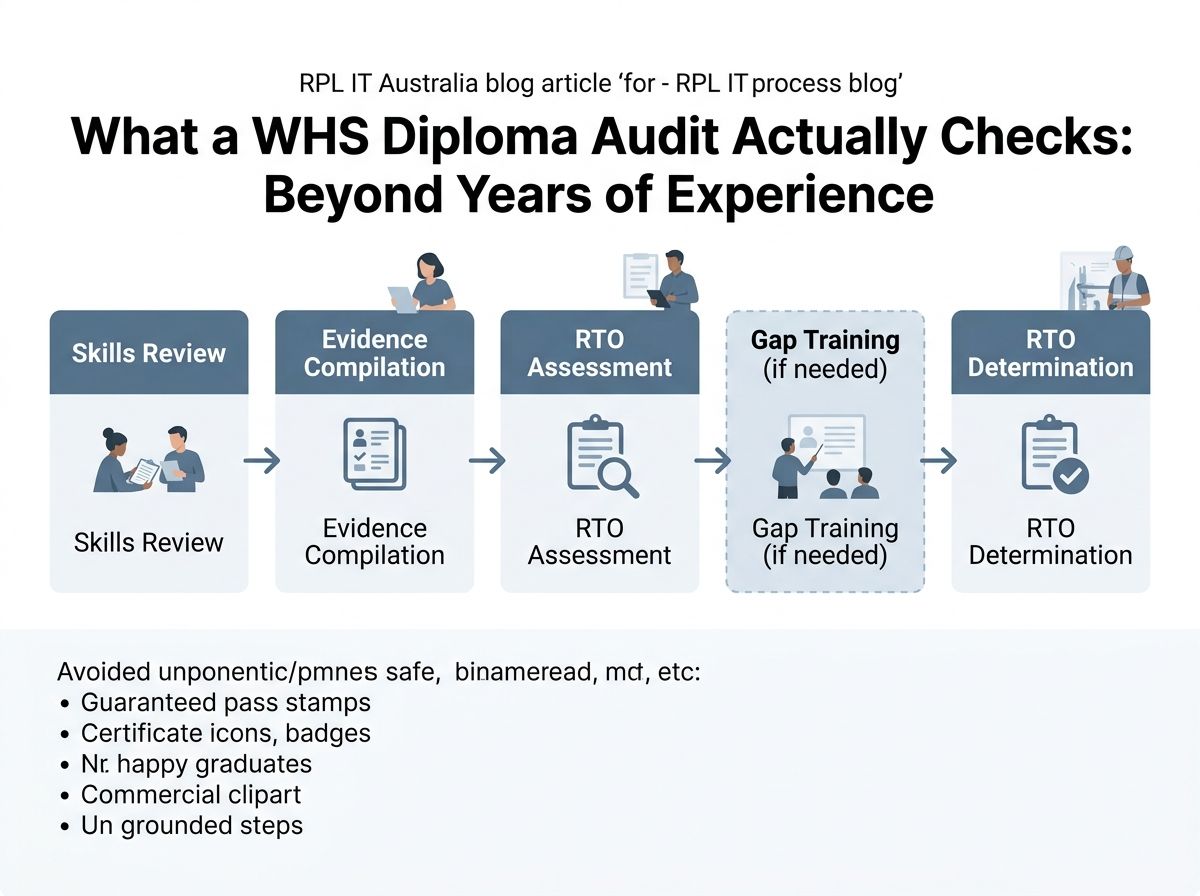
RPL it guides you through this process. We help you identify the evidence you already have, organise it against the competency requirements, and present it in the format the assessor requires. The final assessment and qualification decision are made entirely by the partner RTO assessor.
The assessment process typically involves:
- A skills review that maps your safety career history against the qualification requirements, giving you an honest picture of where your evidence is strong and where potential gaps exist.
- Evidence compilation. Identifying, retrieving, and organising your workplace documentation against each competency category. This is where professional guidance makes the most practical difference.
- Formal assessment by an assessor from the partner RTO, who reviews your evidence portfolio and may conduct a technical conversation to clarify or supplement your documentation.
- Gap training, if required. If certain competencies cannot be proven through your existing files, targeted gap training addresses those areas. This is a routine part of the process, not a failure.
- Qualification award. Once the assessor determines that competency is demonstrated across all required units, the RTO issues the Diploma of Work Health and Safety, the same nationally recognised qualification as any other pathway.
Outcomes are never guaranteed by the RPL process itself. They depend entirely on the assessor's professional judgement of whether your evidence meets national competency standards. The RPL process simply ensures your experience is presented as clearly and professionally as possible.
The documentation your WHS career has already generated
Experienced safety managers are often surprised to discover how much diploma-level evidence already exists in their files. The challenge is not generating new documents, but identifying, collecting, and formatting what you already have in a way an assessor can evaluate.
The following types of workplace documents are highly relevant for a WHS Diploma RPL assessment. While the final accepted list depends on your specific RTO and assessor, this offers a practical starting point for understanding what your career may have generated:
- WHS management plans and system documentation you authored or co-wrote
- Risk management frameworks, risk registers, or risk assessment methodologies you developed
- WHS audit reports from audits you conducted or safety systems you managed
- Incident investigation reports showing root cause analysis and systemic recommendations
- WHS consultation records, including meeting minutes, frameworks, and documented outcomes of worker engagement
- Correspondence or formal reports showing your response to legislative updates and regulatory obligations
- Official position descriptions detailing your safety management responsibilities
- Third-party verification from a direct manager, client, or colleague confirming your safety management role and contributions
- Training records or files for safety programs you designed or presented
Not all of these files will be available for every candidate. You may have changed employers, or worked in organisations with less formal record-keeping. A structured skills review identifies what you have, what can be reconstructed, and where real gaps remain.
How to find out if your WHS experience qualifies
The initial step is not enrolment; it is a thorough skills review.
A free skills review maps your safety career history against the qualification requirements. It offers a practical assessment of whether RPL is viable for your situation, identifying potential evidence files and clarifying if any gap training is needed.
This is a transparent starting point. We prefer to guide you to the correct development pathway rather than enrol you in a process that does not fit your background. If RPL is not the right choice for you, we will tell you directly.
The final decision remains yours, but it starts with a clear understanding of your current standing.
You can also visit our Diploma of Work Health and Safety qualification page to review the full unit requirements for BSB51319.
General information only, current at the date shown. Licensing rules change, so check the current requirements with the relevant regulator before you rely on them. RPL it Australia is a student support service, not a Registered Training Organisation; qualifications are assessed and issued by our partner RTOs.