How to know if your overseas degree counts before paying a cent
Find out if your overseas qualification is recognised in Australia. Learn what a genuine free assessment looks for before you spend money on courses.

The question every skilled migrant is afraid to ask
You have years of practical experience in your field. You have built your career carefully, earned your qualifications, and developed real expertise. Then you arrived in Australia and discovered that none of your background seems to count on paper.
The fear that your overseas degree is officially worthless keeps many skilled migrants in a frustrating holding pattern. You avoid taking action or asking questions, waiting for a sense of certainty that never arrives on its own. This hesitation is understandable, but it carries a real cost, and so does taking the wrong first step.
This article is designed as a practical diagnostic tool. By the end of it, you will have a much clearer picture of whether your overseas qualification can be assessed under Australian standards. You can determine this before you pay any money, sign any commitments, or hand over your personal contact details to anyone.
What qualification recognition in Australia actually means
Most skilled migrants arrive with one central question: "Does my degree count here?" However, that single question actually involves three distinct pathways, and each of those pathways has its own requirements, procedures, and outcomes.
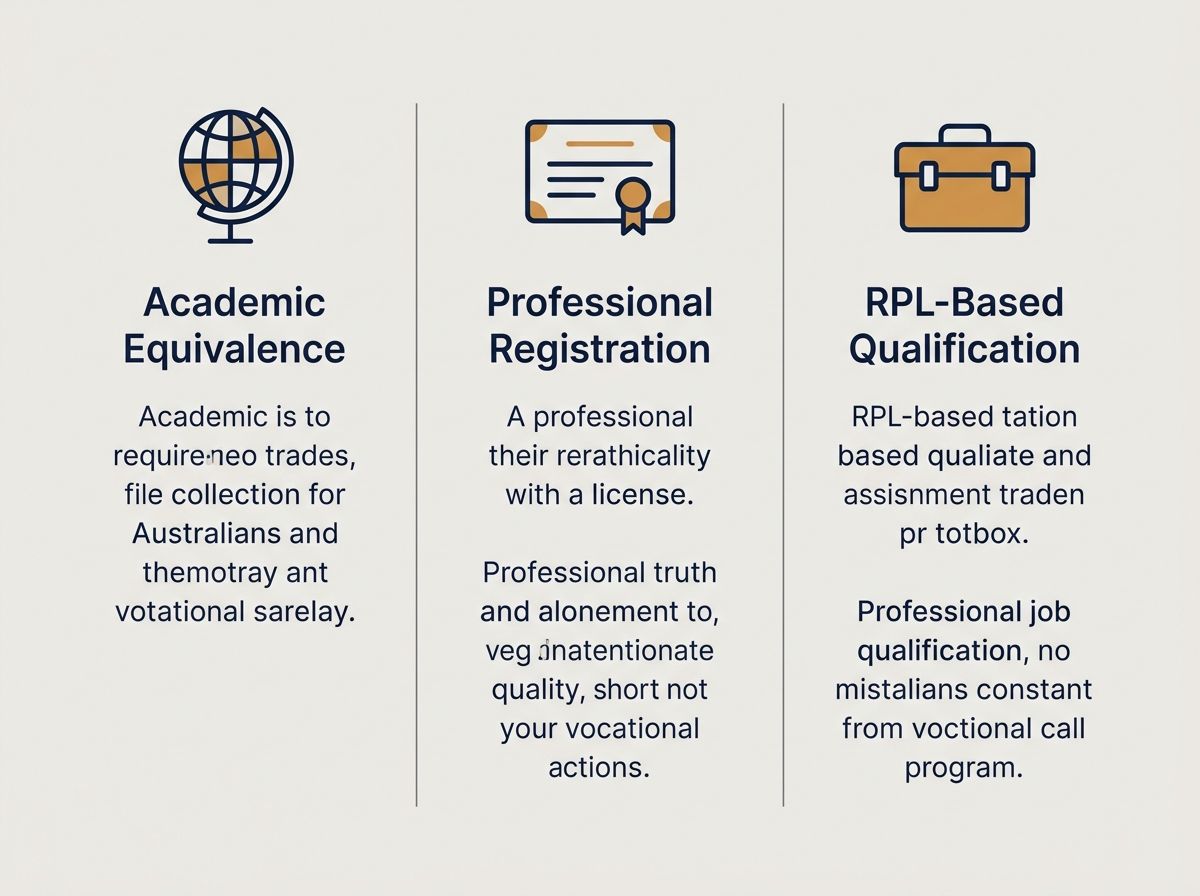
The first pathway is academic equivalence. This process determines whether your overseas qualification matches an Australian degree for the purposes of further study or general employer comparisons. This assessment is managed by government agencies, such as the Overseas Qualifications Unit, and outcomes depend on the country and institution where you studied.
The second pathway is professional registration. Certain occupations require you to be registered with a licensing board, such as AHPRA for healthcare professionals or Engineers Australia for engineers. RPL alone cannot grant registration in these fields. You must meet these registration requirements directly through the relevant authority.
The third pathway is RPL-based qualification recognition, which is the focus of this article. According to ASQA, Australia's national VET regulator, Recognition of Prior Learning is a formal process that assesses the skills and knowledge you have gained through work history, life experience, and informal study. This process does not compare your overseas certificate to an Australian one. Instead, it tests whether you can demonstrate competency against the specific national units of competency within an Australian qualification.
This distinction is critical. Many skilled migrants spend time trying to secure academic equivalence or mutual recognition when RPL is actually the most direct path to an Australian qualification. Knowing which path matches your career history is your first diagnostic step.
You can read the official ASQA guidelines on the difference between credit transfer and recognition of prior learning to understand which process matches your current situation.
Five indicators of a genuine, free qualification check
A genuine suitability check does not ask you to fill out a basic contact form and wait for a sales call. It reviews specific, verifiable facts about your professional history. Here are the five key indicators a legitimate check looks at, which you can begin to evaluate for yourself today before speaking with anyone.
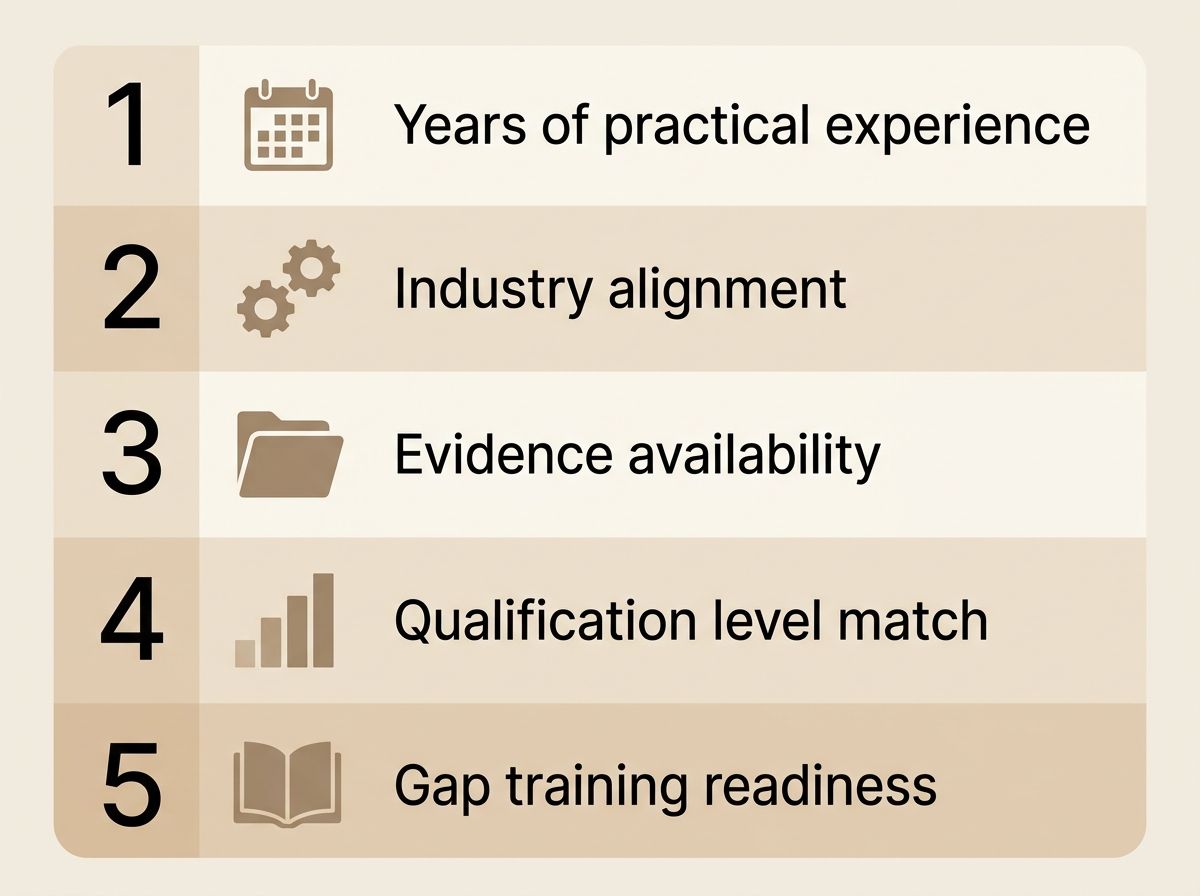
- 1. Years of practical experience. RPL is designed for professionals with a solid working history. The key is how closely your daily work matches the specific Australian qualification you want. A decade of work in a related role might be assessed differently than a decade spent in the exact job title listed in the qualification.
- 2. Alignment with Australian qualifications. Does your overseas work experience match a qualification that exists within the Australian Qualifications Framework (AQF)? The AQF ranges from Certificate I to Graduate Diploma. If your professional history matches an active Australian qualification, RPL is a viable option.
- 3. Available evidence. RPL is an evidence-based process. You must show you have the skills through work samples, reference letters, position descriptions, logbooks, site photos, or training records. The process does not doubt your ability, but it does require documented proof of that ability.
- 4. Matching the correct qualification level. The level you target must match your actual responsibilities. Applying for a Certificate III when your experience is at a Diploma level, or applying for a Diploma when you have basic trade skills, will affect your results. A proper review identifies the right level before you start.
- 5. Potential gap training. A thorough RPL assessment sometimes finds areas where your current experience does not fully meet the national standard. This is useful progress, not a failure. Where these gaps exist, targeted training is arranged to complete the qualification. A clear assessment highlights these needs from the start.
Take a moment to review these five indicators against your own career history. They will give you a realistic idea of where you stand before you speak with an advisor.
How to spot a generic lead form disguised as an assessment
Some "free assessment" offers are misleading. In the vocational education sector, this term is sometimes used for simple contact forms designed to generate sales calls, rather than providing an actual evaluation of your skills and experience.
The Federal Court previously found that one training provider broke Australian Consumer Law by marketing courses as "free" when enrolment actually left students with significant government loan debts. The court ruled that the college did not properly assess whether the courses were suitable for the students before enrolling them. The ACCC, which ran the case, emphasized that checking student suitability is a critical, mandatory step, not a paper exercise.
Read the official ACCC media release on the Federal Court ruling against AIPE to see how misleading claims and poor suitability checks can lead to legal action.
A Senate inquiry into private vocational education also found that marketing courses as "free" or "government-funded" was a widespread problem, as it often hid the real debt and financial commitments students were taking on.
A genuine skills check is different. It is a real conversation about your specific history, your sector, the target qualification, and the evidence you can show. It does not guarantee a successful outcome. It does not ask you to enrol first. And it tells you clearly if RPL is not the right option for you.
Our policy at RPL it is direct: we prefer to guide you to the correct pathway rather than enrol you in an unsuitable program. This means we will tell you if RPL is not your best option before you commit to anything.
Evaluating your current situation
Go back to the five key indicators. For each one, ask yourself: does my background fully meet this point, partially meet it, or fail to meet it?
If you can answer yes to most of the indicators, such as having current experience, finding an aligned qualification, having access to evidence, choosing the right level, and accepting that some gap training might be required, your case is strong enough for a formal suitability review.
If your answers for several indicators are unclear, that is still useful. It means a structured review conversation can help you identify what extra evidence you need, or find out if a different qualification level is a better fit.
If you do not meet most of these points, for example, if your work does not match any current Australian qualification or you have been out of the industry for many years, an honest check will tell you directly. Finding this out early saves you time and money.
Keep in mind that if an RPL assessment identifies a skill gap, you will be offered gap training to meet the required national standard. This is a standard part of the system, not an assessment failure. The qualification you receive at the end of a proper RPL process is fully accredited because the assessment is thorough.
Gaining recognition should not mean starting your career over from scratch. However, it does require a realistic assessment. The choice to move forward is always up to you.
What a genuine Free Skills Review involves
The Free Skills Review with RPL it is a consultative conversation, not a commercial commitment. This is what you can expect.
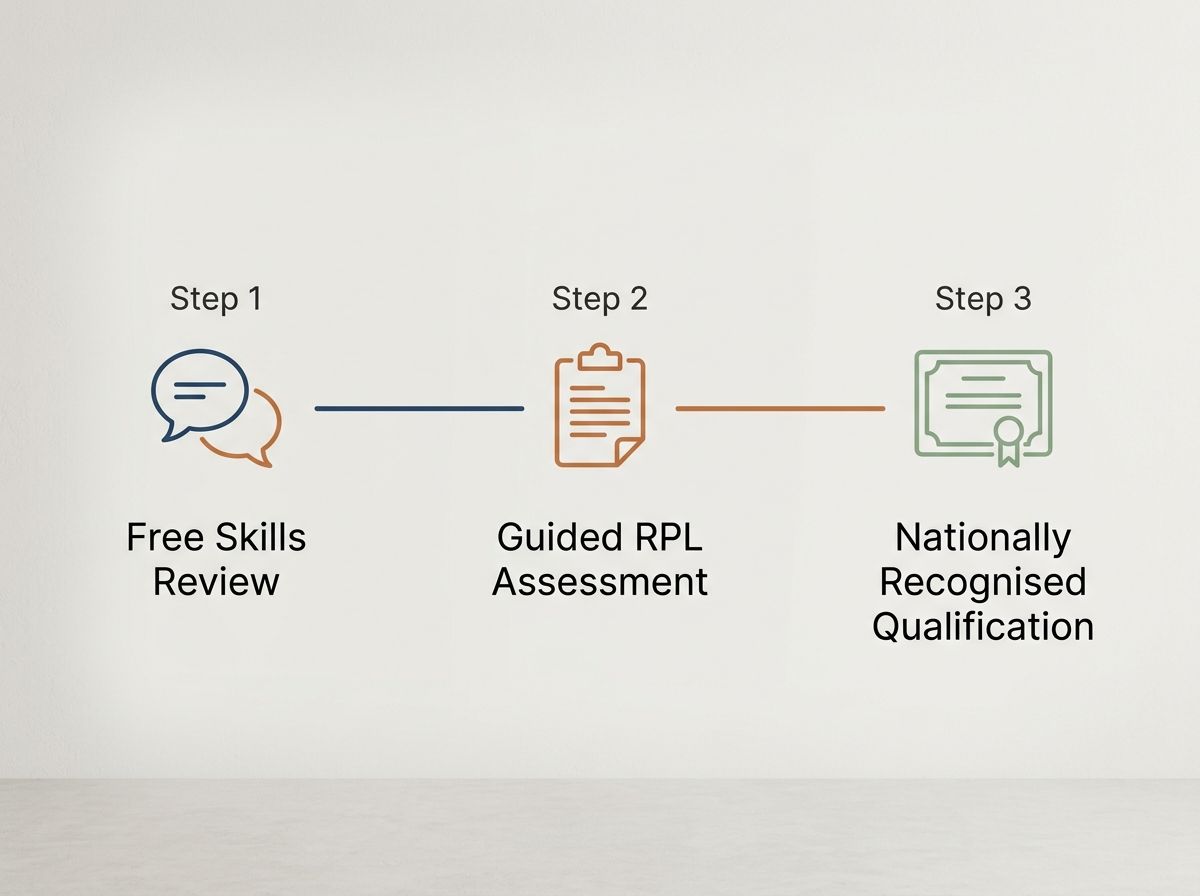
You will speak with an advisor who understands the Australian vocational education system and RPL requirements. They will ask about your work history, your industry, the qualification you want, and what proof you have. They focus on your specific career, not a generic template.
Based on your discussion, they give you an honest view of your options. If RPL looks viable, they explain the next steps and how the process works. If RPL is not suitable, or if a different qualification level fits your experience better, they will tell you directly.
It is important to understand how this process works: RPL it helps candidates prepare their applications for recognition. The actual assessment is completed by a qualified assessor at a Registered Training Organisation (RTO). If you demonstrate competency, that RTO issues your qualification. RPL it acts as your support partner and advisor throughout the process, rather than assessing your work or issuing the qualification directly.
This initial review is free and does not commit you to any program. It is a diagnostic step designed to give you clarity before you make any decisions.
The cost of delaying, and the financial risk of the wrong first step
There are two main risks you should consider.
The first risk is waiting. Every month you spend in career limbo is a month of professional recognition lost. For skilled migrants dealing with visa applications, job hunts, and registration barriers, this delay directly affects your income, visa eligibility, and career progression.
The second risk is taking the wrong path first. Paying for an RPL assessment before confirming your suitability is expensive. For example, one registered training provider charges a non-refundable $500 application fee plus $250 for every unit assessed, regardless of whether you pass. For a full qualification, those fees add up quickly.
To put this in perspective, a parliamentary inquiry into vocational education reported average costs for full qualifications ranging from a few thousand dollars for a Certificate IV to more than $20,000 for a trade diploma. These figures represent complete study programs, not RPL assessments, and prices vary depending on the provider, level, and government subsidies.
The Productivity Commission’s 2026 Report on Government Services notes that VET qualifications range from Certificate I to Graduate Diploma. Fees depend heavily on the course level, unit load, and funding options, such as the Fee-Free TAFE programs running in high-demand industries.
You can consult the Productivity Commission’s Report on Government Services 2026 to see how vocational qualification costs and funding options vary across Australian states.
The Free Skills Review is designed to eliminate both risks. It costs nothing and carries no obligations. It provides an honest evaluation of your chances before you spend any money on formal assessments or classes.
You already have the professional experience. The next step is finding out if it matches Australian standards. A Free Skills Review gives you this answer without any financial commitment or obligation to proceed.
Ready to Get Recognised?
Start with a free skills review to find out if RPL is right for you.