You Have Done the Work for Years, But Your Resume Says Otherwise
Train new staff and know the ward? Learn how the Certificate III in Health Services Assistance (HLT33115) formally recognises your work experience.

The ward knows your skills. Your resume should too.
You have worked on the ward for years. You know which patients need extra care. You understand handover protocols thoroughly. When a new hire arrives, fresh from their course with certificate in hand, you show them how the ward actually runs. You explain infection control procedures, walk them through documentation, and answer their questions at the end of a long shift.
Then a senior role opens up. It is the job you have been doing in everything but name. But the job description requires a Certificate III in Health Services Assistance.
You do not have the paper qualification. Because of this, the recruitment system, the HR portal, and the hiring panel do not see your capability. They only see a blank space where a qualification is required.
This is not a reflection of your competence. It is a structural issue. Your expertise is real, but it exists in the wrong format for the systems that decide who gets promoted. This situation is more common than most people realise.
Australia's healthcare and social assistance sector is one of the largest in the country. According to the Australian Bureau of Statistics, the 2021 Census recorded more than 1.7 million people working in this sector, with over 549,000 employed in hospitals. The number of aged and disabled carers grew by 72 per cent between 2016 and 2021.
Yet the national health workforce datasets tracking qualifications and registration cover only the 16 regulated health professions, such as registered nurses, doctors, and pharmacists. Roles like nursing support workers and personal care workers, who provide the majority of hands-on patient care, are excluded from that data entirely.
The ward knows your work. Your resume does not. The Certificate III in Health Services Assistance is designed to close that specific gap.
The five-stage cycle experienced health services workers face
This pattern plays out in wards, aged care facilities, and community health settings across Australia. Many experienced health services workers have lived through it multiple times. Identifying the cycle is the first step to breaking it.
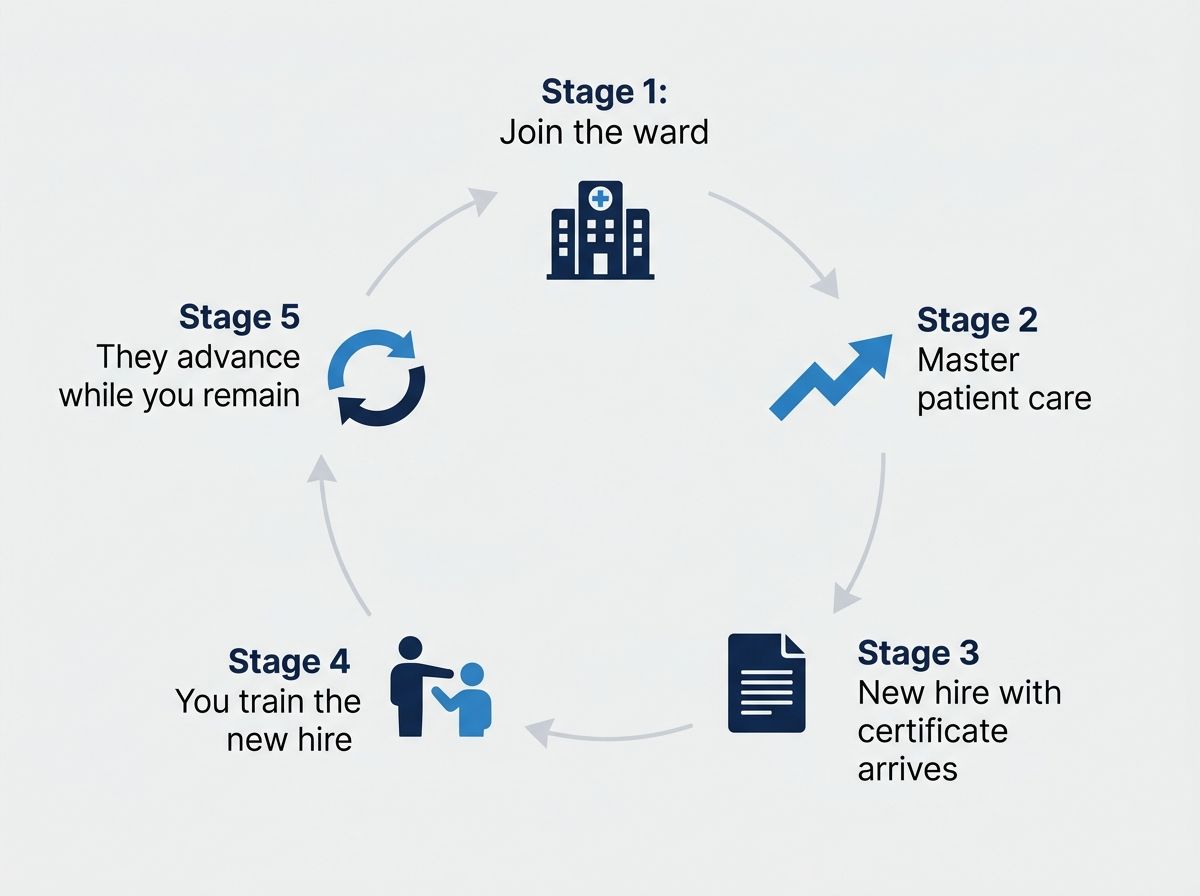
- Stage 1: You join the team and learn quickly. Within months, you master tasks that take new hires much longer to learn.
- Stage 2: You build expertise over several years. You develop practical instincts, patient relationships, and procedural knowledge that no classroom can teach.
- Stage 3: A new hire arrives with a qualification. They are capable, but they do not know the ward. You are asked to train them.
- Stage 4: A senior role opens up. The position description requires a Certificate III. They apply and progress, but you are not eligible to apply.
- Stage 5: You start the process again with another new hire and another round of training, while you remain in the same position.
If this pattern feels familiar, you are not alone. This is not a reflection of your capability. It is the predictable outcome of a system that prioritises credentials over practical competence. The same issue affects experienced community health workers, whose frontline expertise remains invisible to formal systems because it is undocumented.
Why the ward trusts you but the system does not
Formal systems like HR recruitment portals, application filters, and promotion panels exist to process credentials. They are not designed to evaluate daily competence. When a job description lists the Certificate III in Health Services Assistance as a prerequisite, the recruitment software does not count your years of practical experience. It checks for the qualification. If you do not have it, your application is filtered out.
This is a structural issue, not a personal one. National health workforce datasets track qualification levels only for registered health professions. Roles like health services assistants and personal care workers do not require professional registration, so they fall outside the scope of these databases.
This leaves a workforce of experienced, capable people whose daily work is invisible to the systems that control promotions. Your competence is real, but the system cannot recognise it without the correct documentation.
Recognition of Prior Learning (RPL) is the process that translates your experience into a formal format that recruitment systems recognise. It does not require you to study subjects you already know. Instead, it allows you to demonstrate your existing skills.
This structural problem has a clear name, and identifying it is the first step to resolving it.
What the Certificate III in Health Services Assistance covers
The Certificate III in Health Services Assistance (HLT33115) is a nationally recognised qualification. It covers the skills needed to work as a health services assistant, assistant in nursing, or patient support worker in hospitals, aged care, and community health settings. The qualification consists of 15 units, with 7 core and 8 elective units, and is current on the National Training Register.
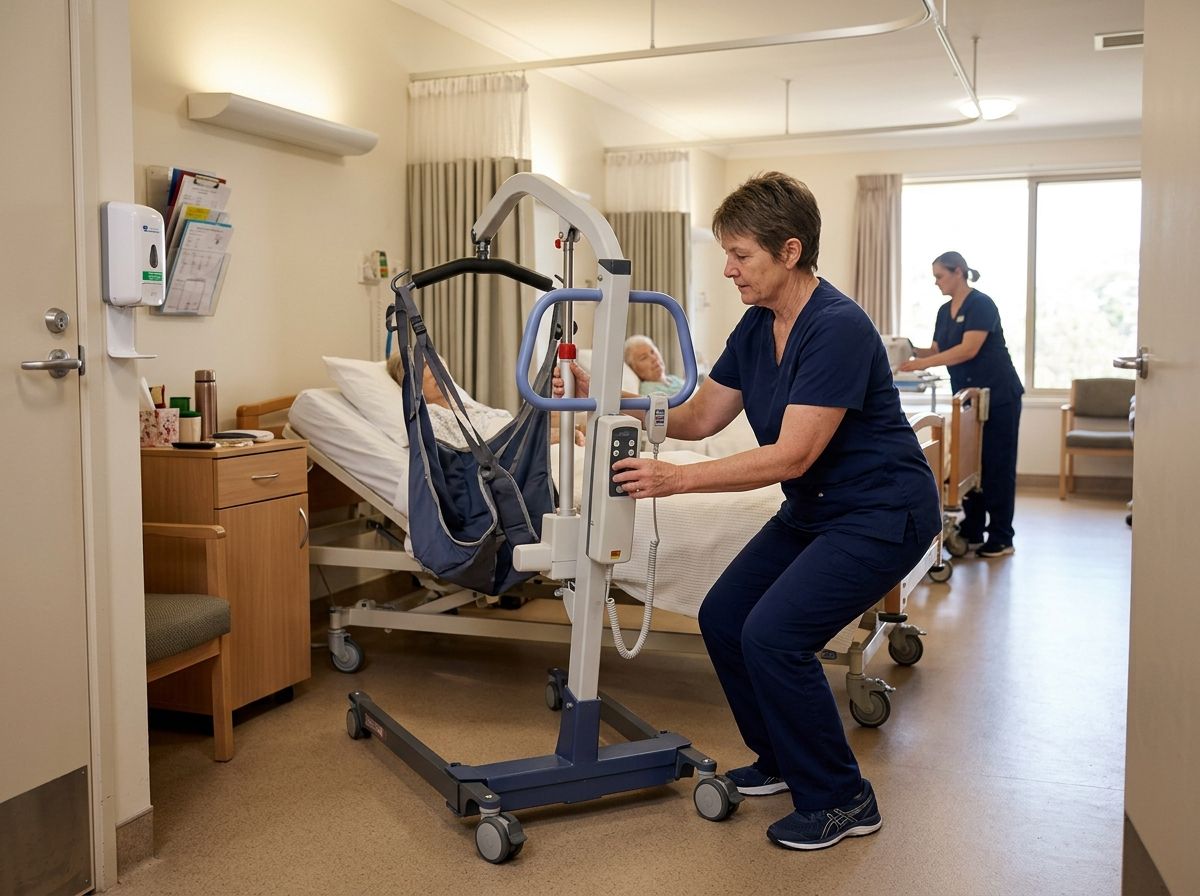
If you assist patients with personal hygiene and mobility, monitor vital signs, support clinical staff during procedures, maintain infection control standards, communicate with families, or prepare clinical environments, you are already performing the work of this qualification.
The Certificate III is not a training course for things you still need to learn. It is a formal framework that maps what you already do every day. The focus is on whether your existing experience meets these established competency standards through assessment.
For experienced health services workers, your skills can often be verified through a Recognition of Prior Learning assessment. You can read more about the Certificate III in Health Services Assistance and how the RPL pathway works on the RPL it qualification page.
How RPL translates ward experience into a formal qualification
Recognition of Prior Learning (RPL) is a formal assessment process. It allows experienced workers to have their current skills evaluated against the requirements of a national qualification without needing to attend classes.
For this Certificate III, the RPL assessment requires you to collect evidence that proves your competence in each unit. This evidence can include employment history records, documentation of tasks you perform, third-party verification statements from supervisors, and workplace documents such as completed care plans or incident reports.
A qualified assessor from a registered training organisation (RTO) conducts the actual assessment. RPL it does not assess your portfolio or issue qualifications, as that remains the responsibility of the RTO. Instead, RPL it guides you through the preparation process by helping you identify what evidence you need, how to assemble it, and what to expect during the evaluation.
RPL is a rigorous assessment process, not an automatic certification. If the assessor identifies gaps between your experience and the required units, you may need to complete targeted gap training. A detailed suitability review before you start is the best way to determine if RPL is the correct option for your situation.
This pathway respects your workplace history. It does not require you to relearn your job. It simply asks you to prove that you already have these skills.
What formal recognition changes for your career
Gaining your Certificate III in Health Services Assistance does not change your daily work. It changes how visible your skills are to employers.
The recruitment software can read your application, the selection panel can verify your qualification, and you meet the job description requirements. The structural barrier that was holding you back is removed.
Beyond meeting immediate job requirements, the Certificate III opens pathways to further education. According to Jobs and Skills WA, completing HLT33115 can provide credit towards relevant higher-level qualifications. TAFE NSW lists the Diploma of Nursing as a progression option, alongside the Certificate IV in Ageing Support, Certificate IV in Mental Health, and Certificate IV in Aboriginal and/or Torres Strait Islander Primary Health Care Practice. Some training providers also note that students who apply for RPL or credit transfer can complete these higher qualifications in less time.
Credit arrangements vary depending on the provider and the course, and RTOs assess them on an individual basis rather than granting them automatically. However, the path remains open. The qualification that formally recognises your current capability can serve as the foundation for your next career step.
You already have the necessary experience. The Certificate III simply makes it visible to the healthcare system. The decision on how to use that qualification is up to you.
Is your experience enough for an RPL assessment?
The answer depends on your specific work history, and a Free Skills Review is the most direct way to find out. The information below is a general guide rather than a guarantee of eligibility.
Your experience is likely relevant for a Certificate III in Health Services Assistance RPL assessment if you work in a hospital, aged care facility, or community health setting. You should regularly perform duties such as assisting patients with personal care and hygiene, supporting clinical staff with procedures, monitoring patients, maintaining infection control standards, communicating with families and clinical teams, and preparing clinical spaces.
The duration of your employment is important. Assessors look for consistent, recent experience across the core units of the qualification rather than short-term exposure to a few tasks. The specific evidence you need will depend on the RTO conducting your assessment.
There are also industry requirements that sit alongside the qualification. Employers and training providers typically require current first aid certification, up-to-date vaccinations for healthcare environments, and a national police check. These requirements cannot be met through RPL, as they are separate compliance obligations you must maintain.
If you are unsure whether your experience meets the criteria, the Free Skills Review provides a direct assessment. This includes telling you clearly if RPL is not the right fit for you, because finding the correct pathway is more important than pursuing an unsuitable option.
The Certificate III in Health Services Assistance is a nationally recognised qualification. For current details on units and structure, visit the official training register listing.
To read about continuing study pathways after HLT33115, including the Diploma of Nursing and Certificate IV options, TAFE NSW offers a detailed guide.
The Australian Bureau of Statistics 2021 Census data provides details on the size and growth of the national healthcare and social assistance workforce.
The National Health Workforce Dataset explains why healthcare support roles, including nursing support and personal care workers, are excluded from registration tracking data.
Ready to Get Recognised?
Start with a free skills review to find out if RPL is right for you.