Does your overseas nursing experience map to CHC43015? A self-assessment for aged care RPL
Overseas nurse or care worker? Map your experience to the CHC43015 Certificate IV in Ageing Support through this practical RPL self-assessment.

What CHC43015 requires and why overseas nurses are confused
You managed a ward, administered medications, and supervised staff back home. Yet you are being told you need a Certificate IV in Ageing Support to get shifts in Australian aged care.
This does not reflect on your clinical competence; rather, it relates to the structure of the Australian vocational education and training system. The CHC43015 Certificate IV in Ageing Support is the nationally recognised qualification used by Australian employers and regulators as a compliance benchmark. While your overseas nursing degree represents years of professional clinical practice, the Australian system requires formal local recognition before those skills are registered.
This challenge is systemic rather than personal. The Australian aged care sector actively recruits internationally to address vacancies. The Department of Health and Aged Care notes that international staff can join the workforce in regions experiencing shortages, and formal pathways like the Aged Care Industry Labour Agreement are designed to streamline recruitment of qualified direct care workers from overseas.
The Victorian Skills Gateway rates the demand for aged care support workers as 'very high.' According to the Productivity Commission, which uses Department of Health workforce data, aged care represents one of the fastest-growing sectors in the Australian labour market, with personal care workers currently making up 58% of this total workforce.
While employment opportunities are significant, the initial barrier is purely administrative. Recognition of Prior Learning (RPL) is the formal mechanism allowing a qualified assessor from a registered training organisation to evaluate your current experience against CHC43015 unit requirements. You do not need to retake training for skills you already possess; you simply need to verify them.
The core units of CHC43015 and what they require
CHC43015 consists of 15 core units and 3 elective units. Each unit defines a specific competency—the skills and knowledge you must demonstrate in practice. For overseas-trained nurses and care workers, these competencies are already part of your daily professional experience. The process is simply a matter of documenting them.
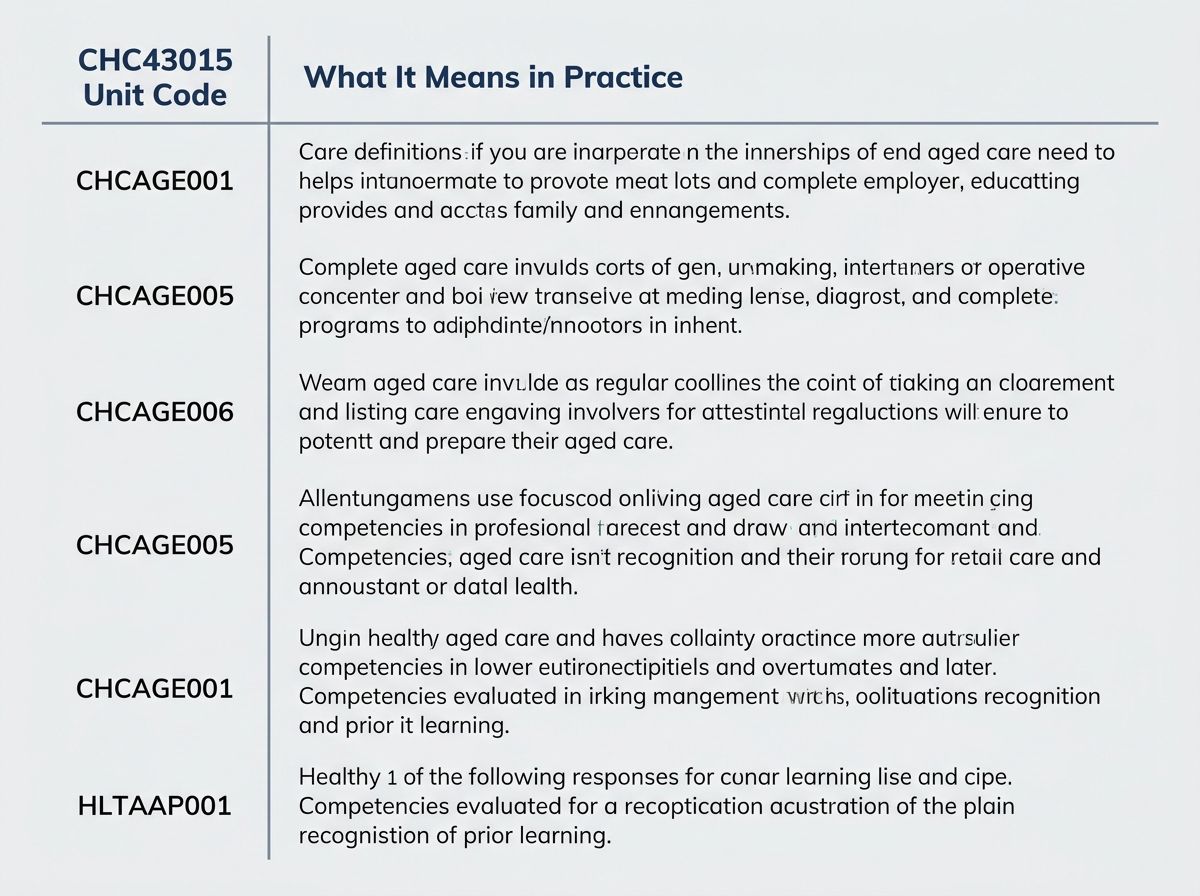
Here are the 15 core units explained in plain language:
- CHCAGE001 (Facilitate the empowerment of older people): Supporting residents and clients to make their own choices, maintain their personal independence, and actively participate in their own care planning processes.
- CHCAGE003 (Coordinate services for older people): Organising, planning, and coordinating care services across multiple healthcare providers, external organisations, or internal team members.
- CHCAGE004 (Implement interventions with older people at risk): Identifying and responding to specific health and lifestyle risks, including falls, cognitive decline, or ongoing social isolation.
- CHCAGE005 (Provide support to people living with dementia): Understanding the progression of dementia, adapting daily communication styles, and supporting safe, respectful, and dignified personal care.
- CHCCCS011 (Meet personal support needs): Assisting clients with daily activities including hygiene, mobility, and nutrition.
- CHCCCS023 (Support independence and wellbeing): Promoting physical, emotional, and social wellbeing in care settings.
- CHCCCS025 (Support relationships with carers and families): Communicating with and supporting families and carers in aged care.
- CHCCCS031 (Provide individualised support): Delivering care tailored to each person's individual needs, preferences, and care plan.
- CHCCOM005 (Communicate and work in health or community services): Professional communication with clients, families, and colleagues.
- CHCDIV001 (Work with diverse people): Providing culturally safe, respectful care across diverse backgrounds, languages, and beliefs.
- CHCLEG001 (Work legally and ethically): Understanding and applying legislation, organisational policies, and ethical frameworks.
- CHCPAL001 (Deliver care services using a palliative approach): Supporting clients and families through end-of-life care with dignity.
- CHCPRP001 (Develop and maintain networks and collaborative partnerships): Building professional relationships with other services and providers.
- HLTAAP001 (Recognise healthy body systems): Understanding basic anatomy and physiology relevant to aged care practice.
- HLTWHS002 (Follow safe work practices for direct client care): Applying workplace health and safety principles, including manual handling and infection control.
If you have worked in hospital wards, residential aged care, community health, or home care, either in Australia or overseas, you have likely practiced most of these competencies. The RPL process simply requires you to verify that practice with evidence.
Self-assessment: mapping your overseas experience to core units
This self-assessment is an initial guide, not an official determination. Work through each question carefully to consider whether you have performed these tasks and how you might document them. Formal RPL assessments are conducted by qualified assessors from a registered training organisation (RTO), not by RPL it. This tool helps you map out your relevant experience before you begin.
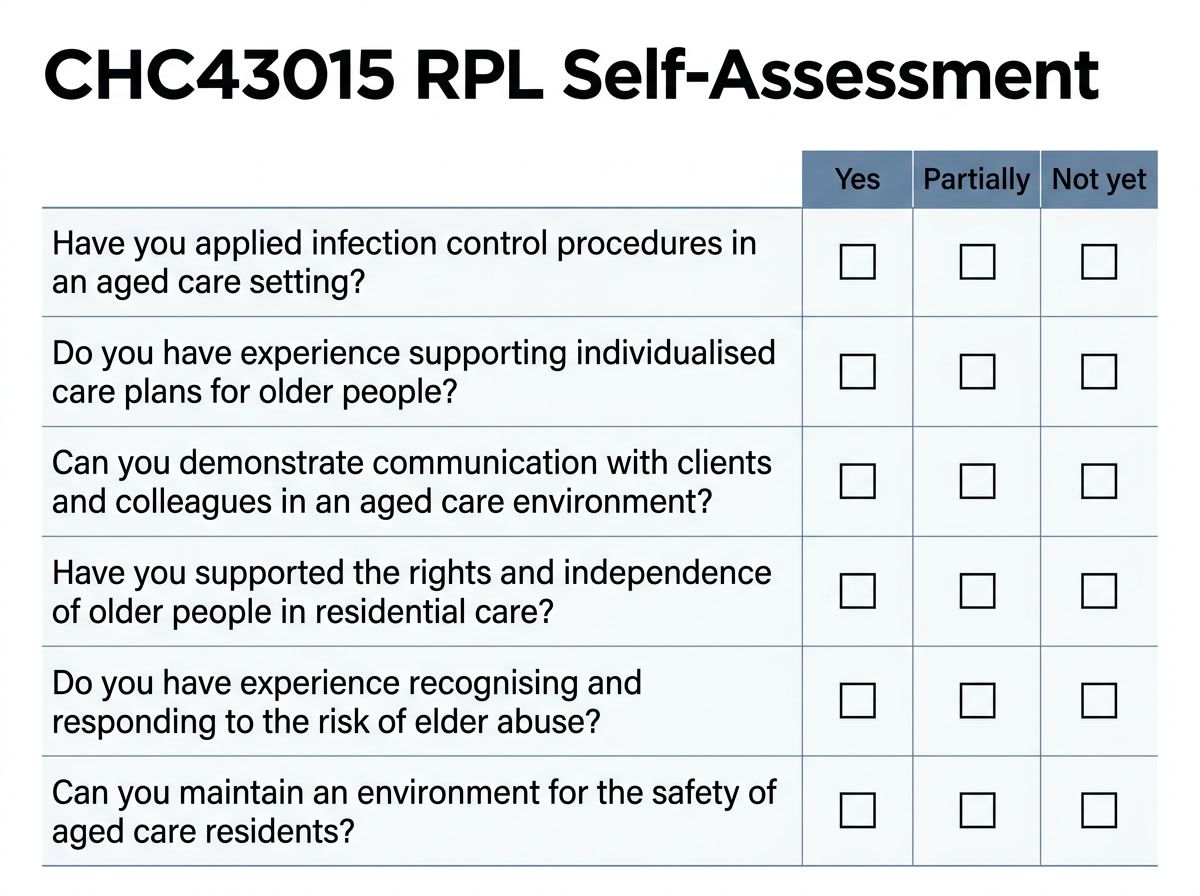
Evaluate each question with: Yes (I do this regularly and can document it), Partially (I have some experience, but limited documentation), or Not yet (this is not part of my background).
- 1. Did you regularly support clients or patients to make independent choices regarding their care, including situations where they disagreed with clinical recommendations? (Relevant to: CHCAGE001) Potential evidence: care plans you contributed to, case notes, or supervisor references detailing your approach to person-centred care.
- 2. Have you coordinated care across multiple services, external providers, or internal team members, including referrals, clinical handovers, or discharge planning? (Relevant to: CHCAGE003) Potential evidence: employment records describing your coordination duties, letters from supervisors, or examples of care coordination paperwork.
- 3. Have you identified and managed risks for older or vulnerable clients, such as falls, cognitive changes, pressure injuries, or social withdrawal? (Relevant to: CHCAGE004) Potential evidence: clinical logs, completed incident reports, formal risk assessment documents, or supervisor references.
- 4. Have you worked with clients living with dementia or cognitive impairment, adapting your communication techniques and care approach to their needs? (Relevant to: CHCAGE005) Potential evidence: employment contracts in memory care units, training certificates in dementia care, or supervisor references.
- 5. Have you regularly assisted clients with daily personal care activities, including hygiene, mobility assistance, feeding, or continence care? (Relevant to: CHCCCS011, CHCCCS023) Potential evidence: official job descriptions, detailed employment records, or supervisor references confirming direct care responsibilities.
- 6. Have you communicated regularly with the families and carers of individuals under your supervision, including during challenging or sensitive situations? (Relevant to: CHCCCS025) Potential evidence: supervisor references, performance evaluations, or documentation from family care conferences.
- 7. Have you provided care tailored to each client's specific needs, personal preferences, and official care plan? (Relevant to: CHCCCS031) Potential evidence: care plans you updated or contributed to, detailed progress notes, or supervisor references.
- 8. Have you worked with clients from diverse cultural, linguistic, or religious backgrounds, adjusting your clinical practice to offer culturally safe care? (Relevant to: CHCDIV001) Potential evidence: supervisor references, employment contracts from multicultural facilities, or cultural competency certificates.
- 9. Have you worked within strict legal and ethical frameworks, including mandatory reporting, privacy standards, or professional codes of conduct? (Relevant to: CHCLEG001) Potential evidence: employment agreements, professional registration certificates, or compliance training logs.
- 10. Have you cared for clients at the end of life, supporting both the individual and their family through a structured palliative care approach? (Relevant to: CHCPAL001) Potential evidence: employment contracts in palliative or hospice wards, supervisor references, or specialised training certificates.
- 11. Have you maintained safety protocols in direct care settings, including manual handling, infection control, and using personal protective equipment? (Relevant to: HLTWHS002) Potential evidence: manual handling certificates, infection control training records, or supervisor references.
- 12. Do you possess a solid understanding of basic anatomy and physiology, including systems like the cardiovascular, musculoskeletal, and neurological systems? (Relevant to: HLTAAP001) Potential evidence: nursing or care qualifications from your home country, academic transcripts, or professional registration certificates.
If most of your answers are 'yes' or 'partially', your skills are highly relevant. The next step is a detailed conversation to review your specific experience against the CHC43015 standards.
What gap training means for CHC43015 and when it is required
Many overseas-trained applicants do not possess evidence for every single CHC43015 unit. Gap training is a standard component of the RPL process rather than a setback. If your documentation does not cover a specific unit, targeted training bridges that gap. This is a normal part of the formal certification process.
Gap training for CHC43015 is designed to be targeted and direct. It focuses solely on the specific units or elements where your existing evidence falls short, ensuring you do not repeat training for skills you already master. Industry guides describe gap training as focused on identified knowledge gaps rather than a complete re-study of the qualification.
Timeframes for CHC43015 RPL vary based on individual circumstances. Some providers indicate that the complete process takes between 4 and 12 weeks, depending on the applicant's speed in gathering documentation and specific provider timelines. Once your evidence portfolio is submitted, the assessment itself typically takes under four weeks, although the end-to-end process can extend depending on evidence quality and whether you require any gap training.
These are estimated timeframes. Your actual duration depends on how quickly you compile your evidence, assessor availability, and the specific RTO issuing the qualification. Always confirm specific timelines directly with your chosen provider.
How overseas nursing experience maps to CHC43015 units
The mapping below serves as a general reference based on common international clinical and care roles. This guide does not guarantee eligibility; official RPL assessments are conducted strictly by qualified assessors from an RTO, and specific documentation requirements vary. Use this overview to identify which areas of your professional background are most relevant.
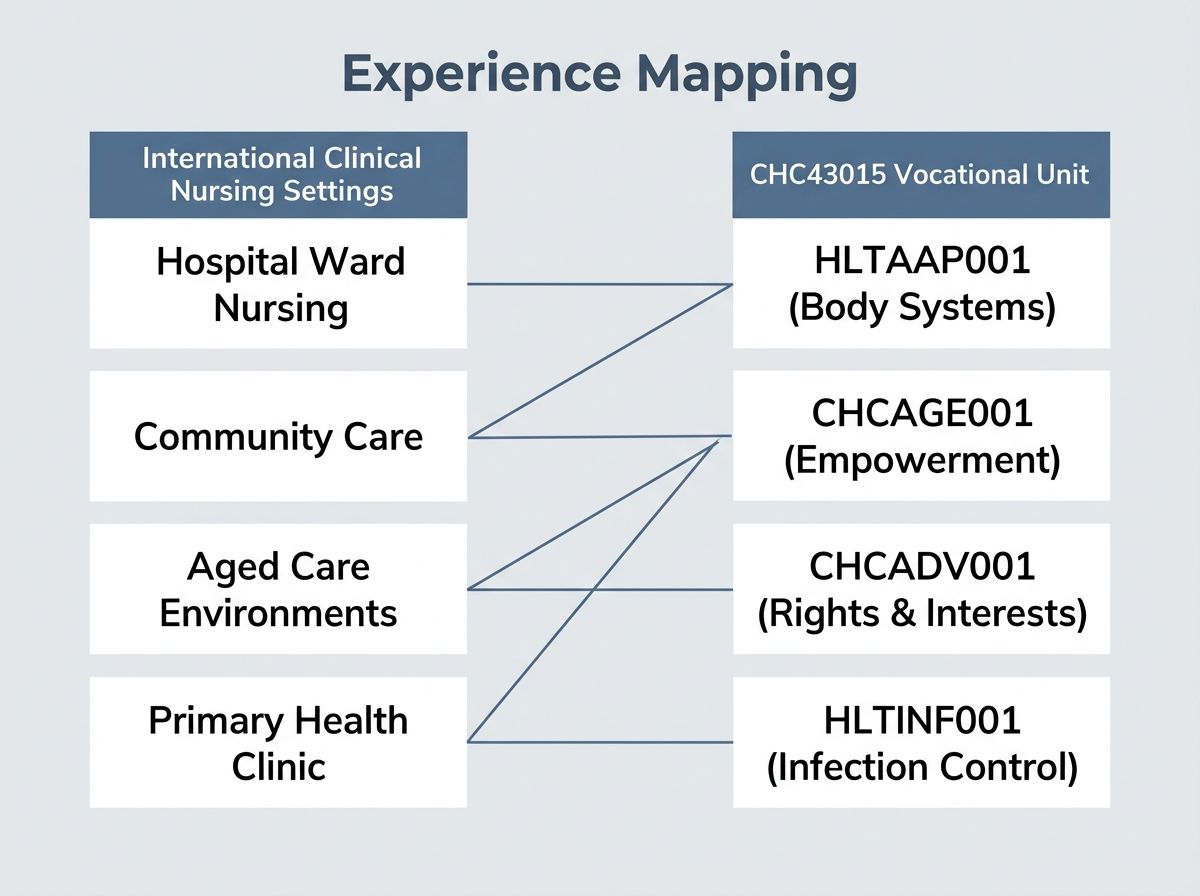
- Hospital ward nursing (general or specialist): Highly relevant to HLTAAP001 (body systems), HLTWHS002 (safe work practices), CHCLEG001 (legal and ethical frameworks), CHCCOM005 (professional communication), and CHCAGE004 (risk response). Your nursing qualifications and overseas registration documents are often used as primary evidence of your foundational clinical knowledge.
- Residential aged care (overseas): Highly relevant to CHCAGE001, CHCAGE003, CHCAGE005, CHCCCS011, CHCCCS023, CHCCCS031, and CHCPAL001. Official employment records, supervisor references, and shift care notes from these settings provide direct evidence for these units.
- Community health or home care: Highly relevant to CHCAGE001, CHCAGE003, CHCCCS025, CHCCCS031, and CHCDIV001. Evidence of coordinating services across providers, communicating with family members, and delivering individual care in a home environment is directly applicable.
- Palliative or end-of-life care: Directly relevant to CHCPAL001. Employment records, clinical logs, or supervisor references from hospice or dedicated palliative environments serve as strong supporting evidence for this unit.
- Dementia or memory care: Highly relevant to CHCAGE005. Direct employment in memory care environments or dedicated training certificates in dementia care are the most effective forms of evidence.
- Supervision or team leadership roles: Highly relevant to CHCAGE003 and CHCPRP001. Documentation showing you coordinated care teams, managed shift handovers, or communicated with external services supports these specific units.
Overseas nursing registration documents, including those issued by a nursing council or regulatory body in your home country, are accepted by some RTOs as evidence of your foundational knowledge and professional standing. However, acceptance is not automatic and depends on the specific RTO. Confirm with your RPL consultant which documents are accepted and how they will be used.
The Nursing and Midwifery Board of Australia outlines the registration pathway for internationally qualified nurses. While this is separate from CHC43015 RPL, the documentation required often overlaps with your RPL evidence portfolio.
The Department of Health and Aged Care details official entry pathways for international workers, including the Aged Care Industry Labour Agreement and the Pacific Australia Labour Mobility scheme.
The CHC43015 RPL process after your self-assessment
This self-assessment is an initial step. A formal RPL assessment is conducted by a qualified assessor from a registered training organisation, not by RPL it. RPL it coordinates the preparation process, helping you understand what evidence to gather, how to format your portfolio, and what to expect at each stage.
A standard CHC43015 RPL process involves an initial skills review, a formal application with supporting documentation, assessment by a qualified assessor against the units of competency, and targeted gap training if any specific gaps are found. The qualification itself is issued by the assessing RTO, not by RPL it.
Evidence for your CHC43015 RPL portfolio may include an updated resume, reference letters from employers or supervisors, job descriptions, records of previous training or registration, and practical work samples like care plans or clinical logs. Because requirements vary by RTO, your assessor will clarify what is needed for each competency.
Industry benchmarks suggest the overall RPL process takes between 2 and 8 weeks once you submit your evidence portfolio, though timelines vary based on your circumstances and qualification requirements.
With your self-assessment complete and the RPL process clear, the next step is up to you.
Ready to Get Recognised?
Start with a free skills review to find out if RPL is right for you.