Your Overseas Qualification Isn't Useless in Australia — You're Just Translating It Wrong
Told your overseas community services qualification doesn't count in Australia? The problem is translation, not your skills. How RPL bridges the gap.
By RPL it Australia8 min read

The Qualification That Stopped Counting at the Border
You have the experience. Ten years of it, perhaps more. Case management. Crisis support. Working with families navigating impossible circumstances. Coordinating care for people who had no one else. Back home, that work was respected. It was recognised. It counted.
Then you arrived in Australia, and somewhere between the airport and the job application, it stopped counting. The employer asked for an Australian qualification. The visa form had no field for overseas credentials. The assessment authority sent a letter explaining that your qualification did not align with the Australian Qualifications Framework.
This is a common experience. Australia has workforce shortages in health, aged care, and community services, where skilled migrants are a critical resource. Parliamentary analysis has noted that sectors including aged and disability care are projected to face substantial workforce shortfalls in the years ahead.
And yet, experienced community services workers arrive with years of genuine expertise and find the formal system cannot see it. That is not a skills problem. It is a format problem. Your qualification exists. The Australian system simply does not yet have a way to read it.
Why 'Your Qualification Doesn't Count' Is the Wrong Diagnosis
The conventional wisdom — that overseas qualifications are simply not recognised — is a misdiagnosis. The real problem is a translation failure.
Australian formal recognition systems are built around the Australian Qualifications Framework (AQF). Qualifications issued in other countries are not inferior; they are written in a different language. The Australian system cannot read them directly, not because the content is wrong, but because the format is unfamiliar.
This is the shift in perspective that changes everything: from 'my qualification is worthless' to 'my qualification needs translation.'
Your years of community services work — the client assessments, the case plans, the crisis interventions, the coordination with other agencies — represent genuine competence. That competence is real. It is simply not yet presented in a format the Australian system can formally acknowledge. The problem is not what you know. The problem is how it is documented.
It is worth noting that community services occupations — including Community Worker, Residential Care Officer, and Youth Worker — appear on Australia's skilled occupation lists used for certain visa pathways. Aged and disability care roles are also recognised for priority processing under current ministerial directions. The demand for your skills is formally acknowledged. The gap is in the credential format, not the capability.
What 'Translation' Actually Means in the Australian System
Recognition of Prior Learning — RPL — is the formal translation mechanism. It is a structured assessment process, conducted by a registered training organisation (RTO), that evaluates whether you can demonstrate competency against specific Australian qualification standards. It does not ask where you learned. It asks whether you can show what you know.
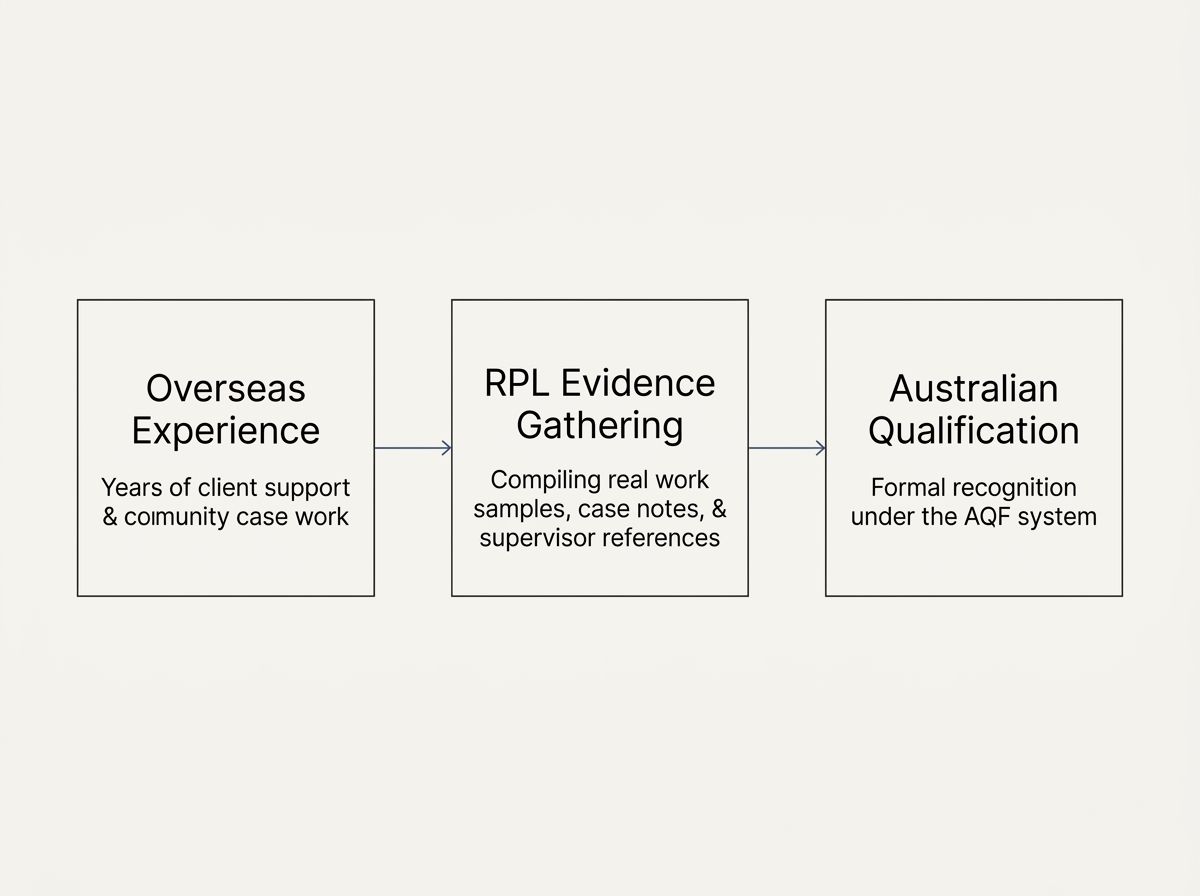
For community services workers, this means your overseas training, your years of case management, your experience supporting people through crisis, your work with families and individuals across complex circumstances — all of it becomes evidence. RPL is the process that makes that evidence legible to the Australian formal system.
RPL is not a shortcut. It is not an alternative for people who could not complete formal study. It is the recognised, rigorous process for converting demonstrated competence into a formal Australian qualification. The qualification you receive at the end is nationally recognised precisely because the assessment is genuine.
The current qualification code for the Diploma of Community Services in Australia is CHC52025. This is the qualification most commonly pursued by experienced community services workers seeking formal Australian recognition of their expertise.
The CHC52025 Diploma of Community Services is listed on the national training register, where you can review the full qualification structure including all core and elective units.
How Your Community Services Experience Maps to Australian Standards
The CHC52025 Diploma of Community Services comprises 20 units in total — 12 core units and 8 elective units. The core units cover the foundational competencies of community services work: person-centred practice, case management, legal and ethical frameworks, workplace health and safety, diversity, and responding to family violence.
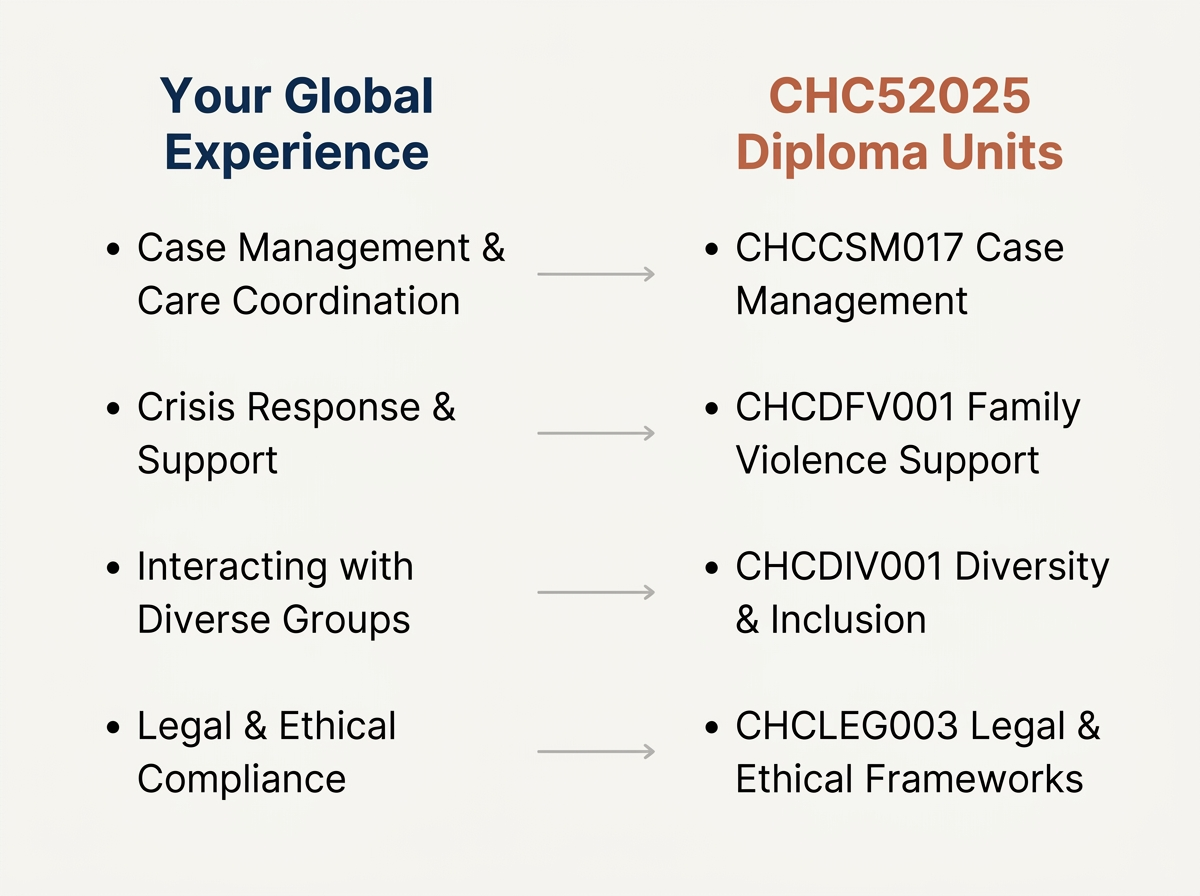
If you have worked in community services overseas, you have almost certainly practised the competencies these units describe. Here is how common overseas experience types map to the qualification's core areas:
- Case management and client coordination → CHCCSM017 (Lead and manage case management practice)
- Working with diverse communities and cultural groups → CHCDIV001 and CHCDIV002 (Work with diverse people; Promote Aboriginal and/or Torres Strait Islander cultural safety)
- Crisis support and family violence response → CHCDFV001 (Recognise and respond appropriately to domestic and family violence)
- Legal and ethical practice in client services → CHCLEG003 (Manage legal and ethical compliance)
- Supervision, team leadership, or service coordination → CHCMGT005 (Facilitate workplace debriefing and support processes)
- Workplace health and safety responsibilities → HLTWHS003 (Maintain work health and safety)
- Reflective practice and professional development → CHCPRP003 (Reflect on and improve own professional practice)
The elective units allow for specialisation in areas such as case management, child, youth and family welfare, social housing, or responding to family violence — reflecting the breadth of community services work that experienced practitioners bring from overseas contexts.
This is the translation in practice. Your work is not being dismissed; it is being mapped. The RPL process takes what you have done and asks: does this demonstrate the competency the Australian standard requires? For many experienced community services workers, the answer across most units is yes.
If you recognise yourself in this mapping and want to understand the broader landscape of community services qualifications available through RPL, the Community and Health page outlines the range of pathways.
What RPL for a Diploma of Community Services Actually Involves
RPL is a genuine assessment process. It is worth being clear about what that means, because understanding it honestly is what allows you to prepare well.
An RPL assessment for the Diploma of Community Services is conducted by a qualified assessor from a registered training organisation. The assessor's role is to evaluate whether your existing experience and knowledge meets the competency requirements of each unit. They are not there to teach you; they are there to assess what you already know.
The assessment typically involves gathering and presenting evidence of your competence. According to government guidance on RPL, an assessment may ask you to perform tasks or demonstrate your work, talk through how you approach your role, and provide samples of your work.
For community services work specifically, evidence is likely to include some combination of the following:
- A resume outlining your work history and the responsibilities you held
- References or third-party reports from supervisors or colleagues who can verify your practice
- Work samples such as case notes, care plans, referral letters, client assessments, or program documentation (with appropriate privacy considerations)
- Job descriptions that define the scope of your role
- Certificates or records of prior training, workshops, or professional development
- A professional interview or structured conversation with the assessor about how you approach your work
All evidence must be current, authentic, valid, and sufficient. The assessment process itself must be fair, flexible, and reliable — these are the standards that apply to all RPL assessments under the national framework.
The Western Australian Government's fact sheet on Recognition of Prior Learning outlines the quality principles that govern RPL assessments across Australia.
It is also important to be honest about one aspect of RPL that is sometimes overlooked: gap training may be required. If the assessment identifies areas where your evidence does not yet demonstrate the required competency, additional training or assessment activities may be needed before the qualification can be issued. This is not a failure; it is the assessment working as it should. A reputable RTO will be transparent about this possibility from the outset.
Who This Pathway Is — and Isn't — For
RPL for a Diploma of Community Services is well-suited for people with substantial, documented experience in community services work. If you have worked in roles involving direct client support, case coordination, crisis response, family services, disability support, aged care, or community development — and you can provide evidence of that work — RPL is a credible pathway worth exploring.
It is not the right pathway for everyone. RPL is not suitable for people with minimal experience in the field, those seeking a qualification in a sector they have not worked in, or those whose overseas work was in a significantly different context from Australian community services practice. The assessment is genuine, and the evidence requirements are real.
It is also worth noting that community services work in Australia is not uniformly regulated in the same way as health professions registered through AHPRA. Requirements vary depending on the employer, the funding body, and the specific role. Some positions specify the Diploma of Community Services as a minimum qualification; others accept equivalent experience. Understanding what your target role or visa pathway actually requires is an important first step.
Our commitment is to guide people toward the right pathway, not the most convenient one. If RPL is not the right fit for your situation, an honest skills review will tell you that, and point you toward what might be.
For a broader perspective on when RPL is and isn't the right answer for overseas qualifications, the article on the myths surrounding overseas degree recognition in Australia is worth reading.
The First Step Is Finding Out — Not Committing
Your overseas community services qualification is not useless. Your experience is not invisible. The problem has never been what you know; it has been the format in which it is presented.
RPL for the Diploma of Community Services is the translation mechanism that converts demonstrated global expertise into formal Australian recognition. It is rigorous. It is legitimate. And for many experienced community services workers, it is the pathway that finally makes their expertise legible to the Australian system.
The decision about whether to pursue it belongs to you. The first step is simply finding out whether your experience is likely to qualify, before committing to anything.
The Queensland Government's recognition of prior learning page provides a clear overview of how RPL assessments work across vocational qualifications in Australia.
General information only, current at the date shown. Licensing rules change, so check the current requirements with the relevant regulator before you rely on them. RPL it Australia is a student support service, not a Registered Training Organisation; qualifications are assessed and issued by our partner RTOs.