



Start My Skills Review
Accepting applications

Certificate IV in Ageing Support

This qualification reflects the role of support workers who complete specialised tasks and functions in aged services; either in residential, home or community based environments.

Qualification overview
CHC43015
LevelAQF 4Certificate IV
Units1815 core, 3 elective
PackageCHCCommunity Services
Timeframe
Typically 4 to 6 weeksAfter evidence is submitted to the RTO. Individual timelines vary.
Fees
Personalised quote before you commitRefund and withdrawal policy
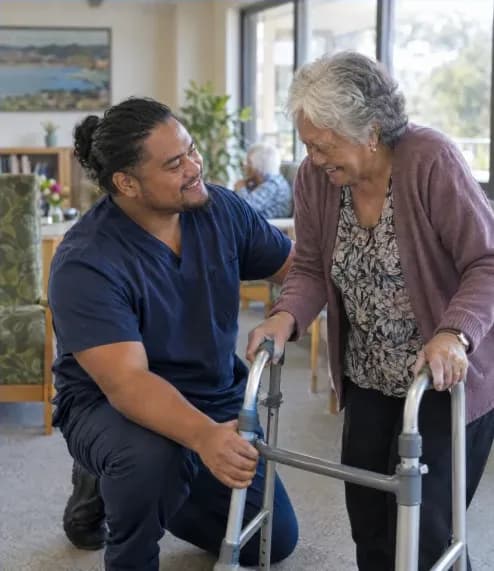
A carpenter marking timber framing on a building site, a chef plating a dish in a commercial kitchen, and an aged care worker helping a resident with her walking frame
Recognition of Prior Learning

What is an RPL qualification?

Recognition of Prior Learning assesses skills you already have against a nationally recognised qualification. Demonstrate competency, and you receive the same nationally recognised qualification, issued by a registered training organisation (RTO), as someone who completed the full course.

Who is eligible for RPL?

  • You have years of experience in your field
  • You learned the work on the job, through mentoring or on your own
  • You need the qualification for licensing, promotion or migration
  • You hold overseas qualifications you want recognised in Australia

About this qualification

Certificate IV in Ageing Support (CHC43015) through RPL

CHC43015 Certificate IV in Ageing Support is the step up for aged care workers who plan services, support residents with dementia, use a palliative approach or guide other staff. It is often searched as RPL aged care. The core units include facilitating the rights and empowerment of older people, coordinating services, interventions for older people at risk, dementia support and palliative care. If you already do this work, RPL it Australia helps you build the evidence, and a partner RTO decides whether it meets the standard.

What the qualification covers

This qualification reflects the role of support workers who complete specialised tasks and functions in aged services; either in residential, home or community based environments. Workers will take responsibility for their own outputs within defined organisation guidelines and maintain quality service delivery through the development, facilitation and review of individualised service planning and delivery.Workers may be required to demonstrate leadership and have limited responsibility for the organisation and the quantity and quality of outputs of others within limited parameters.To achieve this qualification, the candidate must have completed at least 120 hours of work as detailed in the Assessment Requirements of the units of competency. 

Who it suits

  • Care supervisors who oversee a team of personal care workers in a residential facility
  • Experienced carers who write individual service plans and review them with clients and families
  • Community program coordinators who link older people with local service providers
  • Assistant hostel supervisors and residential care officers managing complex care needs day to day

Evidence you could gather

  • Individual service plans and assessments. Service plans, care assessments and client progress reports that show you planned, delivered and reviewed support for older people.
  • Dementia and palliative care records. Support plans, interventions and care records for clients living with dementia or receiving palliative care, with identifying details removed.
  • Risk management plans for clients at risk. Risk plans, incident reports and follow-up notes showing how you responded when an older person was at risk of harm.
  • Supervision and mentoring evidence. Team meeting minutes, staff supervision records and notes showing you coordinated outside providers or mentored junior care workers.

Work placement

This qualification requires a minimum of 120 hours of work in an aged care environment. For RPL candidates, your current or past employment in the sector is typically used to satisfy this requirement, provided your experience aligns with the specific assessment criteria of the training package.

After the qualification

This qualification is commonly linked to roles such as Care Supervisor, Residential Care Officer, Community Program Coordinator and Care Team Leader. People with a Certificate III in Individual Support often use it as the next step in aged care, and it can lead toward further study. Our data does not list licensing for this qualification, so check any employer or regulator requirement directly. The RTO makes the assessment decision, and RPL it Australia cannot guarantee it.

Units of competency (74)

Core units

  • CHCADV001 Facilitate the interests and rights of clients
  • CHCAGE001 Facilitate the empowerment of older people
  • CHCAGE003 Coordinate services for older people
  • CHCAGE004 Implement interventions with older people at risk
  • CHCAGE005 Provide support to people living with dementia
  • CHCCCS006 Facilitate individual service planning and delivery
  • CHCCCS011 Meet personal support needs
  • CHCCCS023 Support independence and wellbeing
  • CHCCCS025 Support relationships with carers and families
  • CHCDIV001 Work with diverse people
  • CHCLEG003 Manage legal and ethical compliance
  • CHCPAL001 Deliver care services using a palliative approach
  • CHCPRP001 Develop and maintain networks and collaborative partnerships
  • HLTAAP001 Recognise healthy body systems
  • HLTWHS002 Follow safe work practices for direct client care

Elective units

  • BSBFIN501 Manage budgets and financial plans
  • BSBINS201 Process and maintain workplace information
  • BSBLDR411 Demonstrate leadership in the workplace
  • BSBLDR413 Lead effective workplace relationships
  • BSBOPS301 Maintain business resources
  • BSBSTR402 Implement continuous improvement
  • BSBTEC201 Use business software applications
  • CHCAGE008 Implement falls prevention strategies
  • CHCAGE012 Provide food service
  • CHCAOD001 Work in an alcohol and other drugs context
  • CHCCCS001 Address the needs of people with chronic disease
  • CHCCCS007 Develop and implement service programs
  • CHCCCS010 Maintain a high standard of service
  • CHCCCS017 Provide loss and grief support
  • CHCCCS018 Provide suicide bereavement support
  • CHCCCS019 Recognise and respond to crisis situations
  • CHCCCS026 Transport individuals
  • CHCCCS033 Identify and report abuse
  • CHCCCS034 Facilitate independent travel
  • CHCCCS038 Facilitate the empowerment of people receiving support
  • CHCCCS039 Coordinate and monitor home-based support
  • CHCCOM002 Use communication to build relationships
  • CHCDIS014 Develop and use strategies for communication with augmentative and alternative communication systems
  • CHCDIS017 Facilitate community participation and social inclusion
  • CHCDIS018 Facilitate ongoing skills development using a person-centred approach
  • CHCDIS019 Provide person-centred services to people with disability with complex needs
  • CHCDIV002 Promote Aboriginal and/or Torres Strait Islander cultural safety
  • CHCDIV003 Manage and promote diversity
  • CHCEDU002 Plan health promotion and community intervention
  • CHCINM001 Meet statutory and organisation information requirements
  • CHCLLN001 Respond to client language, literacy and numeracy needs
  • CHCMGT001 Develop, implement and review quality framework
  • CHCMGT002 Manage partnership agreements with service providers
  • CHCMGT006 Coordinate client directed services
  • CHCMHS001 Work with people with mental health issues
  • CHCPAL004 Contribute to planning and implementation of care services using a palliative approach
  • CHCPAS003 Plan for the provision of pastoral and spiritual care
  • CHCPAS004 Provide pastoral and spiritual care
  • CHCSET003 Work with forced migrants
  • CHCSOH013 Work with people experiencing or at risk of homelessness
  • HLTAAP002 Confirm physical health status
  • HLTAHA035 Provide support in dysphagia management
  • HLTAHA039 Assist in the development of meals and menus to meet dietary and cultural requirements
  • HLTAHA040 Assist with the monitoring and modification of meals and menus according to individualised plans
  • HLTAHA042 Assist with screening and management of nutritional risk
  • HLTAID011 Provide First Aid
  • HLTAID014 Provide Advanced First Aid
  • HLTFSE001 Follow basic food safety practices
  • HLTHPS006 Assist clients with medication
  • HLTHPS007 Administer and monitor medications
  • HLTOHC004 Provide or assist with oral hygiene
  • HLTOHC008 Inform and support patients and groups about oral health
  • HLTOHC009 Apply and use basic oral health products
  • HLTOHC010 Use basic oral health screening tools
  • HLTOHC011 Apply fluoride varnish
  • HLTWHS003 Maintain work health and safety
  • HLTWHS004 Manage work health and safety
  • TAEDEL412 Facilitate workplace-based learning
  • TAEDEL414 Mentor in the workplace
An RPL it team member sorting an electrician's job photos and reference letter into his evidence folder at a ute tailgate on a building site

How RPL works in four steps

  1. Free Skills Review

    Tell us about your work experience. We’ll match it to valid qualifications.

  2. Build your evidence

    Your account manager helps you gather your required evidence for your RTO.

  3. RTO assessment

    Your evidence portfolio is submitted to our partner RTO. A qualified assessor evaluates your competency.

  4. Get your qualification

    Once assessed as competent, the RTO issues your nationally recognised qualification.

Career Outcomes

Explore Roles Associated with this Qualification

If your current or past work looks like one of these roles, this qualification may suit you.

  • 01

    Care Supervisor

    Supervising care teams and ensuring quality service delivery meets both organisational and legislative requirements.

  • 02

    Residential Care Officer

    Providing high-level person-centred support while managing complex care needs and individualised planning in group housing.

  • 03

    Community Program Coordinator

    Implementing community-based programs and developing partnerships with service providers to support social inclusion.

  • 04

    Care Team Leader

    Overseeing the day-to-day operations of integrated home care services, including respite and property maintenance.

Evidence Checklist

What Suitable Evidence Can Support Your Evidence Portfolio?

Your consultant can help you identify relevant workplace records. The delivering RTO decides whether the evidence is sufficient and current.

Work History & Roles
  • Current resume and detailed position descriptions
  • Performance reviews and professional development logs
  • Third-party reports from care supervisors or facility managers

Service Planning & Delivery
  • Individualised service plans and care assessments
  • Case notes and client progress reports
  • Evidence of facilitating client rights and advocacy

Specialised Care
  • Dementia care interventions and support plans
  • Palliative care service delivery records
  • Risk management plans for clients at risk of harm

Compliance & Safety
  • Workplace health and safety incident reports
  • Infection control and medication assistance logs
  • Evidence of managing legal and ethical compliance in care

Leadership & Coordination
  • Team meeting minutes or staff supervision records
  • Coordination of external services and provider networks
  • Evidence of mentoring junior personal care workers

Qualification comparison

RPL and Traditional Study

Two routes to the same qualification, assessed against the same RTO competency standards.

RPL PathwaySupported by RPL it, assessed by the RTO
Traditional StudyDelivered and assessed by the RTO
Starting point
Your existing, current workplace skills and evidence
A planned course of learning and assessment
How competency is shown
Workplace evidence mapped to the qualification requirements
Learning activities, assignments, practical work, and assessment
Assessment decision
Made by a qualified assessor from the delivering RTO
If gaps are identified
Additional evidence or targeted gap training may be required
Learning and assessment continue through the course structure
Qualification outcome
Issued only when the RTO determines all requirements are met

RPL it Australia reviews

What our clients say

Selected Google reviews. Individual experiences vary. Every applicant is assessed against the same requirements, and some require gap training or additional evidence.

Frequently asked questions

Recognition of Prior Learning, your experience, and your next step.

Got more questions?
How do I get started with RPL for this qualification?

The process begins with a free skills review where we evaluate your aged care background. If you are a suitable candidate for RPL, we will guide you through building a portfolio of evidence—such as service plans and progress notes—which is then formally assessed by a qualified assessor from our partner RTO.

Is an RPL qualification the same as one from full-time study?

Yes. The Certificate IV in Ageing Support you receive via RPL is the exact same nationally recognised qualification as one earned through traditional study. It meets the same Australian Quality Training Framework standards and is held in equal regard by employers and regulatory bodies.

How long does the process typically take?

Most candidates complete the RPL process within 4 to 6 weeks once their evidence portfolio is submitted. Because this pathway recognises the skills you have already developed on the job, it is significantly faster than enrolling in a standard classroom-based course.

What kind of evidence do I need to provide for Ageing Support?

Evidence typically includes your current resume, position descriptions, and third-party reports from supervisors. You may also provide redacted samples of work such as individualised service plans, case notes, records of facilitating community activities, or evidence of workplace leadership.

How does the work placement requirement work for RPL?

While this qualification includes mandatory work placement hours, experienced workers can satisfy this requirement by providing evidence of their current or previous employment in an aged care setting. Your consultant will help you document these hours as part of your evidence portfolio.

Does this qualification allow me to work in both residential and home care?

Yes. The Certificate IV in Ageing Support is designed for support workers in residential, home, and community-based environments. It recognises your ability to take responsibility for quality service delivery and individualised planning across diverse aged care settings.

Do I need Certificate III in Individual Support before applying for CHC43015?

Our qualification data states this qualification has no entry requirements, so a Certificate III is not a prerequisite. Many candidates do hold one, and it can help show your background. The RTO still assesses your evidence for every unit. A free skills review can confirm what you already hold.

How many hours in aged care are needed for the Certificate IV in Ageing Support?

Our data states a minimum of 120 hours of work in an aged care environment. For RPL candidates, current or past employment in the sector is typically used to satisfy this, provided it matches the training package assessment criteria. Payslips and employer letters help document hours.

Which units cover leadership and coordination?

CHCAGE003 Coordinate services for older people and CHCPRP001 Develop and maintain networks and collaborative partnerships are core units. Electives such as Demonstrate leadership in the workplace are also available. Evidence of supervising staff or coordinating providers maps most clearly to these.

How long does the RPL process take?

Most candidates who submit a complete evidence portfolio receive their qualification within 4 to 6 weeks from RTO assessment. The total timeline depends on evidence readiness. Strong documentation can help the process move quickly, while evidence gaps or gap training may take longer.

Is an RPL qualification the same as one from TAFE?

Yes. An RPL qualification is issued under the Australian Qualifications Framework, the same framework that governs qualifications from TAFE colleges and all other Registered Training Organisations. It carries the same national recognition. Licensing requirements vary, so check with the relevant authority.

How much does RPL cost?

RPL costs vary by qualification level, complexity, and number of units. Because RPL assesses what you already know rather than teaching new content, it is typically less expensive than full enrolment. Contact our team for a tailored quote. Payment plans are interest-free with no establishment fee, and the instalment schedule and any extension fee that could apply are set out in your quote.

What evidence do I need for RPL?

Evidence can include your resume, reference letters from employers, photos or videos of your work, previous qualifications and certificates, job descriptions, and any other documentation that demonstrates your skills and knowledge. The RTO tells you exactly what evidence it needs for your specific qualification, and your RPL it consultant helps you put it together.

Can I get credit for units I have already completed?

Yes, if you hold a qualification or Statement of Attainment that includes units equivalent to units in this qualification. This is called credit transfer. The delivering RTO checks your AQF certification documents or authenticated VET transcript. Where a unit is equivalent and your certification is authenticated, the RTO must grant credit for it. It can refuse only on limited grounds, for example where a licensing or regulatory requirement calls for reassessment.

Delivering RTO · 1 partner RTOs

Assessed and issued by a partner RTO

Your delivering RTO is confirmed before enrolment. Check any RTO’s registration on training.gov.au.