How to spot a genuine RPL provider and avoid certificate mills
Learn the credibility markers of genuine Australian RTOs, spot certificate mills, and protect your visa application from non-compliant RPL providers.

Why choosing the wrong RPL provider costs more than money
You have valuable work experience. You do not need an assessment provider who treats your career history as a transaction rather than the foundation for a genuine RPL process.
For skilled migrants in Australia, choosing the wrong RPL provider carries serious risks. A qualification issued through a non-genuine process will likely be rejected by employers, licensing boards, and immigration authorities. In regulated sectors like aged care, childcare, disability support, and construction, the impact of these quick-fix certificates can place unqualified workers into safety-critical roles.
The national regulatory body, the Australian Skills Quality Authority (ASQA), has warned of rising risks around fraudulent qualifications. This includes the exploitation of RPL pathways, often driven by visa and migration requirements. ASQA's official documents state that 'cash for qualifications' schemes are a growing problem that threatens the integrity of the sector.
This guide does not aim to alarm you. Instead, it provides the practical knowledge to evaluate any RPL provider, including us, against clear and objective criteria. Your caution is reasonable. Use it to protect your career and your future in Australia.
What a genuine RPL provider is and is not
Recognition of Prior Learning is an assessment pathway. It measures your existing skills and past learning against the official standards of a specific qualification or unit of competency.
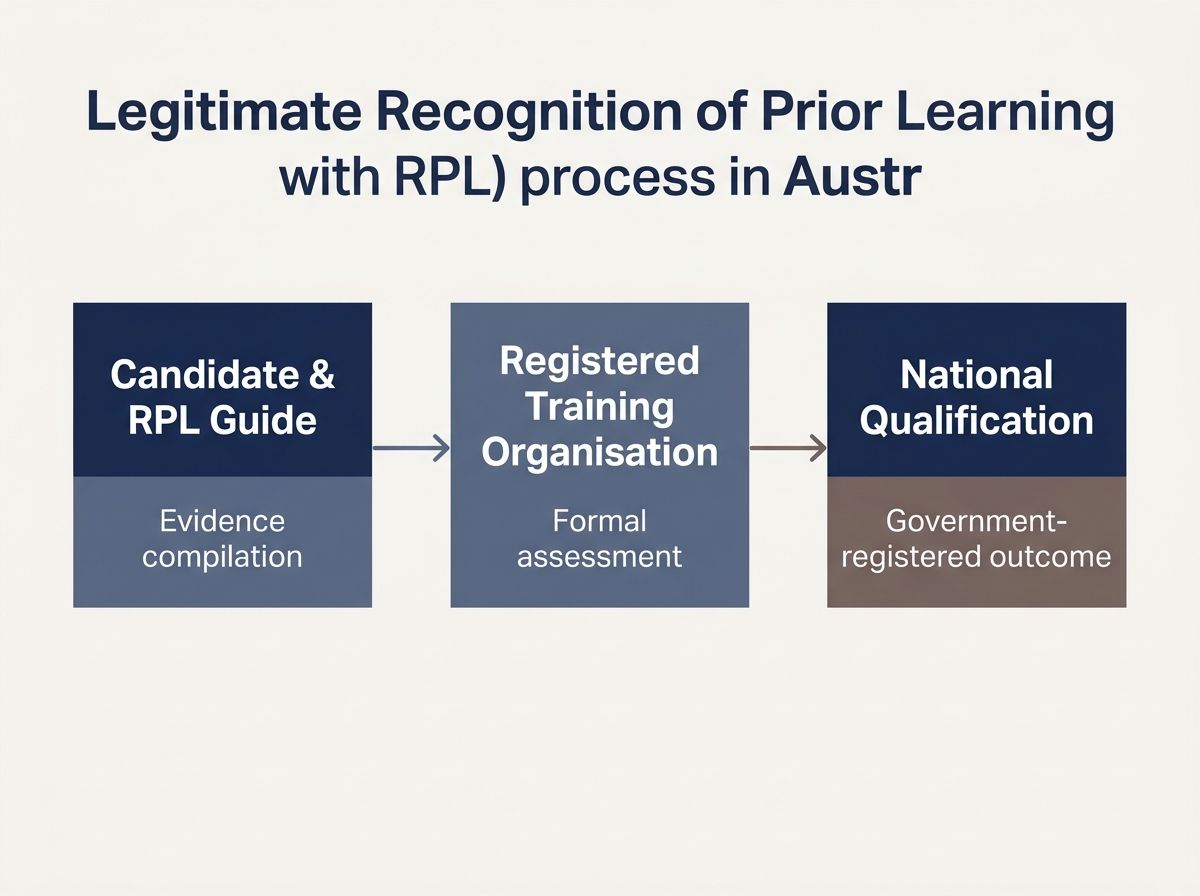
Many candidates do not realise that an RPL partner and a Registered Training Organisation (RTO) are different entities. A genuine RPL provider helps you gather and organise your evidence. However, only an RTO can conduct the official assessment and issue a nationally recognised qualification. These organisations must be registered directly with ASQA, VRQA, or TAC.
Only RTOs have the authority to deliver nationally recognised training and issue qualifications. Every approved qualification is listed on the National Register of VET at training.gov.au. If a provider claims they can issue certificates themselves without holding RTO status, or refuses to name the RTO conducting your assessment, you are dealing with a significant compliance risk.
A genuine RPL partner is always transparent about this structure. They will tell you upfront which registered RTO will assess your portfolio. They will encourage you to look up that RTO's registration status. They are clear about where their role ends, which is evidence preparation, and where the RTO's role begins, which is assessing your competency and issuing your certificate.
How to check an RTO's registration status
Before you pay or sign a contract, verify the partner RTO's registration on the National Register of VET. ASQA's student guidance advises using training.gov.au, where you can search using the RTO's registration number, Australian Business Number (ABN), or registered name.
When you find the RTO in search results, check that their registration status is active, identify their regulatory manager (ASQA, VRQA, or TAC), and verify their registration start and expiry dates. Use the 'View scope' tab to confirm they are approved to assess your specific qualification.
Search the National Register of VET at training.gov.au to verify an RTO's current registration and approved scope.
One vital step is to confirm that the specific qualification you want is on that RTO's approved scope. If they do not hold explicit approval for that exact code, they cannot legally issue the qualification through RPL.
Seven signs of a legitimate RPL provider
You can use these markers to assess any RPL partner you are considering. A legitimate provider will meet every single one of these criteria. If you are unsure about any point, ask them directly before making a commitment.
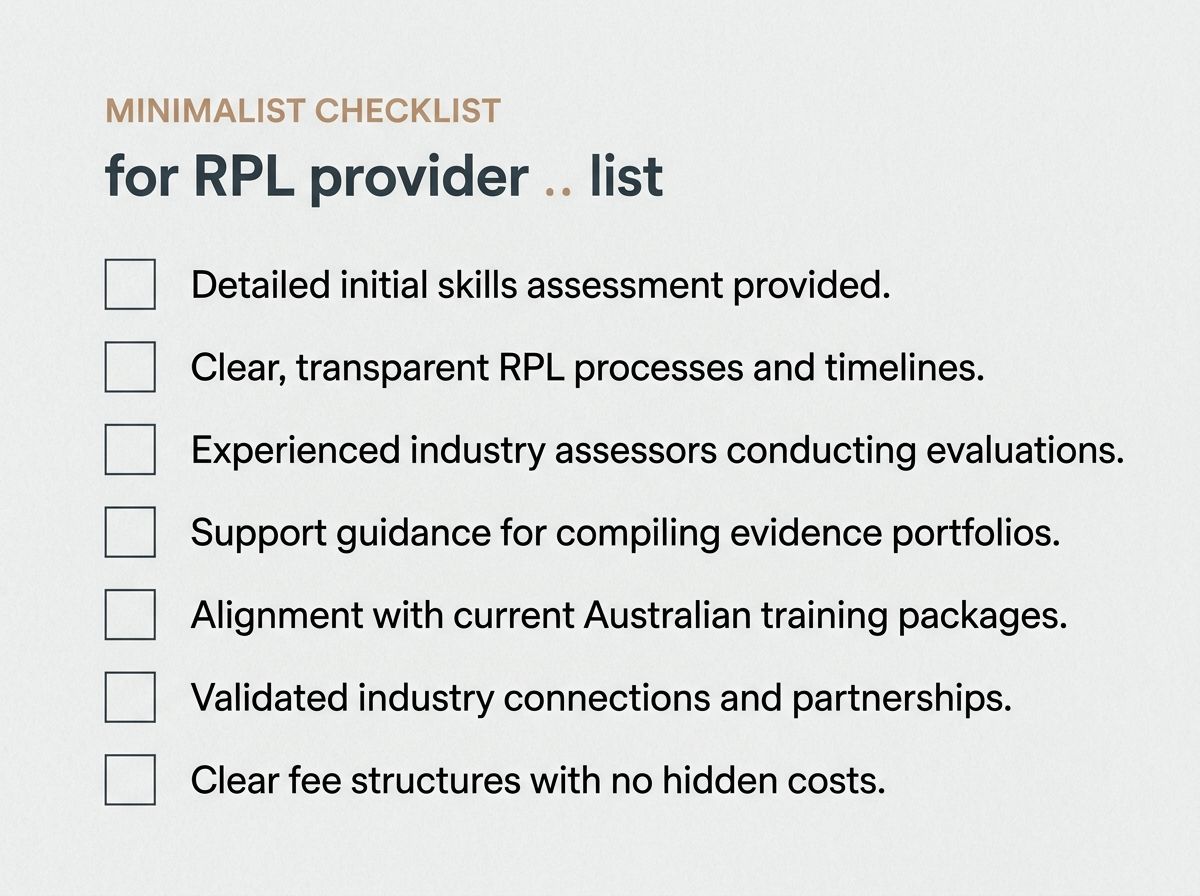
- They name their partner RTO before you enrol, allowing you to check their status on training.gov.au. Transparency about who will assess your skills is vital. If a provider is evasive or cannot give you a registration number, do not proceed.
- They carry out a suitability assessment before you enrol. A legitimate provider will review your background, skills, and target qualification before asking for payment. This check ensures you are actually a suitable candidate.
- They are honest about gap training requirements. RPL must be conducted with the same rigour as any other assessment. If your evidence does not meet every requirement, a legitimate provider will explain how you can complete gap training rather than hiding it.
- They never guarantee final outcomes. The final decision is always made by a qualified assessor employed by the partner RTO. No provider can guarantee you will be found competent before your evidence is reviewed. Any business promising a qualification beforehand is making a promise they cannot legally keep.
- They explain the evidence-gathering process in detail before you pay any fees. You should understand what documents, references, or work samples you need to provide, and how the assessor will verify them, before committing financially.
- They offer a clear fee structure with no hidden charges. All costs, including assessment, administration, and any gap training, should be disclosed upfront. Unexpected fees after enrolment are a sign of an unreliable provider.
- They have real, verifiable feedback from actual candidates. Look for detailed, specific descriptions of the assessment process rather than brief, generic praise. Check independent, third-party platforms that verify user identities.
Five red flags of an RPL certificate mill
The national regulator, ASQA, has identified the misuse of RPL processes as a serious threat to the standards of the Australian training sector. This includes operations where certificates are practically sold with little or no assessment of actual skills. ASQA's Integrity Unit is specifically focused on identifying and shutting down these non-compliant practices.
Watch out for these five warning signs:
- They guarantee the qualification before seeing your evidence. This is the clearest sign of a certificate mill. Real assessment requires time, documentation, and the independent decision of an assessor. A guarantee of success before this process begins means no genuine assessment will happen.
- They cannot name or verify their partner RTO. If a provider cannot tell you which RTO will perform the assessment, or if the RTO they name does not show up as currently registered on training.gov.au, any certificate they promise has no legal validity.
- They promise an incredibly fast turnaround. Genuine RPL is a thorough process. Gathering documents, mapping them to national units, and conducting verification checks takes time. Anyone offering a fully assessed qualification in 24 or 48 hours is not conducting a real assessment.
- They demand full payment before discussing your eligibility. A genuine provider makes sure RPL is the right pathway for your career history before taking your money. Demanding payment before reviewing your experience reverses the correct and legal order of assessment.
- Their reviews are generic, impossible to verify, or missing. Legitimate RPL providers have a clear history of helping clients. If you cannot find independent, detailed accounts of the process from real candidates, or if reviews seem artificial, look elsewhere.
Why our free skills review sets the standard
We encourage you to apply these quality checks to any RPL partner you are evaluating, including us. The high standards of compliance we set for our own service are the same standards we believe you should expect from anyone in this industry.
Our Free Skills Review is where we establish this standard. Before you enrol or pay anything, we complete a thorough evaluation of your work history to see if your experience is likely to meet the requirements for your target qualification. If RPL is not the right option for you, we will tell you directly. We believe it is far better to guide you to the correct pathway than to enrol you in a program that does not suit your needs.
This approach is not a marketing tactic. It is the only way to ensure that your qualification is completely credible when you present it to employers, licensing boards, and immigration departments. A certificate is only as valuable as the assessment process behind it.
Questions to ask before choosing an RPL partner
You have every right to ask these questions of any provider you contact. A legitimate, compliant business will welcome your questions and answer them clearly. If a provider is evasive, defensive, or dismissive when you ask for these details, that tells you everything you need to know.
- Which partner RTO will assess my portfolio, what is their registration number, and can I verify this on training.gov.au?
- Is the specific qualification code I want listed on that RTO's approved scope of delivery?
- What happens if my experience does not cover all the requirements? Will you let me know before I enrol, and what does gap training involve?
- What specific types of evidence will I need to collect, and how will the RTO's assessor verify my documents?
- What is the realistic timeframe for this process, from my initial eligibility check to the final assessment outcome?
- Can you provide a complete breakdown of all fees, including any potential gap training or reassessment costs, and when are they due?
- What is your refund policy if the assessor identifies significant skill gaps that were not picked up during my eligibility review?
- Are you able to share verified case studies or connect me with past clients who can speak honestly about their experience?
If you want to understand how consumer protection laws apply to training services in Australia, the Australian Competition and Consumer Commission (ACCC) provides clear resources on resolving disputes. State and territory consumer protection offices can also advise you on your rights as a consumer.
The ACCC's guidance identifies ASQA as the regulator for vocational education and explains where students can raise formal concerns about non-compliant providers.
The steps after choosing a reliable provider
A genuine RPL pathway follows a clear and logical sequence. First, you undergo an eligibility check to assess whether your work history is likely to meet the national standards. Second, you begin evidence gathering, which is a supported process where you collect documents, photos, and references showing your skills. Third, a qualified assessor from our partner RTO evaluates your portfolio. If they identify any minor gaps in your skills, you can complete targeted gap training. Finally, the RTO issues your qualification.
A compliant assessment process takes time. This is not a flaw; it is the reason why the qualification holds weight in the industry. Australian employers and licensing authorities respect these credentials because they know they represent a real evaluation of your skills. The rigour of the assessment is what gives your qualification its true value.
Research by the National Centre for Vocational Education Research (NCVER) on RPL confirms that the system is designed to give experienced individuals formal recognition through a genuine, evidence-based assessment against national competency standards.
Now that you understand what to look for, you can evaluate providers with confidence. The choice of who to trust is entirely yours.
Ready to Get Recognised?
Start with a free skills review to find out if RPL is right for you.