Why allied health assistance is a practical choice for overseas nurses waiting on AHPRA
Waiting for AHPRA? Overseas nurses can get a Certificate IV in Allied Health via RPL to earn more and gain recognized Australian clinical experience.

The AHPRA wait costs more than time
You have the qualifications. You have the clinical hours. You have the experience of running a ward, managing patients, and making decisions that mattered. Now you are waiting, sometimes for months, for AHPRA to process your registration as an internationally qualified nurse.
The AHPRA registration pathway for internationally qualified nurses is a multi-step process. Processing timelines vary depending on the pathway and how complete your documentation is. For many nurses, this wait stretches well beyond what they anticipated. During this period, the pressure to earn is immediate, as is the pressure to gain Australian healthcare experience. The default response is often to accept any entry-level healthcare work available, but this decision can carry hidden professional costs.
This article is not about the wait itself. It explains how to make productive use of this time.
What most overseas nurses do, and why it delays progress
The most common response to AHPRA delays is practical: taking personal care work, aged care support shifts, or assistant in nursing (AIN) roles. This income helps, and working close to healthcare settings feels relevant. It is also based on a reasonable assumption that any Australian clinical exposure is better than none.
The problem is not the work itself, but what that work fails to produce. Entry-level personal care shifts generate immediate income, but they do not generate formally assessed, nationally recognised Australian qualifications. They do not build the documented evidence trail that formal recruitment systems require. While you are gaining real experience, it remains undocumented in a way that helps your career.
This pattern keeps skilled overseas nurses hidden from the formal Australian healthcare system. Capable professionals accumulate practical experience that formal employment processes cannot officially recognize.
What is the Certificate IV in Allied Health Assistance, and why is it useful?
The Certificate IV in Allied Health Assistance (HLT43021) is a nationally recognised Australian qualification for working alongside registered health professionals in clinical settings. This is a formal credential that qualifies you for positions in hospitals, community health services, rehabilitation centres, aged care, and disability services. In these roles, you work directly under the supervision of physiotherapists, occupational therapists, speech pathologists, and other registered practitioners.
The qualification consists of ten core units and eight elective units. Core competencies cover medical terminology, infection prevention and control, allied health program assistance, and safe work practices. Elective units allow you to focus on specific areas such as movement and mobility support, psychosocial support, or physical therapy assistance. The full list of units is published on the National Training Register at training.gov.au.
For an overseas nurse, this qualification is not a step down. It is a formally recognised Australian credential earned in a clinical context, backed by a documented scope, assessed competencies, and national recognition. This structure provides a distinct professional advantage compared to undocumented personal care shifts.
Why overseas nurses are already qualified, and how to present the evidence
The reality is simple: overseas nurses do not need to learn allied health assistance from scratch. They have already practiced most of these skills in their daily work.
Clinical observation, patient handling, therapeutic support under supervision, infection control, clinical documentation, medical terminology, and working in multidisciplinary teams are standard parts of nursing practice worldwide. Many of the competencies assessed in the HLT43021 qualification overlap directly with the daily responsibilities of a trained nurse.
Obtaining the Certificate IV in Allied Health Assistance via Recognition of Prior Learning (RPL) does not require you to learn new skills. It formally matches your existing experience to Australian standards. A qualified assessor from a registered training organisation reviews your employment history, clinical documentation, supervisor references, and professional background. Where your skills align with the qualification units, you receive credit. If there are any areas not fully covered, target training resolves the gaps.
Your professional experience serves as your evidence. For overseas nurses, this proof is already there. The main task is presenting it in a format that the Australian system can officially recognise.
A Free Skills Review is a practical first step to identify which units your experience covers before making any commitments. This is an initial diagnostic, not an enrolment.
The practical case: why this qualification makes sense during your wait
Three clear advantages emerge when an overseas nurse obtains the Certificate IV in Allied Health Assistance via RPL while waiting for AHPRA. First, your earning potential increases, because allied health assistant roles generally pay higher award rates than standard personal care positions. Second, you build documented Australian clinical experience within a formally assessed, national framework. Third, you gain a standalone credential with lasting career value, regardless of when your nursing registration is completed.
Regarding income, personal care work and allied health assistant positions are covered by different award scales in Australia. Allied health assistants typically earn higher rates of pay. This pay difference becomes significant over a waiting period that often lasts for several months.
Regarding experience, working as a qualified allied health assistant in a clinical setting provides documented, assessed Australian healthcare hours. This is different from working undocumented personal care shifts. It demonstrates continuous practice in an active clinical environment, which is highly useful for any professional pathway requiring formal proof of Australian clinical hours.
Regarding the qualification, the Certificate IV in Allied Health Assistance holds strong individual value in the employment market. Demand for allied health assistants is growing across Australia due to an aging population and expanded community health programs. This credential opens employment opportunities that remain closed to unqualified workers, regardless of your AHPRA outcome.
This is a practical career step that allows you to earn a better income, build documented clinical proof, and secure a recognised qualification at the same time.
The RPL process for the Certificate IV in Allied Health Assistance
RPL for the Certificate IV in Allied Health Assistance is a formal assessment process rather than an automatic shortcut. It requires compiling evidence of your current skills, such as employment records, clinical documents, position descriptions, supervisor references, and completing a skills interview. This portfolio is evaluated by an assessor from a Registered Training Organisation (RTO), who conducts the assessment and issues the qualification. RPL it supports you throughout the process of gathering and organizing this evidence.
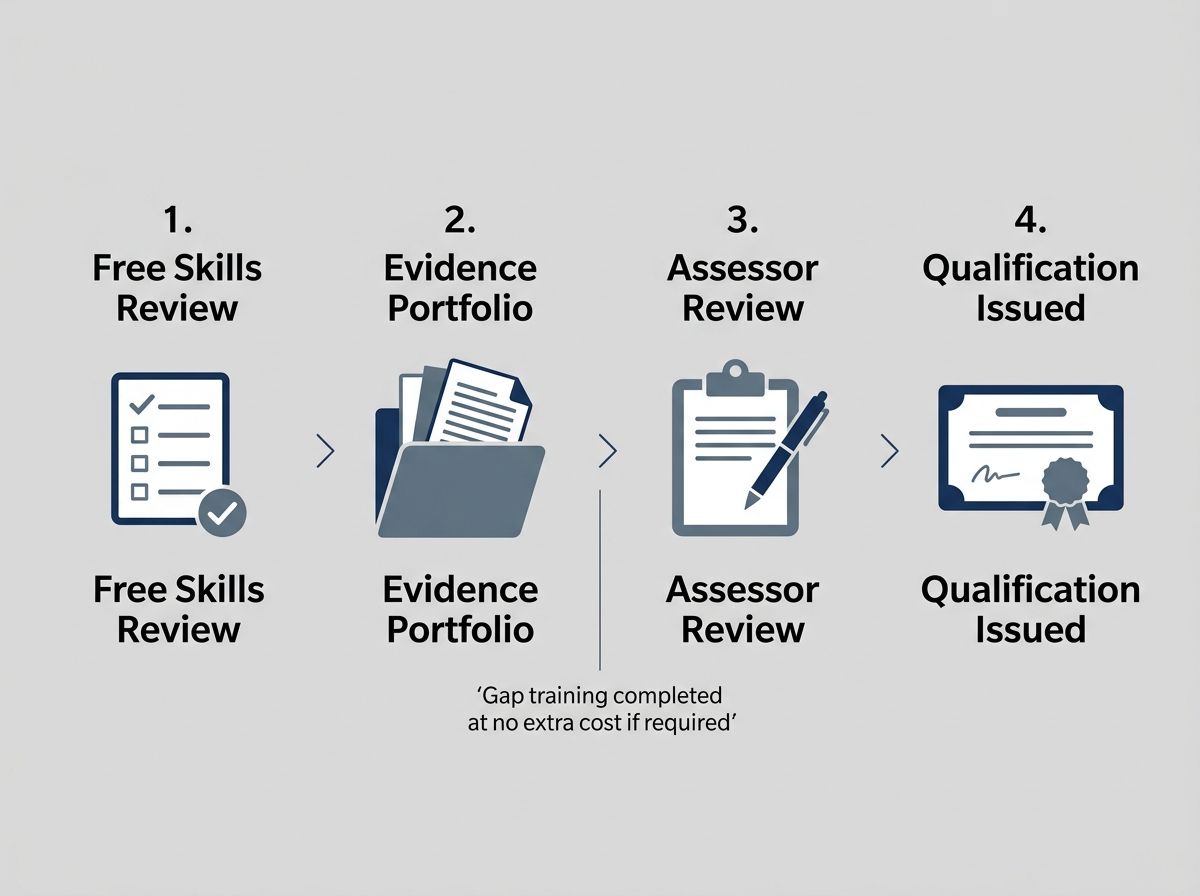
If your evidence does not fully cover every unit requirement, some gap training may be necessary. When this occurs, the gap training is included at no extra cost. This assessment is a thorough review of your actual abilities, and the qualification is nationally recognised because the evaluation process is rigorous.
The process starts with a skills review to evaluate whether your experience aligns with the qualification units. This review is completed before you enrol, commit to any course, or pay any fees.
Is this the right path for your situation?
The RPL pathway for the Certificate IV in Allied Health Assistance is not suitable for every applicant. It relies on documented clinical experience that matches the qualification units. Overseas nurses with general clinical backgrounds, including patient care, therapeutic support, multidisciplinary teamwork, infection control, and record keeping, usually have the required evidence. Nurses whose experience is mostly administrative or focused in highly specialized niches may have fewer direct overlaps with the units.
We prefer to tell you early if this pathway is not a good match, rather than start an assessment that cannot be completed. The Free Skills Review is designed to give you a clear, honest answer before you make any commitment.
If your overseas nursing experience is broad, clinically focused, and well-documented, this RPL pathway is a practical option to consider. It offers higher pay than entry-level support work, secures a formal Australian credential, and builds documented clinical hours. These advantages help you make the most of a registration waiting period that might otherwise feel like a pause in your career.
Your clinical skills are already developed. The next step is translating them into a format that the Australian healthcare sector can officially recognise. The choice to begin is yours.
Ready to Get Recognised?
Start with a free skills review to find out if RPL is right for you.