Start My Skills Review
Accepting applications

Certificate IV in Allied Health Assistance

This qualification reflects the role of allied health assistants who provide therapeutic and program related support to persons, in the health, aged care, disability and any other settings where Allied Health Professionals provide services.

Qualification overview
HLT43021
LevelAQF 4Certificate IV
Units5310 core, 43 elective
PackageHLTHealth
Timeframe
Typically 4 to 6 weeksAfter evidence is submitted to the RTO. Individual timelines vary.
Fees
Personalised quote before you commitRefund and withdrawal policy
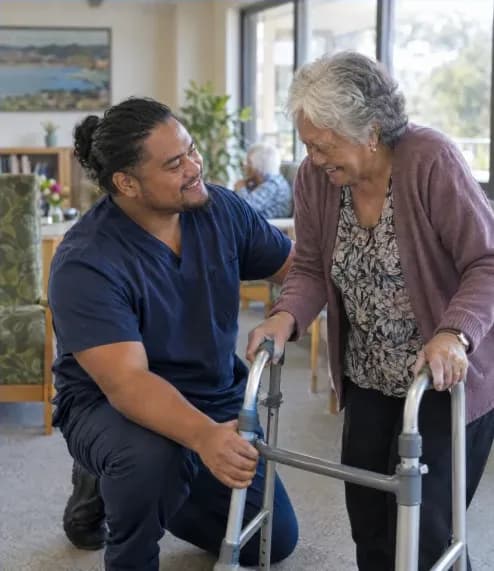
A carpenter marking timber framing on a building site, a chef plating a dish in a commercial kitchen, and an aged care worker helping a resident with her walking frame
Recognition of Prior Learning

What is an RPL qualification?

Recognition of Prior Learning assesses skills you already have against a nationally recognised qualification. Demonstrate competency, and you receive the same nationally recognised qualification, issued by a registered training organisation (RTO), as someone who completed the full course.

Who is eligible for RPL?

  • You have years of experience in your field
  • You learned the work on the job, through mentoring or on your own
  • You need the qualification for licensing, promotion or migration
  • You hold overseas qualifications you want recognised in Australia

About this qualification

Certificate IV in Allied Health Assistance (HLT43021) through RPL

What the qualification covers

This qualification reflects the role of allied health assistants who provide therapeutic and program related support to persons, in the health, aged care, disability and any other settings where Allied Health Professionals provide services. Allied Health Assistants work under the delegation and supervision of Allied Health Professionals and assist in identifying circumstances and risks and report issues.Supervision may be direct, indirect or remote and must occur within organisational requirements, according to the individual allied health assistant’s scope of practice and experience.They may be engaged to work in single discipline or multidisciplinary roles not limited to health, aged care or disability services and other settings and may also have responsibility for other allied health assistance workers according to their scope of practice.To achieve this qualification, the candidate must have completed at least 120 hours of clinical placement as detailed in the Assessment Requirements of the units of competency.The skills in this qualification must be applied in accordance with Commonwealth and State/Territory legislation, Australian standards and industry codes of practice.


Work placement

This qualification requires a minimum of 120 hours of clinical placement. For recognition candidates, your current or past work experience in a supervised allied health setting may be used to demonstrate this requirement, provided it can be verified by a qualified professional against the unit standards.

Units of competency (53)

Core units

  • BSBMED301 Interpret and apply medical terminology appropriately
  • CHCCCS020 Respond effectively to behaviours of concern
  • CHCCCS036 Support relationships with carer and family
  • CHCCCS038 Facilitate the empowerment of people receiving support
  • CHCDIV001 Work with diverse people
  • HLTAHA027 Assist with an allied health program
  • HLTAHA047 Engage with clinical supervision and delegation
  • HLTAHA049 Recognise impact of health conditions
  • HLTINF006 Apply basic principles and practices of infection prevention and control
  • HLTWHS002 Follow safe work practices for direct client care

Elective units

  • BSBMED303 Maintain patient records
  • CHCAGE007 Recognise and report risk of falls
  • CHCAGE008 Implement falls prevention strategies
  • CHCAGE011 Provide support to people living with dementia
  • CHCCCS001 Address the needs of people with chronic disease
  • CHCCCS002 Assist with movement
  • CHCCCS037 Visit client residence
  • CHCCCS040 Support independence and wellbeing
  • CHCDIV002 Promote Aboriginal and/or Torres Strait Islander cultural safety
  • CHCMHS001 Work with people with mental health issues
  • CHCPRT027 Work collaboratively to maintain an environment safe for children and young people
  • HLTADM008 Administer and coordinate Telehealth services
  • HLTAHA028 Deliver and monitor physical or manual therapy programs
  • HLTAHA029 Support independence and community participation
  • HLTAHA030 Assist with basic foot care
  • HLTAHA031 Assist in rehabilitation programs
  • HLTAHA032 Support maintenance of functional status
  • HLTAHA033 Conduct group sessions for individual outcomes
  • HLTAHA034 Support the development of speech and communication skills
  • HLTAHA035 Provide support in dysphagia management
  • HLTAHA036 Assist and support the use of augmentative and alternative communication system
  • HLTAHA037 Deliver and monitor a hydrotherapy program
  • HLTAHA038 Support the use of orthoses or prostheses
  • HLTAHA039 Assist in the development of meals and menus to meet dietary and cultural requirements
  • HLTAHA040 Assist with the monitoring and modification of meals and menus according to individualised plans
  • HLTAHA041 Support food services and dietetics in menu and meal order processing
  • HLTAHA042 Assist with screening and management of nutritional risk
  • HLTAHA043 Support the provision of basic nutritional advice and education
  • HLTAHA044 Work within a community rehabilitation environment
  • HLTAHA045 Assist people management in medical imaging
  • HLTAHA046 Support the medical imaging professional
  • HLTAHA048 Provide allied health assistance in remote or isolated settings
  • HLTAHA050 Assist with podiatry exercise
  • HLTAHA051 Assist with podiatric procedures
  • HLTAHA052 Assist with social work
  • HLTAHA053 Support and deliver individual hearing rehabilitation program
  • HLTAUD007 Conduct basic audiometric testing
  • HLTAUD008 Conduct audiometric testing
  • HLTHSS011 Maintain stock inventory
  • HLTINF002 Process reusable medical devices and equipment
  • HLTOTH001 Apply casts
  • HLTOTH003 Remove casts
  • HLTWHS005 Conduct manual tasks safely
An RPL it team member sorting an electrician's job photos and reference letter into his evidence folder at a ute tailgate on a building site

How RPL works in four steps

  1. Free Skills Review

    Tell us about your work experience. We’ll match it to valid qualifications.

  2. Build your evidence

    Your account manager helps you gather your required evidence for your RTO.

  3. RTO assessment

    Your evidence portfolio is submitted to our partner RTO. A qualified assessor evaluates your competency.

  4. Get your qualification

    Once assessed as competent, the RTO issues your nationally recognised qualification.

Career Outcomes

Explore Roles Associated with this Qualification

If your current or past work looks like one of these roles, this qualification may suit you.

  • 01

    Occupational Assistant

    Assisting occupational therapists in delivering rehabilitation programs and supporting client mobility and independence.

  • 02

    Therapy Assistant

    Working under the supervision of allied health teams to implement therapeutic interventions and monitor progress.

  • 03

    Nutrition Assistant

    Supporting dietitians with meal planning and processing orders to meet specific nutritional and cultural requirements.

  • 04

    Physiotherapy Assistant

    Supporting physiotherapy staff with exercise programs and maintaining equipment within a clinical environment.

Evidence Checklist

What Suitable Evidence Can Support Your Evidence Portfolio?

Your consultant can help you identify relevant workplace records. The delivering RTO decides whether the evidence is sufficient and current.

Work History & Roles
  • Current and detailed resume
  • Position descriptions from health settings
  • Performance reviews and clinical appraisals

Clinical Support
  • Therapy program activity logs
  • Records of assisting with therapeutic tasks
  • Client progress notes and handover reports

Communication & Diversity
  • Evidence of working with diverse client groups
  • Documentation showing use of medical terminology
  • Records of family or carer liaison

Safety & Compliance
  • Infection control training records
  • WHS incident reports or risk assessments
  • Hand hygiene compliance documentation

Supervision & Delegation
  • Clinical supervision logs
  • Records of tasks delegated by health professionals
  • Workplace meeting minutes

Qualification comparison

RPL and Traditional Study

Two routes to the same qualification, assessed against the same RTO competency standards.

RPL PathwaySupported by RPL it, assessed by the RTO
Traditional StudyDelivered and assessed by the RTO
Starting point
Your existing, current workplace skills and evidence
A planned course of learning and assessment
How competency is shown
Workplace evidence mapped to the qualification requirements
Learning activities, assignments, practical work, and assessment
Assessment decision
Made by a qualified assessor from the delivering RTO
If gaps are identified
Additional evidence or targeted gap training may be required
Learning and assessment continue through the course structure
Qualification outcome
Issued only when the RTO determines all requirements are met

RPL it Australia reviews

What our clients say

Selected Google reviews. Individual experiences vary. Every applicant is assessed against the same requirements, and some require gap training or additional evidence.

Frequently asked questions

Recognition of Prior Learning, your experience, and your next step.

Got more questions?
How do I get started with RPL for this qualification?

The process begins with a free skills review where we assess your Allied Health experience against the HLT43021 standards. Once eligible, you will compile a portfolio of evidence—such as workplace documents and supervisor reports—which is then assessed by our partner RTO to award your qualification.

Is an RPL qualification the same as one from full-time study?

Yes, a qualification obtained through Recognition of Prior Learning is identical to one earned through traditional study. It is nationally recognised under the Australian Qualifications Framework (AQF) and is held in the same regard by employers and health services.

How long does the process typically take?

Most candidates complete their RPL journey within 4 to 6 weeks after their evidence portfolio has been submitted. The timeline depends on how quickly you can gather your documentation and the specific assessment requirements of the RTO.

Does this qualification require a work placement?

The Certificate IV in Allied Health Assistance typically requires the completion of clinical placement hours. Through RPL, your current or past employment in a health or community setting can often be used to satisfy these requirements, provided you can demonstrate the necessary practical experience under supervision.

What kind of evidence do I need to provide for Allied Health Assistance?

Evidence can include position descriptions, workplace observations, client progress notes (de-identified), incident reports, and third-party reports from supervising Allied Health Professionals such as Physiotherapists or Occupational Therapists.

Can I use RPL if I have worked across multiple health disciplines?

Absolutely. If you have provided support across physiotherapy, occupational therapy, or speech pathology, these diverse skills are highly valuable and can be mapped against the elective and core units of the HLT43021 qualification.

How long does the RPL process take?

Most candidates who submit a complete evidence portfolio receive their qualification within 4 to 6 weeks from RTO assessment. The total timeline depends on evidence readiness. Strong documentation can help the process move quickly, while evidence gaps or gap training may take longer.

Is an RPL qualification the same as one from TAFE?

Yes. An RPL qualification is issued under the Australian Qualifications Framework, the same framework that governs qualifications from TAFE colleges and all other Registered Training Organisations. It carries the same national recognition. Licensing requirements vary, so check with the relevant authority.

How much does RPL cost?

RPL costs vary by qualification level, complexity, and number of units. Because RPL assesses what you already know rather than teaching new content, it is typically less expensive than full enrolment. Contact our team for a tailored quote. Payment plans are interest-free with no establishment fee, and the instalment schedule and any extension fee that could apply are set out in your quote.

What evidence do I need for RPL?

Evidence can include your resume, reference letters from employers, photos or videos of your work, previous qualifications and certificates, job descriptions, and any other documentation that demonstrates your skills and knowledge. The RTO tells you exactly what evidence it needs for your specific qualification, and your RPL it consultant helps you put it together.

Can I get credit for units I have already completed?

Yes, if you hold a qualification or Statement of Attainment that includes units equivalent to units in this qualification. This is called credit transfer. The delivering RTO checks your AQF certification documents or authenticated VET transcript. Where a unit is equivalent and your certification is authenticated, the RTO must grant credit for it. It can refuse only on limited grounds, for example where a licensing or regulatory requirement calls for reassessment.