From unofficial therapy assistant to fully qualified AHA without losing income
Already running physio exercises but paid as a carer? Qualify for a Certificate IV in Allied Health Assistance via RPL. Here is how.
The work you are already doing has a name
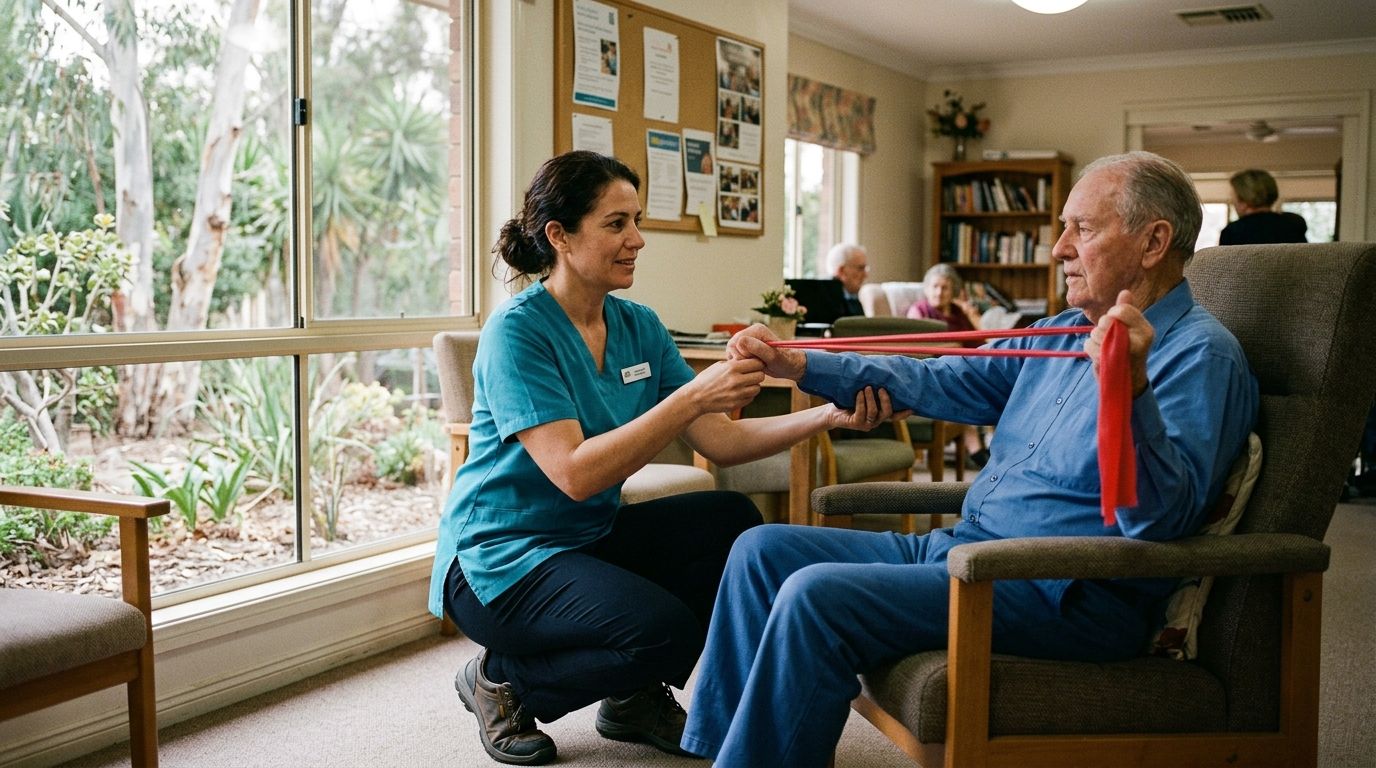
You run the exercises. You track the progress. You know your clients' mobility goals better than almost anyone else in the building. When the physiotherapist delegates a task, you do not hesitate, because you have been doing this work for years.
What you might not realise is that the work you do has a formal name: Allied Health Assistant. There is a nationally recognised qualification that maps directly to your experience, which is the Certificate IV in Allied Health Assistance (HLT43021).
The gap between your daily work and your actual job title is not a reflection of your capability. It is a common pattern that plays out across aged care, disability support, and community health settings throughout Australia. Your experience is real. The system simply has not caught up with you yet.
How the pattern starts: Task creep without a title change
It usually begins the same way. You are trusted and good with clients. The physiotherapist or occupational therapist starts asking you to assist with a specific exercise, or to run through a mobility routine with a client between their scheduled sessions. You do it well, so they ask you again.
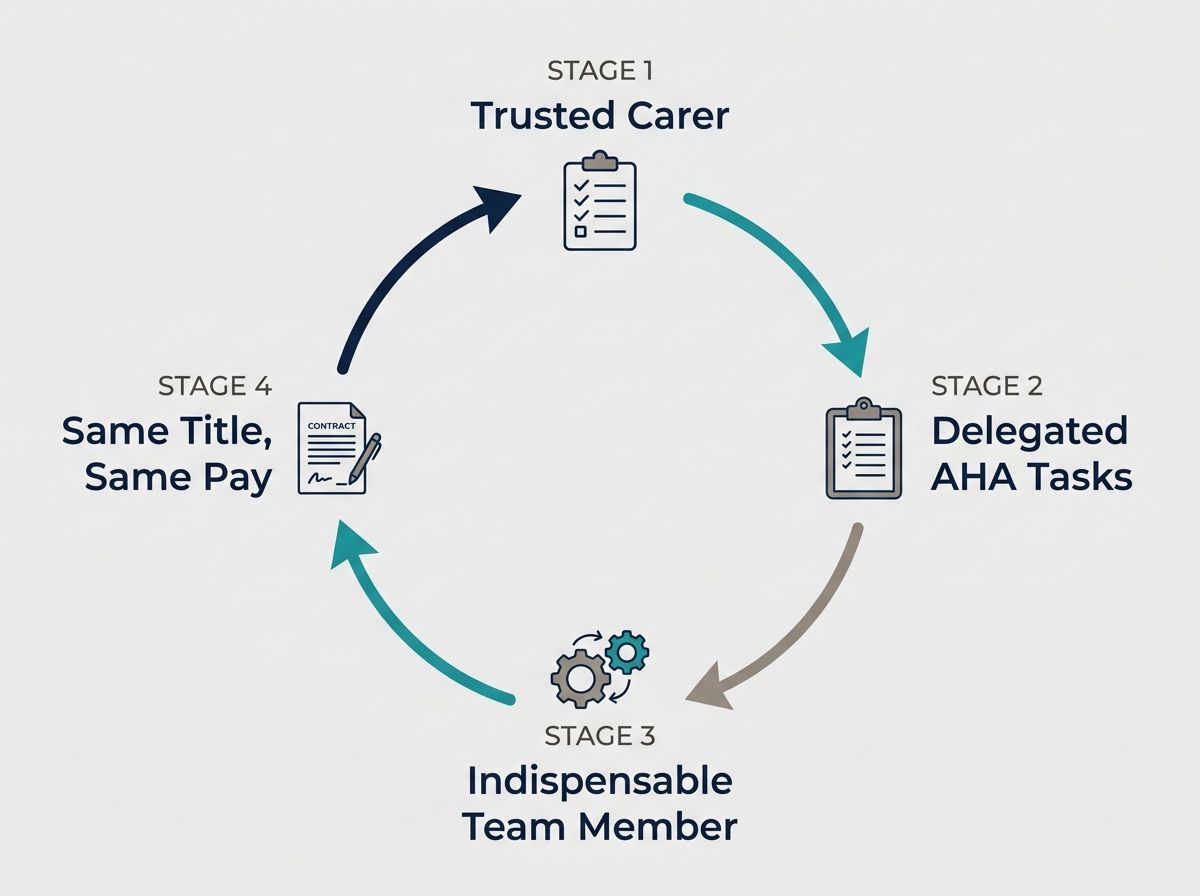
Over time, your responsibilities grow. You support therapeutic activity programs, monitor client progress, and report back to the allied health team. You are the person the team relies on to maintain continuity between formal sessions. In practice, you have become an Allied Health Assistant.
But the title on your contract has not changed. Neither has your pay.
This is not an accident, nor is it a personal failing. It is a structural pattern in the health and community services workforce. It leaves experienced workers carrying responsibilities that exceed their formal classification, without the recognition they have earned.
If this pattern sounds familiar, you are not alone. We have written about how floor experience in aged care often goes unrecognised, and what can be done to fix it.
What the Cert IV in Allied Health Assistance covers
The Certificate IV in Allied Health Assistance (HLT43021) is a nationally recognised qualification listed on the Australian National Training Register. It is structured around 18 units (10 core and 8 elective) with specialisation streams available in physiotherapy support, occupational therapy support, and exercise physiology support.
The qualification prepares workers to operate under the delegation and supervision of Allied Health Professionals, helping to identify risks and report issues. Supervision can be direct, indirect, or remote, depending on the individual's scope of practice and clinical experience.
Core units include assisting with an allied health program, engaging with clinical supervision, and recognising how health conditions affect clients. If you have been doing any of this in your day-to-day work, even informally, you are already working within the scope of this qualification.
The qualification has no formal entry requirements at the training package level. One registered training organisation notes that prior lower-level qualifications or industry experience are strongly advised, though not mandated. Admission criteria, such as basic literacy and numeracy assessments, vary between RTOs.
To achieve the qualification, candidates must complete at least 120 hours of clinical placement, as detailed in the assessment requirements of the individual units. For example, the core unit HLTAHA027 (Assist with an allied health program) requires activities to be performed during at least 120 hours of allied health assistance work, with at least 60 per cent carried out in an allied health workplace.
The financial cost of staying invisible
Pay rates in the social and community services sector, including aged care and disability support, are set through award instruments administered by the Fair Work Commission. The Fair Work Ombudsman publishes a dedicated page of pay rates for the social and community services industry, including details about the Equal Remuneration Order (ERO) that has affected rates for certain classifications over time.
Coverage under these rate-setting arrangements depends on your classification and your specific work stream. Pay rates vary by state, stream, and classification level, and they are updated annually. The Fair Work Ombudsman's Pay and Conditions Tool is the recommended starting point for verifying the current rates that apply to your situation.
What we can say with confidence is that the classification you hold determines the pay rate you receive. If you are classified as a general carer or personal care worker, you are paid at that rate, regardless of whether your actual work aligns with a higher classification. Every year that gap persists is a year of being underpaid for your actual skills.
To understand the pay rates that apply to your specific classification and stream, use the Fair Work Ombudsman's Pay and Conditions Tool. It is the authoritative source for current community services industry rates.
Formal recognition of your work is about more than a title. It is about ensuring your pay rate matches your daily responsibilities.
For a broader look at what staying unqualified can cost healthcare workers over time, read our piece on the hidden cost of working without a formal qualification in health.
Why RPL is the right pathway for working carers
Recognition of Prior Learning (RPL) is a formal assessment pathway within the Australian VET system. It assesses what you already know and can do against the standards of a qualification. It means you do not have to study what you have already mastered in practice.
For care workers already performing AHA duties, RPL is not a shortcut. It is the correct legal pathway. The assessment is rigorous and requires you to prove competency, not simply claim it. However, the evidence you need to prove that competency likely already exists in your day-to-day work.
The process is straightforward. RPL it guides you through gathering your evidence and preparing your documentation. The assessment itself is conducted by a qualified assessor from a registered training organisation (RTO). The RTO determines competency and issues the qualification. If gaps are identified during this assessment, gap training is typically provided to address them.
Because the qualification comprises 18 units, the volume of evidence required across an RPL assessment can be substantial. Requirements vary between RTOs, so you should confirm the specific process with the training provider you choose.
The National Training Register lists HLT43021 as a current qualification. You can verify its status and unit structure directly on training.gov.au.
If you are unsure what counts as evidence in an RPL process, our article on what actually counts as evidence for RPL is a practical starting point.
What evidence do you actually need?
RPL evidence is assessed at the unit level. Each unit in the qualification has its own assessment requirements and conditions, set out in the national training package. What is sufficient for one unit may differ from another, and requirements vary between training providers. The specific evidence types accepted for HLT43021 units should be confirmed with your chosen RTO.
That said, the evidence you need to prove competency is grounded in your actual workplace practice. One provider describes the RPL process as potentially involving submitting documentation, completing a third-party observation checklist, answering knowledge questions, and attending a competency conversation. These are illustrative examples rather than a universal list, and your RTO will guide you on what applies to your situation.
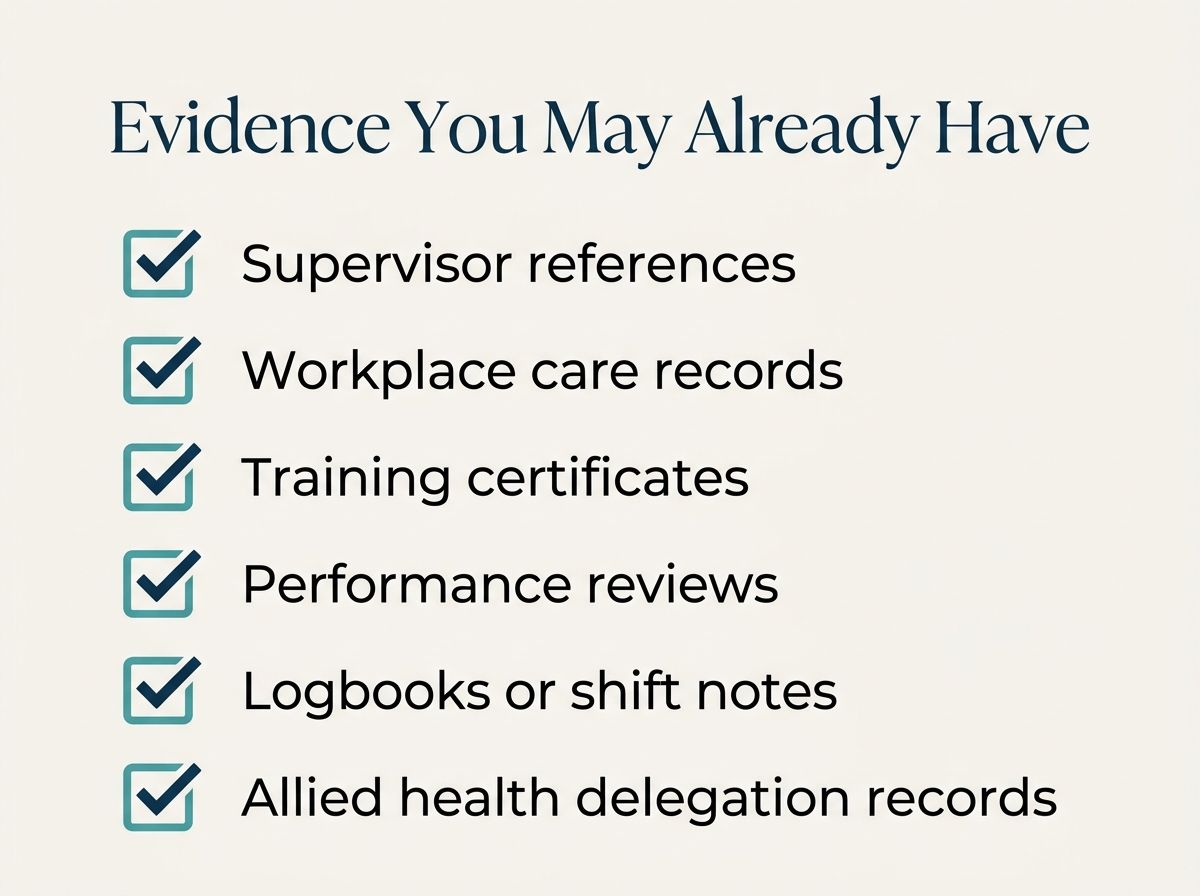
For care workers already performing AHA duties, several types of workplace documentation may be relevant to an RPL conversation. Whether they are accepted, and in what form, depends on the RTO and the specific unit's assessment requirements:
- Supervisor or manager references confirming the tasks you perform daily
- Workplace records or progress notes relating to allied health support activities
- Training certificates, including first aid, manual handling, or any allied health-specific short courses
- Performance reviews that describe your duties in detail
- Logbooks or shift notes documenting client support activities
- Records of allied health team sign-off or delegation arrangements
Workplace documents such as care plans or progress notes may be relevant, but their acceptance as RPL evidence depends entirely on the RTO and the unit's assessment conditions. Some documents will require de-identification to comply with privacy obligations. Confirm these details with your RTO before gathering evidence.
If you have completed any prior VET training, your USI transcript can also support your RPL application. Find out how your USI transcript can support your RPL application.
Is this pathway right for you?
RPL is not suitable for everyone. Honest suitability guidance is far more valuable than a blanket promise, and that is the only kind we offer.
RPL for the Certificate IV in Allied Health Assistance is worth exploring if you have been working in a role where you regularly assist allied health professionals with client programs, mobility support, or therapeutic activities. The more directly your day-to-day work maps to the units in HLT43021, the stronger your starting position.
It is worth being realistic about a few details. The qualification requires 120 hours of clinical placement as a completion requirement. How this interacts with your RPL assessment depends on your RTO and the specific unit requirements. Gap training may be required if your assessor identifies areas where your evidence does not yet demonstrate competency. This is a normal part of the process, not a failure.
The skills in this qualification must be applied in accordance with Commonwealth, State, and Territory legislation, Australian standards, and industry codes of practice. Your assessor will look for evidence that your practice meets those standards, not just that you have performed the tasks.
The best way to find out whether RPL is the right pathway for your experience is to have an honest conversation about it before you commit to anything.
If you are curious about how other health workers have used this pathway, our article on why allied health assistance is a smart pivot for overseas nurses offers a different perspective on the same qualification.
Ready to Get Recognised?
Start with a free skills review to find out if RPL is right for you.