How to find and use your USI transcript to prove past training
Access, read, and use your USI transcript to prove completed VET qualifications and support your RPL application.

Your training history is already on record—you just might not see it yet
You have done the work. Years of it. Think of the short courses taken between jobs, or a statement of attainment from a workplace safety program. Perhaps you started a partial qualification and never finished it—or completed the training but lost the physical paperwork. For many experienced workers, the formal record of that training remains scattered, forgotten, or completely invisible.
The Australian Government holds a centralised record of your nationally recognised VET training. This record is called your USI transcript. For anyone pursuing Recognition of Prior Learning (RPL), this official document can bring to light older training you might have forgotten about—training that can serve as valuable evidence toward a formal qualification today.
This guide explains how to access your USI transcript, what information it contains, and how to use it in an RPL application. If you are not sure what a USI is or whether you have one, our companion guide on the Unique Student Identifier covers those basic details.
If you are new to the USI system, start here.
What is a USI transcript and what does it show?
A USI transcript is an official government-held record of every nationally recognised VET qualification and statement of attainment you have completed in Australia. It is compiled from data reported by registered training organisations (RTOs) to the USI Registry, which is administered by the Student Identifiers Registrar. You can access the official portal at usi.gov.au.
Your transcript lists the details reported by your training providers. This includes the qualification or statement of attainment name, the national training code, the completion date, and the name of the issuing RTO. The RTO name shown on your transcript comes directly from the training organisation name field in the AVETMISS data that the RTO submits to the national registry.
There is an important limitation to keep in mind. Your USI transcript only shows VET training completed from 2015 onwards, when the USI system was first introduced. Qualifications or statements of attainment completed before 2015 will not appear on this record, because training providers were not required to collect or report USI data before that date.
The time it takes for a recently completed qualification to appear on your transcript also varies. RTOs report their training data on different schedules throughout the year, meaning a course you finished recently might not show up on your record straight away.
How to access your USI transcript step by step
Accessing your USI transcript is a simple process. You will need an active USI account and a secure way to verify your identity through the federal government's digital identity system. This is the general process you will need to follow.
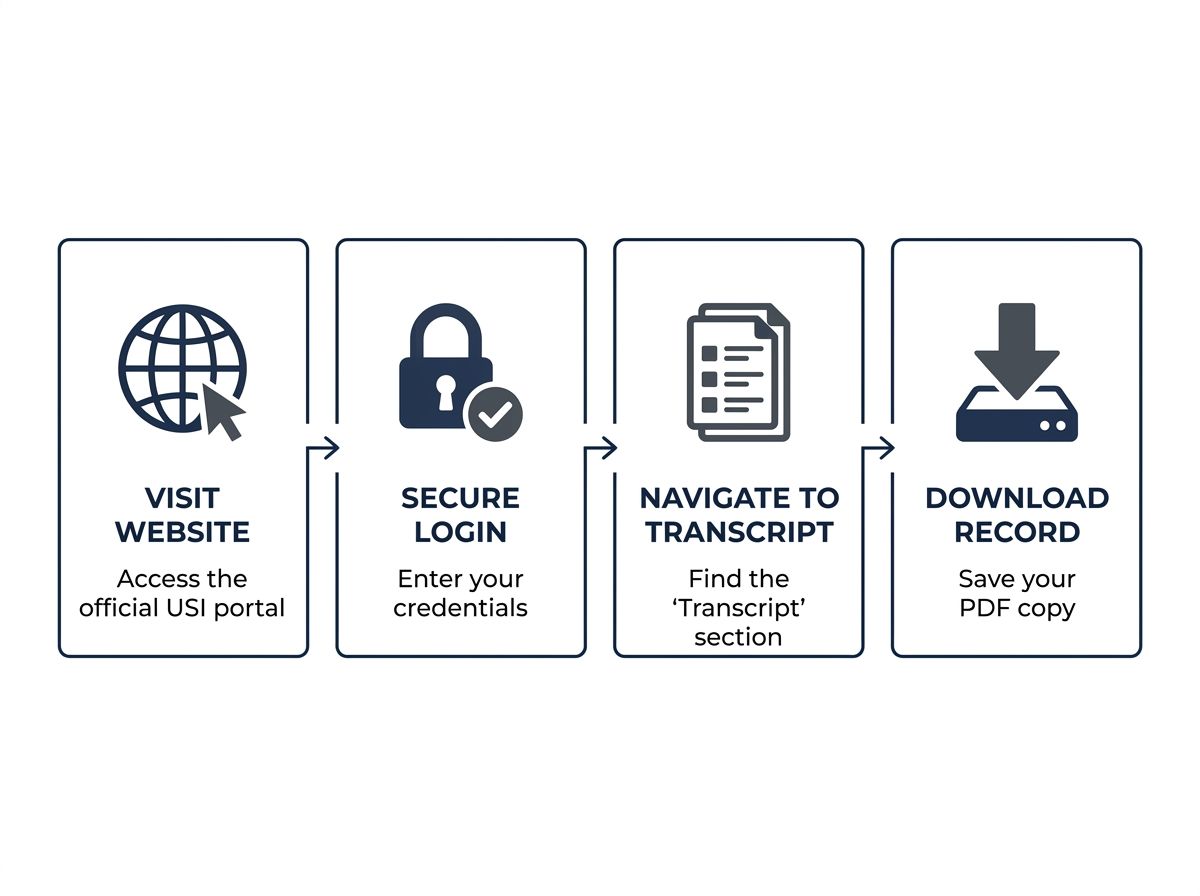
- Go to the official website at usi.gov.au and head to the login page. The portal has separate login areas for individuals and providers; you need to choose the Student Portal.
- Log in using your myGov account. The USI portal connects directly with myGov, allowing you to access your training records using the same credentials you use for other government services. You can also link your USI directly to your myGov dashboard.
- Once you log in, find the transcript section on your student dashboard. Your official USI VET transcript is accessed directly from this area.
- View or download your record. The portal lets you read through your training history online or download a PDF copy to share with your chosen RTO or employer.
- If you need to share your transcript for an RPL application, check the digital sharing options in the portal. Some RTOs prefer you to grant them direct access through the system instead of sending a downloaded file.
Portal functions and login steps can change over time. If the login process looks different when you log on, check the help and support section at usi.gov.au for up-to-date instructions.
What to do if your training is missing from your transcript
This is a common issue, and it does not mean your training is invalid. There are several practical reasons why a completed qualification or unit might not appear on your USI record.
The main reason is timing. If you finished your training before the USI system started, it will not show on your transcript. The USI registry only records nationally recognised VET training completed from 2015 onwards. Any courses completed before this year exist outside this database.
Another reason is that your training provider may not have reported your details to the registry. Although RTOs must submit student data, some providers have been inconsistent with reporting, and others have shut down without handing over complete training files.
If your training provider has closed down, the Australian Skills Quality Authority (ASQA) might hold your records. Closed providers must submit their student files to ASQA when they stop trading. Note that ASQA does not run a central database of every qualification issued in Australia; they can only supply records that closed providers actually sent to them.
If you are trying to find files from a closed provider, ASQA requires you to know the exact name of the RTO. Without this name, they cannot perform a search. ASQA keeps a public register of closed RTOs that successfully submitted student records; check this register on the ASQA website before submitting a formal search request.
If your training provider is currently closing down or has entered administration, ASQA will not have these records yet. Your best course of action is to contact the provider or their appointed administrator immediately to ask for your certificates before the business closes permanently.
If your provider was regulated by the Victorian Registration and Qualifications Authority (VRQA) or the Western Australian Training Accreditation Council (TAC), you can contact those state bodies directly to request your student records.
Some state and territory training regulators operating before 2011 did not collect records from closed RTOs. If your training took place before then, official records might not exist in any government database.
An incomplete USI transcript does not weaken your RPL application. Your practical experience, supervisor references, and work samples carry major weight with assessors. The transcript is simply one piece of evidence among many.
Read our guide on what RPL assessors look for before you start gathering your evidence.
How to use your USI transcript for RPL
Your USI transcript is a useful starting point for your application, but it is not the entire evidence file, nor does it guarantee automatic qualification on its own.
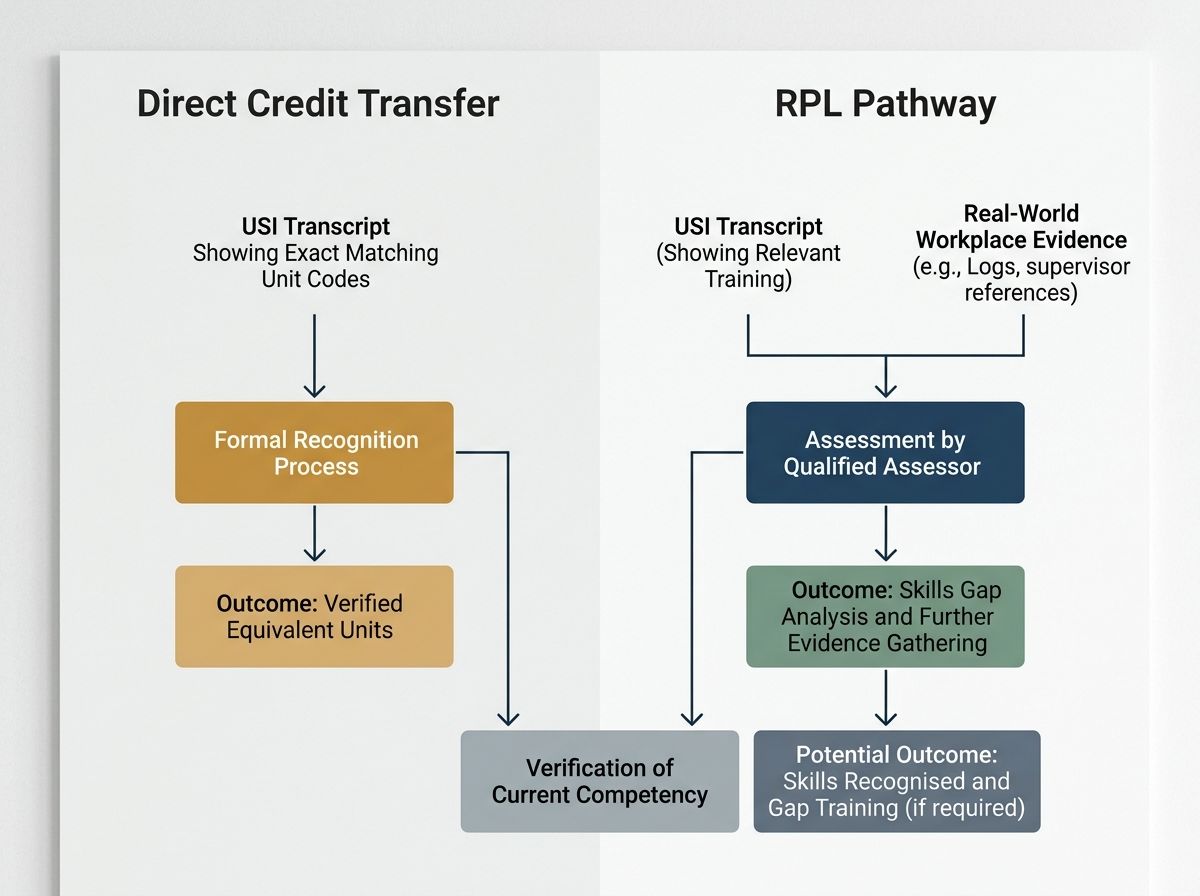
A transcript entry is relevant to two separate pathways. The first pathway is credit transfer. If your record shows completed units that match the exact codes in your target qualification, an RTO can grant credit transfer. This is a direct match of completed formal training, where the transcript entry acts as the sole evidence required.
The second pathway is RPL, which is broader. This process assesses your actual competency—your day-to-day work skills, knowledge, and experience—regardless of where or how you learned them. A transcript entry showing prior training supports your RPL application, but assessors will still need other evidence like work samples, workplace documents, and references from supervisors.
Treat the transcript as a starting point rather than a final assessment. It documents your formal training, while your daily work shows what you can actually do on the job. Together, these two elements give an assessor a complete view of your professional capability.
Finding forgotten training on your USI transcript
When you access your transcript, you might find courses you had completely forgotten you completed. These could include a safety induction from an old job, a first aid certificate with nationally recognised units, or a brief training module completed years ago that you never listed on your current resume.
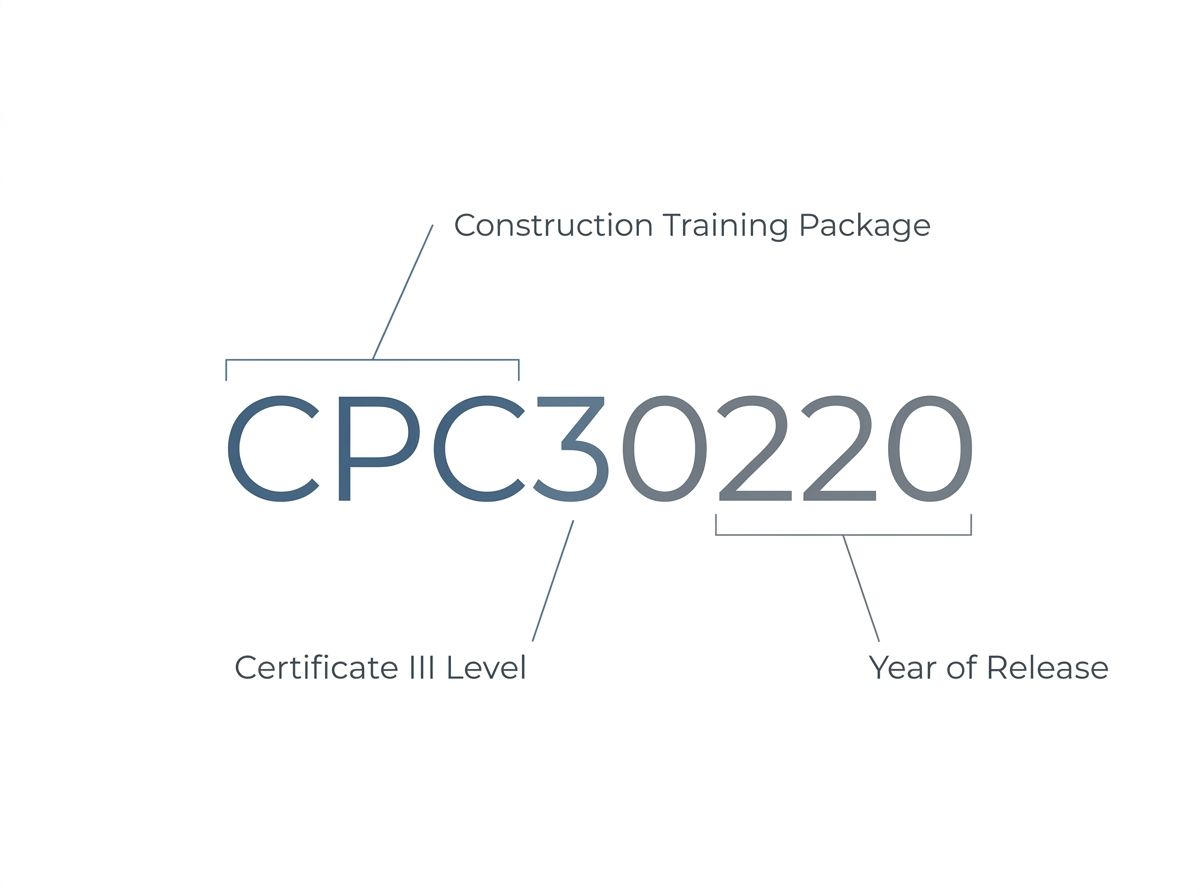
Every entry on your record shows a national training code made up of letters and numbers that identify the specific unit or qualification. These codes follow a standardised system across the country. For example, codes starting with 'CPC' relate to construction, plumbing, and services, while 'CHC' codes cover community services and health.
If you see an unfamiliar code, you can search for it on training.gov.au, the official national register of vocational education and training. This database is the authoritative source for details on training packages, units, and qualifications. Searching the code will show you the full title, the specific skills it covers, and whether the unit remains current.
training.gov.au is the official national register for vocational education and training in Australia, providing authoritative details on units, qualifications, and training packages.
Look closely at your statements of attainment alongside any full qualifications. A statement of attainment proves you completed specific units of competency. Even if you did not finish a full qualification, these units are formal records of training that can often match requirements in your target qualification.
If a qualification on your transcript is marked as superseded, it means a newer version has replaced it. Speak with an RPL specialist about how training providers view older qualifications, as assessment policies for outdated codes vary depending on the industry and the RTO.
Find out what your work experience is worth
Your transcript is only one part of your professional history. It records what you completed in the classroom since 2015, but for most experienced workers, the most valuable evidence comes from your day-to-day work over several years—the practical skills, industry knowledge, and problem-solving abilities that no formal record can capture.
RPL values both forms of learning. Your transcript identifies forgotten formal qualifications or units, while your daily work, references, and practical samples show what you can do right now. Together, these elements form the core of a strong RPL application.
The next step is mapping your formal training and practical experience to an actual qualification. This is exactly what we do during a Free Skills Review.
Learn what RPL assessors look for before you start collecting your evidence.
Ready to Get Recognised?
Start with a free skills review to find out if RPL is right for you.