Why 10 years of care experience matters more than a textbook (and how to prove it)
You have been showing new graduates how to do the job for years. RPL in aged care is a practical way to prove your existing skills without going back to study.

The moment that shows your experience
You are on the floor in the facility. A new carer has just started their first week, fresh out of training. A resident becomes distressed. You watch for a moment, step in, speak quietly, redirect them gently, and the tension diffuses. The new carer watches you handle the situation. They will ask you how you did that later in the shift.
That is the moment that demonstrates what you actually know.
You have had that moment, or something very similar, more times than you can count over a decade of floor work. You know which residents need extra time in the morning. You know when something is wrong before any vital signs confirm it. You know how to speak to a family that is frightened, angry, and does not know where to direct their worry.
None of that is found in a textbook, yet on paper, you remain unqualified.
What a textbook cannot teach
The Certificate IV in Ageing Support (CHC43015) covers essential industry competencies, including providing person-centred care, legal and ethical compliance, supporting individual independence, and working with diverse groups of clients. These are the formal units of competency assessed within this qualification.

However, the skills that make an experienced aged care worker highly capable develop through years of practical work on the floor. These skills include:
- Reading a resident's non-verbal cues when they are no longer able to communicate clearly
- De-escalating distress in a resident living with dementia by knowing when to speak, when to be silent, and when to simply remain present
- Recognising the early signs of physical deterioration before the situation becomes a crisis
- Navigating complex family dynamics with care, including managing worried relatives and the anticipatory grief that families experience
- Mentoring new staff members through their initial difficult shifts
- Documenting incidents accurately and comprehensively under pressure
- Performing manual handling with the safe, instinctive precision that comes from daily repetition
These are professional competencies, not optional attributes. They are the reason experienced aged care workers are indispensable, and why it is frustrating when the system does not formally recognise this expertise.
Why the system requires formal qualifications
The aged care sector in Australia operates under strict, ongoing regulatory oversight. The Royal Commission into Aged Care Quality and Safety, which delivered its final report in 2021, made clear recommendations for stronger workforce qualifications and established minimum standards. The Aged Care Act 2024 introduced new statutory obligations for providers, specifically around staffing qualifications and the skill mix of workers.
The entry-level qualification for aged care work is the Certificate III in Individual Support. For roles with greater responsibility, such as leading care, supervising staff, or managing complex needs, the Certificate IV in Ageing Support (CHC43015) is the industry standard.
This requirement is about how evidence must be presented, rather than a doubt of your competence. Regulators, employers, and insurance providers require formal documentation of competency because large-scale formal systems must operate on a consistent, easily assessable standard.
The worker has the capability, but the challenge lies in how that capability is documented. This is the specific issue that RPL for aged care addresses.
Understanding what RPL assessors look for helps clarify what qualifies as acceptable evidence.
RPL in aged care: what it actually is
Recognition of Prior Learning (RPL) for aged care is a formal assessment process. It evaluates your existing hands-on skills and experience against the specific units of the Certificate IV in Ageing Support (CHC43015). If your documented evidence demonstrates competency in these units, the qualification is awarded by a registered training organisation (RTO). If gaps are identified in your evidence, some additional training will be required to complete the qualification.
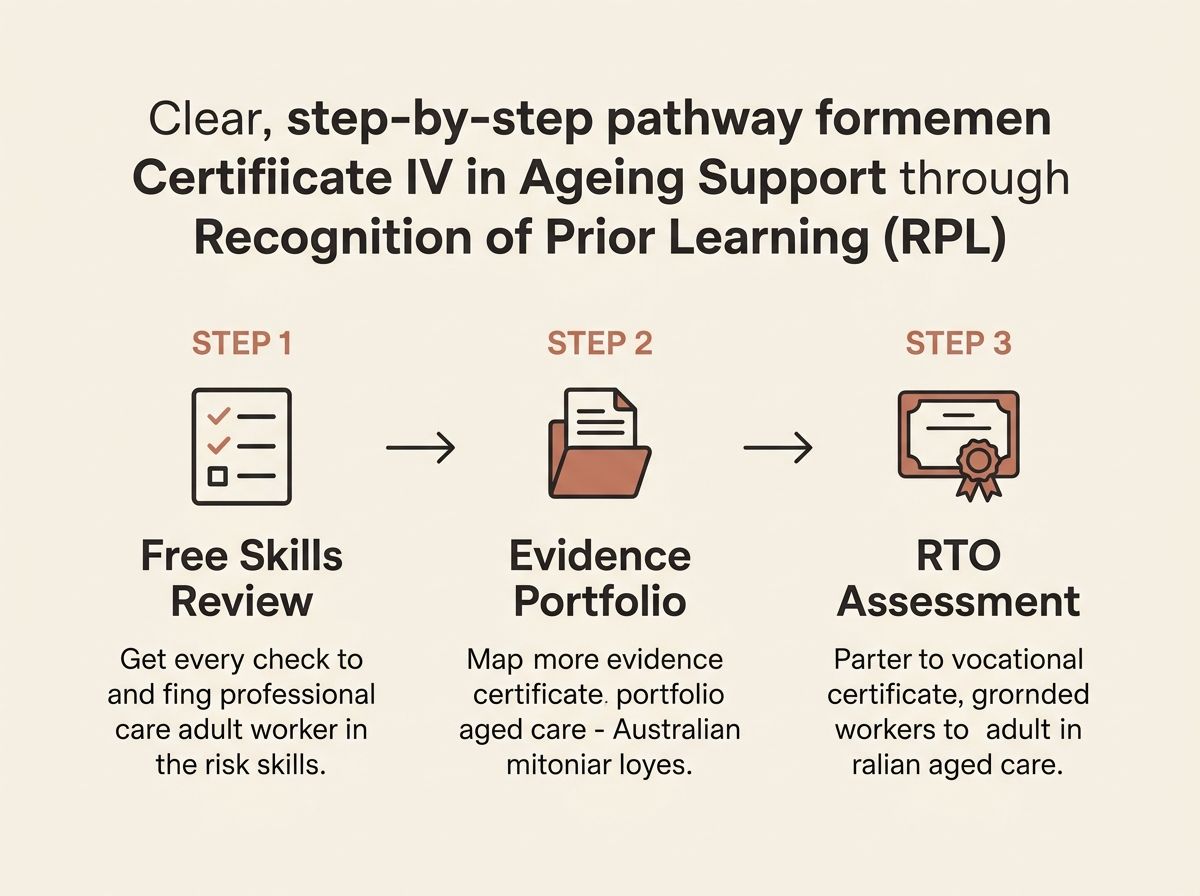
RPL is a rigorous, nationally recognised assessment pathway, not a shortcut. The assessor is a qualified professional from the partnering RTO, and their judgement is independent. The resulting qualification is the same CHC43015 produced by traditional study, as the assessment standard remains identical.
RPL it does not assess your work or award qualifications directly. Instead, we guide you through the initial process of identifying, organising, and presenting your evidence so that the partner RTO assessor can review it. This distinction is important: your qualification is earned through a formal assessment of your skills, not granted as a convenience.
If your evidence shows competency in all required units, the qualification is awarded. If gaps are identified, they must be addressed through extra training before the qualification is issued. Any gap training requirements and associated costs will be clearly outlined during the assessment process.
What counts as evidence for RPL
RPL assessment relies on documentation showing you can perform the competencies required by the CHC43015 units. For experienced workers, this evidence usually exists already; it simply needs to be compiled and organised.
The types of evidence that RTO assessors look for during the RPL process include:
- Employment records, including payslips, contracts, and job descriptions confirming your role and hours worked
- Supervisor or manager references, which are written statements from people who have directly observed your day-to-day work
- Third-party reports and observations from colleagues, team leaders, or allied health professionals who can verify your skills
- Care plans and case notes that you have written or contributed to, showing your approach to person-centred care
- Incident reports and progress notes showing your ability to document and respond to workplace situations
- Training records, including in-house courses, mandatory compliance certificates, or professional development sessions
- Evidence of mentoring or supervision, such as logs or references confirming you have guided newer staff members
Most experienced aged care workers have years of this material. The challenge is not a lack of proof, but knowing how to match it to the qualification units. Professional guidance helps you organise these documents to satisfy the RTO standards.
The free skills review: how the process begins
Your experience is valuable. The Free Skills Review is designed to show how much of your work history already aligns with the CHC43015 standard. This review costs nothing and carries no obligation to proceed.
This review is a practical assessment of your suitability, not a sales call. We prefer to guide workers to the correct pathway rather than suggest RPL if it is not the right fit. If RPL is suitable for you, we will map out the next steps. If not, we will explain why, leaving you with clear options.
What happens after the initial review
If the Free Skills Review shows that RPL is a viable option for your situation, you will begin the process of gathering your evidence. RPL it assists you in identifying, locating, and structuring the documents needed to prove your competency against the required CHC43015 units.
Once compiled, this documentation is submitted to the RTO assessor. A qualified assessor from the partner RTO reviews your entire submission against the national competency standards. Their assessment is independent and based strictly on the provided evidence.
If the evidence provided is sufficient across all required units, the Certificate IV in Ageing Support is awarded to you. If any gaps are identified, they must be addressed through gap training before the qualification is issued. The credential is fully and nationally recognised because it meets the exact same assessment standard as traditional classroom study.
The assessment process takes the time it needs to verify your skills, depending on your evidence and the assessor's review. Because of this, we do not promise specific timeframes or instant turnarounds. However, you will have support at each stage of the journey.
This recognition pathway is also available across other community and health sector roles.
You have already done the work. Deciding how to use that experience is your next step.
Ready to Get Recognised?
Start with a free skills review to find out if RPL is right for you.