Why your years of experience feel invisible (and what actually counts for RPL)
Years of hands-on experience but no formal qualification? Understand what RPL requirements in Australia actually involve and what evidence assessors look for.

The invisible resume problem
You have the experience. You have spent years, or even decades, doing the work. You have trained colleagues, solved problems, managed complex tasks, and delivered results. Yet, when a job application asks for a formal qualification, or when a promotion requires a piece of paper you do not have, something quietly deflating happens. Your expertise feels invisible.
This is not a skills problem; it is a translation problem. Your competence exists in a form that formal systems struggle to read. According to the Australian Bureau of Statistics, around 36% of Australians aged 15–74 do not hold a formal non-school qualification. Among those who do hold one, employment rates are significantly higher at 80%, compared to 58% for those who do not. The gap between what people can do and what they can prove on paper is real, and it affects a substantial portion of the Australian workforce.
Recognition of Prior Learning (RPL) exists because this gap exists. It is a formal assessment pathway rather than a workaround, designed to evaluate what you already know and can do. Understanding what RPL requirements in Australia actually involve is the first step in knowing whether this pathway applies to your situation.
What RPL actually is (and what it is not)
Recognition of Prior Learning (RPL) is a formal assessment process. It evaluates skills and knowledge gained through work experience, informal training, or life experience to see if those skills meet the requirements of a nationally recognised qualification. A qualified assessor from a Registered Training Organisation (RTO) conducts the assessment. If awarded, the qualification is nationally recognised under the Australian Qualifications Framework, which is the same system that governs qualifications earned through traditional classroom study.
RPL is a rigorous assessment pathway rather than a shortcut or a lesser qualification. It asks a straightforward question: can you demonstrate the competencies required for this qualification? The answer is determined by your evidence, not by how long you sat in a classroom.
RPL does not bypass assessment and it does not guarantee a qualification. It is not suitable for everyone. Honest suitability guidance is important, and a reputable provider will tell you if RPL is not the right pathway for your situation before you commit to anything.
What RPL requirements in Australia actually involve
RPL requirements in Australia focus on demonstrating competency through evidence rather than sitting exams or completing coursework. Assessors look at what you have done, what you can show, and what others can confirm about your work. The evidence you provide is assessed against the units of competency in the qualification you are seeking.
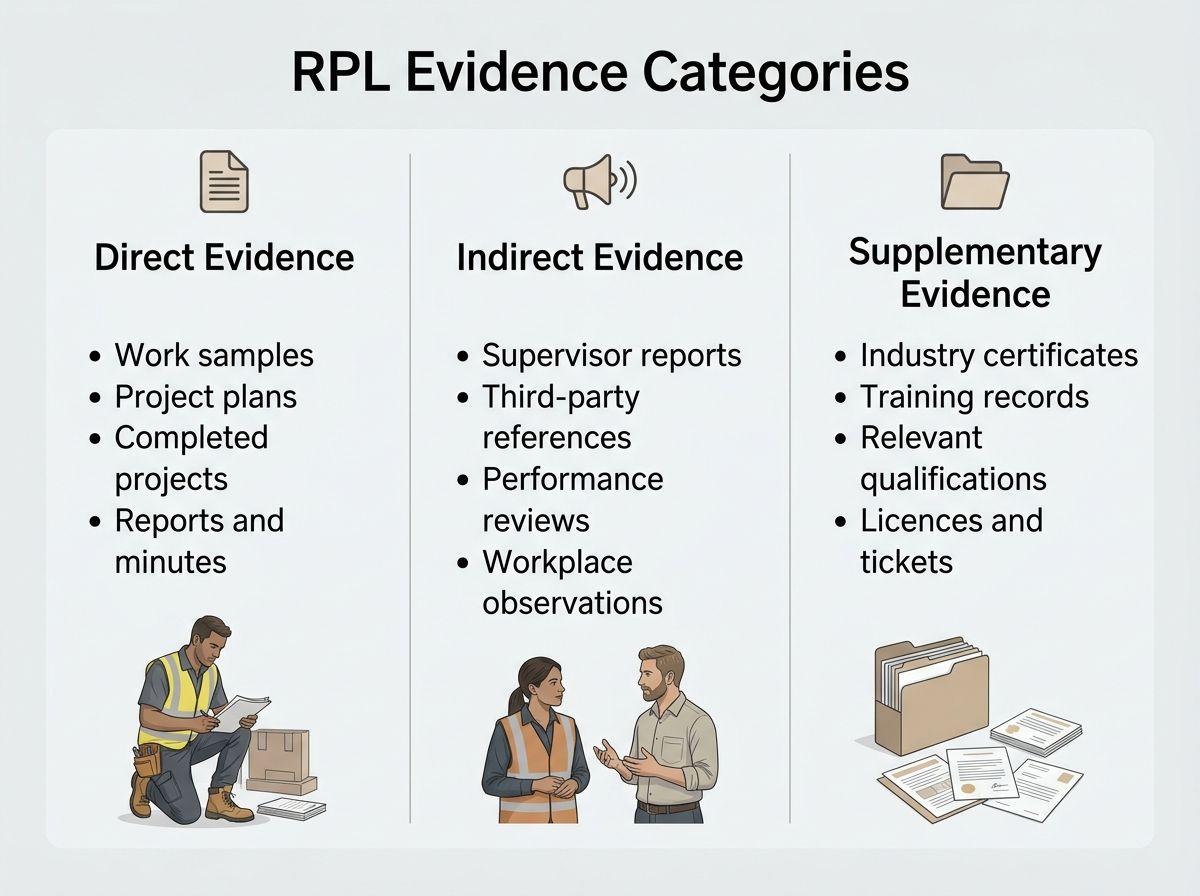
RTO guides commonly describe three broad categories of RPL evidence:
- Direct evidence: Work samples, reports, project plans, and documentation you produced in your role. This is material that directly demonstrates your competency.
- Indirect evidence: Third-party confirmation of your skills, such as employer references, supervisor statements, performance reviews, or letters from clients and colleagues who can speak to your work.
- Supplementary evidence: Supporting materials including certificates from prior training or workshops, job descriptions, position statements, or records of professional development.
In trades and hands-on industries, photos and videos of completed work are particularly useful because they provide direct, visual evidence of practical competency that written documents alone cannot convey. In community services and care roles, case notes, care plans, and supervisor references carry significant weight, while business and management roles rely on project documentation, reports, and decision records.
The specific evidence required varies by qualification, RTO, and the units of competency being assessed. There is no universal checklist. What matters is that the evidence, taken together, gives the assessor confidence that you can perform the required tasks to the standard the qualification demands.
For a practical overview of how evidence is typically gathered and submitted, the METS Training Services RPL guide outlines the types of documentation that RTOs commonly accept across a range of industries.
Why assessors care about competency, not credentials
The Australian VET system is built on competency-based training. Training packages specify the knowledge and skills (the competencies) required to perform effectively in the workplace. Units of competency are then packaged into nationally recognised qualifications that align with the Australian Qualifications Framework.
This matters for RPL because assessors do not look for an existing credential. They look for evidence that you can perform the work. A recent graduate with a qualification but limited practical experience and a veteran worker with fifteen years on the job are both assessed against the same units of competency, answering the same question: can you meet the standard?
This is why years of hands-on experience can satisfy RPL requirements. Experience is not lesser than formal education; it is simply a different form of evidence. When it is properly documented and presented, it can be assessed against the same standard.
The Productivity Commission's Report on Government Services 2026 describes how training packages in the Australian VET sector specify the knowledge and skills required to perform effectively in the workplace, which forms the foundation on which RPL assessment is built.
What happens if there are gaps
Honest guidance is essential here. Not every candidate has evidence for every unit of competency in a qualification. When an assessor identifies gaps where your evidence is insufficient to demonstrate competency, gap training is typically required to address those specific areas.
Gap training is targeted, addressing the specific units where evidence is lacking rather than the entire qualification. It does not mean the RPL process has failed; it shows that the assessment is rigorous and honest. At RPL it, gap training is included at no additional cost when it is required.
The possibility of gap training is one reason why an honest skills review is so important before you begin. Understanding upfront where your evidence is strong and where it may need support means you can approach the process with clear expectations, rather than discovering gaps after you have already committed.
The RPL process: what to expect step by step
The RPL process in Australia follows a clear sequence. While timeframes vary depending on the qualification, the RTO, and the completeness of your evidence, RTO guides commonly outline the following steps:
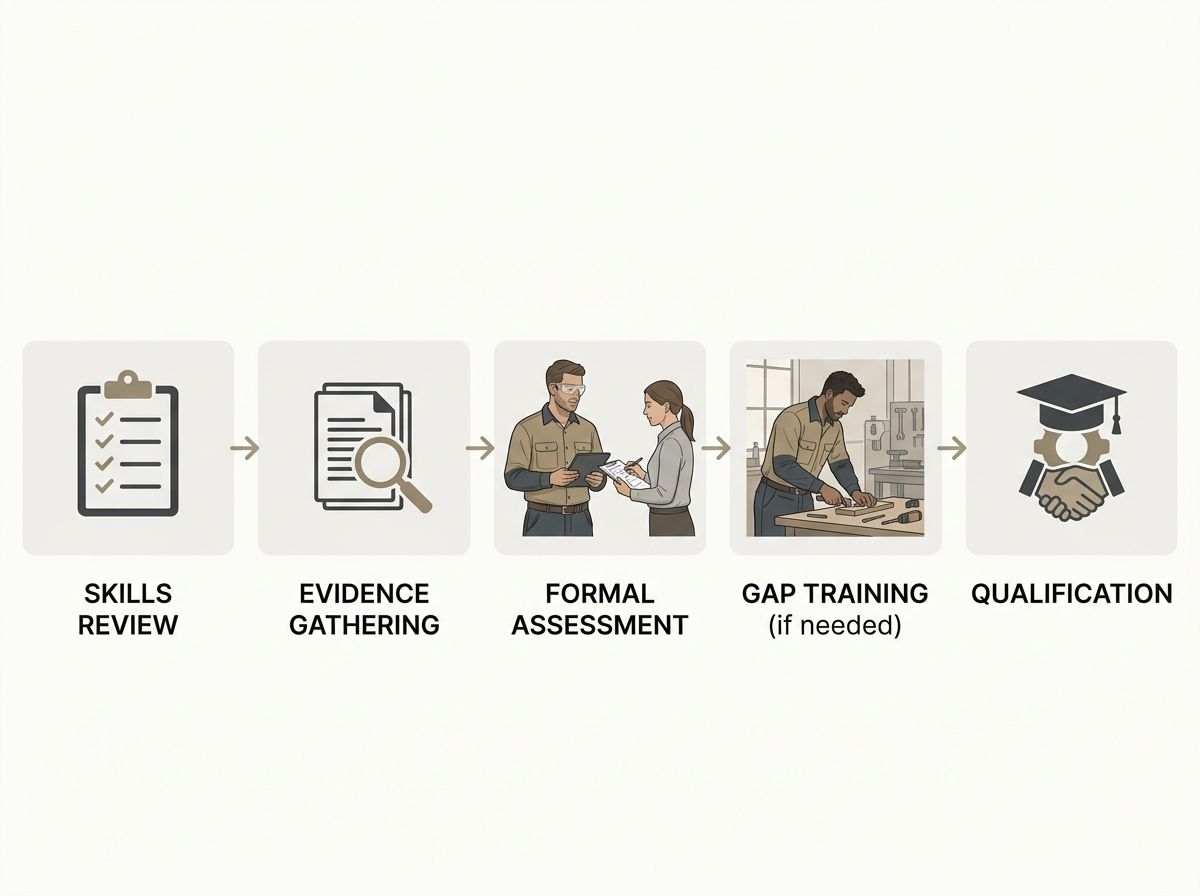
- Step 1: Skills review. An initial conversation to assess whether your experience is likely to align with the qualification you are seeking. This is the stage where your suitability is honestly evaluated before any commitment is made.
- Step 2: Evidence gathering. You compile the documentation, work samples, references, and other materials that demonstrate your competency. A reliable guide will help you understand what is needed and how to present it.
- Step 3: Formal assessment. A qualified assessor from the delivering RTO reviews your evidence against the units of competency in the qualification. They may also ask questions or request a workplace observation to verify your practical skills.
- Step 4: Outcome. If competency is demonstrated across all required units, the qualification is issued by the RTO. If gaps are identified, targeted gap training addresses those specific areas before the qualification can be awarded.
- Step 5: Qualification issued. The nationally recognised qualification is issued by the RTO. This is the exact same qualification that would be issued to a student who completed the course through traditional, classroom-based study.
Timeframes vary. RTO guides suggest the process commonly takes anywhere from a few weeks to a few months, depending on the qualification level and how quickly evidence can be gathered and assessed. These are estimated figures, and your specific timeline will depend on the RTO and the qualification involved.
For a broader view of the industries and qualification types where RPL is commonly used in Australia, the Qualify Me RPL overview covers a range of sectors including building and construction, community services, hospitality, and business.
Your experience is real. The question is how to present it.
The issue is not that your experience is lacking, but that it exists in a form that formal systems cannot read. RPL is the translation mechanism. It is a rigorous, nationally recognised assessment pathway that takes what you have already done and evaluates it against the qualification standard.
Experience can be evidence, and our guided pathway exists to help you prove it.
The decision about whether to pursue RPL is yours. It begins with knowing whether your specific experience aligns with a qualification, which is exactly what a Free Skills Review is for. There is no enrolment and no cost, just an honest assessment of where you stand.
If you have ever updated your resume and felt the frustration of fifteen years of work looking like a blank space, this article on why experience without credentials creates a blank space on paper is worth reading.
Ready to Get Recognised?
Start with a free skills review to find out if RPL is right for you.