Why Australian Universities Ignore Your 10 Years of Industry Experience
Australian education systems are built to ignore industry experience. Here's the pattern behind every rejection — and how RPL qualifications change the equation.
By RPL it Australia10 min read

The Rejection That Shouldn't Have Happened
You applied for a Diploma. Or a Graduate Certificate. Or an advanced program you have been working toward for years. The response came back: application unsuccessful — missing prerequisite qualifications.
You have spent a decade in the field. You have mentored graduates from this very institution. You have solved problems the textbook has not caught up to yet. And the system looked at your application and saw a gap.
This is not an edge case. It is not bad luck. It is a pattern — and it repeats across every industry, every qualification level, and every type of institution in Australia. Once you see it, you cannot unsee it.
This Is Not Bad Luck. It Is a Pattern.
The frustration you are feeling has a name: the Education Lockout. It describes the recurring cycle where experienced professionals are blocked from formal education pathways — not because they lack competence, but because their competence exists in the wrong form. The system requires qualifications. You have experience. These are not the same currency.
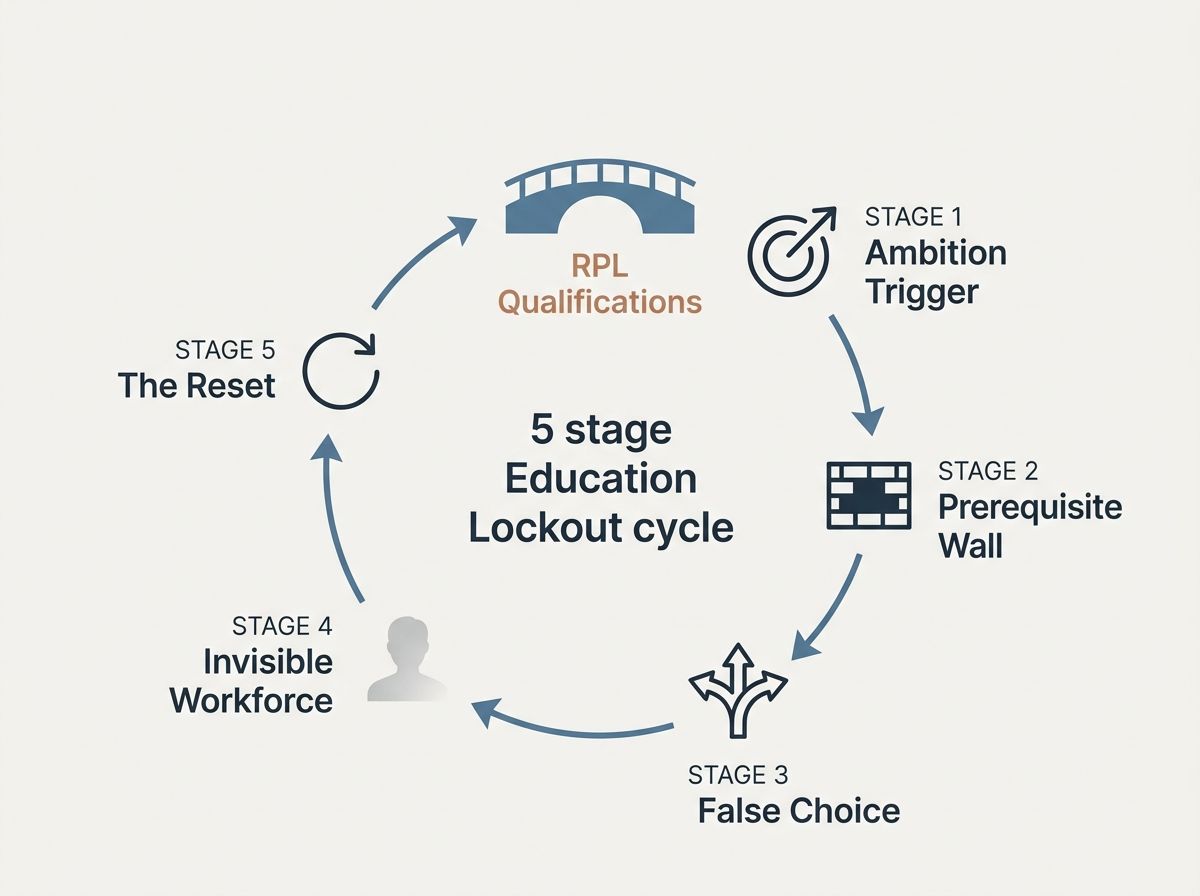
The Education Lockout follows five predictable stages. They repeat regardless of your industry, your seniority, or the specific program you are trying to enter. Naming the stages is the first step to understanding why this keeps happening — and what can be done about it.
- Stage 1: The Ambition Trigger — you decide to formalise your expertise
- Stage 2: The Prerequisite Wall — the system asks for what you already have
- Stage 3: The False Choice — study what you know, or give up
- Stage 4: The Invisible Workforce — experience that doesn't count
- Stage 5: The Reset — starting over when you were already there
If this cycle sounds familiar, you are not alone. It is the same pattern that creates what many experienced professionals describe as the paper ceiling that blocks experienced professionals.
Stage 1: The ambition trigger — you decide to formalise your expertise
The cycle begins with a legitimate career goal. A promotion that requires a Diploma. A postgraduate program that asks for a Graduate Certificate as a prerequisite. A licence upgrade that demands a Certificate IV you do not hold on paper. A new role that lists a qualification you have effectively been performing for years.
You have the competence. You decide to make it official. This is the moment of agency — and the last moment before the system pushes back.
Stage 2: The prerequisite wall — the system asks for what you already have
Q: Why do universities and RTOs require prerequisites even when you have relevant experience? A: Because the Australian qualification system is built around documented competency, not demonstrated competency. Institutions require qualifications — the formally assessed, nationally recognised evidence of learning outcomes — because they cannot verify undocumented experience. A decade on the job does not appear in the system. A Certificate III does.
The application process reveals a prerequisite you do not hold on paper — but demonstrably have in practice. You need a Certificate IV before you can enrol in the Diploma. You need the Diploma before the Graduate Certificate will consider you. You need the qualification that describes exactly what you have been doing for the past eight years.
This is not malice. It is design. The system is built to accept qualifications as evidence. Your experience, however deep, is not in that format.
This structural logic — where the qualification required is precisely what your experience already delivers — is what we call the prerequisite trap that blocks experienced professionals from the programs they're ready for.
Stage 3: The false choice — study what you know, or give up
The system now presents two options. Enrol in the prerequisite program — and spend six months, twelve months, or longer studying content you have applied at work for years. Or abandon the goal entirely.
Neither option honours what you already know. The first asks you to repeat a journey you have already completed. The second asks you to accept that your experience does not count.
This is the injustice at the heart of the Education Lockout. It is not a personal failing. It is a systemic one.
Stage 4: The invisible workforce — experience that doesn't count
The professionals who comply reluctantly spend months in classrooms covering material they have applied for years. Those who do not comply remain stuck. Either way, the system fails to capture the value of their existing expertise.
This is not a small problem. A parliamentary inquiry into skills recognition found that inconsistent training, assessment, and licensing requirements between states impede the mobility of skilled labour — and that occupational licensing regimes create barriers that undermine labour market efficiency and productivity growth.
The same inquiry noted increasing workforce shortages across health professions, particularly in rural and remote areas — shortages that persist in part because the skills of experienced workers are not being formally recognised.
Experienced workers are either delayed by redundant study or lost to the formal qualification pathway entirely. The system's inability to see their expertise is not just frustrating for individuals — it is a workforce-level cost.
Stage 5: The reset — starting over when you were already there
The final stage of the cycle is the reset. The professional either starts from the beginning of a qualification pathway they have already surpassed in practice — or they disengage from formal education entirely. The goal is deferred. The cycle is ready to repeat for the next career ambition.
Recognition should not require starting over. But without a formally recognised alternative, starting over is often the only option the system presents.
Why the system is built this way
The Education Lockout is not a bug. It is a feature of how Australian qualification frameworks are designed — and understanding that design is the first step to working within it rather than against it.
The Australian Qualifications Framework (AQF) is the national policy guide for regulated qualifications in the Australian education and training system. It defines the essential characteristics and required learning outcomes for every qualification — from Certificate I through to doctoral degrees.
The AQF incorporates qualifications from senior secondary, vocational education and training (VET), and higher education into a single comprehensive national framework.
The framework comprises ten levels. VET qualifications sit at Levels 1 to 8. Higher education ranges from Levels 5 to 10. Each level defines specific learning outcomes — and prerequisites exist to ensure that students entering a higher-level qualification have already demonstrated the outcomes of the level below.
All AQF qualifications are quality assured through government accreditation processes. Only authorised providers may issue them.
The key reasons for AQF qualifications include ensuring national recognition and consistency — a common understanding across Australia of what defines each qualification.
This is why prerequisites exist. The system is not designed to be obstructive. It is designed to be consistent. Institutions require qualifications because qualifications are the only evidence format the system is built to verify. Your experience is real. But it is not in the format the system can read.
The AQF framework links school, vocational, and higher education qualifications into a single national system, allowing movement between levels and institutions — but that movement depends on holding the recognised qualification at each level.
RPL qualifications: the break in the cycle
Q: What are RPL qualifications? A: Recognition of Prior Learning (RPL) is the formally recognised mechanism within the Australian qualification framework that allows experienced professionals to have their existing competency assessed against qualification standards — without repeating study they have already surpassed in practice.
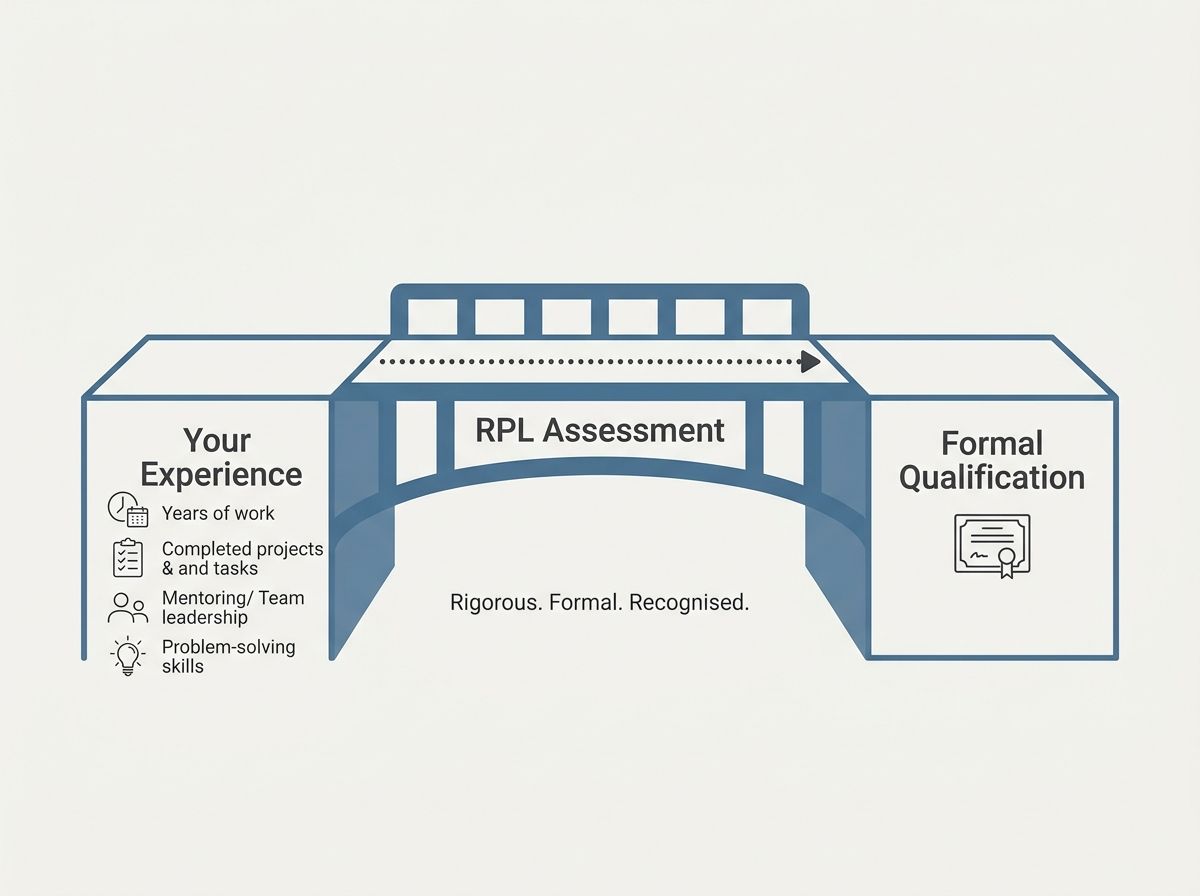
RPL qualifications are not a shortcut. They are a rigorous assessment pathway. The AQF explicitly recognises RPL as a pathway for people seeking credit for previous study or employers looking to verify qualifications.
In practice, RPL assessment involves presenting evidence of your existing competency — work samples, employer references, records of professional practice — which is then assessed by a qualified assessor from a Registered Training Organisation (RTO) against the relevant qualification standards. The assessor determines whether your evidence demonstrates current competency. If it does, the qualification is awarded. If gaps are identified, targeted training may be recommended to address only those specific gaps.
Evidence provided in RPL must be current, authentic, valid, and sufficient. The assessor must be confident that you are currently competent against the endorsed industry competency standards — not merely that you were competent at some point in the past.
According to the Western Australian Government's fact sheet on Recognition of Prior Learning, RPL is an assessment process that must meet the Principles of Assessment and the Rules of Evidence — the same standards that apply to any other form of formal assessment in the VET sector.
RPL assessment timeframes vary depending on the qualification, the quality of evidence, and the delivering RTO. Indicative ranges from RTOs suggest that assessment may take anywhere from two to eight weeks — compared to the months or years required for traditional study of an equivalent qualification.
These are indicative ranges only. Actual timeframes depend on your specific situation, the qualification being assessed, and the evidence you are able to provide. They are not guaranteed outcomes.
Understanding how an RPL certificate translates your experience into a format institutions recognise is the first step toward breaking the Education Lockout cycle.
What RPL qualifications can — and cannot — do
Q: Can RPL replace a prerequisite qualification? A: In many cases, yes — RPL can be used to demonstrate competency at the prerequisite level, allowing entry to a higher-level program. However, this depends on the specific institution, the qualification, and the evidence you can provide. Not every institution accepts RPL for every prerequisite, and not every candidate will have sufficient evidence to meet the required standard.
RPL qualifications can:
- Convert demonstrated competency into formally recognised credentials
- Provide a pathway to bypass prerequisite requirements where your evidence meets the standard
- Unlock entry to programs that were previously inaccessible due to missing qualifications
- Recognise experience across multiple industries and qualification levels
RPL qualifications cannot:
- Guarantee a qualification outcome — the assessor's determination is independent
- Replace genuine gaps in competency — if you haven't demonstrated a skill, gap training may be required
- Work for every candidate in every situation — suitability depends on your evidence and the specific qualification
- Bypass the rigour of formal assessment — the standard is the same as any other assessment pathway
RTOs are required to offer RPL to all applicants on enrolment and to provide adequate information and support to gather reliable evidence.
If evidence gaps are identified during assessment, the assessor may recommend targeted gap training covering only the missing units — not the full qualification.
Honest suitability guidance is part of the process. RPL it would rather guide someone to the right pathway than enrol them in the wrong one.
For a structured self-assessment of whether RPL may be appropriate for your situation, the Productivity Commission's Report on Government Services tracks participation barriers in VET — a reminder that the challenge of accessing formal qualifications is a recognised, systemic issue, not a personal one.
If you are unsure whether RPL is the right pathway, a self-assessment to determine whether RPL is the right pathway for your situation can help clarify your options before you commit to anything.
Your experience has already earned this. The question is whether it has been recognised.
Return to the opening scene. The rejection that should not have happened. The application that came back with 'missing prerequisites' despite a decade of demonstrated competency.
The gap was not competency. It was documentation. Your experience was always sufficient. The system simply could not see it in the format it requires.
You have the experience. You have the evidence. The question is whether the system has seen it.
Experience can be evidence. RPL qualifications exist to make that translation — rigorously, formally, and within the framework the system accepts. The decision to pursue recognition is yours to make.
The reality of working without formal recognition when your expertise already exceeds your title is a situation many experienced professionals know well — and one that RPL qualifications are designed to address.
General information only, current at the date shown. Licensing rules change, so check the current requirements with the relevant regulator before you rely on them. RPL it Australia is a student support service, not a Registered Training Organisation; qualifications are assessed and issued by our partner RTOs.