When 15 Years of Experience Looks Like a Blank Space Without an RPL Certificate
You have 15 years of real experience. Your resume looks empty to automated systems. Here is what an RPL certificate actually is — and why it changes that.
By RPL it Australia7 min read

The Resume That Tells the Wrong Story
You open the job application. Name, address, work history — those sections fill up easily. Then you reach the qualifications field. You stare at it for a moment. Fifteen years of experience. Twelve of them in the same industry. You have trained new staff, solved problems nobody else could solve, and kept things running when everything was falling apart. And yet the qualifications section looks almost empty.
This is not a story about failure. It is a story about format. Your experience is real. The problem is that it exists in a form the system cannot read.
Formal hiring systems — job application portals, automated screening tools, licensing checklists — are designed to process credentials. They look for qualification codes, certificate levels, and AQF designations. They are not built to evaluate fifteen years of demonstrated competence. That is not a flaw in you. It is a structural mismatch between what you have and the format the system expects.
Why the system can't see what you've done
Recruitment systems are not broken. They are built for a specific input. When a job advertisement requires a Certificate III or a Diploma, the system is not making a judgement about your ability — it is applying a filter that was designed to process a particular kind of evidence. Your experience is genuine. It just does not arrive in the format the filter recognises.
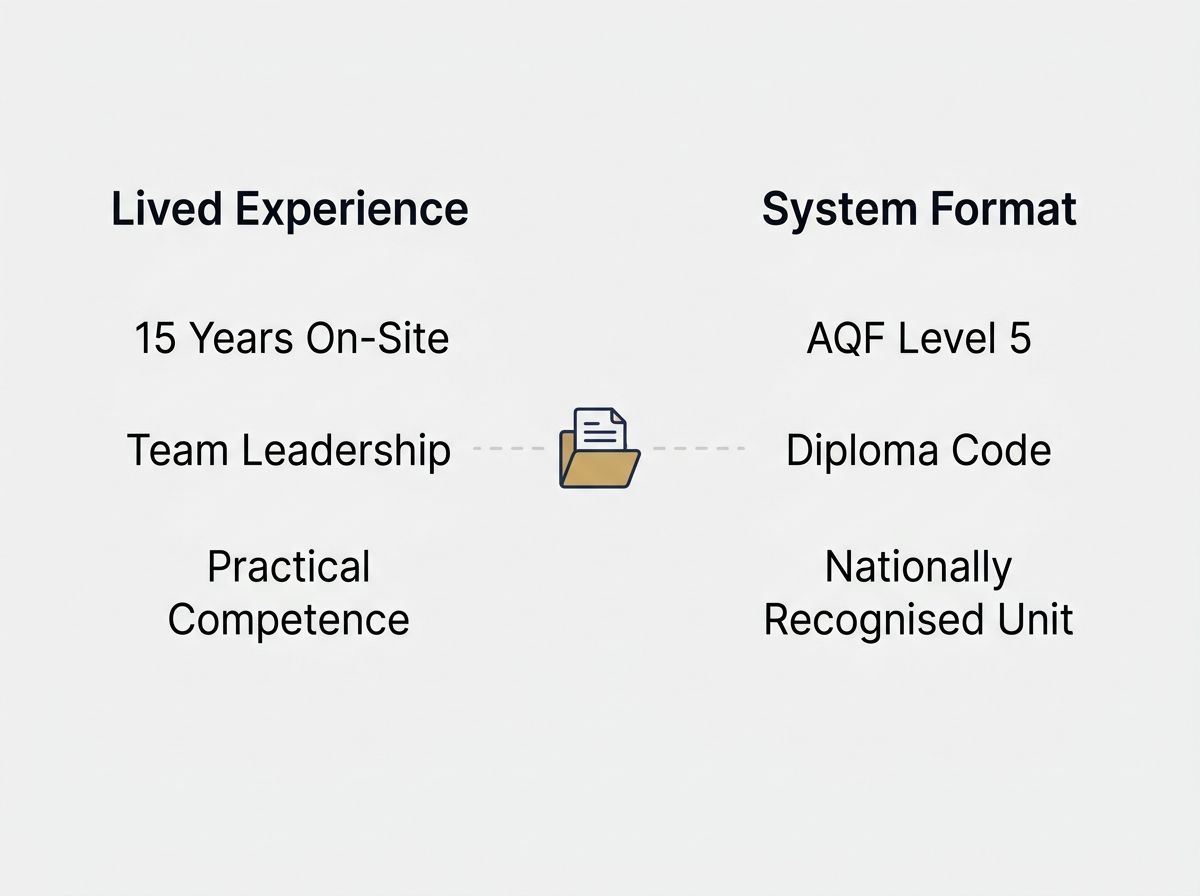
The same logic applies to licensing requirements in trades, healthcare, and community services. Many Australian licensing frameworks reference specific VET qualifications as a condition of practice or employment. The requirement is not arbitrary — it reflects a national standard. But the standard was written for a credential, not for a career history.
Think of it this way. You speak the language fluently. The system only reads one dialect. An RPL certificate is the translation.
According to the Australian Skills Quality Authority, Recognition of Prior Learning is a legitimate part of the VET sector and the Australian education system — not a workaround, but a formal pathway built into the framework.
What an RPL certificate actually is (and what it isn't)
An RPL certificate is not a course. You do not sit in a classroom and study things you already know. You do not repeat training you have already completed through years of practice.
Recognition of Prior Learning — RPL — is a formal assessment process. A qualified assessor from a Registered Training Organisation (RTO) evaluates your existing skills and knowledge against the competency standards of a nationally recognised qualification. If the assessor determines that you meet those standards, the RTO issues the qualification.
ASQA defines RPL as 'an assessment of skills and knowledge acquired through previous training, work or life experience relevant to the course' — and confirms that it allows the provider to assess existing competency against the requirements of the qualification.
The qualification you receive is the same qualification a student would receive after completing the course through traditional study. The assessment standard is the same. The credential is the same. The pathway is different.
The Australian Qualifications Framework — the national policy that governs all regulated qualifications in Australia — applies the same quality assurance requirements to all qualifications regardless of how they were attained.
RPL is not a shortcut. It is not a loophole. It is a rigorous, regulated assessment pathway that has been part of the Australian education system for decades.
Under the Standards for Registered Training Organisations, RTOs are required to offer RPL to students — unless the requirements of the training package or licensing rules prevent it. This is not an optional extra. It is a formal obligation within the national training framework.
The translation, not the test
The RPL process begins with a skills review — an honest conversation about what you have done, what you can demonstrate, and how your experience maps to the units of the qualification you are pursuing.
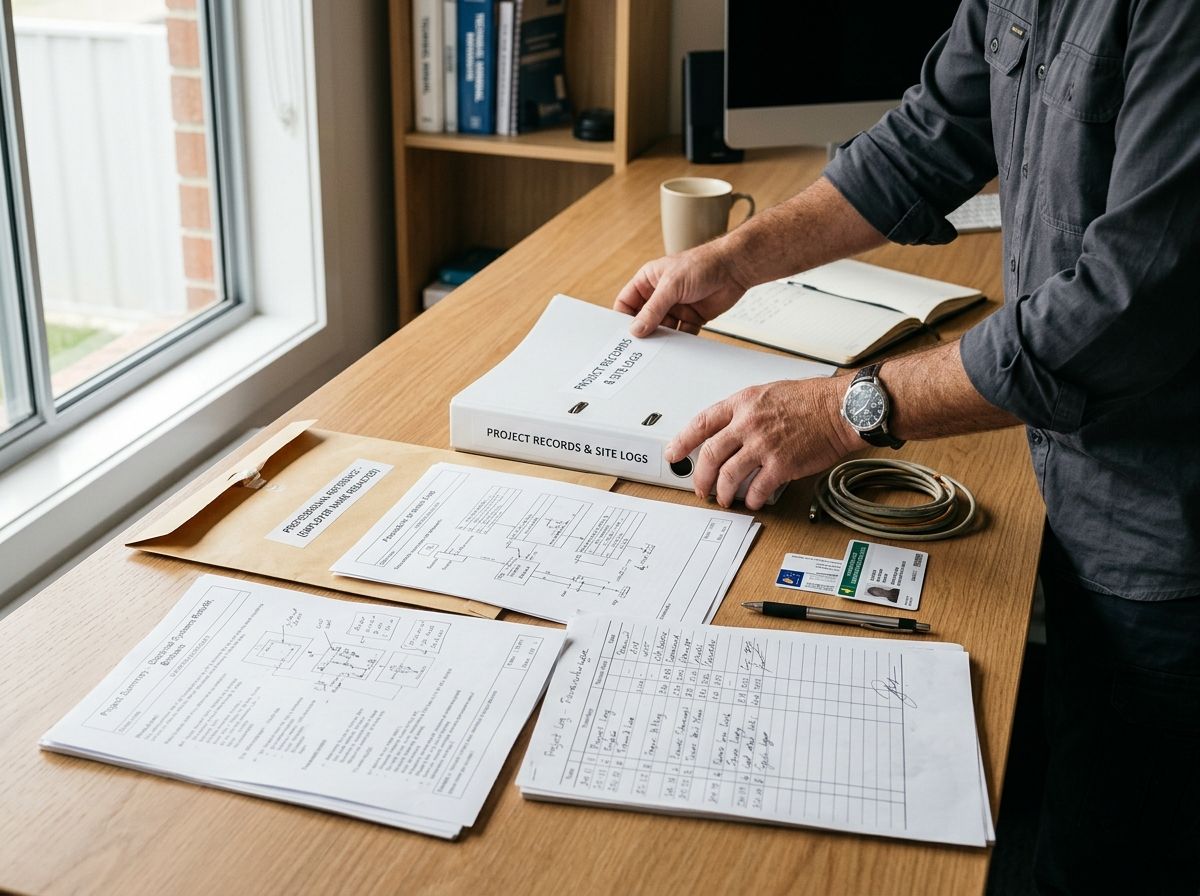
From there, the process moves to evidence gathering. This is the part that can feel unfamiliar, but it is more straightforward than it sounds. Evidence in an RPL assessment is simply documentation of what you already do. It might include:
- Work samples or examples of completed projects
- References or statements from supervisors, managers, or colleagues
- Photos or videos of your work in practice
- Job descriptions or position statements that reflect your responsibilities
- Logbooks, records, or diaries of your professional activity
- Certificates or records of any prior training you have completed
Evidence can be direct — such as an assessor observing your work or reviewing a video of you performing a task. It can be indirect — such as a finished product or a portfolio of work samples. It can be supplementary — such as a reference letter or a job description that confirms the scope of your role. What matters is that the evidence is current, authentic, and sufficient to demonstrate competency against the qualification's standards.
You are not being tested on things you do not know. You are being asked to show what you already do.
One important note: if the assessment identifies areas of the qualification that your experience does not yet cover, gap training may be required. This is not a failure — it is part of a rigorous process. Gap training is provided to ensure the qualification reflects genuine competency across all required units.
Who RPL is actually for
RPL is not a niche pathway for unusual circumstances. It is designed for the many thousands of Australians who have built genuine expertise through work — and who have never had the opportunity, the time, or the need to formalise it.
Consider some of the people this describes:
- The aged care worker who has supported residents with complex needs for twelve years, but has never completed a Certificate III in Individual Support
- The site supervisor who has managed construction crews and subcontractors for a decade, but holds no Certificate IV in Building and Construction
- The community services worker who has been coordinating case plans and supporting vulnerable clients for years, without a formal Diploma of Community Services
- The hospitality professional who has run a kitchen, managed staff, and controlled food costs for a decade — without a commercial cookery qualification
- The business administrator who has managed payroll, HR processes, and operational reporting for fifteen years, but has no formal business qualification on paper
These are not edge cases. They represent a significant proportion of the Australian workforce. Certificate III and IV qualifications are the most commonly completed levels in the VET sector — and they are also the levels where the gap between practical experience and formal recognition is most acute.
RPL is the pathway that was built for exactly this situation.
What becomes possible after the certificate
An RPL certificate does not change what you know. It changes what the system can see.
A nationally recognised qualification may open doors that were previously filtered out — job applications that pass automated screening, licensing requirements that can now be met, promotion conversations that have a formal credential to reference. In some cases, a VET qualification obtained through RPL may also create pathways to further study, including university entry or advanced standing.
The certificate does not rewrite your career. It makes your career legible to the systems that matter.
For many people, that is enough. Not advancement. Not reinvention. Just recognition — in a format the world can read.
Is RPL right for you? Start with a free skills review
RPL is not suitable for everyone. It requires genuine, demonstrable experience in the relevant competency areas. The assessment is conducted by a qualified assessor from the delivering RTO — and that assessor's professional judgement determines the outcome. No provider can guarantee a result in advance, and any that claim otherwise should be approached with caution.
What we can offer is an honest starting point. A Free Skills Review is a no-obligation conversation about whether your experience aligns with the qualification you are considering — before any enrolment decision is made. It is not a sales process. It is a suitability check.
If your experience maps well to a qualification, we will tell you. If it does not, we will tell you that too. The decision is yours.
If you have been wondering why years of management experience still leaves you invisible to formal systems, this piece on why experienced managers hit qualification walls may resonate.
General information only, current at the date shown. Licensing rules change, so check the current requirements with the relevant regulator before you rely on them. RPL it Australia is a student support service, not a Registered Training Organisation; qualifications are assessed and issued by our partner RTOs.