The Prerequisite Trap: When the Qualification You're Told You Need Is One You've Already Earned in Practice
Told you need a Certificate III or IV first? If you have years of practical experience, you may have already earned it. Here is how RPL works.

The Moment the System Stops Making Sense
You have been doing the work for years. You manage the team, run the projects, and navigate the complexity. You know the material—not from a textbook, but from daily practice in conditions that no classroom simulates. When you decide to formalise your skills, you find the program you want, check the entry requirements, and read the line that stops you: *Applicants must hold a Certificate III or IV in [field] before enrolling.*
The qualification they are asking for covers competencies you demonstrate every day. It is not a gap in your knowledge. It is a gap between how the training system measures competence and how you actually acquired it. This is the Prerequisite Trap—and it affects experienced professionals across Australia every day.
What the Prerequisite Trap Actually Is
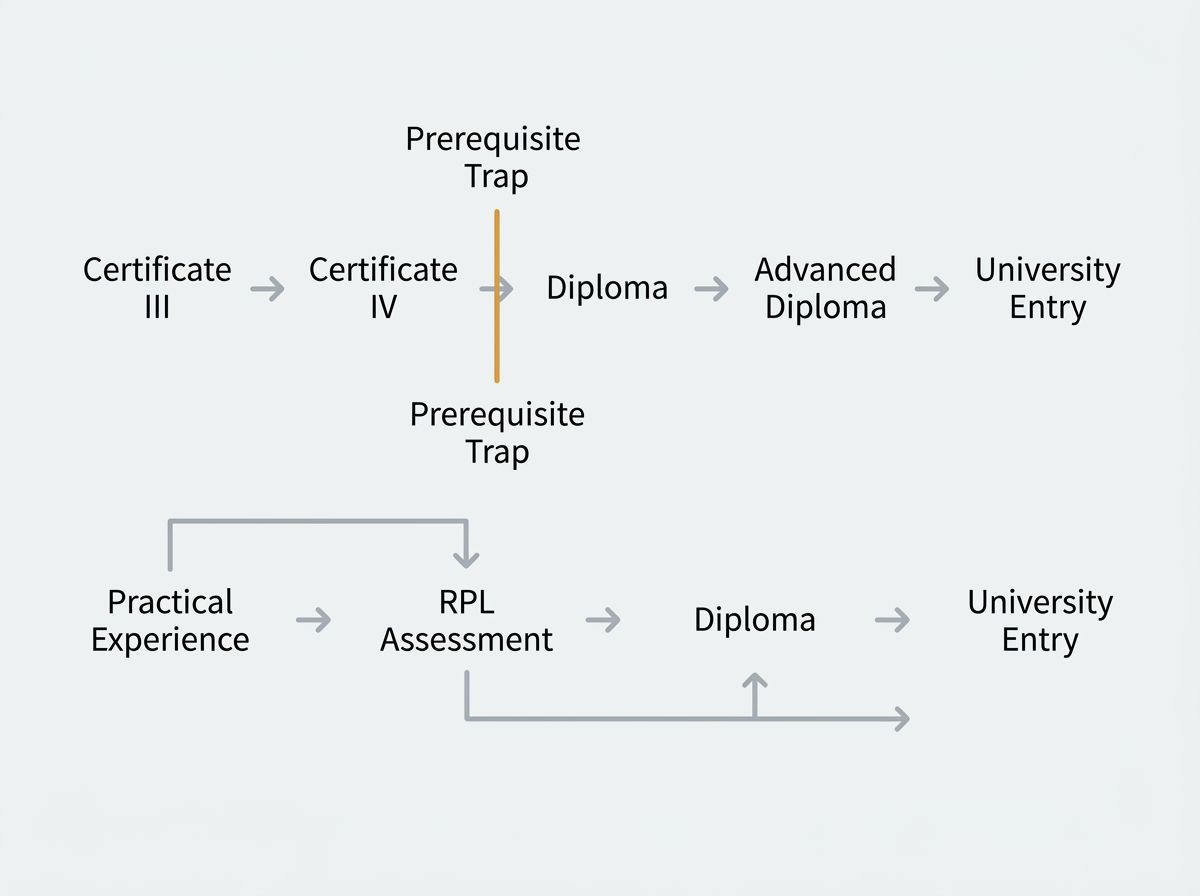
The Prerequisite Trap is a specific structural issue: the qualification required for entry to a program covers the same competencies that your professional experience has already delivered. This makes the prerequisite both mandatory and redundant. The system acknowledges competence through qualifications, but the qualification required is precisely what your practical experience already proves.
This is not a personal shortfall or a gap in your ability. It is a conflict between two different ways of acquiring the same competence—one through formal study, and one through practice. The system is designed to read the first, and it struggles to recognize the second.
This dynamic plays out across industries and qualification levels. Understanding why years of management experience can still leave you invisible on paper is the first step to navigating it.
Why the System Is Built This Way
The VET and university systems are designed to process qualifications as standardised evidence of competence. Prerequisites exist because the system needs a common currency—a shared language that institutions can read quickly and consistently. A Certificate IV in Leadership and Management, for example, signals a defined set of competencies to any RTO or university admissions team. It is clear, portable, and comparable.
The problem is not that prerequisites exist. The problem is that the system treats the absence of a qualification as evidence of absent competence. In reality, it is often evidence of a different pathway to the same skills. The Australian Qualifications Framework defines what each qualification level covers, but it does not automatically recognise that years of professional practice can deliver those same outcomes outside a formal classroom.
Research on recognition of prior learning in higher education identifies this as a structural challenge. It is a documented tension between how formal systems define competence and how competence is actually built in the workplace.
The Specific Moment the Trap Closes
The Prerequisite Trap closes in three common scenarios. First, a professional with years of industry experience—in health, community services, business, or a technical field—attempts to enrol in a Diploma-level program and is told they need a Certificate III or IV first. The Health Training Package, for example, lists Certificate III qualifications such as HLT33021 Certificate III in Allied Health Assistance as qualifications that support pathways to higher-level Diplomas. The Certificate IV in Leadership and Management (BSB40520) similarly supports pathways to the Diploma of Leadership and Management (BSB50420). In both cases, the lower-level qualification is positioned as the entry point, regardless of whether your experience already covers that ground.
Second, a professional with substantial management experience attempts to enter a Graduate Certificate or MBA program and is told they need an undergraduate degree or equivalent qualification first. Some private higher education providers offer alternative entry pathways. For example, the Australian Institute of Business allows entry to their Graduate Certificate in Management without a degree, provided applicants have a minimum of five years of relevant work experience, including three years in management. These pathways are not always advertised, and many professionals never discover them.
Third, a professional returning to formal education after years in the workforce discovers that their experience does not automatically count as credit toward the prerequisite. Credit transfer requires a prior formal qualification. Experience alone, however extensive, is not a currency the standard admissions process can read.
How Australian universities accept RPL as an alternative to prerequisite qualifications is something most professionals never discover—but it changes the equation entirely.
Recognition of Prior Learning: The Formal Mechanism That Breaks the Trap
Recognition of Prior Learning (RPL) is the formal, nationally regulated mechanism that resolves the Prerequisite Trap. RPL does not bypass the prerequisite. It satisfies it.
Through RPL, your practical experience is assessed against the specific competency units of the required qualification. If the assessment confirms competency, the qualification is issued by a registered training organisation (RTO). That qualification then meets the prerequisite requirement. You do not study what you already know. You demonstrate what you already know and receive the formal credential that proves it.
This is not a workaround. Under the 2025 Standards, registered training organisations are required to maintain robust RPL processes. This means that where a candidate can demonstrate prior learning, that learning must be assessed. RPL is a legitimate, regulated assessment pathway, not an exception to the rules.
Experience is evidence. RPL is the process that makes that evidence legible to the formal system.
What RPL Assessment Actually Involves
RPL is a genuine assessment, not a rubber stamp. Candidates are assessed against specific competency units by a qualified assessor from an RTO. Evidence typically includes certifications, licences, professional memberships, work portfolios, photographs of work, diary entries, and third-party references from peers or employers. The exact requirements vary depending on the RTO and the specific qualification.
The assessment is rigorous because the qualification is real. The difference from traditional study is that the evidence comes from practice rather than coursework. RPL requires effort, documentation, and time. It is not a shortcut, but it is not starting from scratch either.
Where gaps are identified—competency units that the evidence does not fully cover—gap training may be required. This is part of an honest assessment process. The goal is accurate recognition, not automatic approval.
Understanding how to map your real-world experience to the specific competency units of a Diploma is the practical starting point for any RPL application.
The Fast Track University Pathway: RPL at Qualification Level
For professionals whose target is a Diploma, Graduate Certificate, or MBA, RPL can be used to obtain the prerequisite VET qualification, which then satisfies university entry requirements. This is the mechanism that allows experienced professionals to enter postgraduate study without completing an undergraduate degree or a lower-level VET qualification through traditional classroom study.
The Fast Track University pathway maps the specific qualification levels available and is the starting point for assessing whether this pathway suits your situation. It covers both VET-level prerequisites and university-level entry requirements, starting with an assessment of suitability rather than a sales pitch.
Understanding how a VET qualification obtained through RPL acts as a standardised currency that university admissions systems can read is the key to unlocking postgraduate entry.
Explore the Fast Track University pathway and the qualification levels it covers.
Is RPL the Right Pathway for You?
RPL is not suitable for everyone. The pathway works best for candidates who have substantial, recent, and relevant practical experience that maps to the competency units of the required qualification. It is less suitable for candidates who are early in their careers, whose experience is in an unrelated field, or whose target qualification covers competencies they have not yet had the opportunity to demonstrate.
Honest suitability guidance matters here. The right pathway is the one that genuinely fits your situation, not the one that sounds most appealing. If RPL is not the right fit, there are other pathways, and a professional guide will tell you so.
Recognition should not require starting over. But it does require an honest assessment of where you are and what you can demonstrate. That assessment is where the process begins.
A structured self-check for assessing whether university RPL is the right pathway for your situation is a useful starting point before committing to any process.
Ready to Get Recognised?
Start with a free skills review to find out if RPL is right for you.