The Paper Ceiling: Why Your Decade of Experience Is Suddenly Hitting a Wall
You have the skills and the years. But without the right qualification, the system can't see you. Here's what the Paper Ceiling is and how RPL helps.
By RPL it Australia9 min read

You Have the Experience. The System Has a Different Question.
You have been doing this work for over a decade. You have solved problems that stumped colleagues with the right letters after their name. You have trained staff who now outrank you. And then, at the moment that should have been yours—the promotion, the contract, the senior role—someone asked for your certificate.
Not your track record. Not your references. Your certificate.
If that moment is familiar, you are not alone. Across construction, healthcare, business, IT, and other industries, skilled Australians hit the same invisible wall. Their competence is real. Their experience is deep. But in the formal systems that govern hiring and promotion, experience that has not been assessed and credentialled is invisible.
We call this the Paper Ceiling.
What Is the Paper Ceiling?
The Paper Ceiling is the barrier that blocks career advancement for workers whose practical competence is real but whose formal credentials are absent or incomplete. It is not a skills gap. It is a recognition gap—the distance between what you can do and what the system can see. The system requires proof in a specific format: a qualification. Without that format, years of demonstrated expertise remain invisible to the people making decisions.

This is not a new problem, but it is a growing one. The term 'paper ceiling' has begun to appear in workforce discussions to describe the barriers facing workers who are capable but uncredentialled. In Australia, it is not an established policy term—which means the experience it describes has been widespread without ever being properly named. Naming it matters. When you can name what is happening, you can start to address it.
The Paper Ceiling is not about skill. It is about a system that requires proof in a specific format—and the frustration of knowing you have the substance but not the paper.
Five Signs You Are Hitting the Paper Ceiling Right Now
The Paper Ceiling shows up in specific, recognisable moments. If any of these sound familiar, you are likely experiencing it.
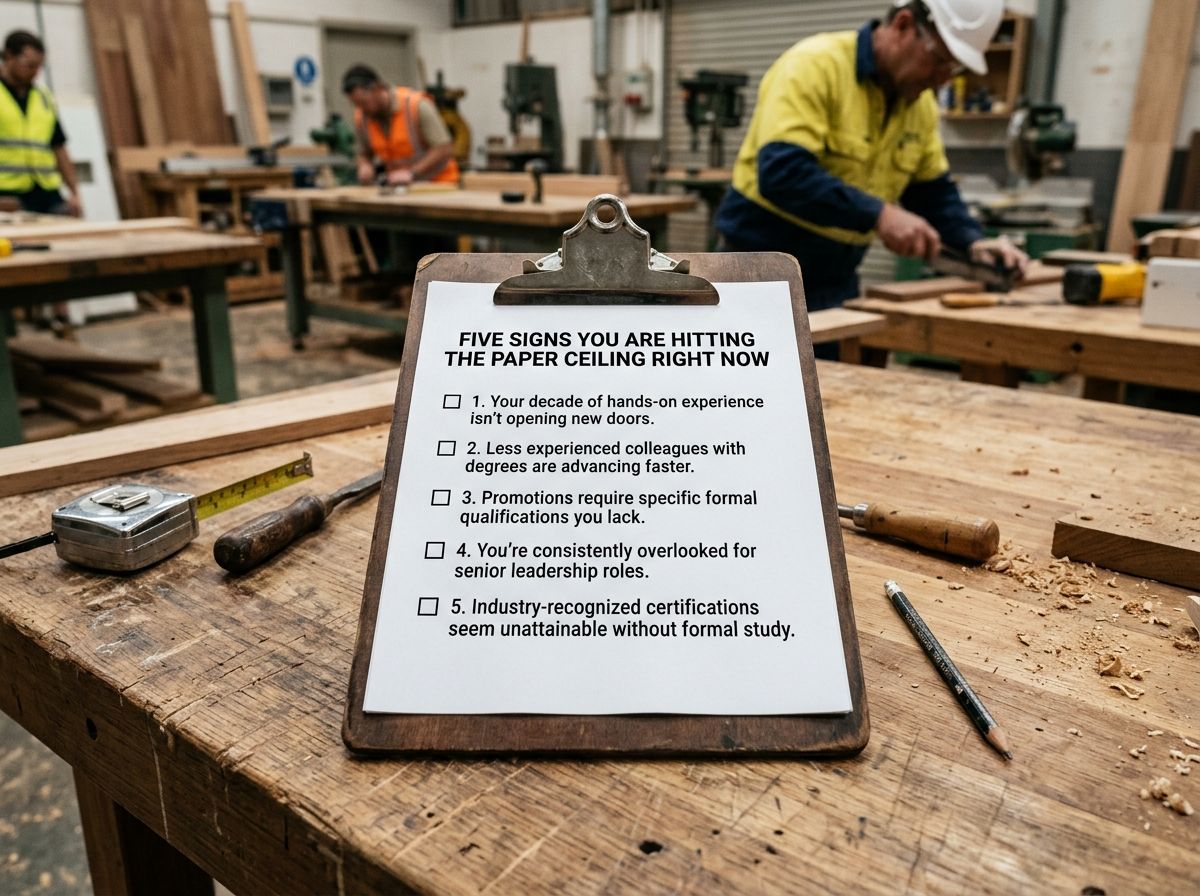
- You applied for a role you have been doing informally for years, and the first filter was a qualification you do not hold—not a skills test or a reference check, but a certificate.
- A colleague with less experience but the right credential was promoted over you. You trained them, and you know more than they do, but the system does not recognise this.
- You have been asked 'do you have your ticket?' on a site, in a tender, or in a job interview—and had to explain your situation rather than saying yes.
- A client or employer wanted to engage you directly but could not without formal qualification documentation. The work was right, but the paper was not.
- You have thought about getting formally qualified for years, but assumed it meant going back to study—repeating things you already know—and this has kept you from starting.
If you recognised yourself in any of these, a Free Skills Review can tell you whether your experience maps to a formal qualification, at no cost and with no obligation to proceed.
Why the Paper Ceiling Exists—And Why It Is Not Your Fault
The Paper Ceiling is not a personal failure. It is a structural feature of how formal qualifications work in Australia.
The Australian Qualifications Framework (AQF) is the national policy that defines what qualifications mean and what they require. Under the AQF, qualifications are defined by their learning outcomes—the specific knowledge, skills, and application of knowledge and skills that a graduate is expected to demonstrate. Critically, these outcomes must be assessed formally. A qualification is not awarded on the basis of time spent or experience accumulated; it is awarded when a qualified assessor from a registered training organisation confirms that the required outcomes have been demonstrated.
The AQF does acknowledge that learning can be formal, non-formal, or informal—and its Qualifications Pathways Policy is designed to maximise credit for learning already undertaken. But that credit is not automatic. It must be assessed against the qualification's required outcomes, and it must maintain the integrity of what the qualification represents.
All AQF qualifications are quality assured through government accreditation processes. Education providers that issue them must be authorised to do so under law.
This is why on-the-job experience, no matter how deep or how long, does not automatically translate into a formal qualification. The system is not designed to assess experience directly. It is designed to assess evidence. And evidence, in this context, means documented, assessed proof that specific competencies have been met.
The result is a structural gap between how skills are acquired—through work, mentorship, and real-world problem-solving—and how they are formally recognised. Employers and regulators use qualifications as auditable evidence of competency. Without that evidence, your experience is real but invisible to the people making decisions.
Research from the Productivity Commission indicates that Australian employers are more than twice as likely to train their employees through unaccredited learning than through formal VET qualifications, suggesting that a significant proportion of skill development in Australia happens outside the formal qualification system.
ABS data also shows that employed Australians without a non-school qualification are disproportionately concentrated in lower skill-level occupations, a pattern that may indicate that genuine skills are not always reflected in formal credential status.
The Real Cost of Staying Below the Ceiling
The Paper Ceiling is not just frustrating. It is expensive.
ABS data from 2022–23 shows that full-time employed men with three or more non-school qualifications earned an average of $2,558 per week—$983 more per week than full-time employed men without a non-school qualification. For women, the gap was $857 per week. These are broad aggregate figures that do not control for role or industry, but they illustrate the scale of the credential gap in Australian earnings.
The same data shows that 78% of people with a non-school qualification were employed, compared with 57% of those without one—a 21-percentage-point employment rate gap that reflects how deeply formal credentials shape access to work.
For context, the median weekly earnings for all employees in Australia were $1,436 as of May 2025, with full-time persons averaging $2,130.60 per week. The credential gap sits against that backdrop.
Beyond earnings, the cost of the Paper Ceiling compounds over time. Every year without formal recognition is a year your experience is working harder than your career is advancing. Promotions deferred. Contracts lost. Roles you were qualified to do—in every practical sense—that you could not apply for.
At the application stage, research suggests that around a quarter of Australian employers prioritise qualifications and licences as a hiring criterion, meaning the credential filter operates before your experience is ever considered.
RPL Qualifications: The Mechanism That Breaks Through
Recognition of Prior Learning (RPL) is the formal pathway that exists to address exactly this situation. According to ASQA—the Australian Skills Quality Authority—RPL is an assessment process that assesses an individual's formal, non-formal, and informal learning to determine the extent to which they meet the requirements specified in a training package or VET accredited course.
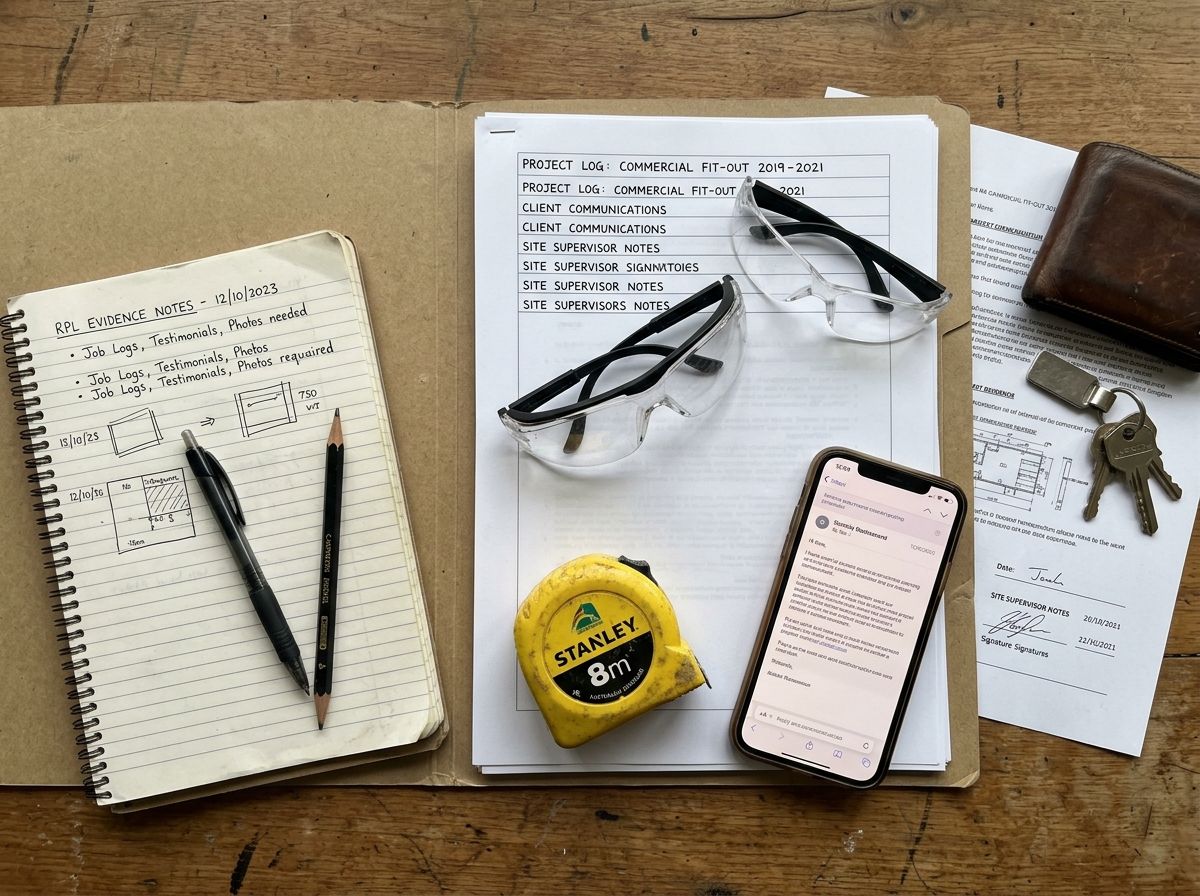
RPL is an assessment-only process. It is not a training program. You are not re-learning what you already know. You are demonstrating, through structured evidence, that you already meet the competency requirements of a qualification. The assessment is conducted by a qualified assessor from a registered training organisation (RTO). RTOs are required by the Standards for Registered Training Organisations to offer RPL to students, unless the training package or licensing requirements prevent it.
When RPL is performed well, it provides a robust framework to ensure people can have their skills recognised, while maintaining the integrity of the qualification through genuine, competency-based assessment by qualified assessors.
It is worth being direct about what RPL involves. It requires documentation—evidence of your experience, employer references, records of work completed, and in some cases practical demonstration. It is not a shortcut. It is a recognition pathway. The qualification you receive at the end is nationally recognised precisely because the assessment is genuine.
RPL it guides candidates through this process, helping you understand what evidence is needed, how to document your experience, and how to navigate the formal assessment. The qualification itself is issued by the RTO, not by RPL it. Our role is to guide, support, and advocate for you through the process.
To explore what RPL qualifications are available and whether your experience may be eligible for assessment, visit our RPL Qualifications page.
Who RPL Qualifications Are—and Are Not—For
RPL is not suitable for everyone. Being direct about this is part of how we work.
RPL is designed for people who have genuine, demonstrable experience in the relevant field—workers who have been doing the work and can provide evidence that maps to the specific competency requirements of a qualification. If your experience is limited, or if you are entering a new field, a different pathway may serve you better.
It is also worth knowing that gap training may be required. If an assessor identifies areas where your evidence does not fully meet the qualification requirements, additional training may be needed to address those gaps. This is not a failure; it is the assessment process working as intended.
ASQA has noted concerns about inadequate RPL practices in the sector, including unethical marketing and high-volume, low-quality assessment models that issue qualifications without genuine assessment. A qualification obtained through a process that does not involve rigorous, competency-based assessment is not worth having. Choosing a provider committed to honest, thorough assessment protects both you and the value of the credential.
If you have the experience, the question is not whether RPL can work for you; it is whether your experience is documented in a way that an assessor can evaluate. That is exactly what a Free Skills Review is designed to explore.
The First Step: A Free Skills Review
The Paper Ceiling is real. The recognition pathway is also real. The question is whether your specific experience maps to a qualification, and that is a question worth answering before you commit to anything.
A Free Skills Review is where that conversation starts. It is free. It carries no obligation to proceed. It exists to give you an honest picture of whether your experience is likely to meet the requirements of an RPL assessment, before you invest time or money in the process.
Your skills speak. We help them be heard. The decision is yours.
The Australian Qualifications Framework sets out how all formal qualifications in Australia are defined and quality assured—understanding this framework helps explain why experience alone does not automatically translate into a credential.
ASQA's guidance on Recognition of Prior Learning outlines what the assessment process involves and what RTOs are required to offer—useful context for anyone considering the RPL pathway.
ABS data on qualifications and work provides a clear picture of the employment and earnings gap between formally qualified and unqualified Australians—the numbers behind the Paper Ceiling.
General information only, current at the date shown. Licensing rules change, so check the current requirements with the relevant regulator before you rely on them. RPL it Australia is a student support service, not a Registered Training Organisation; qualifications are assessed and issued by our partner RTOs.