Do You Actually Need the Prerequisite? A Self-Assessment for Professionals Blocked by Entry Requirements
Blocked by a prerequisite you may already meet through experience? Use this structured self-assessment to find out if RPL is your pathway.

The Prerequisite Problem: When the System Asks You to Learn What You Already Know
You have the experience. You have spent years doing the work — managing teams, running projects, and solving problems that textbooks have not caught up to yet. Then you find the course you want, the qualification that would move your career forward, and there is a barrier: a prerequisite you do not hold on paper.
The frustration is specific. It is not a matter of being unqualified. It is about being asked to prove what you already demonstrate in practice, every working day, through a formal credential you never needed to get the job done. Recognition of Prior Learning exists for this situation. Whether it applies to you depends on four practical questions.
This self-assessment is designed to help you answer them.
How to Use This Self-Assessment
Work through the four questions in order. Each is a genuine decision criterion, the same kind a qualified RPL assessor looks at. Answer honestly, not optimistically. The goal is clarity, not confirmation of what you want to hear.
Some readers will reach the end and find that Recognition of Prior Learning is a strong pathway. Others will find that formal study is the right answer. Both outcomes are useful. The worst outcome is spending months pursuing the wrong pathway because nobody gave you an honest framework to assess your situation.
Question 1: How Many Years of Relevant Experience Do You Have?
Experience volume matters, but there is no single national minimum. The 2025 Standards for Registered Training Organisations set requirements for how RTOs must conduct RPL, but they do not prescribe a fixed number of years of experience that makes a candidate eligible.
In practice, requirements vary by institution and qualification level. As a general guide, most RTOs expect candidates to have substantial, recent, and relevant work experience before RPL is viable. For a Diploma-level qualification, that typically means several years of hands-on experience in a directly related role. For higher-level qualifications, the expectation is usually greater. If your experience is limited to a few months, or if it is primarily theoretical rather than practical, RPL is unlikely to be the right pathway.
Ask yourself: is my experience deep enough that I could walk into an assessment and demonstrate competency, rather than just describe it? If the honest answer is yes, continue to Question 2. If you are uncertain, that uncertainty is itself useful information.
Question 2: Does Your Current Role Actually Cover the Competencies in the Prerequisite?
This is the core question. Volume of experience is not enough; the experience must be relevant to the specific units of competency that make up the prerequisite qualification. A decade of experience in a different field does not automatically qualify you for a prerequisite in a field you have not worked in.
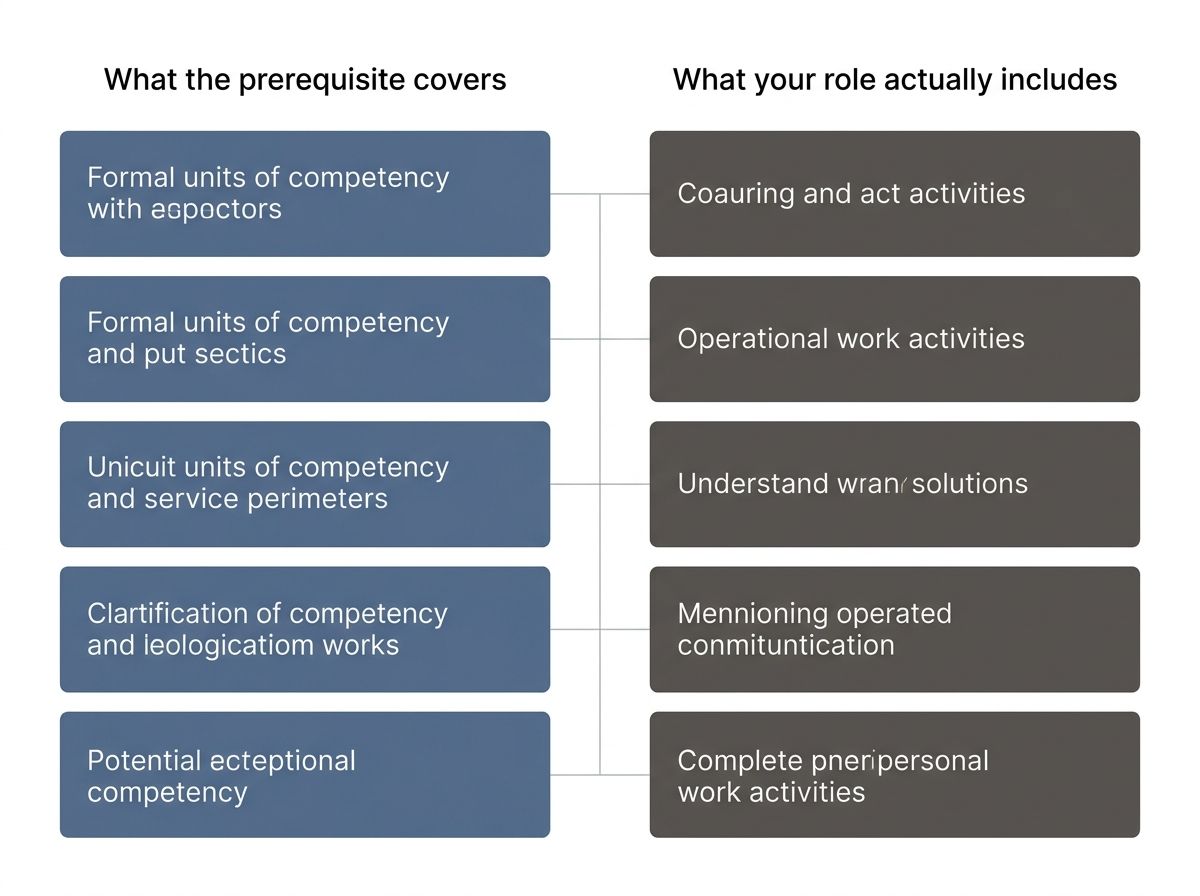
Every nationally recognised qualification in Australia is built from specific units of competency. These units describe exactly what a competent person can do, knows, and understands. You can find the unit list for any qualification by searching the national register at training.gov.au — filter by 'Unit of competency' to locate the specific units that make up the prerequisite you are trying to bypass.
The national register of training at training.gov.au lists all units of competency for every nationally recognised qualification. Use the search filters to find the units that make up your prerequisite qualification.
Once you have the unit list, compare it honestly against your current role. Look at the actual tasks you perform, not your job title. Do you regularly do the things those units describe? Could you produce evidence that you do them competently? If the answer is yes across most of the units, RPL may be viable. If there are significant gaps — whole areas of the prerequisite that your role does not cover — those gaps will need to be addressed, either through gap training or through a different pathway.
For a practical guide to mapping your daily work against formal competency units, see
Question 3: Is the Prerequisite a Formal Requirement or a Recommendation?
Not all prerequisites are the same. Some are mandatory entry requirements set by the institution, meaning you cannot enrol without meeting them. Others are recommended prior learning or assumed knowledge, which the institution prefers you to have but can be waived or substituted.
This distinction matters because it changes what RPL can do for you. Where a prerequisite is a recommendation, your professional experience may be accepted as sufficient without a formal RPL process. Where it is mandatory, Recognition of Prior Learning may still be an option, but the institution needs to explicitly confirm that RPL can substitute for that specific requirement. TEQSA guidance indicates that prior learning, whether formal or informal, can be used for credit or RPL, and that providers should have a policy framework for assessing equivalence of experience. However, decisions are made case by case, and individual institutions set their own policies.
The practical step: contact the admissions office directly and ask a specific question: 'Can Recognition of Prior Learning substitute for this prerequisite?' You are entitled to ask. The answer will tell you whether RPL is even on the table before you invest further time.
For more on how Australian universities accept RPL as an alternative to prerequisite qualifications, see
Question 4: Can You Demonstrate the Learning Outcomes — Not Just Describe Them?
Recognition of Prior Learning is an evidence-based assessment. It is not a self-declaration, and it is not a shortcut. A qualified assessor from a registered training organisation will evaluate whether your experience meets the competency standards, and they will need evidence to make that judgement.
The reality is that most professionals have more evidence than they realise. Common types of evidence accepted in Australian RPL assessments include:
- A résumé outlining your relevant work history and responsibilities
- References or declarations from employers who can verify your experience
- Work samples, such as reports, project plans, checklists, or other documents showing your performance
- Job descriptions that define your role and duties
- Photos or videos of work, particularly useful in practical or hands-on roles
- Certificates and records from prior training, short courses, or workshops
- Assessment records from previous units of study
The question to ask yourself is not 'do I have the experience?' — you already know the answer to that. The question is: 'Can I show it?' If you can gather documentation that demonstrates your competency across the relevant units, RPL is a credible pathway. If your experience exists but leaves no documentary trail, that is a gap worth understanding before you proceed.
Reading Your Results: What Your Answers Tell You
Your answers to the four questions point toward one of three outcomes.
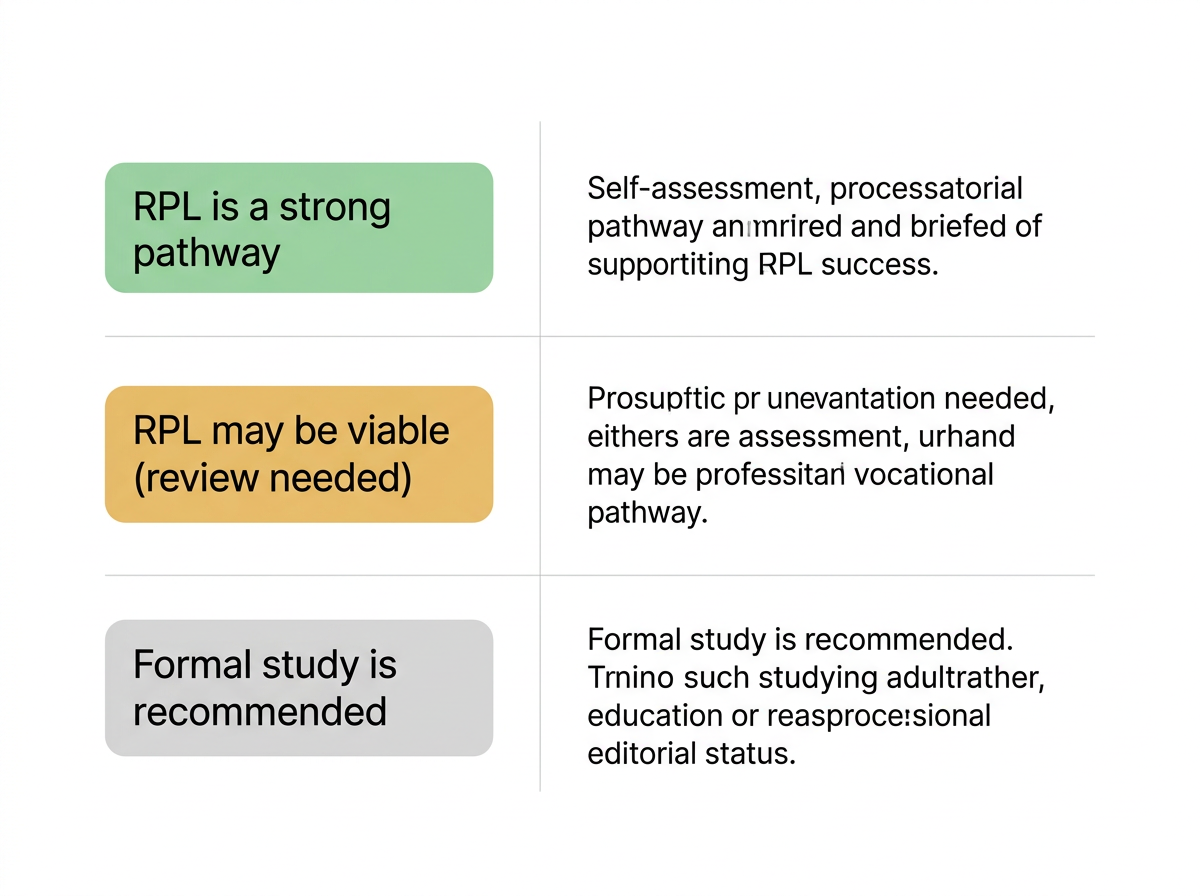
RPL is a strong candidate pathway if you have substantial, relevant experience; your current role covers most of the competency units in the prerequisite; the institution confirms RPL can substitute for the requirement; and you can gather documentary evidence of your competency. If all four conditions are met, Recognition of Prior Learning is worth pursuing seriously.
RPL may be viable but requires professional assessment if most conditions are met but you have uncertainty about one or two. Perhaps your experience covers most but not all of the competency units, or you are unsure whether your evidence is sufficient. A qualified adviser can assess your specific situation and tell you honestly whether the gaps are bridgeable.
Formal study is the right path if your experience does not cover the prerequisite competencies, if you cannot demonstrate competency through evidence, or if the institution does not accept RPL for that specific requirement. This is not a failure; it is an honest answer. Knowing this now saves you the time and cost of pursuing a pathway that was never going to work.
When RPL Is Viable: What Happens Next
If your self-assessment points toward RPL, the process involves several stages. First, a skills review to confirm suitability. This is the starting point, not a commitment to enrolment. Then comes evidence gathering: compiling the documentation that demonstrates your competency against the relevant units. After that, formal assessment is conducted by a qualified assessor from a registered training organisation. The RTO conducts the assessment and issues the qualification; RPL it guides you through the process.
If gaps are identified during assessment, gap training is typically provided to address them. The timeframe for an RPL assessment varies depending on the qualification level and the completeness of your evidence. Indicative timeframes published by some RTOs range from a few weeks to a few months, but this varies significantly and should be confirmed with your chosen RTO.
The qualification you receive through RPL is nationally recognised because the assessment is genuine. That is what makes it credible to employers and institutions alike.
ASQA identifies RPL as a risk priority area and emphasises that genuine RPL assessment — conducted rigorously by registered training organisations — is essential to the integrity of nationally recognised qualifications.
When Formal Study Is the Right Answer
Recognition of Prior Learning is not the right pathway for everyone, and it would be dishonest to suggest otherwise. If your experience does not genuinely cover the competency units in the prerequisite, if you cannot produce evidence of that competency, or if the institution does not accept RPL for that specific requirement, then formal study is the appropriate path.
That is a legitimate outcome. Knowing it clearly, rather than discovering it after months of pursuing the wrong pathway, is exactly what this self-assessment is for. The decision is yours.
If you are still exploring what pathways exist for experienced professionals, see
The Australian Qualifications Framework sets out the structure of qualifications across all sectors. Understanding where your target qualification sits within the AQF can help clarify which pathways — including RPL — are available to you.
Ready to Get Recognised?
Start with a free skills review to find out if RPL is right for you.