Stop losing NSW tenders because your supervisors aren't properly credentialed
Losing NSW construction tenders over supervisor credentials? Learn what the Qualified Supervisor Certificate requires and how RPL converts experienced foremen.

The tender you lost wasn't about price
You didn't lose that NSW tender on price. You lost it on supervisor compliance.
It is a pattern that repeats across NSW construction businesses every tender cycle. The quote is competitive. The track record is solid. The crew has the experience to deliver. But somewhere in the compliance checklist, buried in the prequalification criteria or the contract conditions, there is a requirement for a credentialed supervisor. And the foreman who has been running your sites for a decade lacks the paperwork.
The capability was never in question. The credential gap is the problem, and it costs real contracts.
NSW government agencies and private head contractors increasingly require that supervisors on site hold a recognised credential, specifically a Qualified Supervisor Certificate or equivalent. When that credential is absent, the tender fails at the compliance gate before anyone reads your methodology or your price.
This article explains what NSW actually requires, why experienced foremen are often caught in the gap, and how Recognition of Prior Learning (RPL) converts existing site experience into formal credentials without disrupting your operations.
What NSW actually requires: The Qualified Supervisor Certificate explained
A Qualified Supervisor Certificate (QSC) is a credential issued under NSW building and trade licensing arrangements that authorises an individual to supervise licensed building or trade work. It is distinct from a contractor licence, and that distinction is important.
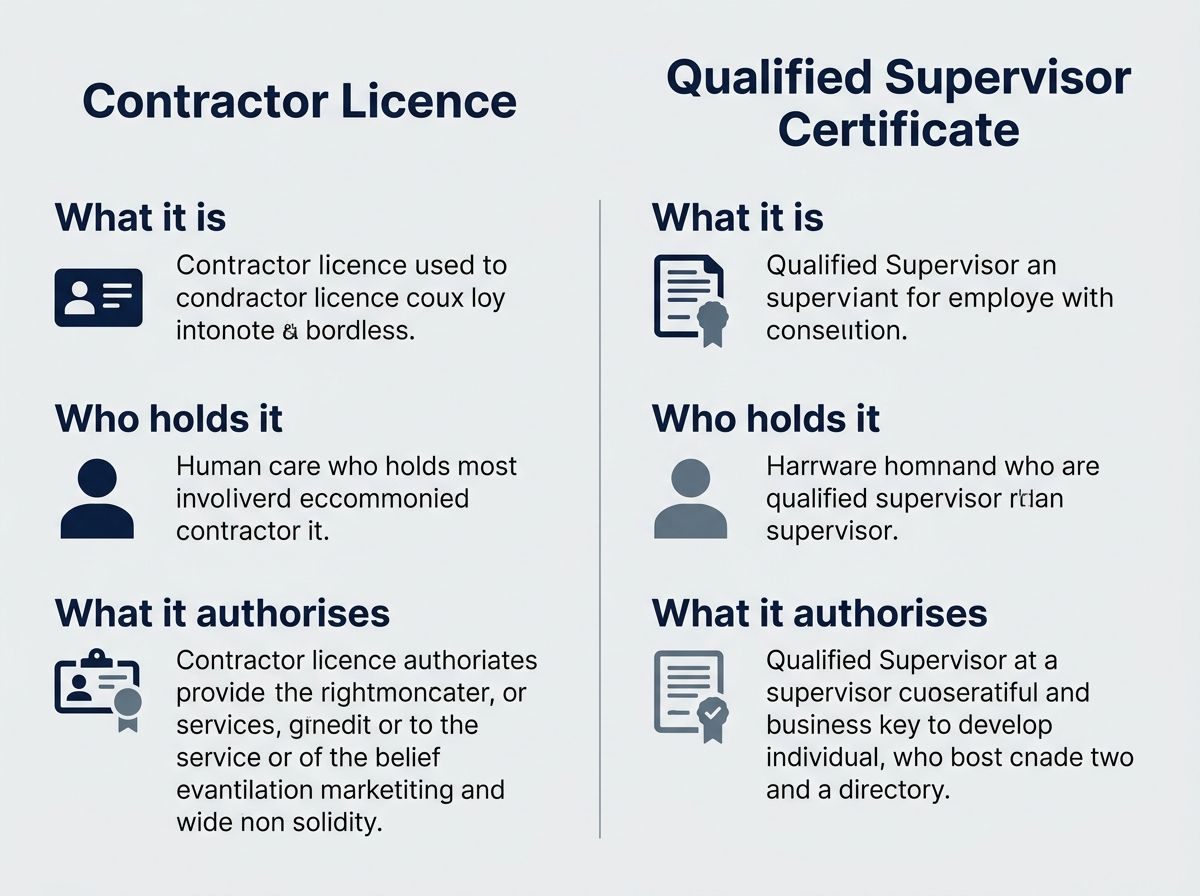
The NSW Government's licence verification service makes this clear: you can only enter into a contract with a licensed contractor. You cannot enter into a contract with the holder of only a Qualified Supervisor or Tradesperson Certificate.
In practical terms, this means the QSC authorises supervision rather than contracting. A licensed contractor must hold, or nominate, a QSC holder to supervise the relevant work. For companies and partnerships holding a contractor licence, NSW requires that a nominated qualified supervisor be in place for the licence to operate compliantly.
QSCs are issued by class, covering categories such as general building, carpentry, plumbing, electrical, and other trade work. The specific class determines what work the certificate holder can supervise. A foreman who has spent years supervising carpentry work on residential and commercial sites may have the practical competence for a carpentry QSC, but without the formal credential, that competence is invisible to the licensing system.
NSW also maintains a public compliance and enforcement register for licence and certificate holders. This register records cancellations, compensation fund claims, disciplinary actions, penalty notices, prosecutions, public warnings, suspensions, and tribunal orders.
The register is a statutory record maintained by the Commissioner for Fair Trading.
For employers, this means compliance failures are publicly visible and can affect a licensee's standing with clients, insurers, and procurement bodies. Getting the credential structure right protects both the business and the individual supervisor.
For more detail on the NSW Construction Supervisor credential pathway, see the
Why your most experienced foremen are your biggest compliance risk
There is a paradox at the centre of this problem. The foremen with the deepest site experience, namely those who have run crews, managed subcontractors, and delivered projects for fifteen or twenty years, are often the ones without formal credentials.
This is a reflection of when they came up through the industry, rather than a measure of their competence.
Many experienced supervisors entered the workforce before formal credentialing requirements tightened. They learned on the tools, progressed through merit, and built careers on demonstrated performance. The regulatory environment has since moved, but the paperwork did not follow.
National data from the NCVER on the construction managers occupation group gives some context to the broader picture. Among workers in this group nationally, the median age is 46 years, and the qualification mix is varied, with Certificate III/IV qualifications accounting for 44.7% of qualifications held, and 90.3% of VET qualifications considered relevant to the job held.
These are national figures for a broad occupational group, not NSW-specific data for site supervisors. But they point to a workforce where formal qualifications are common, and where gaps still exist, particularly among workers who progressed through experience rather than structured training.
For NSW construction businesses, the practical consequence is this: your most capable supervisors may be your most exposed. They have the skills, but they lack the certificate. In a compliance-driven tender environment, that gap is a liability.
The real cost: What unqualified supervision is doing to your tender pipeline
The compliance gap is both a regulatory risk and a revenue problem.
NSW government procurement operates through prequalification schemes, also known as Multi-Use Lists, Approved Lists, or Procurement Lists, that allow agencies to access suppliers who meet relevant experience and qualification standards.
These schemes are designed to reduce administrative work and simplify sourcing. However, they also function as qualification gates. Suppliers must meet relevant experience and qualification standards to be engaged for specified business opportunities.
Tender documentation issued by agencies may include conditions for participation, specifications, and evaluation criteria.
Where supervisor credentialing is a participation condition, as it is in many NSW construction contracts, a business without a credentialed supervisor cannot meet that condition. The tender fails before evaluation begins.
The cost of that failure compounds. Each lost tender is lost revenue. Each prequalification tier you cannot access is a category of work you are excluded from. Each contract cycle where your competitors have credentialed supervisors and you do not is a competitive disadvantage that widens over time.
The issue is not whether you can afford to get your supervisors credentialed, but whether you can afford to leave them without credentials.
RPL: Converting your foremen's experience into recognised credentials
Recognition of Prior Learning (RPL) is a formal assessment process conducted by a registered training organisation (RTO) that evaluates a candidate's existing skills and experience against the requirements of a nationally recognised qualification. It is not a shortcut. It is a rigorous, evidence-based assessment pathway that formally recognises what experienced workers already know and can demonstrate.
For NSW construction supervisors, the relevant qualification pathway may include the Certificate IV in Building and Construction (CPC40120), a nationally recognised qualification that some RTOs offer via RPL. The Master Builders Association of NSW, for example, describes its CPC40120 RPL program as designed to meet part of the Building Commission NSW criteria to apply for a Building Licence.
Note that the specific qualification required for a Qualified Supervisor Certificate application depends on the licence class and the current requirements of Building Commission NSW. Requirements vary, and this guidance is general. Before commencing any RPL pathway, verify current QSC requirements directly with Building Commission NSW and confirm qualification and unit availability with a registered training organisation.
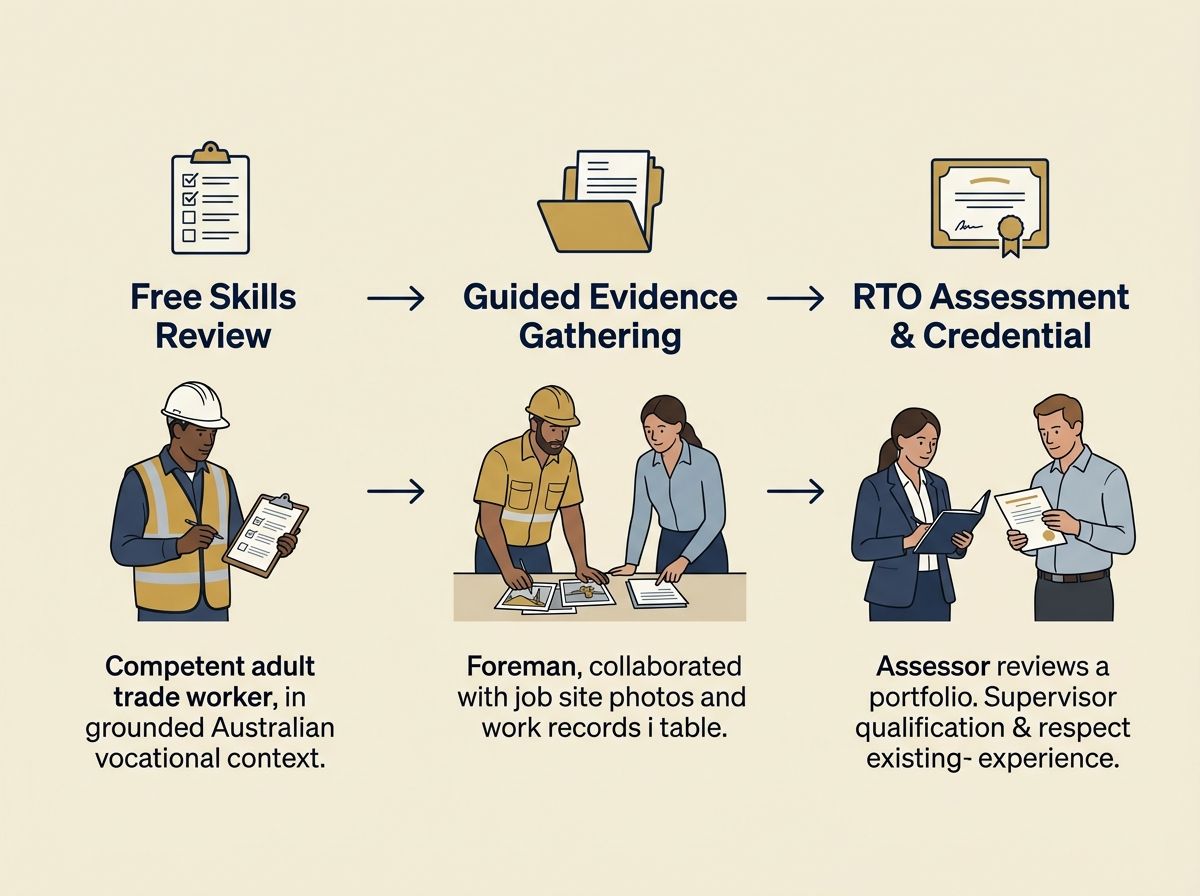
The RPL process typically involves three stages. First, a skills review to assess whether the candidate's experience is likely to meet the qualification requirements. Second, guided evidence gathering, which draws on the candidate's existing work history, project records, and professional references. Third, formal assessment by the RTO's qualified assessor, who determines competency against the qualification standards.
If gaps are identified during assessment, gap training is provided at no additional cost. The qualification is issued by the RTO and not by RPL it. RPL it guides and supports candidates through the process; the RTO assesses and awards.
One RTO's program for CPC40120 via RPL is designed to be completed within six months, with knowledge-based assessment submitted within two months and all evidence within five months, requiring an estimated commitment of ten to fifteen hours per week.
These are indicative timeframes from one provider's program. Individual completion times vary based on the candidate's evidence, the RTO's assessment schedule, and whether gap training is required. Do not treat any timeframe as guaranteed.
What RPL does offer is an assessment pathway that respects what experienced supervisors already know, presenting it in the format the licensing system requires. The experience is real, and RPL helps demonstrate that.
What qualifies as evidence? What your foremen already have
One of the most common misconceptions about RPL is that gathering evidence is a major undertaking. For experienced construction supervisors, the evidence is usually already there; it simply needs to be compiled and presented correctly.
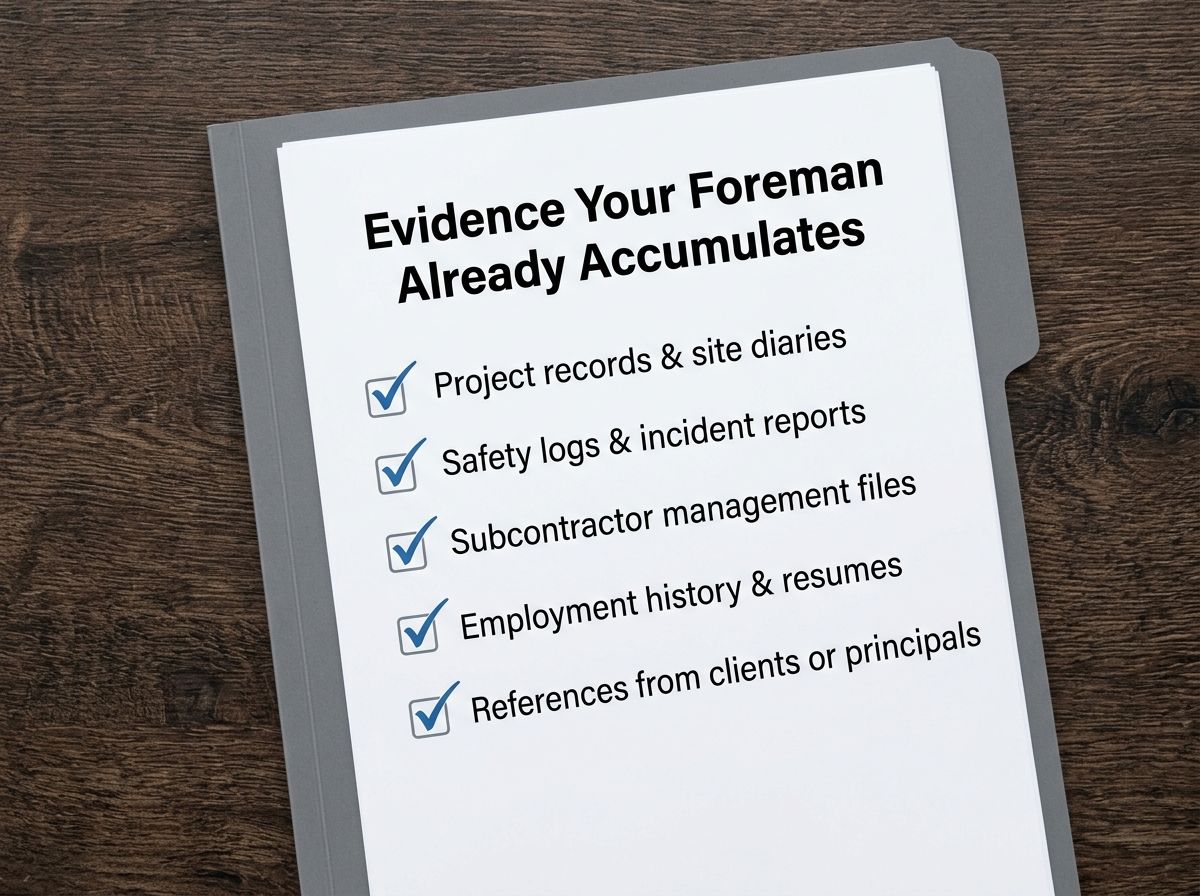
RTOs assessing construction supervisor RPL typically look for evidence across several categories. The Master Builders Association of NSW's entry requirements for its CPC40120 RPL program give a useful indication of what experienced candidates are expected to bring:
- At least three years of experience in supervisory building roles
- Supervisory and/or management experience on specified residential and commercial projects
- A valid White Card (General Construction Induction)
- Referee details from principals, head contractors, or clients
- Intermediate computer skills for evidence submission
Beyond these entry requirements, RPL evidence typically draws on documentation that experienced supervisors accumulate in the ordinary course of their work: project records and site diaries, safety documentation and incident reports, subcontractor management records, photos of completed work, employment history and position descriptions, and written references from principals or clients.
The specific evidence requirements are set by the assessing RTO and vary by qualification and candidate. A guided skills review at the outset helps identify what evidence exists and what, if anything, needs to be gathered or supplemented.
Your foreman probably has more evidence than he realises. The challenge is not finding it, but rather presenting it in the correct format.
How to start: Getting your supervisors assessed without disrupting the site
The first step costs nothing and commits to nothing.
A Free Skills Review is an honest assessment of whether RPL is likely to be a suitable pathway for your supervisor. It is not a sales call, but a genuine suitability check. If RPL is not the right option, we will tell you directly.
The review looks at the supervisor's work history, the types of projects they've managed, their supervisory responsibilities, and the evidence they're likely to have available. From there, you get a clear picture of where they stand and the steps required to proceed.
The process is designed to work around the site, not against it. Evidence gathering is guided and structured, meaning it does not require your supervisor to step away from daily operations. Assessment is conducted by the RTO's qualified assessors, with RPL it supporting the candidate through every stage of documentation and preparation.
The decision is yours. But the next tender cycle won't wait.
The NSW Government's procurement framework requires suppliers to meet relevant experience and qualification standards to be engaged for specified business opportunities, and tender documentation sets out the applicable participation conditions.
NSW maintains a public licence register where compliance and enforcement records, including penalty notices, disciplinary actions, and suspensions, are publicly visible for all licence and certificate holders.
The Master Builders Association of NSW offers CPC40120 Certificate IV in Building and Construction via RPL, describing the program as designed to meet part of the Building Commission NSW criteria for a Building Licence.
Ready to Get Recognised?
Start with a free skills review to find out if RPL is right for you.