Stop losing your best fabricators: why funding a welder qualification is cheaper than hiring
Think training your best welders means they will leave? The real risk is losing them to compliant competitors. Here is the cost case for RPL.
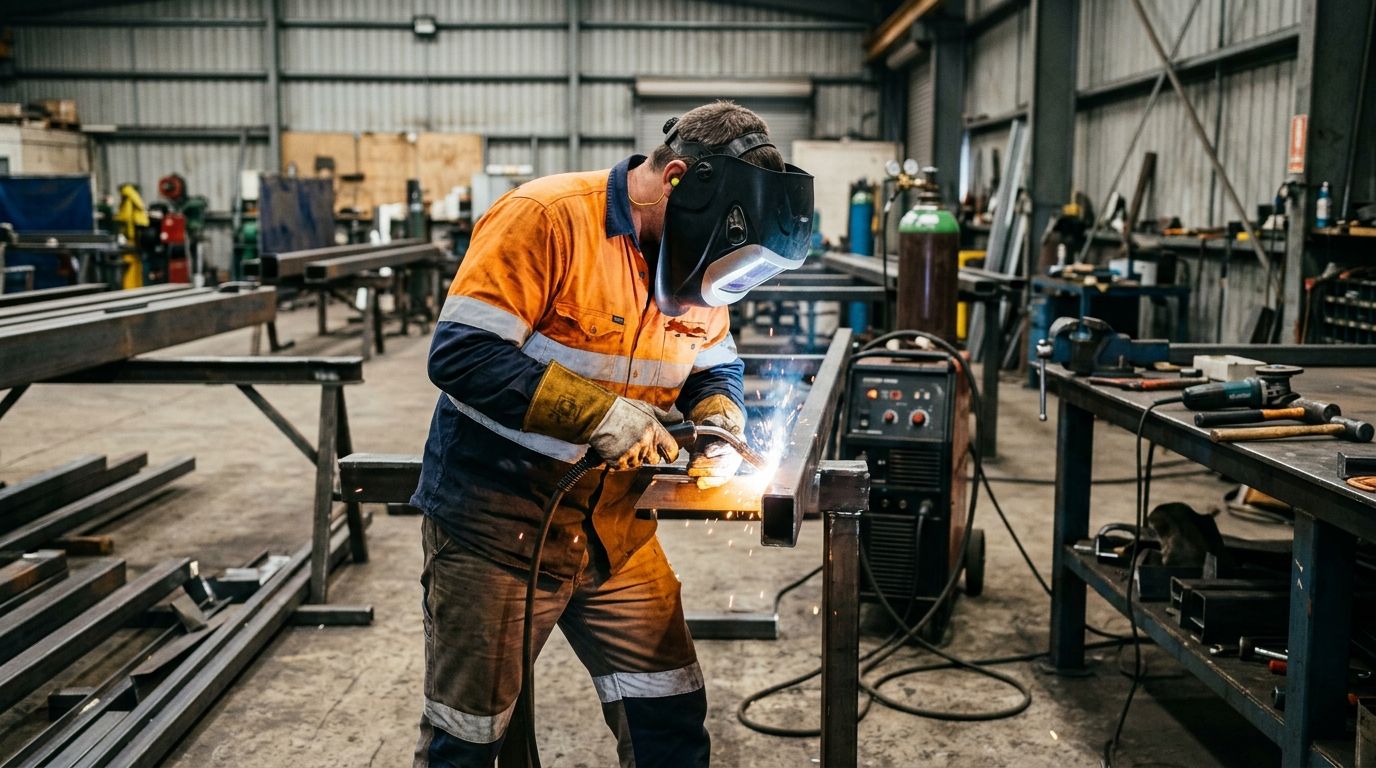
The fear that's costing you your best welders
We spend months trying to hire qualified welders while our best people are already here. They are just missing the ticket.
If you have said something like that, you already understand the problem. What you may not have considered is that the fear driving your inaction—the worry that funding their welder qualification means they will leave—is pointed at the wrong target.
The risk of losing staff comes from the lack of training, not the training itself. Experienced fabricators without formal qualifications cannot access the sites, contracts, and roles that pay well. When a competitor offers them a position on a compliant project, or when your own site loses work because your workforce is not documented, you lose those workers anyway. The training did not cause them to leave. The missing qualification did.
What 'welder qualification' actually means in Australia
Before making any decision about your workforce, you need to understand what a formal welder qualification actually is, and what it is not.
In Australia, the nationally recognised qualification for welding and fabrication work is the Certificate III in Engineering – Fabrication Trade (MEM31925). This is an Australian Qualifications Framework (AQF) qualification delivered by registered training organisations, including TAFE providers. It includes a Boilermaking/Welding Trade specialisation, with elective units covering manual metal arc welding, gas metal arc welding, and gas tungsten arc welding processes.
This is distinct from welder certification under technical standards such as AS/NZS 2980, which is a separate testing regime for specific welding applications. The two are not interchangeable, and employers sometimes conflate them. A nationally recognised AQF qualification, which is issued by a registered training organisation, is what most site compliance requirements, tender documents, and licensing frameworks reference when they ask for documented welder competency.
In Victoria, this qualification is typically delivered through an apprenticeship, though formal skills recognition processes, including Recognition of Prior Learning, are also accepted pathways.
If you are based in Victoria and want to understand what is required for a welder trade licence, the RPL it Trade Licence VIC Welder page is a useful starting point.
The real reason your best fabricators are leaving
Here is the real situation: you do not lose your best fabricators because you train them. You lose them because you do not.
Structural welding on construction sites in Victoria must meet documented quality assurance requirements. WorkSafe Victoria has identified the lack of documentation verifying the qualifications or competency of welders performing structural welding as an unsafe practice on Victorian construction sites.
WorkSafe Victoria's guidance states that the quality assurance system for on-site structural welding should include verification of the qualifications and competency of the welders engaged, alongside a welding specification, a welding procedure developed by a qualified person, oversight by a qualified welding supervisor, and sign-off by a qualified welding inspector. The guidance references AS/NZS 1554.1:2014 for further detail on acceptable qualifications.
WorkSafe Victoria's guidance on risk controls for on-site structural welding details these requirements, including the specific situations where qualification documentation was missing.
Importantly, WorkSafe Victoria also states that even where compliance with Australian Standards is not specified in the structural engineer's or designer's specifications, an alternative and equivalent quality assurance system must still be used, followed, and documented. Qualification documentation is not optional; it is required either way.
What this means in practice: when a project requires documented welder competency and your fabricator cannot produce it, they cannot work on that job. When a competitor offers them a role where they can work because that employer has sorted the paperwork, your fabricator goes with them. The training did not create the risk of them leaving. The compliance gap did.
The hidden cost of an unqualified fabricator
Beyond site access, the financial liability of an unqualified welding workforce builds up across several areas.
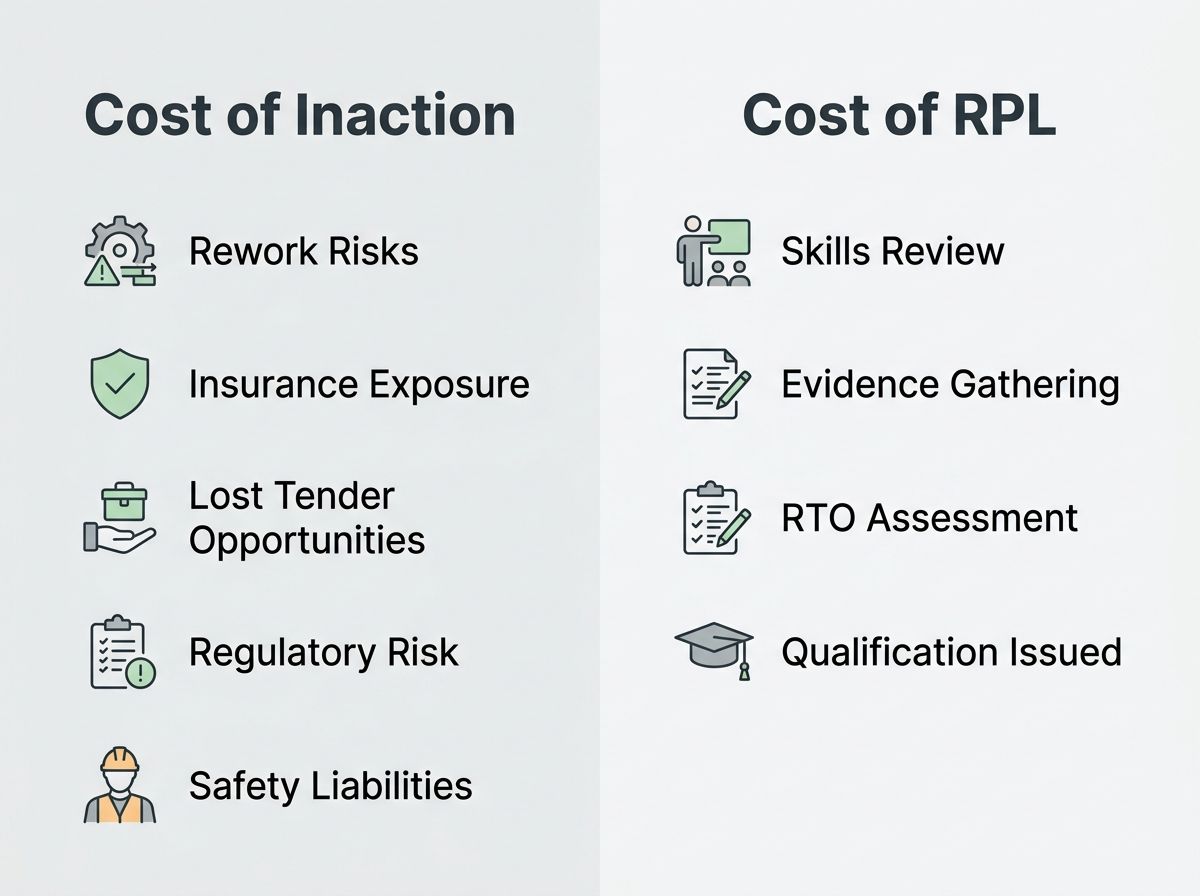
- Rework risk: Structural welds that cannot be verified against a documented quality assurance system may require inspection, remediation, or replacement at the contractor's cost.
- Insurance exposure: Where work is performed without the required qualification documentation, insurance coverage may be affected. The specific implications depend on your policy and the type of work.
- Tender disqualification: Many government and major infrastructure projects require evidence of workforce qualifications as part of prequalification. An undocumented workforce can exclude you from bidding.
- Regulatory risk: WorkSafe Victoria has identified missing qualification documentation as an observed unsafe practice. Enforcement action is a real possibility where this is found on site.
- Structural safety: WorkSafe Victoria warns that unsafe on-site structural welding practices could result in catastrophic structural collapse causing serious or fatal injuries.
None of these costs show up on a training budget. They appear on your insurance claim, your project variation, or your incident report.
Why hiring a qualified welder costs more than you think
The alternative to qualifying your current fabricator is hiring someone who already holds the qualification. This is sometimes the right decision, but it is rarely the cheap one.
According to Jobs and Skills Australia, there are approximately 79,100 people employed as Structural Steel and Welding Trades Workers nationally, with annual employment growth of only 1,100 across the occupation group. The pool of available, qualified welders is small, and the competition for them is high.
Median full-time weekly earnings for this occupation group were $1,688, with 96% working full-time and average hours of 46 per week. These are not entry-level wages; qualified welding tradespeople command market rates that reflect genuine scarcity.
The Jobs and Skills Australia occupation profile for Structural Steel and Welding Trades Workers provides the most current government data on earnings, employment size, and geographic distribution for this group.
Beyond salary, hiring externally means spending on advertising, recruiter fees, reference checking, and managing the productivity gap while a new hire learns your systems, materials, tolerances, and team. An experienced fabricator who already knows your operation, and whose welder qualification you fund, is fully productive from day one of their qualified status. A new hire is not.
Recruitment consistently costs more than keeping your existing staff. While specific figures vary by role and industry, the principle is clear. For a skilled trade in a tight labour market, the gap is wider than most employers expect.
How RPL turns your fabricator's experience into a formal welder qualification
Recognition of Prior Learning (RPL) is the formal assessment process that evaluates whether a worker's existing skills, knowledge, and experience meet the requirements of a nationally recognised qualification. This means they do not have to repeat training they already master on the job.
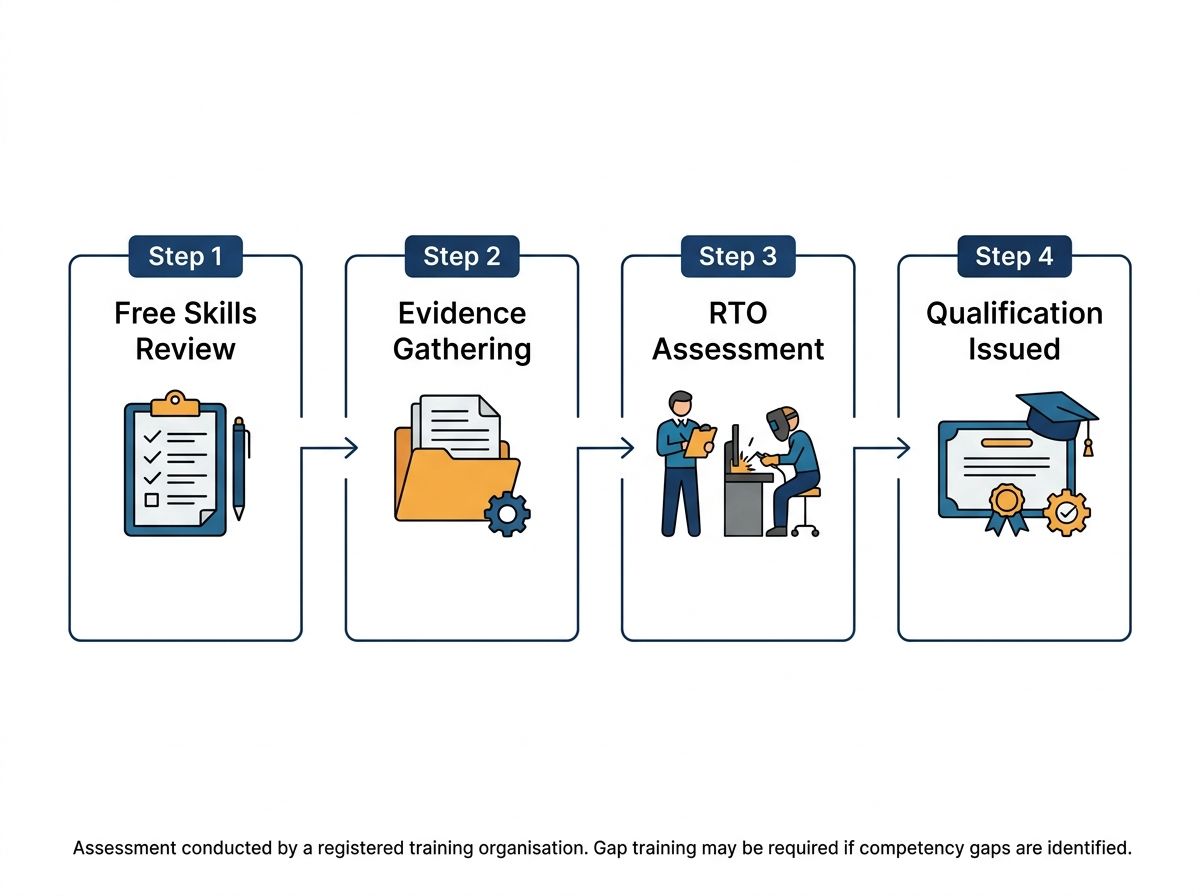
For a fabricator with years of on-the-job welding experience, RPL means their existing competency is assessed against the units of the Certificate III in Engineering – Fabrication Trade (MEM31925). The assessment is conducted by a registered training organisation (RTO). If the assessor determines that the evidence demonstrates competency, the RTO issues the qualification. RPL it guides candidates and employers through this process, but the assessment and qualification are always conducted and issued by the RTO.
What does the evidence typically look like? Based on general RPL practice for trade qualifications, assessors commonly look for:
- A resume or employment history documenting relevant welding and fabrication roles
- Employer references or third-party reports from supervisors or site managers
- Photos or videos of completed work, which are particularly useful in hands-on trades
- Job descriptions or duty statements from current or previous roles
- Any prior training records, certificates, or statements of attainment
The timeframe for completing an RPL application varies by RTO, qualification, and how quickly evidence can be gathered. General guidance from RTOs suggests a range of approximately two to eight weeks for the assessment process. This is indicative only and depends on the specific provider and how ready the evidence is.
You must be realistic about what RPL is not. It is a rigorous assessment rather than a shortcut. If competency gaps are identified during your assessment, you may need to complete gap training before the qualification can be issued. An honest skills review before the formal process begins is the best way to understand whether RPL is a realistic pathway for a particular person.
The Certificate III in Engineering – Fabrication Trade can be obtained through a Training Contract or through formal trade recognition assessment processes, which can include RPL.
What employers get wrong about loyalty and qualification
The final counterintuitive point is that employers who invest in their workers' qualifications tend to see higher retention, not lower.
Australian employers continue to invest in developing their workforce's skills through both accredited training and on-the-job learning. According to NCVER's 2025 survey of employer views on the VET system, the majority of employers with apprentices and trainees use TAFE as their main training provider. The most common reasons are course appropriateness and access, rather than cost avoidance.
NCVER's Employers' use and views of the VET system 2025 provides the most current national data on how Australian employers engage with accredited training.
The logic is straightforward. When you fund a fabricator's welder qualification, you show them that their experience is valued and that you are investing in their future alongside your own. That signal builds loyalty. The alternative, which is leaving them unqualified while they watch compliant colleagues access better sites and higher pay, builds resentment.
Your best fabricators already have the skills. The qualification is simply the formal acknowledgement of what they have earned.
The first step: a Free Skills Review for your fabricator
The decision is yours. But before you post the job ad, find out whether the answer is already on your team.
A Free Skills Review is the starting point. It is a no-obligation assessment of whether RPL is a realistic pathway for your fabricator, based on their actual experience rather than a sales pitch. If RPL is not suitable, we will tell you. If it is, we will explain what the process looks like and what is involved.
Ready to Get Recognised?
Start with a free skills review to find out if RPL is right for you.