Stop losing Tier-1 contracts because your crew is not fully ticketed
Losing tenders because your electricians lack formal qualifications? Electrician RPL converts their experience into compliance without off-site training.

The electrical contracts your business is losing (and why this continues)
You put forward a competitive tender. Your experienced crew has completed this type of work successfully for years, and your pricing was sharp. Yet the contract went to a rival firm. This occurred because their team holds formal trade qualifications while your staff does not.
This is the practical compliance gap. It is not an issue of trade skill, as your crew understands the work thoroughly. The problem is that modern procurement systems cannot recognise undocumented experience. In commercial and public sector electrical contracting, what cannot be verified through formal credentials is simply not accepted.
Electrician RPL (Recognition of Prior Learning) is the formal mechanism that bridges this compliance gap. It is a nationally recognised assessment pathway that evaluates your crew's existing on-the-job competency against current training standards, removing any requirement for them to repeat study for skills they already master.
This guide is written for electrical contractors and business owners who watch highly lucrative contracts go to competitors because of a paperwork deficit rather than a capability issue. It explains the specific compliance requirements, the commercial cost of leaving this unaddressed, and how electrician RPL works as a practical workforce management tool.
What Tier-1 principals and government agencies strictly require
The Certificate III in Electrotechnology Electrician (qualification code UEE30820) is the nationally accredited benchmark qualification for electrical trade work in Australia. Holding this qualification is the primary technical requirement for individual electrical licensing applications across all Australian states and territories.
When a principal contractor, government agency, or large commercial developer specifies that electrical work must be performed by licensed or formally qualified tradespeople, they are generally referring to workers who hold a qualification at this level. Without this trade certificate, your electricians cannot legally sign off on their own work in most jurisdictions, and your business cannot satisfy the strict compliance documentation that Tier-1 and government tenders require.
While specific tender criteria and local licensing rules vary by state and contract, the underlying principle remains constant: formal, independently assessed competency is the baseline requirement. Practical experience alone, regardless of depth, does not satisfy these rigorous documentation standards. Only the formal qualification meets this criteria.
The UEE30820 is a nationally recognised qualification delivered by registered training organisations (RTOs) under the Australian Qualifications Framework and is publicly catalogued on training.gov.au. If your trade staff do not hold this specific credential, your business is exposed to a compliance gap that limits the commercial contracts you can bid on.
The commercial liabilities of an unticketed electrical workforce
The most visible commercial loss is the tender you do not secure, but the underlying compliance gap carries deeper liabilities for your company.
Your crew is highly capable, but the project specifications exclude them. This gap results in compounding commercial disadvantages that affect your contracting business over the long term.
- Contract exclusion: Most commercial and public sector electrical contracts stipulate formal qualifications as a mandatory condition. An unticketed trade crew means your business cannot be named on the tender, regardless of your pricing or experience.
- Liability exposure: Electrical safety laws across Australian states and territories impose strict legal duties on employers regarding the formal qualifications of workers performing electrical tasks. Because statutory obligations vary by jurisdiction, if you are uncertain about these operational requirements, seek guidance from your state regulator or a qualified legal adviser.
- Insurance complications: Commercial public liability and professional indemnity insurance policies often feature specific clauses regarding worker trade qualifications. You must review your insurance policy wordings carefully if any members of your on-site crew lack formal credentials.
- Sign-off limitations: In most Australian jurisdictions, electrical workers cannot legally sign off on their own installations without holding the correct electrical licence, which relies on a formal trade qualification. An unticketed crew means every minor task requires a licensed supervisor to inspect and sign off, creating a workflow bottleneck.
- Preferred supplier panels: Government departments and Tier-1 principal contractors maintain panels with strict compliance benchmarks. An unqualified workforce can prevent your company from being approved for these panels, or result in immediate suspension.
These operational costs are real commercial risks. They represent the practical consequences of a compliance standard that is steadily tightening across the construction sector. The immediate question is not whether to address this gap, but how.
What electrician RPL is (and what it is not)
Electrician RPL is a formal assessment process that measures your crew's practical on-the-job experience against the performance standards of the UEE30820 Certificate III in Electrotechnology Electrician. If the assessment demonstrates that your workers meet the standard, the qualification is issued by an RTO. If minor gaps are found, target gap training addresses them.
RPL is not a shortcut or a method to avoid assessment. It is a rigorous, nationally accredited process under the Australian Qualifications Framework, which ensures the qualification is accepted by major commercial clients. A qualification achieved through RPL holds identical legal and professional standing as one completed via an apprenticeship, as both must meet the same national standard.
The difference with the RPL pathway is that the assessment is based on verified evidence of current trade competence, meaning your team does not need to sit through classroom instruction for skills they demonstrate daily.
RPL it guides your electricians through compiling their evidence portfolios and connects them with a registered training organisation to conduct the formal assessment. The RTO issues the qualification. Our practical role is to make this evidence process straightforward, assisting from the initial skills review to final document submission.
Timelines for the RPL process depend on individual factors: the depth of current experience, the availability of technical evidence, and the partner RTO's assessment schedule. The Free Skills Review completed at the beginning of the process provides a realistic timeline tailored to your specific crew.
What your electricians must demonstrate for UEE30820 RPL
The RPL process for the UEE30820 assesses competency across the core components of the Certificate III qualification. For experienced tradespeople, these practical skills are already proven. The main task is not learning new skills, but documenting their current knowledge in a format that meets assessment guidelines.
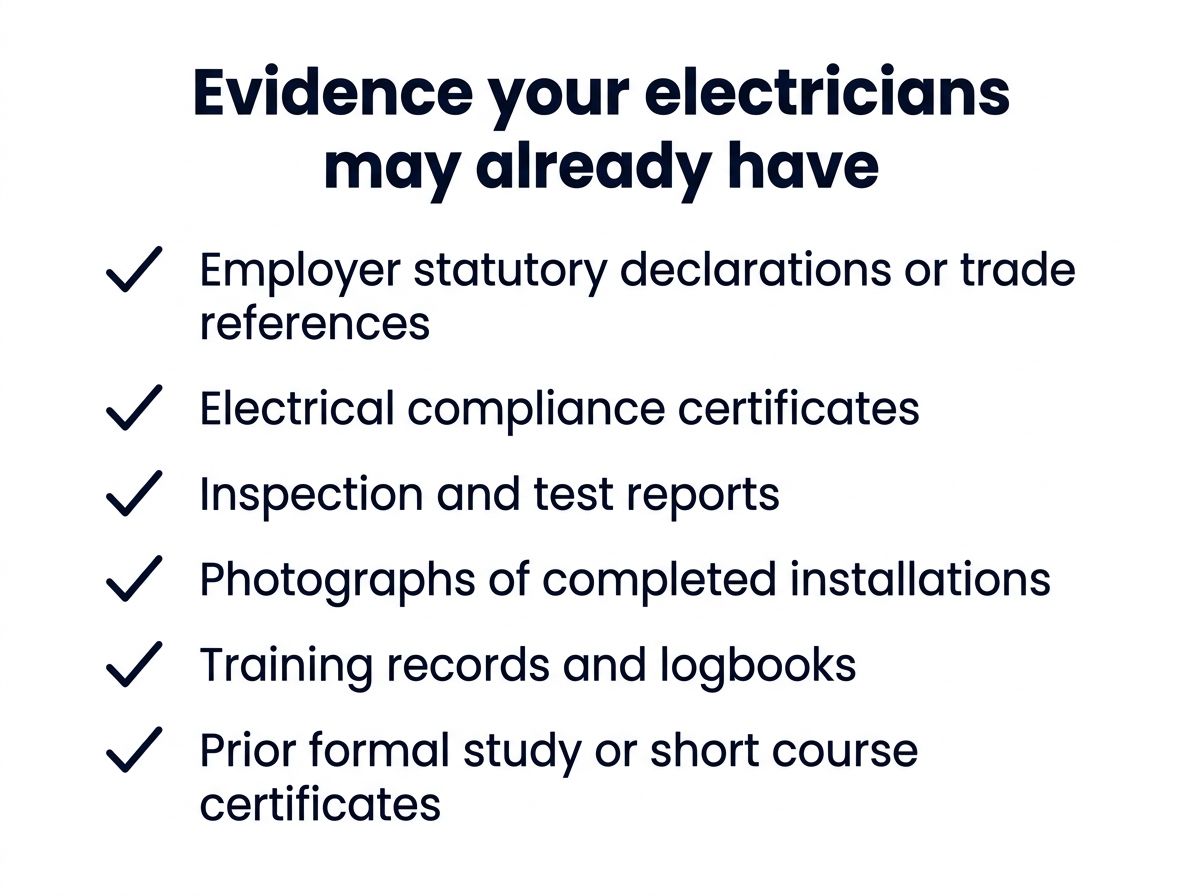
Evidence compiled for the RPL assessment is drawn from the daily commercial work your electricians perform. Standard evidence includes:
- Employer statutory declarations or trade references detailing the precise scope of work completed.
- Records of finished electrical installations, including regulatory compliance certificates and official inspection reports.
- Photographic evidence of completed works showing direct compliance with specific unit assessment criteria.
- Logbooks, work orders, or digital job sheets detailing the volume and variety of tasks performed.
- Third-party validation reports from qualified site supervisors, project managers, or licensed tradespeople confirming competent performance.
- Previous formal training documentation, statements of attainment, or relevant international trade licences.
Specific evidence requirements are defined by the assessing RTO under national UEE30820 guidelines. RPL it guides your staff in identifying and structuring their current workplace records, while highlighting any competency areas that may require supplementary documentation or targeted gap training.
If competency gaps are identified during this process, practical gap training is arranged to resolve them. This is a standard element of RPL and does not indicate candidate failure. The objective is simply to meet the national trade standard through the most efficient pathway available.
The commercial case: what a qualified electrical workforce unlocks
A formally qualified electrical crew represents a valuable asset. Resolving the compliance gap changes your market positioning.
- Expanded tender access: You can bid on major contracts requiring formally qualified electrical personnel. This includes public infrastructure developments, Tier-1 commercial sites, and industrial enterprise agreements that stipulate trade qualifications as a condition.
- Licensing pathways: The UEE30820 is the mandatory prerequisite for electrical worker licensing in most jurisdictions. Helping your crew secure this credential allows them to apply for individual licences, which increases your operational capacity to self-certify installations and reduces supervisory bottlenecks.
- Reduced liability exposure: A qualified workforce demonstrates systematic corporate due diligence regarding workplace electrical safety standards. This is vital for insurance coverage terms, regulatory compliance records, and during project audits conducted by principal contractors.
- Preferred supplier status: Government departments and Tier-1 principal builders require proof of workforce qualification compliance during pre-qualification. A ticketed trade team helps secure and maintain your commercial position on preferred subcontractor panels.
- Staff retention: Providing a clear pathway to formal trade qualifications supports career progression and professional confidence. Investing in your crew's credentials helps retain skilled workers in a highly competitive employment market.
The cost of getting your team qualified is quickly recovered through the commercial contracts you can now bid on. The alternative is continuing to leave contract revenue to fully compliant competitors.
How the electrician RPL process works for your business
The RPL process follows a systematic sequence designed to minimise operational disruption. The path consists of four main phases.
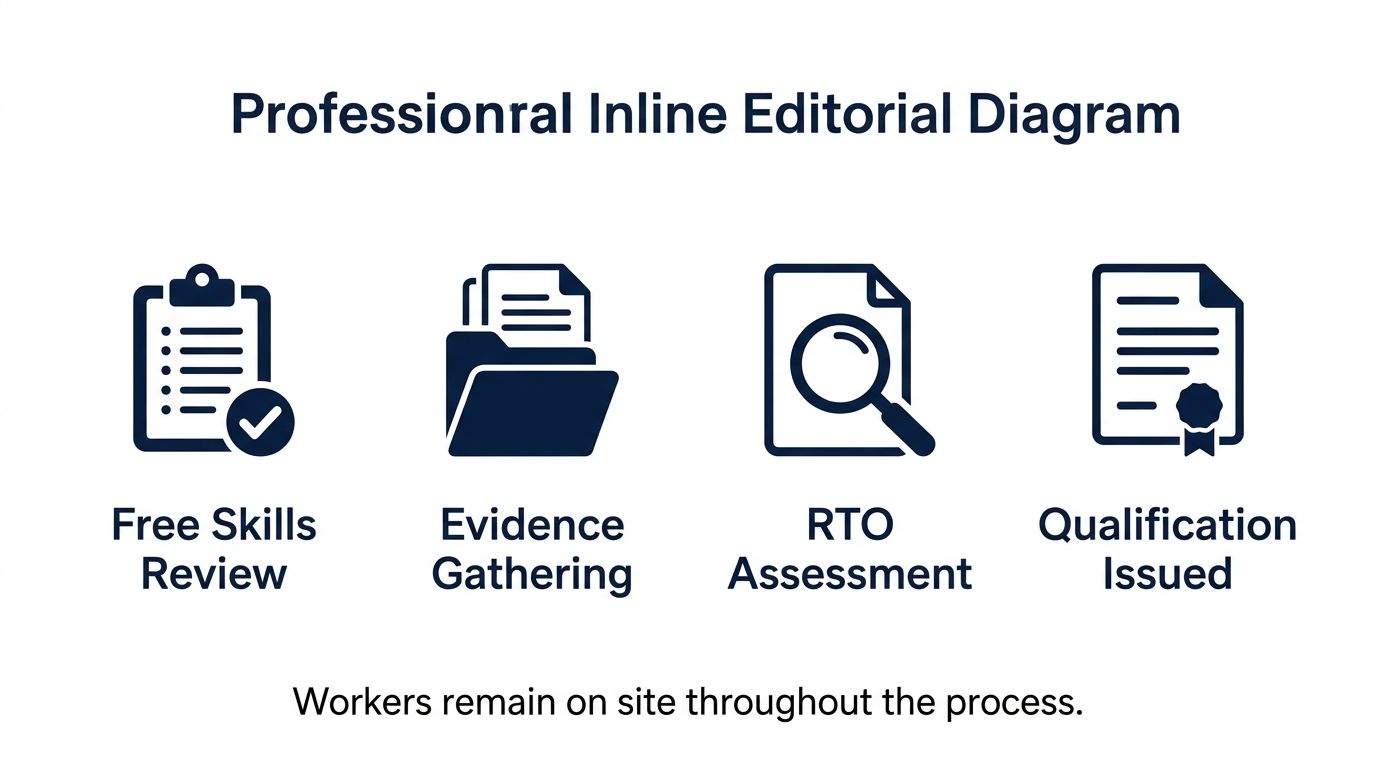
- Step 1: Free Skills Review. We conduct an initial review to confirm if your electricians are suitable candidates for the UEE30820 RPL pathway. This is an objective assessment of trade suitability. If a worker does not qualify, we will advise you immediately.
- Step 2: Evidence Compilation. For eligible candidates, RPL it assists with gathering and structuring evidence that demonstrates competency against national unit standards. We help document the work your electricians perform daily into a format that meets formal criteria.
- Step 3: RTO Assessment. The portfolio is submitted to a partner registered training organisation, whose assessors evaluate the documented evidence against national standards. If minor gaps are identified, practical gap training is arranged to complete the assessment.
- Step 4: Qualification Issue. Once competency is verified, the partner RTO issues the UEE30820 Certificate III in Electrotechnology Electrician. This is an accredited national qualification under the Australian Qualifications Framework.
This pathway is structured around your active project commitments. Your electricians do not need to take extended leave from the job site to complete their RPL assessment. Evidence gathering and RTO evaluation are managed alongside regular duties, with specific schedules adapted to your business operations.
How to confirm your crew's eligibility through a Skills Review
The Free Skills Review is the initial step in the process. It is a practical evaluation of candidate eligibility, not a high-pressure sales consultation, and carries no obligation.
The review evaluates if your team members possess the specific background and experience required for the UEE30820 RPL pathway. If they are suitable, you receive a detailed breakdown of the required documents and steps. If RPL is not the correct path for a particular worker, we will state that clearly.
Our services are based on practical, honest suitability guidance. Enrolling tradespeople who do not meet the core standards wastes your time and money. The Free Skills Review answers the eligibility question clearly before you commit any business resources.
The final decision to proceed remains entirely yours. The review simply provides the objective data required to make an informed commercial decision.
Ready to Get Recognised?
Start with a free skills review to find out if RPL is right for you.