The ceiling you hit without a plumbing licence
You can do the work, but without a licence you can't sign compliance certificates. Here is the pattern experienced plumbers hit, and how to break it.
The moment every experienced plumber recognizes
You have done the rough-in. You have run the lines, pressure-tested the system, and fitted off every fixture. The job is complete, and it is done properly. Then you stop, because you cannot sign the compliance certificate. Instead, you have to call someone else. You wait for them to arrive, inspect your work, and put their signature on it. And you pay them for the privilege of signing off on what you built.
If that scenario sounds familiar, you have already hit the ceiling. It is not just a single, minor inconvenience. It is a recurring pattern that repeats every time you take on plumbing work that requires a licensed plumber's signature.
Why this keeps happening: the pattern behind the ceiling
The cycle is structural rather than accidental. In the Northern Territory, plumbing and draining are regulated occupations under the Plumbers and Drainers Licensing Act 1983. The NT Plumbers and Drainers Licensing Board administers licensing in the territory. A cross-jurisdictional regulatory review notes that, at the time of that review, WA and the Northern Territory were the only Australian jurisdictions where a board was involved in the regulation of plumbing work, which makes the NT framework distinct from most other states.
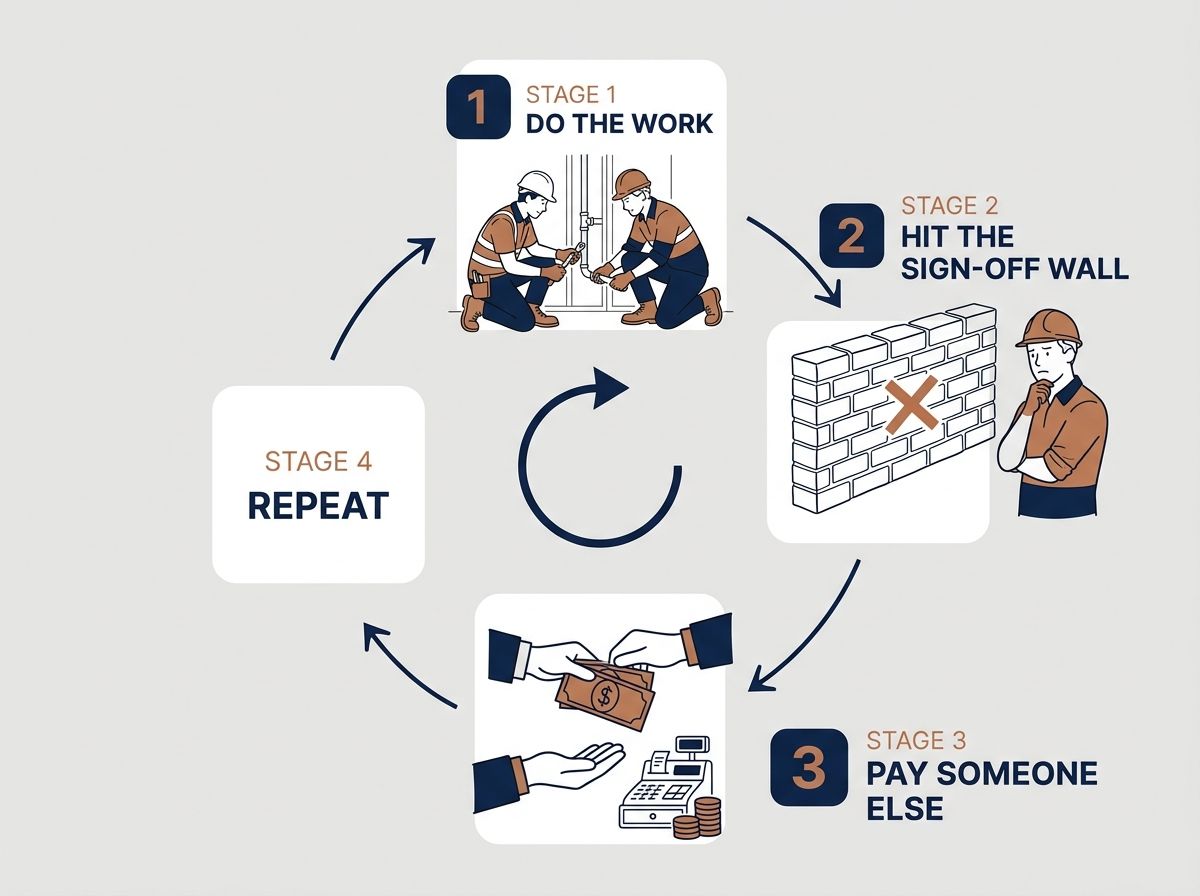
The cycle works in a specific way. You take on a job. You complete the physical work—the rough-in, the fit-off, the pressure test, and everything else. Then you hit the sign-off wall. The work requires a Certificate of Compliance for plumbing and drainage, and only a licensed plumber who is also registered as a certifying plumber and drainer with the Building Practitioners Board can issue it. Because you do not hold this licence, you call one in. You pay them, and the cycle repeats on the next job.
The same pattern plays out across other licensed trades. The experience is real and the competence is real, but the formal credential is the specific requirement that the regulatory system demands.
If you have worked in another licensed trade and hit the same wall, this pattern is familiar.
What the NT plumbing licence actually unlocks
It is important to be precise about what the licence actually enables, because it represents much more than a simple piece of paper.
In the NT, a certifying plumber or drainer is a licensed plumber who is also registered with the Building Practitioners Board. That registration is what authorizes them to issue a Certificate of Compliance for plumbing and drainage work. The NT Government advises always using a licensed plumber for plumbing work, including work to fixtures and fittings, whether or not a compliance certificate is required.
Without the licence, you can complete the physical work. With the licence, you can sign off on it. Without the licence, you work under someone else's name. With the licence, you work under your own name. Without the licence, you cannot contract directly with a customer as a plumber. With the licence, you can.
It is also worth noting what sits outside the plumbing licence framework in the NT. Gas fitting is regulated separately by NT WorkSafe under the Dangerous Goods Regulation, not by the Plumbers and Drainers Licensing Act. Roof plumbing and mechanical services are not regulated under the NT plumbing framework at all. The only regulated categories are plumbing and draining.
The licence is not a mere formality. It is the practical difference between working for someone else's signature and working under your own.
Three moments when the ceiling becomes undeniable
First, you complete a job—such as a new water supply to an existing building, a drainage line replacement, or a grease trap installation—and you have to call in a licensed plumber to issue the Certificate of Compliance. You have done the work, they have done the paperwork, and you have paid them for it. This moment shows that the credential gap costs you money on every job that requires sign-off.
Second, you try to tender for a job independently. The client asks for your licence number, but you do not have one. The job goes to someone else, who may have less practical experience than you. This moment shows that without the plumbing licence, you cannot compete for licensed work on your own terms.
Third, you look at starting your own plumbing business. You run the numbers and you know the trade. However, a journeyman—someone who holds registration but not a full licence—cannot contract directly with a customer. All work must be supervised by an advanced tradesperson. This moment shows that the licence is not just about sign-off authority, but about your legal right to operate independently.
These are not isolated incidents. They are the same ceiling showing up at different points in the same career.
Why going back to TAFE is not the only option
The obvious solution of going back to TAFE to complete the Certificate III in Plumbing often feels wrong. You already know how to do this work. Sitting in a classroom for what training providers describe as a four-year full-time apprenticeship program to prove your skill is not recognition. It is simply repetition.
Multiple TAFE providers across Australia list the Certificate III in Plumbing (CPC32420) as a four-year apprenticeship program, which typically requires employment under a training contract as a condition of entry.
CPC32420, the Certificate III in Plumbing, is the nationally recognised qualification associated with plumbing licensing pathways across Australia. It replaces the older CPC32413. As training provider course documentation notes, plumbing is a licensed occupation, and licensing, legislative, regulatory, or certification requirements can differ between Australian states and territories. Readers should confirm the specific requirements for NT licensing with the relevant NT authority.
Recognition of Prior Learning (RPL) is different from going back to TAFE. It is a formal assessment process, conducted by a registered training organisation, that evaluates what you already know against the units of competency in the qualification. It is not a shortcut or a rubber stamp. It is a rigorous assessment of existing skills and knowledge that recognizes experience as a legitimate form of evidence.
A Western Australian Government fact sheet on RPL describes it as an assessment process that must meet the Principles of Assessment and Rules of Evidence. It is distinct from credit transfer and requires evidence that is current, authentic, valid, and sufficient.
For experienced plumbers, the question RPL asks is not whether you can learn this trade, but whether you can demonstrate that you already know it.
Understanding how RPL works for experienced tradespeople is the starting point for anyone who has been doing the work without the formal credential.
What RPL actually looks like for a plumber
The evidence you need for an RPL assessment is likely closer to hand than you think. Your job sheets are evidence. Your photos of completed rough-ins, fit-offs, and pressure tests are evidence. References from supervisors, builders, or clients who can verify your work are evidence. Compliance documentation you have helped produce, even if someone else signed it, is evidence of the work you completed.
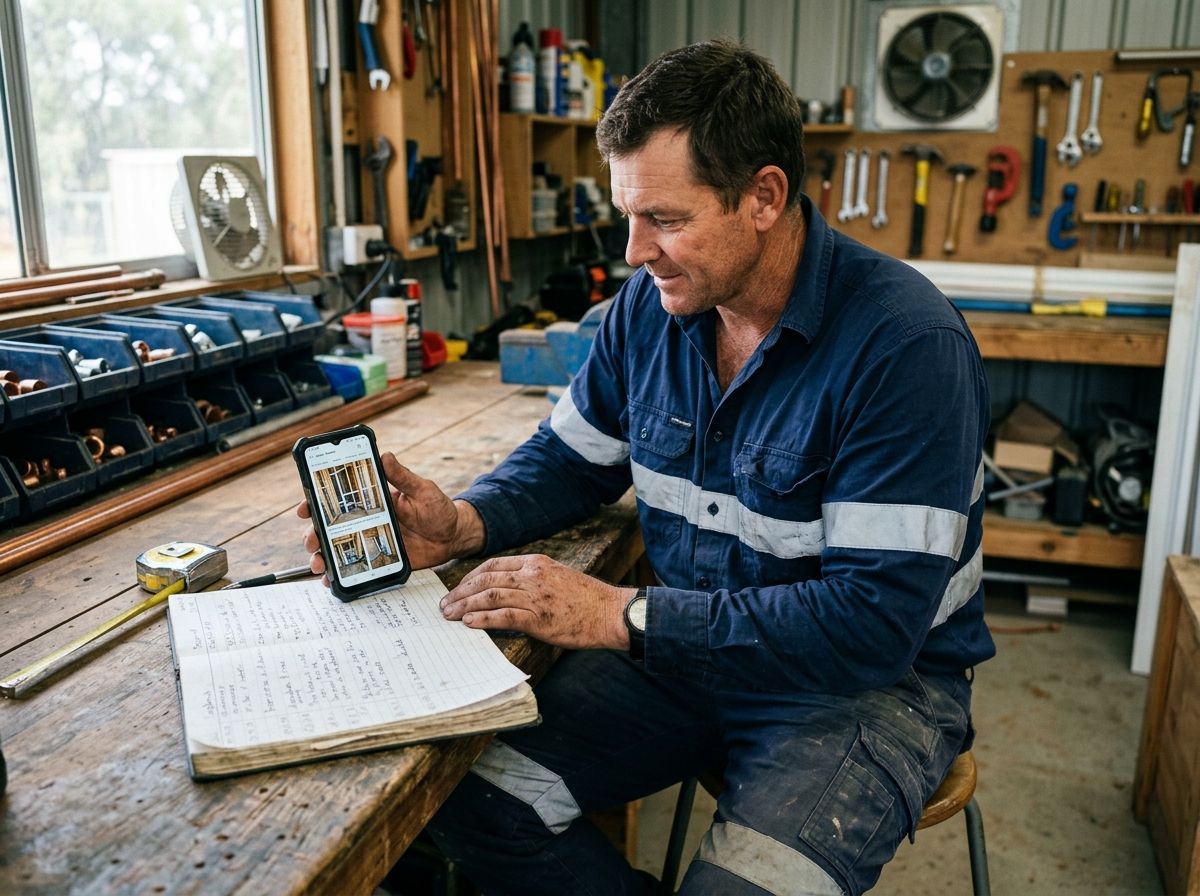
RPL evidence must be current, authentic, valid, and sufficient. A single document or example is rarely enough; assessors need a range of evidence covering all aspects of the competency. Authenticity may be verified through interviews, third-party reports, or direct observation. If your experience is recent and well-documented, you are likely in a stronger position than you realize.
Some RPL providers working with CPC32420 may ask for items such as a resume, referee testimonials, work samples, photographs of completed work, and certifications you already hold. Assessment methods can include portfolio reviews, interviews, and practical demonstrations. Requirements vary by registered training organisation, and the specific evidence required for your assessment will depend on the RTO you work with.
An assessor will review your evidence against the units of competency. If there are gaps where your documented experience does not fully cover a unit, these will be identified. Gap training addresses those specific areas. It is a standard part of the process, not a sign of failure.
Charles Darwin University's course information for CPC32420 Certificate III in Plumbing notes that assessment methods can include written assessment, questioning, portfolios, work samples, direct observation, practical assessments, and third-party feedback.
Outdated experience may not be sufficient for RPL unless supported by recent application in the workplace. If you have been actively working in plumbing—even without a licence—your recent work history is your strongest asset.
Breaking the cycle: the first step
The cycle of doing the work, hitting the sign-off wall, paying someone else, and repeating the process only breaks when you decide it does. That decision starts with a single, practical step: understanding whether your experience is likely to support an RPL pathway toward the plumbing licence.
For more information on NT plumbing licence requirements, the NT Plumbers and Drainers Licensing Board is the relevant authority.
You can also explore what the NT plumbing licence pathway looks like through RPL.
Ready to Get Recognised?
Start with a free skills review to find out if RPL is right for you.