Why wrenching for 10 years doesn't mean you can sign off
You can diagnose a fault blindfolded but still need a junior to sign off. Learn how AUR31120 via RPL turns your experience into the formal ticket you need.
The sign-off problem nobody talks about
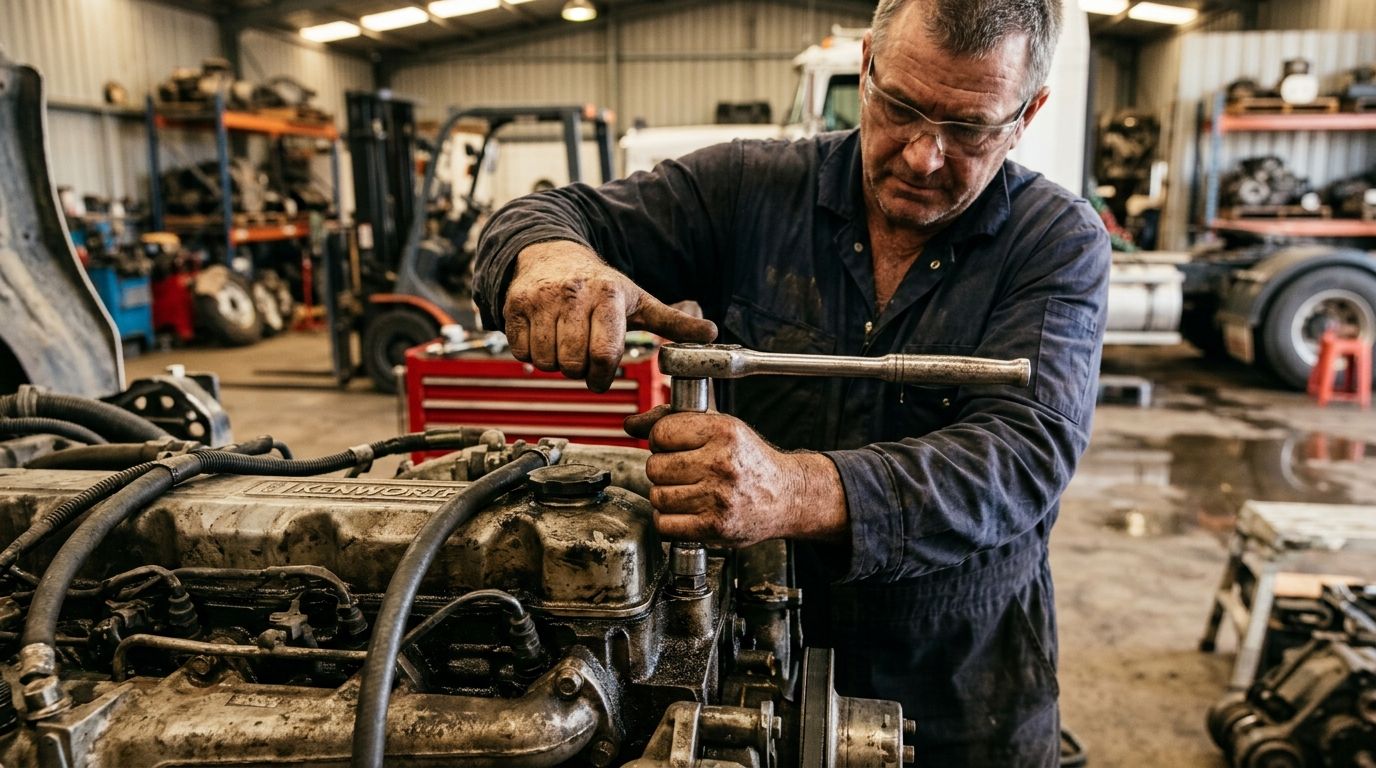
You've rebuilt more engines than the workshop supervisor. You can hear a fault in a diesel before the diagnostic scanner confirms it. You've kept rigs running on remote mine sites where calling in a specialist wasn't an option. And yet, when it comes time to sign off on a job, you need someone else's name on the paperwork.
That someone might have less time on the tools than you. They might have learned the theory in a classroom while you were learning it under a truck. But they hold the formal qualification, the AUR31120 Certificate III in Heavy Commercial Vehicle Mechanical Technology, and you don't. So the signature is theirs.
This is a credential problem, not a skills problem. And it is a systemic one. Heavy Vehicle Industry Australia, in a submission to the Productivity Commission, noted that its members routinely raise concern about the shortage of registered training organisations delivering automotive and manufacturing training packages, a gap that compounds over time as experienced workers remain formally unrecognised while the industry faces an ageing workforce.
The frustration is real. The pathway out of it is also real. It starts with understanding what AUR31120 actually is, and why your years of experience may already constitute the evidence needed to earn it.
What AUR31120 actually is
AUR31120, the Certificate III in Heavy Commercial Vehicle Mechanical Technology, is the nationally recognised qualification for individuals who perform a broad range of tasks on a variety of heavy commercial vehicles in the automotive service and repair sector. That description comes directly from the qualification's listing on the National Training Register at training.gov.au, where AUR31120 is current.
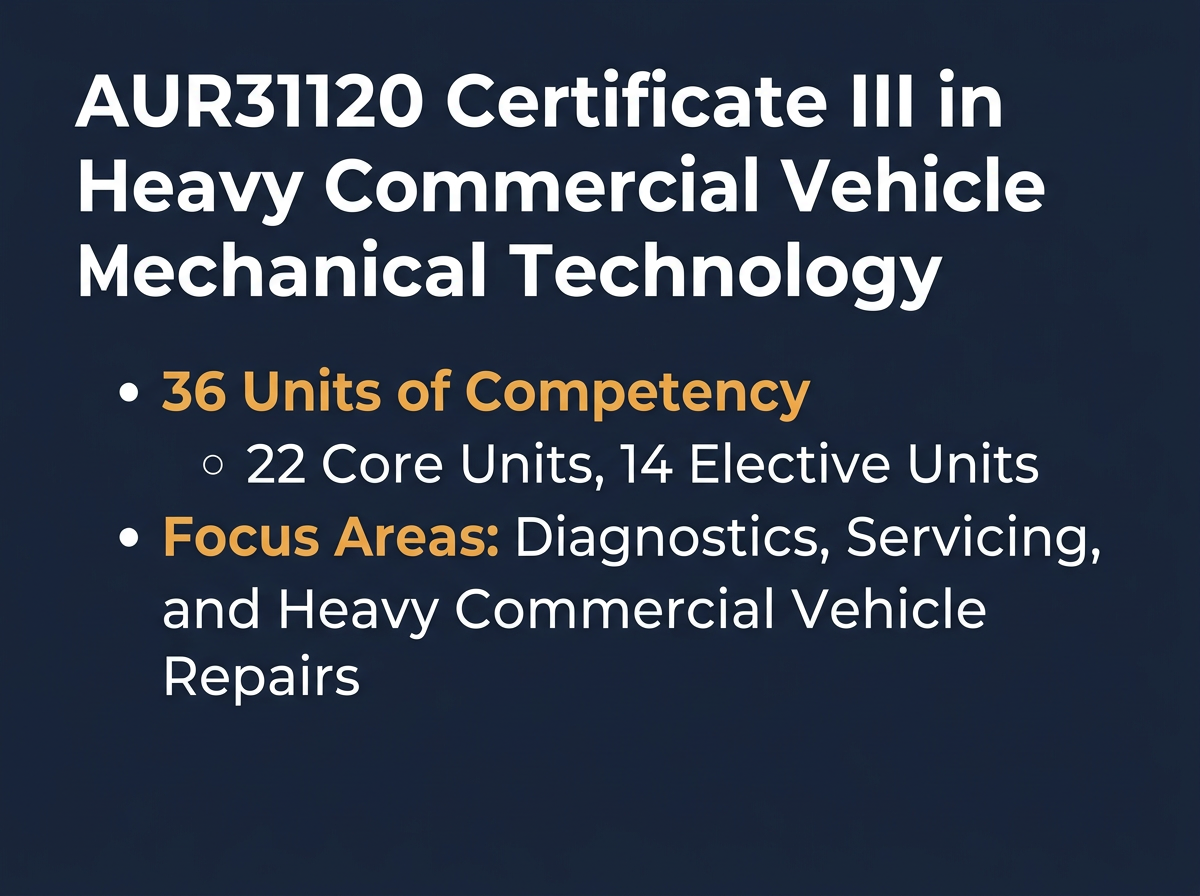
The qualification requires 36 units of competency: 22 core units plus 14 elective units. The core units cover the technical foundations of heavy commercial vehicle work, including safe working and environmental practice, electrical circuits, batteries and charging systems, compression ignition engine management, heavy vehicle air braking, steering, suspension, hydraulic systems, diesel fuel injection, emission control, diagnostic test strategies, and final drive assemblies. At least one elective unit must come from a specialist group covering either heavy vehicle manual transmissions or heavy vehicle automatic transmissions.
The full qualification structure, including the current unit list and packaging rules, is published on the National Training Register.
The qualification carries no licensing or legislative requirements at the national level at the time of publication, though state and territory licensing requirements and employer site-access requirements can differ. The qualification itself does not confer a licence. What it does is formally establish that the holder has been assessed as competent across the full scope of heavy commercial vehicle mechanical technology.
Without it, the formal system cannot see your competence, regardless of how long you have been doing the work.
The gap between what you know and what the system sees
The Australian vocational training system was built around a linear pathway: apprenticeship, structured training, formal assessment, qualification. It works well for people who enter a trade at the beginning of their working life and move through that pathway without interruption.
It was not designed for the mechanic who learned on the job across three different employers. Or the one who spent years maintaining fleet vehicles for a transport company before formal qualifications were a site requirement. Or the FIFO worker who has kept heavy mining equipment running in conditions that would challenge any workshop-trained technician.
The result is a structural invisibility. Genuine competence, the kind that comes from years of real-world problem-solving, exists in the wrong form for the formal system to recognise. The skills are there. The evidence, in the form the system accepts, is not.
This is not unique to heavy vehicle mechanics. A Western Australian government-commissioned vocational skills gap assessment reported that employers in the automotive sector have experienced skills shortages of both light vehicle and heavy vehicle mechanics, with projected shortfalls cited in the report for the 2022/23 period. The report indicates a broader, long-standing pattern: the industry has relied on experienced workers whose formal credentials have not kept pace with their practical capability.
The credential gap is systemic. The pathway to closing it for the individual is Recognition of Prior Learning.
Why experience alone isn't enough, and why that's not the end of the story
Experience can be evidence. That is the foundational principle of Recognition of Prior Learning (RPL) within the Australian Qualifications Framework. RPL is a formal assessment pathway that maps existing skills, experience and knowledge against the requirements of a nationally recognised qualification. Where competency can be demonstrated through evidence, credit is granted without repeating training.
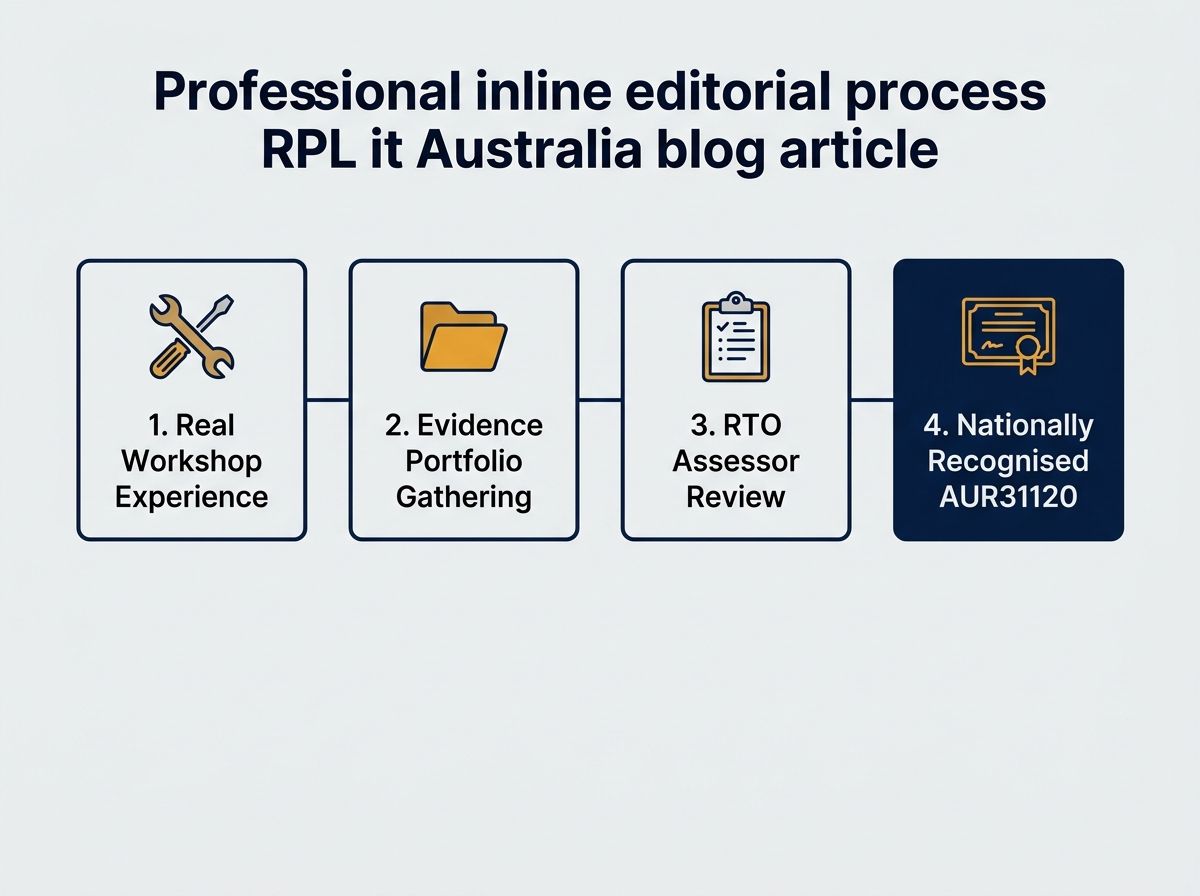
RPL is a different pathway to the same destination, not a shortcut. The assessment is conducted by a Registered Training Organisation (RTO) against the same competency standards that apply to any other candidate for AUR31120. The qualification issued at the end of a successful RPL process is identical to one earned through a traditional apprenticeship, because the assessment standard is the same.
What RPL recognises is that competency is not time-referenced. As Charles Darwin University describes it in its course information for AUR31120, RPL focuses on whether those skills are current and match the elements and performance criteria of the individual units, rather than when or how they were acquired.
That matters for experienced mechanics. It means that skills developed over a decade on the tools, across multiple employers, in remote locations, or on FIFO rosters, can potentially be assessed as evidence, provided they are current and can be documented. The question is not whether you have the competence. The question is whether you can demonstrate it in a form the assessor can evaluate.
What heavy diesel experience actually counts as evidence
The 22 core units of AUR31120 cover the technical work that experienced heavy commercial vehicle mechanics perform every day. Consider what some of those units describe:
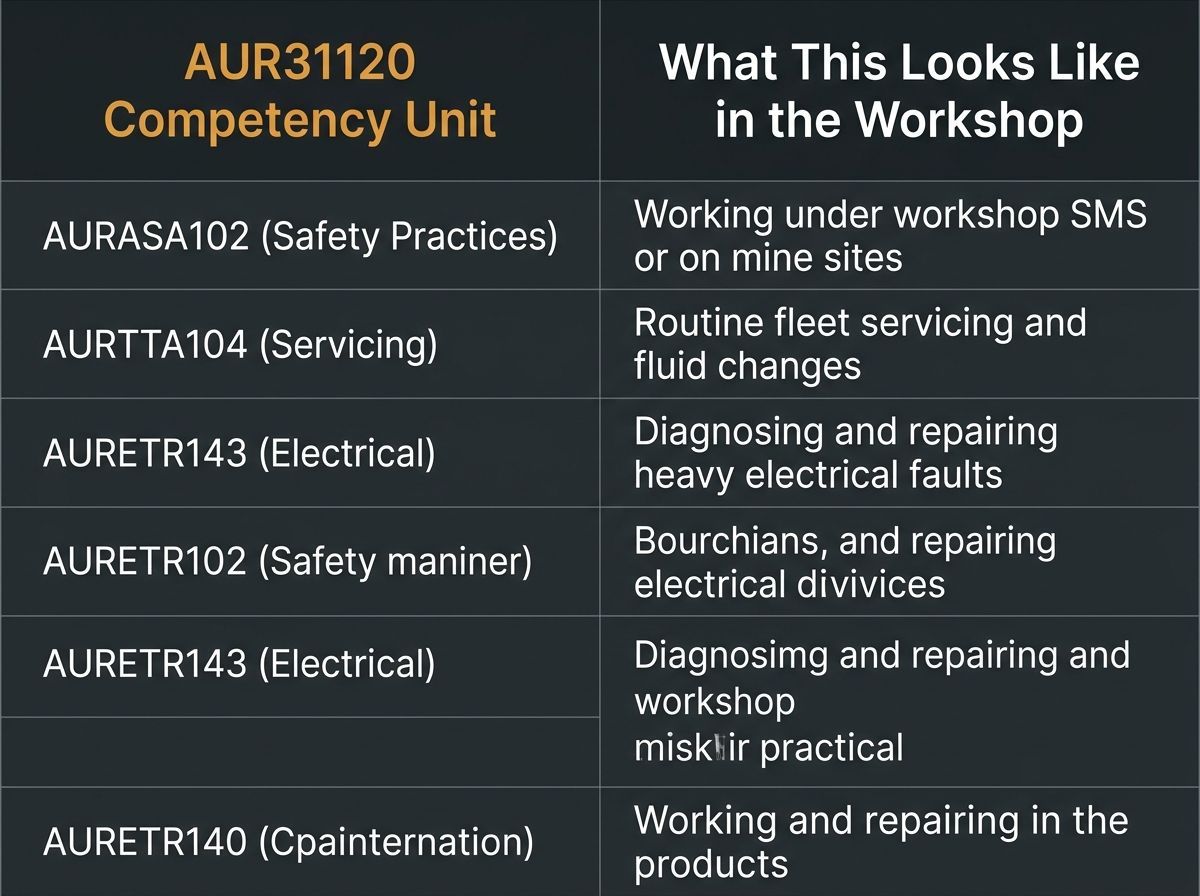
- AURASA102 Follow safe working practices in an automotive workplace: if you have worked under a safety management system on a mine site or in a fleet workshop, this is your daily practice.
- AURTTA104 Carry out servicing operations: routine servicing of heavy commercial vehicles, including fluid checks, filter replacements, and inspections. This is standard practice in any heavy vehicle workshop.
- AURTTA118 Develop and carry out diagnostic test strategies: if you have systematically traced a fault through a heavy vehicle's systems using diagnostic tools and your own knowledge of how those systems interact, this is what this unit assesses.
- AURTTK102 Use and maintain tools and equipment in an automotive workplace: the tools you use on every shift, maintained to the standard required.
- AURHTE102 Diagnose and repair heavy vehicle compression ignition engines: diesel engine diagnosis and repair. If this is not your core work, you may be looking at the wrong pathway.
- AURHTB001 Diagnose and repair heavy vehicle air braking systems: diagnosing, repairing, and testing air brake systems on heavy commercial vehicles.
- AURHTD001 Diagnose and repair heavy vehicle hydraulic systems: diagnosing and repairing hydraulic systems across a range of heavy commercial vehicle applications.
If you have been performing this work professionally, you have been building evidence against these units. The challenge is not acquiring the competence. It is documenting it in a form that an assessor can evaluate.
Automotive RTOs that offer RPL for AUR31120 typically look for evidence that is valid, current, authentic and sufficient. Mechanist, an automotive RTO, describes the evidence types commonly requested. This includes workplace photos and videos, signed employer or supervisor declarations (third-party reports), job sheets and service records, trade-related licences and tickets, employment history documents such as payslips or contracts, and practical demonstrations observed at the workplace. Core trade work is generally expected to be current within the last two to three years, though currency requirements vary between RTOs.
Mechanist, an automotive RTO, publishes a description of its RPL process and evidence expectations for AUR31120 and related qualifications.
For mechanics in mining and resources, including FIFO roles, experience maintaining site vehicles and heavy transport equipment may be considered relevant experience for AUR31120 RPL. One commercial RTO lists mining operations and fleet maintenance facilities as contexts where RPL-relevant tasks are commonly performed. The general principle, as described by Charles Darwin University, is that RPL can consider work experience regardless of how or where it was attained, provided the skills are current and match the competency standards.
Whether your specific experience is sufficient is a question for an assessor, not a question you can answer from a job description. But the starting point is recognising that the work you have been doing is the work the qualification assesses.
The reality of the RPL process
RPL for AUR31120 is a genuine assessment process. The RTO's assessor maps your evidence against each unit of competency, grants recognition for units where evidence is sufficient, and identifies any remaining units where gaps exist. Where gaps are identified, targeted gap training is typically provided, usually at no additional cost, to bring you to the full qualification.
Time served is not the same as competency. An RPL assessment requires documented evidence, not just years in the trade. The assessor is making a professional judgement about whether your evidence demonstrates the required standard, and that judgement is theirs to make, not ours to predict.
The assessment is conducted by the RTO, and the qualification is issued by the RTO. RPL it guides candidates through the process, helping you understand what evidence to gather, how to present it, and what to expect. However, the assessment outcome is determined solely by the assessor against the qualification's competency standards.
How long does the process take? That depends on how complete and well-organised your evidence is, and on the RTO's assessment workload. The process typically takes weeks to months; the more thoroughly your evidence is prepared, the more efficiently the assessment can proceed. No specific timeframe can be guaranteed.
Who this pathway is for, and who it isn't
RPL for AUR31120 is suited to mechanics with substantial hands-on experience in heavy commercial vehicle maintenance and repair. If your working life has been spent diagnosing faults, servicing systems, and repairing components on trucks, buses, heavy plant, or mining vehicles, and you can document that work, this pathway is worth exploring.
It is not suited to those early in their careers, or to mechanics whose experience is primarily in light vehicles. The qualification is specifically for heavy commercial vehicle work, and the evidence needs to reflect that scope.
One provider notes that there is no fixed number of years of experience required; eligibility depends on factors such as the mechanical responsibilities you have held, the types of vehicles you have serviced, your diagnostic experience, the repair work you have performed, and the workplace evidence available to you. Requirements vary between RTOs.
The direct answer to whether you qualify is that we cannot know until we look at your specific background. A Free Skills Review is the practical way to find out.
Finding out if your experience qualifies
You have the experience. The question is whether it constitutes evidence, and the only way to answer that is to have it assessed.
The AUR31120 Certificate III in Heavy Commercial Vehicle Mechanical Technology is the formal credential that the industry and the formal system recognise. It covers the work you have been doing. RPL is the assessment pathway that evaluates whether your experience meets the standard, without requiring you to repeat what you already know.
The decision is yours. But the first step costs nothing.
Ready to Get Recognised?
Start with a free skills review to find out if RPL is right for you.