What Counts as Evidence for Apparel and Textiles RPL When You Trained Overseas
Worked in garment production or textiles overseas? See what evidence — employer letters, production records, samples — counts for RPL in Australia.
By RPL it Australia10 min read
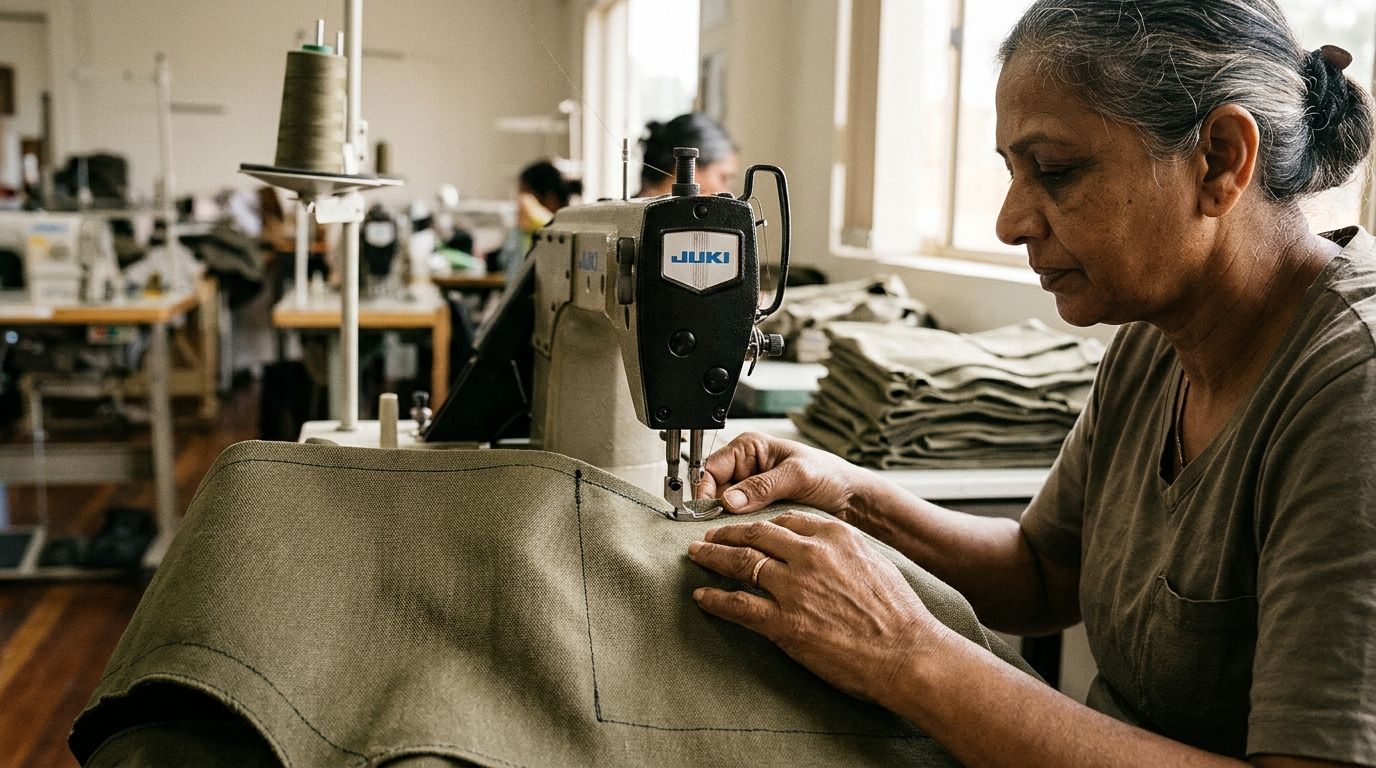
Your overseas apparel experience is real — the question is whether your documentation proves it
You have the experience. Years of it. Cut-and-sew production. Pattern interpretation. Quality checking on the floor. Supervising a team of machinists. Running a section of a garment factory that shipped to international brands.
Here in Australia, none of that automatically counts. Not because the work wasn't real — it was. Not because the skill isn't there — it is. But formal recognition systems require evidence in a specific form. Your competence exists. The question is whether your documentation can demonstrate it to an assessor who wasn't there.
That gap — between what you know and what you can prove — is exactly what Recognition of Prior Learning (RPL) is designed to bridge. RPL is a formal assessment pathway that evaluates your existing skills and knowledge against the requirements of an Australian qualification. If your evidence is sufficient, the qualification can be awarded without repeating training you've already effectively completed.
This article is a practical guide to what counts. It covers the five main categories of evidence RPL assessors typically consider for apparel and textiles qualifications — including the Certificate III in Apparel, Fashion and Textiles (MST31022) — and what each looks like when it comes from overseas work history. Read it as a self-audit: by the end, you should have a clearer sense of whether your documentation is likely to support an application.
What RPL assessors are actually looking for in apparel and textiles
RPL assessors are not looking for proof that you studied. They are looking for proof that you can do the work.
For an apparel and textiles qualification like MST31022, that means demonstrating competency across the core skills the qualification covers. These typically include: interpreting and applying construction specifications, using industrial sewing and production equipment, applying quality standards to finished garments, working with patterns and technical drawings, and understanding production workflows and workplace safety requirements.
The specific units within MST31022 define exactly what competencies are assessed. Each unit has its own evidence requirements. Assessors are trained to evaluate whether the evidence you provide — whatever form it takes — demonstrates that you can perform those competencies to the required standard.
Overseas work history is accepted. What matters is that the evidence is credible, relevant, and sufficient to support a judgement about your competency. The assessor's job is to make that judgement fairly, regardless of where your experience was gained.
This means your ten years in a Dhaka garment factory, your pattern-making work in Ho Chi Minh City, or your quality supervisor role in a textile mill in Gujarat can all form the basis of an RPL application — provided you can document them appropriately.
The five types of evidence that count — and what each looks like from overseas work
There are five main categories of evidence RPL assessors typically accept. Here is what each looks like when it comes from overseas apparel and textiles work history.
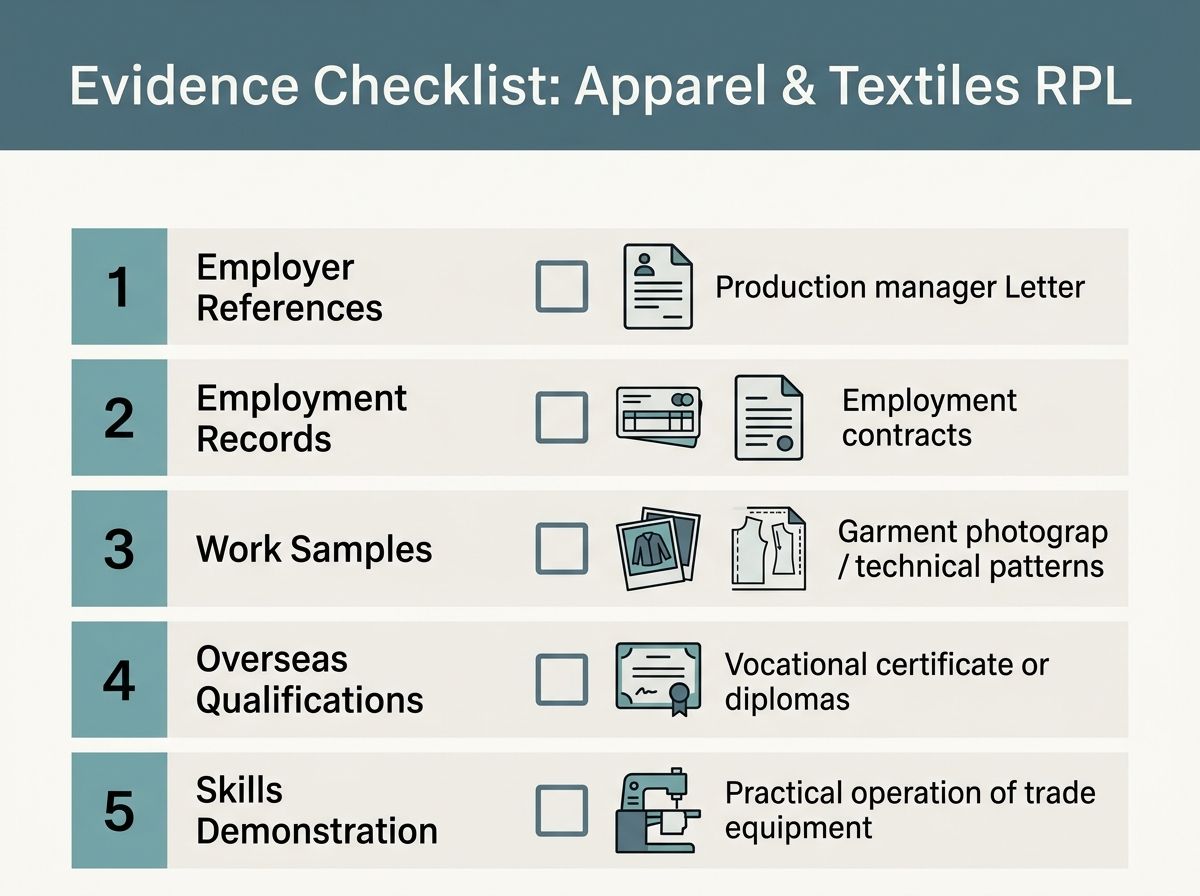
1. Third-party reports and employer references
A written statement from a supervisor, manager, or employer who can confirm the work you performed and the standard you achieved. This is often the most valuable piece of evidence in an RPL application.
From an overseas context, this might be: a letter from a factory production manager describing your role and responsibilities; a reference from a quality control supervisor confirming your inspection standards; or a statement from a business owner or floor manager who worked alongside you.
The letter should be on company letterhead where possible, include the writer's name and position, describe the specific tasks you performed, and cover the period of employment. If the letter is in a language other than English, you will likely need a translated version — check with the delivering RTO about their specific requirements for translated documents.
2. Employment records and payslips
Documentary evidence that you were employed in the industry, for how long, and in what capacity. Payslips, employment contracts, tax records, and social insurance records all serve this purpose.
From an overseas context, this might include: payslips from a garment factory showing your job title and employment period; an employment contract specifying your role as a machinist, pattern maker, or production supervisor; or official records from a government employment or social security system showing your industry and tenure.
Even partial records are useful. If you have payslips for some of your employment period but not all, submit what you have. Assessors understand that documentation practices vary across countries and industries.
3. Work samples and portfolios
Physical evidence of the work itself. In apparel and textiles, this is one of the most powerful forms of evidence available — and one that many overseas-trained workers overlook.
Work samples might include: photographs of garments you constructed or supervised; pattern pieces or technical drawings you created or worked from; samples of finished products from a production run you were responsible for; or photographs of your workstation, equipment, or production environment.
If you have physical garment samples, bring them. If you have photographs on your phone from years of production work, organise them. A portfolio of work samples — even informal photographs — can provide compelling evidence of practical competency that no employer letter can fully replicate.
Note that individual RTOs may have their own policies about how work samples are submitted and assessed. Some may accept digital photographs; others may prefer physical samples for certain competencies. Confirm the requirements with the RTO before your application.
4. Formal qualifications and certificates
Any formal training or certification you completed in your home country. These are not automatically recognised as equivalent to Australian qualifications, but they can serve as supporting evidence that you have formal grounding in the field.
This might include: a vocational certificate from a government training body in your home country; a trade qualification from an industry training institute; or a completion certificate from a factory-based training programme.
Overseas vocational certificates from major garment-producing countries — whether issued by government training bodies or industry organisations — may be accepted as supporting evidence alongside your employment history. They are typically not treated as direct equivalents to Australian qualifications, but they strengthen the overall picture of your background. Confirm with the delivering RTO how they treat overseas qualifications in their assessment process.
5. Structured questioning and skills demonstrations
In addition to documentary evidence, RPL assessors often conduct a structured interview or practical skills demonstration. This is your opportunity to demonstrate competency directly — to show, not just tell.
For apparel and textiles, a skills demonstration might involve: operating industrial sewing equipment; interpreting a technical pattern or construction specification; explaining a quality checking process; or describing how you would manage a production workflow problem.
If your documentary evidence has gaps — perhaps because you worked informally, or because records from your previous employer are no longer accessible — a skills demonstration can provide direct evidence of competency that supplements or partially substitutes for missing documents. Raise this with the assessor early in the process.
To summarise: RPL assessors for apparel and textiles qualifications typically accept employer references, employment records, work samples and portfolios, overseas formal qualifications, and direct skills demonstrations. You do not need all five. A strong combination of two or three — particularly employer references supported by work samples — is often sufficient to begin an assessment.
Evidence assessors commonly see from overseas apparel workers
Australia's apparel and textiles workforce includes workers from a wide range of backgrounds. Many have trained and worked in major garment-producing regions — South and Southeast Asia, China, South Asia, and parts of Europe and the Middle East — before migrating to Australia.
Assessors working with overseas-trained applicants regularly see: employment letters from garment factories and textile mills; payslips and employment contracts from manufacturing operations; portfolios of garment photographs and pattern samples; references from production supervisors and quality managers; and vocational certificates from training institutions in the applicant's home country.
This is not unusual documentation. It is the standard evidence base for overseas-trained apparel workers, and assessors are experienced in evaluating it. The fact that your employer letter is from a factory in another country, or that your payslips are in a different currency, does not disqualify them as evidence.
What assessors are looking for is credibility and relevance. A letter that clearly describes your role, your responsibilities, and the standard of your work — even if it comes from a small factory in a regional city overseas — is credible evidence. A portfolio of photographs showing garments you constructed to a professional standard is relevant evidence. These things count.
If you worked in a country where formal employment documentation was not standard practice — where you were paid in cash, where contracts were verbal, where payslips were not issued — that does not automatically exclude you from RPL. It does mean that your evidence base will rely more heavily on employer references, skills demonstrations, and work samples. Be honest about your documentation situation early in the process so the assessor can advise on the best approach.
What happens if your evidence has gaps
RPL is a rigorous assessment process. It is not a rubber stamp, and it is not designed to award qualifications without sufficient evidence of competency. If your documentation has gaps, that is worth knowing before you apply — not after.
Gaps in evidence are common. They do not automatically disqualify you. What they mean is that the assessment pathway may look different. Where documentary evidence is incomplete, assessors may place greater weight on structured questioning and skills demonstrations. In some cases, gap training may be identified — specific units or competencies where your evidence is insufficient to support a competency judgement.
If gap training is required, it is provided at no additional cost as part of the RPL process through the delivering RTO. Gap training is targeted — it addresses only the specific areas where your evidence falls short, not the full qualification. For experienced workers, gap training is typically modest.
The honest reality is that some applicants will have strong evidence across most competencies and thin evidence in one or two areas. Others may have more significant gaps that require additional training. The only way to know which applies to you is to have your specific background assessed by someone who knows the qualification requirements.
That is exactly what a Free Skills Review is for. It is a no-obligation conversation about your background, your documentation, and whether your evidence is likely to support an RPL application. It is not an enrolment. It is an honest assessment of your situation before you commit to anything.
How to know if you have enough to start an RPL application
Use this as a practical self-check. If you can answer yes to most of these questions, you likely have a sufficient evidence base to begin an RPL application for an apparel and textiles qualification.
- Do you have at least two to three years of work experience in garment production, textile manufacturing, or a closely related apparel industry role?
- Can you obtain a written reference from at least one supervisor, manager, or employer who can describe your work and the standard you achieved?
- Do you have any documentary evidence of your employment — payslips, a contract, tax records, or social insurance records — covering at least part of your work history?
- Do you have photographs, samples, or a portfolio of work that demonstrates the quality and nature of your production work?
- Can you describe, in detail, the specific tasks you performed day-to-day — the equipment you used, the processes you followed, the standards you worked to?
- Do you have any formal training certificates or vocational qualifications from your home country, even if they are not directly equivalent to Australian qualifications?
If you answered yes to four or more of these, you have a reasonable evidence base to explore. If you answered yes to two or three, an RPL application may still be possible — but the pathway may rely more on skills demonstrations and structured questioning. If you answered yes to fewer than two, it is worth having an honest conversation about whether RPL is the right pathway for your situation right now.
The decision is yours. RPL is not the right pathway for everyone, and the right guidance is honest guidance. A Free Skills Review gives you a professional assessment of your specific situation — what you have, what might be missing, and whether an RPL application for MST31022 or a related apparel qualification is likely to be viable.
Your skills speak. The evidence is how they are heard.
Learn more about the Certificate III in Apparel, Fashion and Textiles (MST31022) and the RPL pathway on the qualification page.
General information only, current at the date shown. Licensing rules change, so check the current requirements with the relevant regulator before you rely on them. RPL it Australia is a student support service, not a Registered Training Organisation; qualifications are assessed and issued by our partner RTOs.