Your Overseas Experience Doesn't Exist on Australian Paper — And It's Costing You
Skilled migrants arrive with years of expertise — then discover Australian employers can't see it. Here's the pattern, why it happens, and how RPL changes it.
By RPL it Australia8 min read

The Moment It Stops Making Sense
You are sitting across from a hiring manager. You have ten years of experience in your field — clinical, technical, or trade. Back home, you were respected. You led teams, solved complex problems, and held professional registration. You moved to Australia for a better life, and you brought your expertise with you.
Then comes the question.
'Do you have Australian experience?'
In that moment, a decade of competence becomes invisible. This does not happen because you lack skill or because your work was substandard. It happens because the system you are now inside cannot see what you have unless it exists on Australian paper.
If you have lived this moment, you already know it is not an isolated incident. It is a pattern. And it has a name.
The Pattern Has a Name — And It Repeats
Across healthcare, engineering, IT, trades, and business, the same cycle plays out for skilled migrants in Australia. It is not a personal failure. It is a structural pattern that repeats across thousands of people every year.
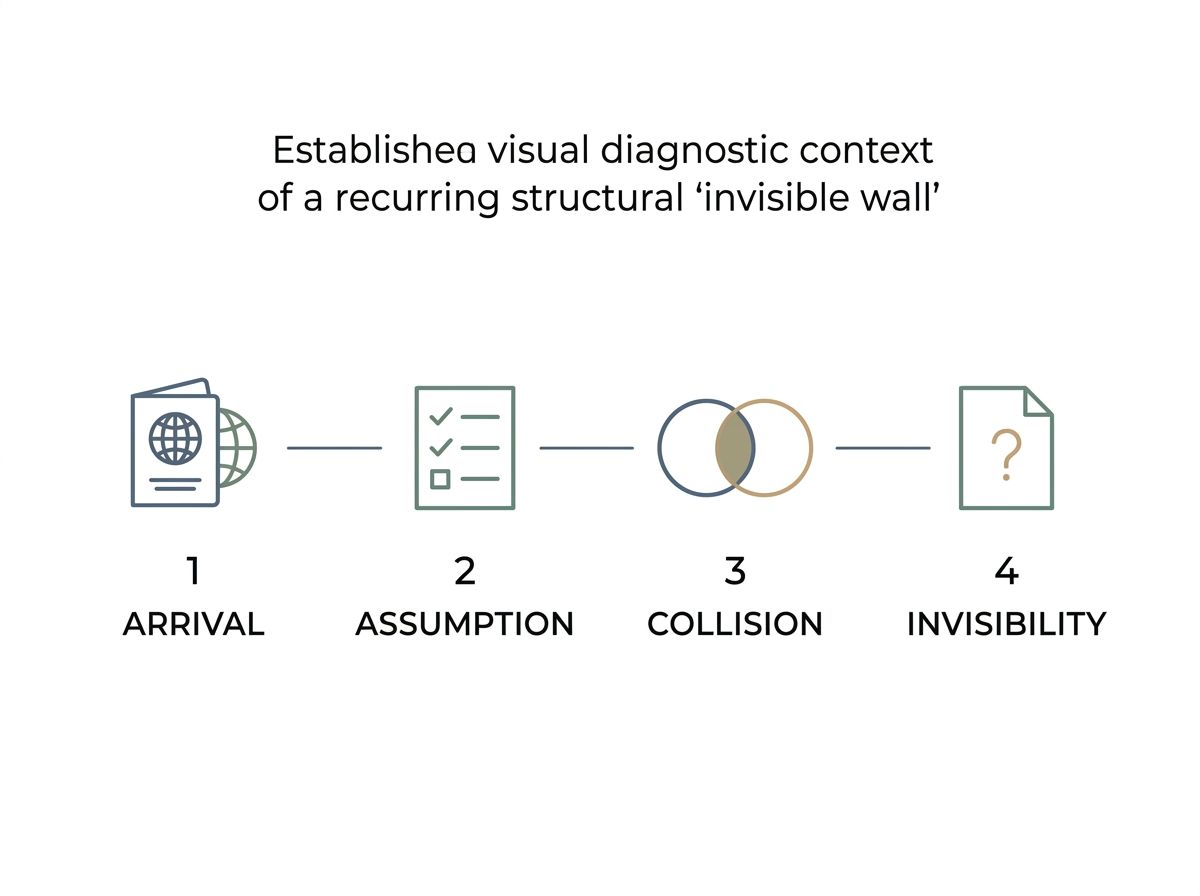
Stage one: Arrival. You arrive with real expertise — years of documented work, professional registration, and formal qualifications from a recognised institution in your home country. Your competence is not in question.
Stage two: The assumption. You expect the Australian system to see what is real. You assume your overseas qualification will be assessed on its merits, that your experience will count, and that the transition will be straightforward.
Stage three: The collision. The job application form has no field for overseas credentials. The licensing body requires an Australian qualification. The immigration skills assessment asks for AQF-aligned evidence. The employer explains, apologetically, that they cannot proceed without local validation.
Stage four: Invisibility. Your competence exists in practice. It does not exist on Australian paper. Without Australian paper, the system cannot formally acknowledge what you know.
A parliamentary committee report has acknowledged that the recognition of overseas qualifications can pose a significant barrier for some migrants in securing jobs that match their skill level. Research published in 2026 identifies non-recognition of foreign qualifications as a key systemic barrier to labour market integration for skilled migrants in Australia — one that leads many to accept roles well below their qualification level.
You are not alone in this. And it is not your fault.
Why Australian Paper Matters More Than You Were Told
The Australian Qualifications Framework (AQF) is Australia's national qualifications system. It establishes ten levels of qualification — from Certificate I through to Doctoral Degree — and sets the standards that Australian employers, licensing bodies, and immigration authorities use to assess credentials.
Overseas qualifications are not automatically mapped to AQF levels. This is not a judgment of overseas education quality. It is a translation problem. The Australian system speaks AQF. Overseas credentials speak a different language. Without a formal translation, the most qualified professional is invisible to the system.
Different professions have different assessing authorities responsible for evaluating overseas credentials against Australian standards. Trades Recognition Australia (TRA) handles trade skills assessments for migration purposes. VETASSESS assesses general professional occupations. Health professions have their own regulatory bodies. Each authority applies its own criteria, and requirements vary significantly by occupation and visa subclass. Source: parliamentary committee report on the skilled visa system.
Understanding this structure is not about accepting an unfair system. It is about navigating it. The gap is not a skills gap. It is a translation gap. And translation has a mechanism.
What an RPL Certificate Actually Is — and Why It Changes the Equation
An RPL certificate is a nationally recognised qualification issued by a Registered Training Organisation (RTO) after a formal assessment of your existing skills and experience against Australian qualification standards. It does not require you to re-learn what you already know. It requires you to present what you already know as evidence.
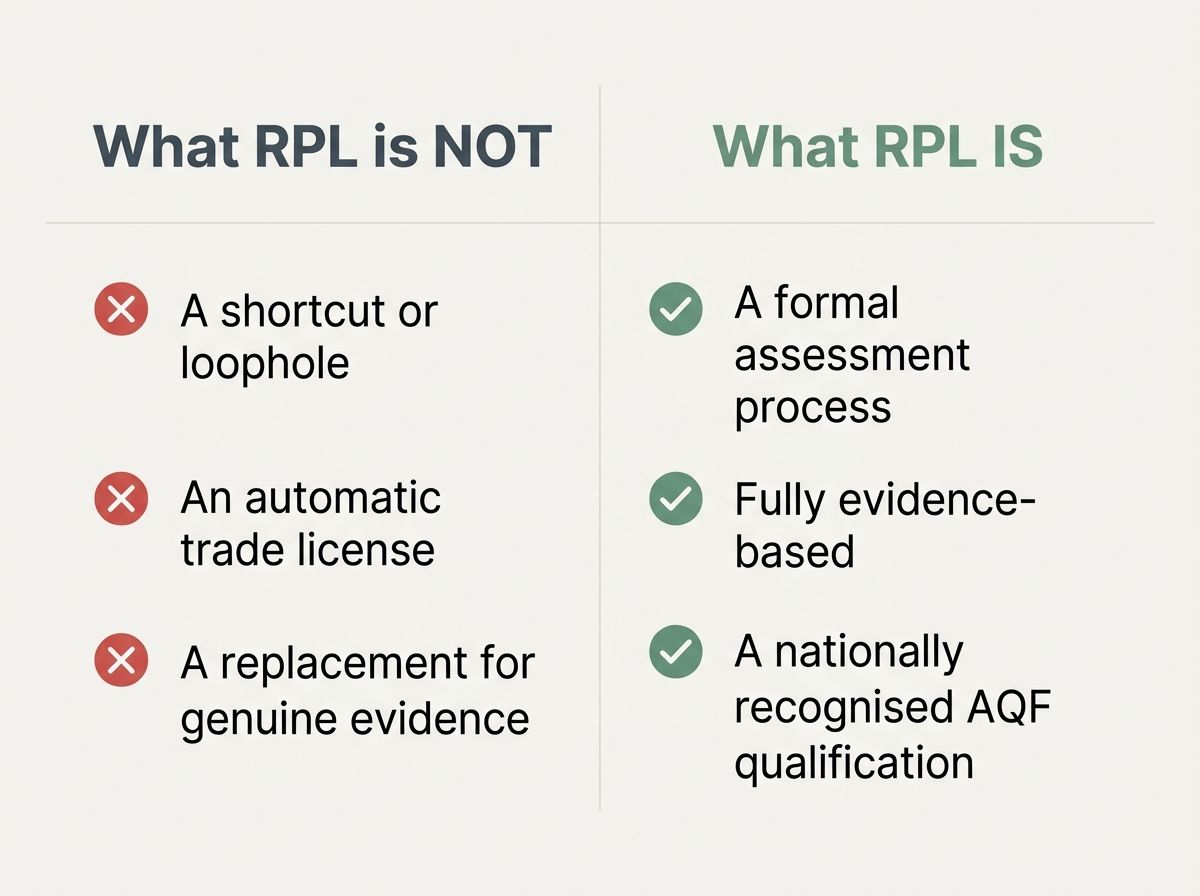
Recognition of Prior Learning (RPL) is defined by the Western Australian Government as 'an assessment process that involves assessment of an individual's relevant prior learning and experience — including skills and knowledge obtained through formal and informal learning — to determine the extent to which the individual meets requirements specified in the training product.'
RPL is distinct from simply transferring a credit or credential. It is a genuine assessment process that must meet the Principles of Assessment and the Rules of Evidence. The qualification is nationally recognised because the assessment is genuine — not because it is a formality.
Only Registered Training Organisations are authorised to issue qualifications through RPL. An RTO must have the relevant training product on its scope of delivery to offer RPL for that qualification. Assessments are conducted by qualified assessors under the same rigour, fairness, and validity required for any other assessment pathway.
For skilled migrants, this is the translation mechanism. RPL converts overseas experience into an Australian-recognised qualification — not by ignoring the assessment, but by conducting it against what you can already demonstrate.
The Four Stages of the Invisible Wall — and Where RPL Breaks the Cycle
The cycle described above is not inevitable. It has a documented exit point.
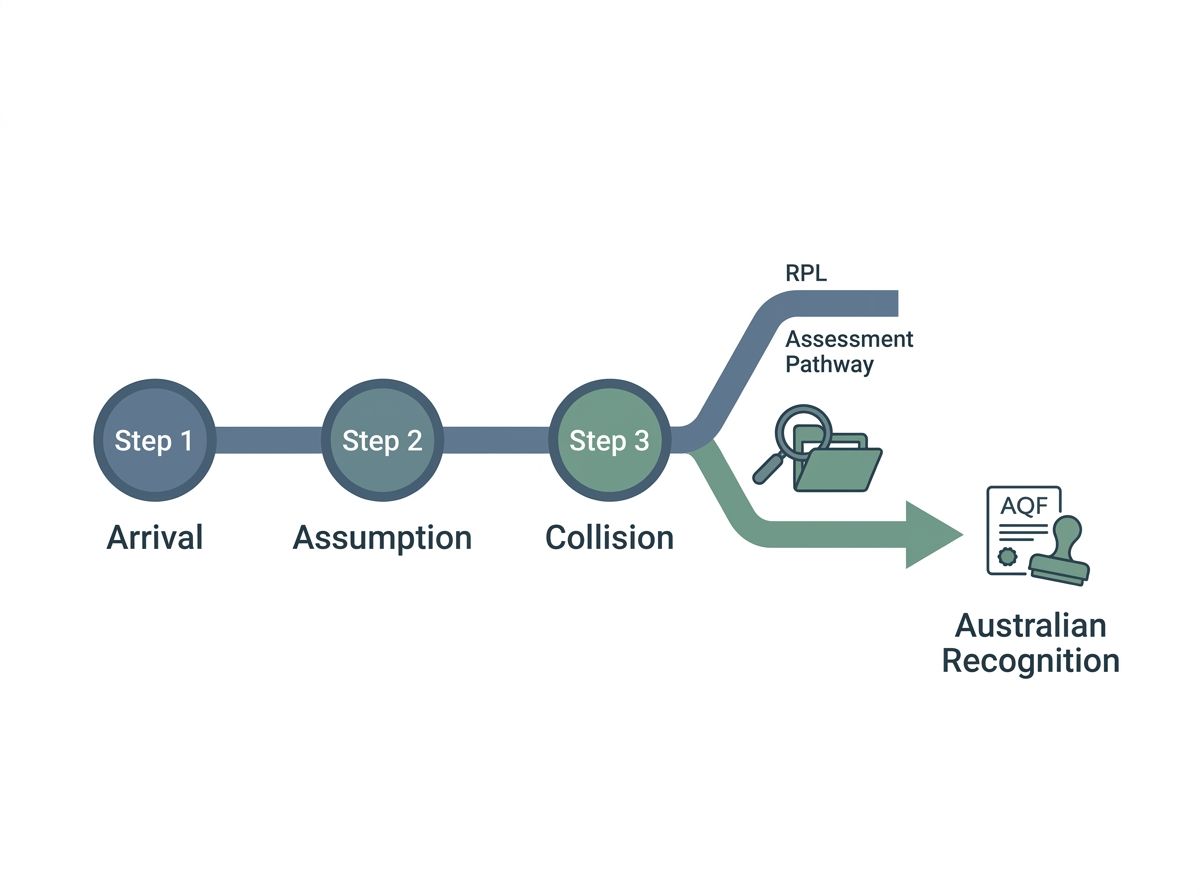
Stage one — Arrival — you bring real expertise. Stage two — Assumption — you expect the system to see it. Stage three — Collision — the system asks for Australian paper you do not have. Stage four — Invisibility — your competence exists but cannot be formally acknowledged.
RPL breaks the cycle at stages three and four. It creates the Australian paper by formally assessing the competence that already exists. The collision becomes a decision point rather than a dead end.
Consider the range of professions where this pattern plays out. A healthcare professional with a decade of overseas clinical experience finds that Australian employers and registration bodies require AQF-aligned credentials. An engineer with overseas professional registration discovers that local licensing requires an Australian qualification. An IT professional with years of systems work finds that employer requirements reference Australian certifications. A tradesperson who has been working on Australian sites discovers that licensing requires a nationally recognised trade certificate.
In each case, the competence is real. The gap is not skill — it is the absence of formal Australian recognition. RPL is the assessment pathway designed specifically for this situation.
Research on RPL in Australia notes that since 1992, the pathway has provided alternative access to formal learning, reduced time and cost in undertaking qualifications, and certified skills and knowledge for career mobility — benefits that are particularly relevant for skilled migrants whose expertise is already developed but not yet formally recognised within the Australian system.
Is RPL the Right Pathway for You? What Honest Guidance Looks Like
RPL is not suitable for everyone. This is not a disclaimer — it is the foundation of honest guidance.
RPL is likely to be a suitable pathway if you have substantial hands-on experience in your field, can document that experience through references, work records, or portfolio evidence, and the qualification you need is available through the RPL pathway. According to guidance from RPL providers, candidates are often considered well-placed for RPL if they have two or more years of relevant work experience, can provide evidence such as employment records, reference letters, work samples, or performance reviews, and are seeking a qualification that reflects skills they already practise.
The quality and relevance of evidence matters more than the volume. A TAFE candidate guide notes that a focused, well-documented portfolio of relevant evidence is more useful than a large collection of loosely related material.
RPL may not be the right pathway if you are new to the field, have limited documented experience, or are seeking a qualification in a highly regulated profession with mandatory training requirements that cannot be assessed through prior learning alone. Final eligibility and evidence requirements are determined by the assessing RTO based on the specific qualification — requirements vary.
The honest first step is finding out. Not committing to a process, not paying for an assessment — just understanding whether RPL is the right pathway for your specific situation.
What Happens After the RPL Certificate: Recognition That Travels
A nationally recognised RPL certificate issued by a registered RTO is valid across Australia. It is not a state-specific credential or a provisional recognition — it is a qualification within the Australian Qualifications Framework, assessed to the same standard as any other pathway to that qualification.
This means it can be used for employment applications, professional registration processes, and licensing applications across Australian states and territories. For skilled migrants navigating the intersection of qualification recognition and visa requirements, a nationally recognised qualification may also be relevant to skills assessment processes — though requirements vary significantly by profession and assessing authority. If immigration is part of your situation, confirm the specific requirements with your relevant assessing authority.
The parliamentary committee inquiry into recognition of overseas skills noted that RPL is considered in skills assessment processes for migration, particularly for incorporating vocational education and training and competency assessment — though the committee also identified ongoing challenges in how these processes are implemented across different professions.
The RPL certificate does not guarantee any specific employment, registration, or immigration outcome. What it does is make your competence visible on Australian paper — which is the translation the system requires.
If your overseas qualification sits at degree or postgraduate level, the article on what skilled migrants are rarely told about overseas degree recognition explores a separate but related pathway.
The Decision Is Yours — But You Don't Have to Make It Without Information
You have the experience. The question is whether RPL is the right way to demonstrate it.
That question deserves an honest answer — not a sales pitch, not a promise, and not a process that begins before you know whether it is right for your situation. The Free Skills Review exists for exactly this moment: to give you the information you need to make the decision yourself.
If RPL is the right pathway, we guide you through it. If it is not, we tell you that too. Recognition should not require starting over. But it does require an honest assessment of where you stand.
General information only, current at the date shown. Licensing rules change, so check the current requirements with the relevant regulator before you rely on them. RPL it Australia is a student support service, not a Registered Training Organisation; qualifications are assessed and issued by our partner RTOs.


