Arrived, Assessed, Asked to Restart: The Cycle Every Skilled Migrant Recognises
Arrived with qualifications. Assessed and found lacking. Asked to restart. If this is your story, it's not personal — it's structural. Here's why it happens and what RPL in Australia offers instead.
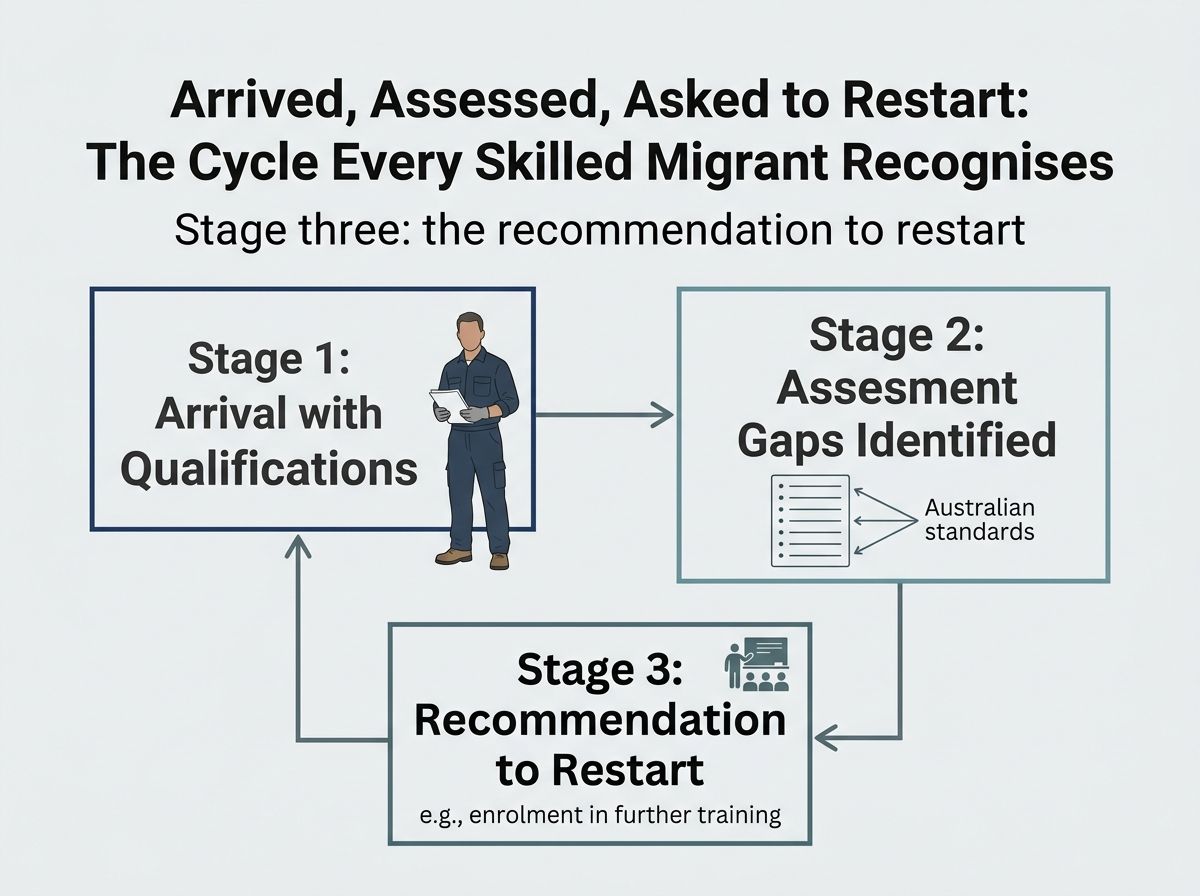
The cycle has three stages — and almost everyone moves through all of them
You arrived with qualifications. Real ones. Earned through years of study and professional practice in a field you know deeply. You expected the process to be administrative — a matter of paperwork, perhaps a short assessment, and then recognition. Instead, you moved through a cycle that thousands of skilled migrants in Australia have described in almost identical terms.
Stage one: arrival with confidence in your existing qualifications. Stage two: a skills assessment or registration process that identifies gaps. Stage three: a recommendation to undertake further study covering material you have already mastered. The professions differ. The countries of origin differ. The cycle does not.
This is not a personal failure. It is a structural pattern — one built into how Australia recognises qualifications. Understanding why it happens is the first step toward finding the pathway out of it.
Stage one: arrival with confidence
The confidence is earned. A civil engineer who spent a decade designing infrastructure projects in South Asia has genuine expertise. A business manager who led a team of forty across three countries has real leadership experience. A registered nurse who worked in a major hospital for eight years has clinical competence that is not in question. These professionals arrive in Australia with every reason to expect their qualifications will be recognised.
Consider a civil engineer who holds a four-year degree from a well-regarded university, has professional registration in their home country, and has managed large-scale projects. They contact the relevant Australian engineering assessment body, expecting the process to confirm what they already know. Or consider a business professional with a postgraduate management qualification and senior leadership experience, who approaches a skills assessment authority to have their credentials assessed for migration purposes. Or a healthcare professional with formal nursing qualifications and years of clinical practice, who contacts the relevant Australian registration authority to begin the process of working in their field.
At this stage, the expectation is reasonable. The qualifications are real. The experience is substantial. The system has not yet revealed its logic.
Stage two: the assessment that finds gaps
The assessment process in Australia is not designed to recognise overseas qualifications on their own terms. It is designed to map them against Australian qualification standards. That distinction matters enormously.
When an assessment body evaluates an overseas credential, it is not asking: 'Is this person competent?' It is asking: 'Does this credential map to an Australian qualification at the required level?' These are different questions. A qualification earned in another country may represent genuine competence — and often does — while still failing to map cleanly onto the Australian framework. The result is a gap finding. Not a finding of incompetence. A finding of credential mismatch.
This is commonly reported across engineering, business, and healthcare assessments. The professional receives a report identifying areas where their overseas qualification does not align with Australian standards. The gaps are framed as educational deficiencies. The recommendation follows logically from the assessment's own logic — but that logic was never designed to treat overseas experience as equivalent evidence.
Stage three: the recommendation to restart
The third stage is the one that produces the sharpest frustration. The assessment has identified gaps. The recommendation is to address those gaps through further study. The study covers material the professional has already mastered — in some cases, material they have been teaching others for years.
This is not the system making a mistake. It is the system doing exactly what it was designed to do. The problem is that the system was designed around Australian qualifications. It was not designed to assess overseas experience as evidence of competence. So when it cannot find the right credential in the right format, it recommends the credential be obtained. From scratch. Through study. Regardless of what the professional already knows.
Recognition shouldn't require starting over. But without a pathway that treats experience as evidence, starting over is what the system recommends.
Why the system creates this loop — and why it's not your fault
Australian qualification recognition is built around the Australian Qualifications Framework — a national policy that organises all Australian qualifications into a single, coherent system. Every qualification issued in Australia sits within this framework. When overseas qualifications are assessed, they are mapped against it.
The framework was designed to bring consistency to Australian education and training. It does that well. What it was not designed to do is provide a direct equivalence pathway for qualifications earned in other countries under different educational systems. The mapping process finds gaps not because overseas qualifications are inferior, but because they were built to different specifications in a different context. Australian recognition is built around Australian qualifications, not overseas equivalents. That is the structural fact at the centre of the cycle.
The cycle is structural, not personal. It repeats across professions, across countries of origin, across qualification levels. The engineer, the business manager, and the nurse all move through the same three stages because they are all encountering the same structural feature of the Australian recognition system. Understanding this does not make the experience less frustrating. But it does change what the right response looks like.
For a closer look at the moment this realisation lands — and what it means for professionals with postgraduate qualifications — see what skilled migrants discover when their overseas qualifications meet the Australian system.
The same cycle across engineering, business, and healthcare
The pattern holds across professions. Consider a civil engineer with a four-year degree and professional registration from overseas. They approach an Australian engineering assessment body expecting credential recognition. The assessment maps their qualification against Australian engineering standards and identifies units not covered by their overseas degree. The recommendation: complete additional study to address the gaps — study that covers fundamentals they applied professionally for a decade.
Consider a business professional with a postgraduate management qualification and senior leadership experience. They approach a skills assessment authority for migration purposes. The assessment finds that their overseas qualification does not map to an equivalent Australian level in the required way. The recommendation: obtain an Australian qualification at the relevant level — a qualification that covers management theory they have been practising, not studying, for years.
Consider a healthcare professional with formal nursing qualifications and clinical experience. They approach the relevant Australian registration authority. The assessment identifies gaps between their overseas training and Australian nursing standards. The recommendation: complete a bridging programme — covering clinical competencies they have demonstrated in practice, not in a classroom.
Three professions. Three assessment bodies. One cycle. The pattern is not a coincidence. It is the predictable output of a system that measures credentials against a local standard rather than assessing demonstrated competence directly.
If you are trying to determine whether your specific situation points toward university-level RPL, a structured self-check can help you evaluate whether university-level RPL is the right pathway for your specific situation.
Recognition of Prior Learning in Australia: the recognised exit from the loop
Recognition of Prior Learning — RPL — is a formal assessment pathway available in Australia that asks a different question. Not: 'Does your credential map to our framework?' But: 'Can you demonstrate that you meet the competency requirements?' The evidence is your experience. The assessment is conducted by a registered training organisation (RTO). The qualification, if competency is demonstrated, is issued by that RTO and is nationally recognised.

RPL at university level can lead to qualifications including Graduate Certificates, Graduate Diplomas, and Advanced Diplomas — qualifications that sit within the Australian Qualifications Framework and are recognised for professional registration, visa purposes, and further study. The process involves presenting documented evidence of your experience: employment records, professional references, work samples, and other materials that demonstrate competency against specific units. A qualified assessor from the delivering RTO evaluates that evidence.
It is worth being clear about what RPL is and is not. It is not a shortcut. It is a rigorous assessment pathway that requires genuine preparation and honest documentation of your experience. Gap training may be identified and, where it is, it is provided at no additional cost. The assessment outcome is determined by the RTO's assessor, not by the candidate or the guide. What RPL does is change the question — from 'where did you study?' to 'what can you demonstrate?'
For experienced professionals who have wondered whether their career history could open a direct pathway into postgraduate study, see how an RPL certificate can open direct entry into postgraduate university study.
And for those whose experience sits in management or leadership roles, see how recognition of prior learning translates years of practice into formal, accredited qualifications.
RPL it is not another stage of the loop — it's a guide through it
RPL it is not an assessment body. It is not a gatekeeper. It does not issue qualifications. What it does is guide skilled professionals through the recognition process — helping you identify the right qualification pathway, gather and present your evidence effectively, and understand what to expect at each stage. The assessment is conducted by a qualified assessor from the delivering RTO. The qualification is issued by that RTO. RPL it's role is to make the process navigable.
You have the experience. The question is whether it can be presented as evidence in a way that a formal assessment can recognise. That is what the guided process is designed to answer.
The first step is a Free Skills Review — a no-obligation conversation that helps determine whether RPL is a credible pathway for your specific situation. Not every professional is suited to RPL, and honest suitability guidance is the starting point. The decision is yours.
Learn more about the Fast Track University pathway and the qualifications available through university-level RPL.
Ready to Get Recognised?
Start with a free skills review to find out if RPL is right for you.