The Myth That You Must Redo Your Degree in Australia: What Skilled Migrants Are Rarely Told
Skilled migrants are often told to redo their degree in Australia. This advice is sometimes wrong. Discover how RPL offers a legitimate pathway.

The advice that stops thousands of professionals in their tracks
You have probably heard it before. It comes from migration agents, settlement workers, and late-night forum threads. The message is consistent: your overseas degree is not recognised in Australia, and you will need to study again.
The people delivering this advice usually mean well. Some of them are correct within their specific context, profession, or the pathways they have seen work. The problem is that a truth applying to specific occupations has been repeated so widely that it is now treated as a general rule. For many skilled migrants, this assumption costs them years of unnecessary study.
Australia receives hundreds of thousands of migrants each year. According to the Australian Bureau of Statistics, total migrant arrivals in 2024–25 reached 568,000, with tens of thousands arriving on skilled visas. A significant proportion of these arrivals hold overseas qualifications, and official parliamentary reports confirm that qualification recognition remains a major barrier to working at an appropriate professional level.
You already have the experience. The real question is whether the pathway to recognition is actually what you have been told.
Where the myth comes from — and why it persists
The myth has a legitimate origin. For certain professions in Australia, overseas qualifications do not transfer directly. Additional assessment, bridging programmes, or supervised practice are legally required before you can work in these fields. This is a real requirement, and it is the primary reason the advice persists.
The issue is that this requirement, which is accurate for a specific subset of regulated professions, has been generalised into a blanket rule. Immigration advisers, settlement workers, and online communities repeat it without distinguishing between regulated occupations and the much larger group of professions where these restrictions do not apply.
The myth persists because it contains a partial truth. And partial truths are often the hardest to challenge.
The Joint Standing Committee on Migration has formally acknowledged that overseas qualification recognition poses a significant barrier for skilled migrants seeking roles that match their skill level — and has recommended greater mutual recognition with major source countries.
The pathway nobody mentions: university-level RPL
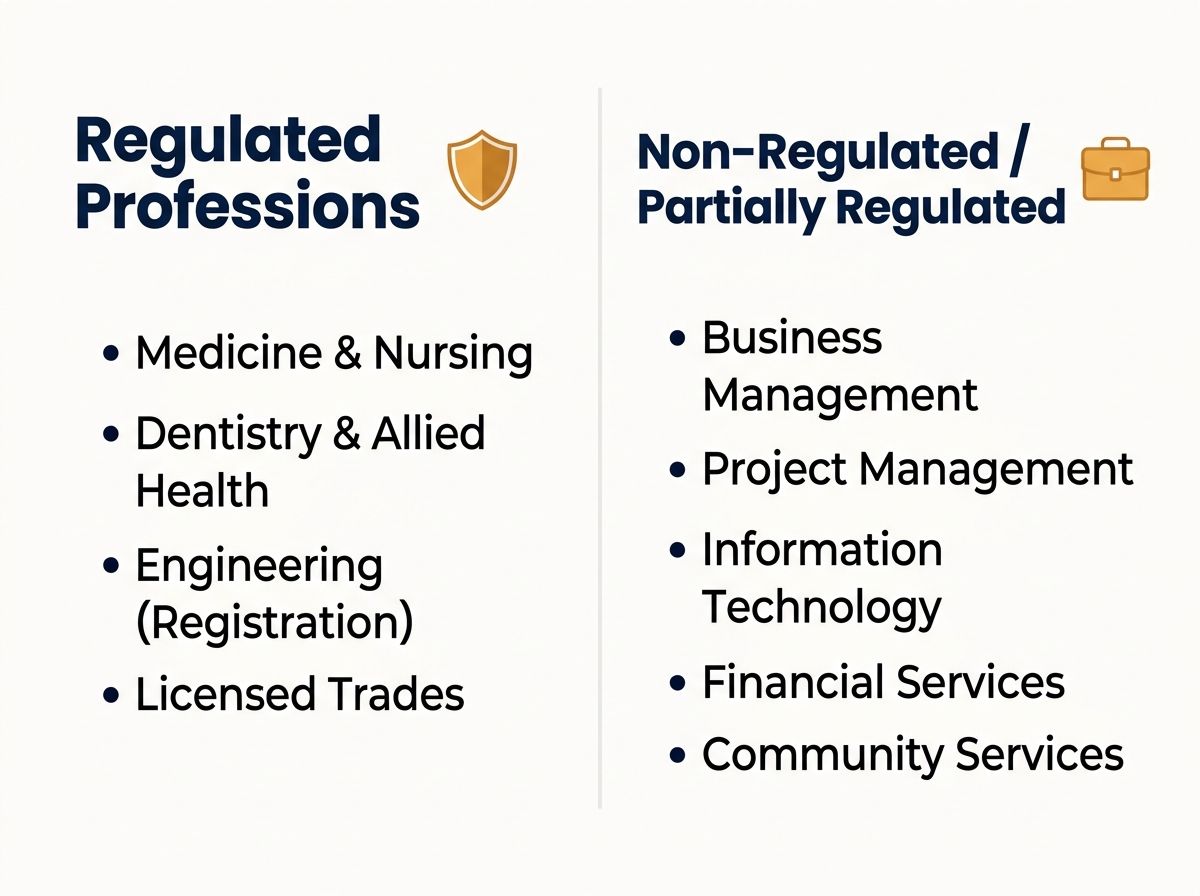
For professionals whose work falls outside tightly regulated industries — such as business, management, project management, IT, finance, and community services — there is an alternative pathway that is rarely publicised.
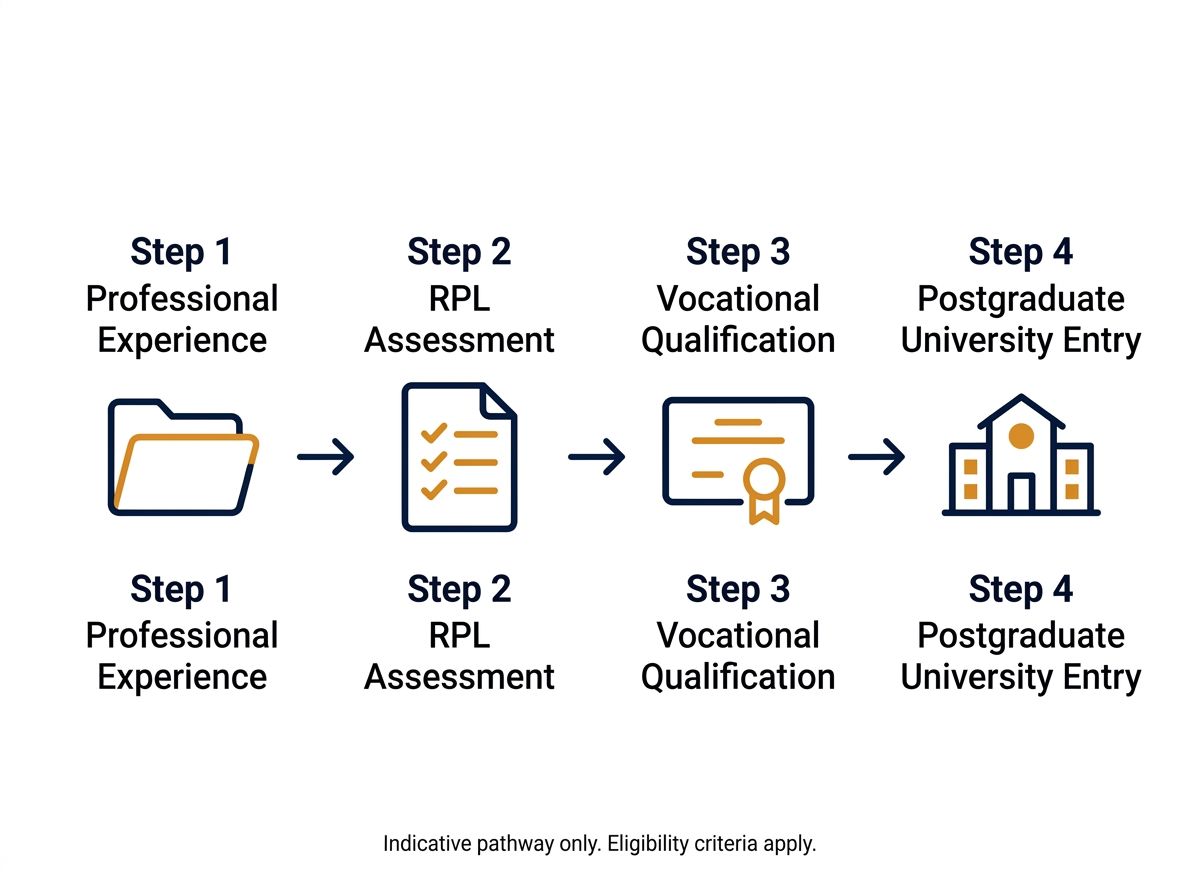
Recognition of Prior Learning (RPL) is a formal assessment process. A qualified assessor from a Registered Training Organisation (RTO) evaluates your professional experience against specific national competency units. If your experience demonstrates these competencies, you can be awarded a nationally recognised qualification without repeating study you have already mastered through your career.
The Australian Qualifications Framework (AQF) requires registered education providers to maintain clear, accessible RPL policies. This is designed to facilitate pathways for people who acquired their skills outside a formal classroom. A key objective of the AQF is to make movement into and through formal qualifications straightforward.
An RPL qualification, such as an Advanced Diploma of Business, can then be used to meet the entry requirements for postgraduate university programmes, including graduate certificates and MBAs. This is a standard, nationally recognised pathway built directly into the structure of the Australian education system. Vocational education and training (VET) qualifications range from Certificate I to Graduate Diploma under the AQF, allowing practical movement between educational sectors.
For a detailed explanation of how an RPL certificate can serve as a pathway into postgraduate study — including the AQF mechanics that make it possible — see our article on the degree shortcut pathway.
When the advice is correct: regulated professions require different pathways
Honest guidance requires identifying where conventional advice is correct. For health professions regulated by AHPRA — including medicine, nursing, dentistry, and physiotherapy — overseas qualifications face strict regulatory requirements that RPL alone cannot resolve.
The Australian Health Practitioner Regulation Agency (AHPRA) requires overseas-trained practitioners to register with the relevant National Board before practising in Australia. Assessment pathways vary by profession and are managed by AHPRA or designated accreditation authorities. Practitioners must consult the website of their specific National Board for these requirements.
To obtain general registration, overseas practitioners must demonstrate that their qualifications are equivalent to Australian standards, or have graduated from an approved program and completed required supervised practice. Area of need registration is also available for practitioners who do not yet qualify for general registration but have the skills to work under supervision in specific roles or locations.
AHPRA's information for international practitioners outlines the registration requirements and directs overseas-qualified health professionals to their relevant National Board for profession-specific guidance.
In engineering, professional associations like Engineers Australia assess competency within co-regulatory registration schemes. While over 60 per cent of Australia's engineering workforce was born overseas, many overseas-qualified engineers face difficulty securing work that matches their skills. This reflects the complexity of the professional assessment landscape rather than a simple recognition process.
If your profession is regulated by AHPRA or a similar licensing body, the conventional advice to retrain or complete specific bridging programs is likely correct. Your pathway is determined by that registration body, not by the AQF or the vocational system. An RPL provider cannot bypass these professional board requirements. This is a practical distinction regarding where RPL is applicable.
How the RPL process works and who it is for
For professionals in non-regulated or partially regulated fields, RPL is a rigorous assessment process rather than an automatic sign-off. It is important to understand what the process requires before deciding to proceed.
The process starts with gathering evidence of your professional experience. According to the Australian Skills Quality Authority (ASQA), common forms of evidence for RPL assessments include work samples, portfolios, training records, certificates, and employer declarations or references.
Assessors may also accept additional evidence, including a detailed resume outlining your roles and responsibilities, official job descriptions, photographs or videos of completed work (common in technical trade industries), and records of prior training like short courses or workshops.
A qualified assessor from the partner RTO reviews this evidence against national competency units. If there are gaps in your evidence, you may need to complete gap training. This is provided as part of the service and is a normal part of the assessment process rather than a failure. The final qualification is issued directly by the RTO, not by RPL it. RPL it assists you in preparing your portfolio; the assessment and qualification issuance are handled entirely by the registered training organisation.
RPL is designed for professionals with substantial, documented experience, particularly in business, management, IT, project management, finance, and community services. It is not suitable for everyone, which makes an honest upfront eligibility check essential before enrolment.
ASQA's guidance on credit transfer and recognition of prior learning outlines what the process involves and what types of evidence are commonly accepted.
The key question to ask before you choose to retrain
Before you enrol in a new degree, ask yourself this: does your target profession require registration through a licensing body that mandates specific Australian university degrees, or does it require a qualification that can be recognised through the national vocational system?
The answer determines your options. For many professionals in business, management, technology, and community services, the answer points to RPL rather than retraining. For others, the licensing body's requirements dictate the process, and RPL cannot substitute for those mandated steps.
The belief that all overseas-qualified professionals must redo their degrees in Australia is widespread and partially true, but it is incomplete. Accepting it without evaluating your options can result in years of unnecessary study.
For a closer look at what skilled migrants discover when their overseas qualifications meet the Australian system — and what options exist — our article on MBA recognition of prior learning explores the landscape in detail.
Focus on recognition over repetition
You already have the professional experience. The real task is finding out if a direct pathway exists for your situation, and obtaining the correct information to access it.
Your career history is evidence. For professionals outside of tightly regulated industries, RPL offers a legitimate, nationally recognised pathway that treats your experience as an asset rather than a qualification gap to be fixed by starting over.
Gaining recognition should not require starting your education from scratch. It is worth finding out if there is a more direct path.
Ready to Get Recognised?
Start with a free skills review to find out if RPL is right for you.