The Experience Exchange Rate: Why 10 Years in Logistics Equals 0 in Construction
You have a decade of real experience — but cross an industry line and it counts for nothing. Learn how an RPL certificate in Australia converts it.
By RPL it Australia9 min read

You have the experience. The new industry just can't read it.
You have the experience. Ten years of it. Supply chain coordination, warehouse team management, safety compliance, logistics documentation — the kind of operational depth that takes a decade to build. Then you decide to move into construction. And the industry looks at your resume and sees a blank space.
This is not a story about lacking competence. It is a story about format. Your experience is real. It is substantial. It is directly relevant to the work you want to do. But it exists in a form that the new industry's formal systems cannot read. The qualification frameworks that govern construction do not speak logistics. And so a decade of genuine expertise registers as zero.
This is not an isolated experience. According to Productivity Commission analysis of ABS microdata covering 2015 to 2023, approximately 80% of industry transitions in Australia involved a major shift — moving from one broad industry category to an entirely different one. Around 22% of employed people changed both their occupation and their industry simultaneously during that period. Large-scale cross-industry moves are common. The credential gap they create is equally common.
Productivity Commission analysis of ABS microdata found that in each year from 2015 to 2023, approximately 80% of industry transitions occurred at the broadest level — meaning workers were making genuinely large shifts between industries, not minor moves within the same sector. Source: Productivity Commission analysis of Australian workforce mobility.
What Is the Experience Exchange Rate?
The Experience Exchange Rate is the invisible conversion factor that determines how much of your expertise from one industry is formally recognised in another. In some cases the rate is favourable — a nurse moving into health administration carries most of their professional value across. In others, the rate collapses to near zero — a logistics manager moving into construction finds that a decade of supply chain expertise is formally unrecognised, regardless of its practical relevance. The rate is not set by the quality of your competence. It is set by formal systems.
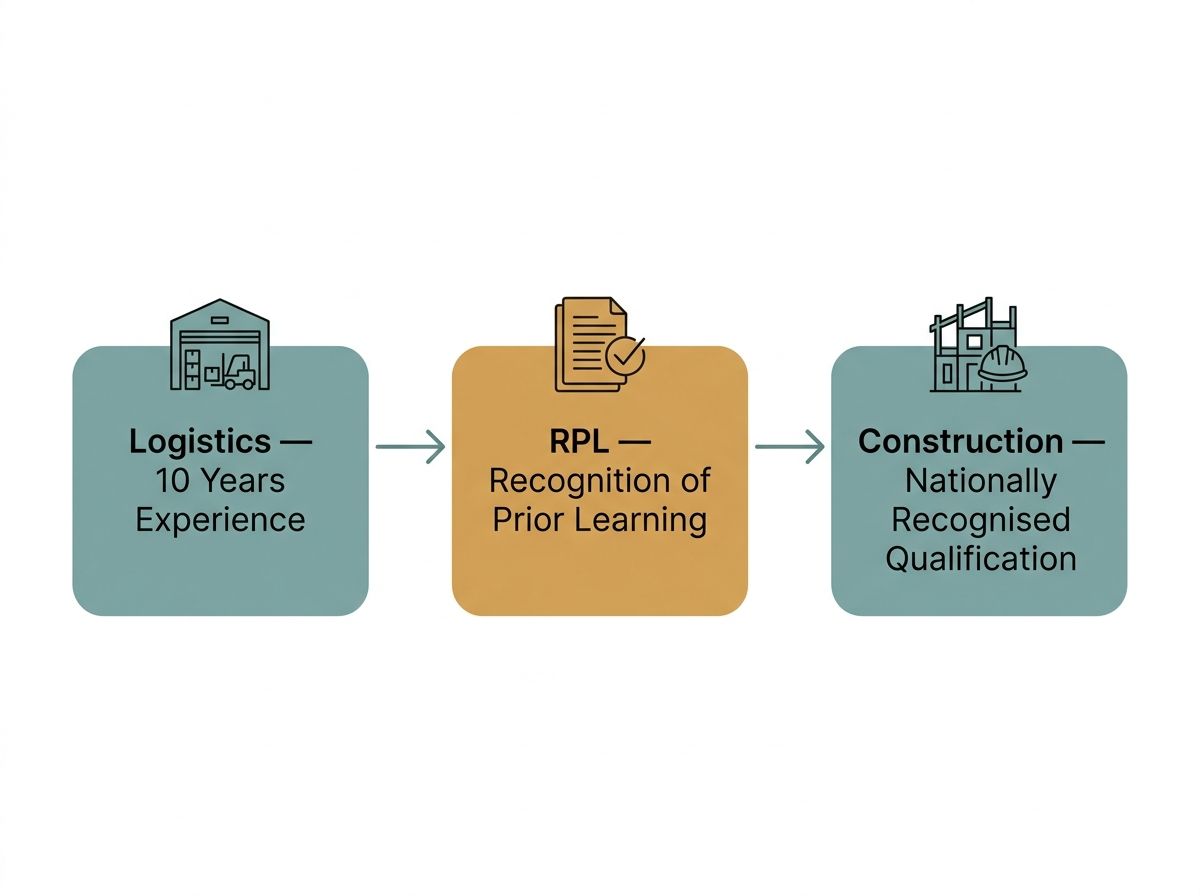
This is the problem that career-pivoting professionals feel but often cannot name. It is not imposter syndrome. It is not a skills gap. It is a translation problem. Your experience speaks one industry's language fluently. The new industry requires a different dialect — and without a formal conversion mechanism, the two systems cannot communicate.
This experience is closely related to what we have called the credential wall that stops experienced workers advancing — a structural barrier that has nothing to do with actual capability.
The Logistics-to-Construction Scenario: Where the Rate Collapses
Consider a logistics operations manager with ten years of experience. They have managed warehouse teams, coordinated complex supply chains, enforced work health and safety protocols, read and produced technical documentation, and overseen the movement of materials across multiple sites. They apply for a construction project coordinator role. They are told they need a Certificate IV in Building and Construction.
Their decade of directly relevant experience registers as zero in the formal system. Not because the experience is irrelevant — much of it maps closely to what the qualification covers. But because the logistics qualification framework and the construction qualification framework are separate systems, developed by separate industry bodies, using separate unit codes. The formal systems do not automatically translate between them.
There is some structural evidence of overlap. The TLI10 Transport and Logistics Training Package imports units from the Resources and Infrastructure (RII) Training Package — units covering confined space entry, working at heights, traffic management, and crane operations. These units appear in both logistics and construction contexts. The competency domains are shared. The formal recognition is not.
The TLI10 Transport and Logistics Training Package includes imported units from the Resources and Infrastructure Training Package — covering areas such as working safely at heights, confined space entry, and civil construction plant operations — demonstrating that competency domains genuinely overlap between logistics and construction, even when formal recognition does not automatically follow.
The translation model for cross-industry career pivots explores this dynamic in detail — showing how skills from one industry can map to qualification units in another, even when the formal systems do not make that connection automatically.
Why the Rate Collapses: The System Is Not Reading Your Experience
The structural explanation is straightforward, and it is worth understanding — because once you do, you can stop taking it personally.
Australian Training Packages are developed to meet the training needs of specific industries and sectors. By design, each package is built by industry reference groups for that industry. The Productivity Commission's Report on Government Services notes that Jobs and Skills Councils develop training products in line with standards set by Skills Ministers, and that these products must comply with the Australian Government's Standards for Training Packages. The system is industry-specific by architecture.
The consequence is that training package components are not always developed in a way that recognises the importance of skills in multiple sectors or encourages cross-sector use. This is not a judgment on your experience. It is a formatting problem. Your decade in logistics is documented in a format that the construction qualification framework was not built to read.
The Productivity Commission's Report on Government Services 2026 confirms that training packages specify the knowledge and skills required for effective workplace performance and detail how units of competency are packaged into nationally recognised qualifications aligned to the Australian Qualifications Framework — a system that is inherently industry-specific in its design. Source: Productivity Commission Report on Government Services 2026.
This structural reality is part of why competence alone doesn't open doors in credential-gated systems — a dynamic explored in depth for workers who have spent years being excellent at their jobs without the formal recognition to show for it.
The Signs Your Exchange Rate Has Collapsed
If you are experiencing the Experience Exchange Rate problem, some of these will feel familiar:
- You are told you need to 'start from the beginning' despite years of directly relevant experience in the new field.
- Job advertisements require qualifications you do not hold for roles you already perform in practice.
- Interviewers acknowledge your experience but cite 'policy' or 'requirements' when explaining why you cannot be considered.
- You are offered entry-level positions despite having management or supervisory experience.
- Your resume accurately reflects what you have done — but not in a way the new industry's HR systems can recognise.
- You feel that your previous experience is being dismissed as irrelevant, when you know it is not.
The Official Exchange Mechanism: What an RPL Certificate in Australia Actually Does
Recognition of Prior Learning — RPL — is the formal conversion mechanism. Not a course. Not a shortcut. A structured assessment process that reads your existing experience in the language of the new industry's qualification framework.
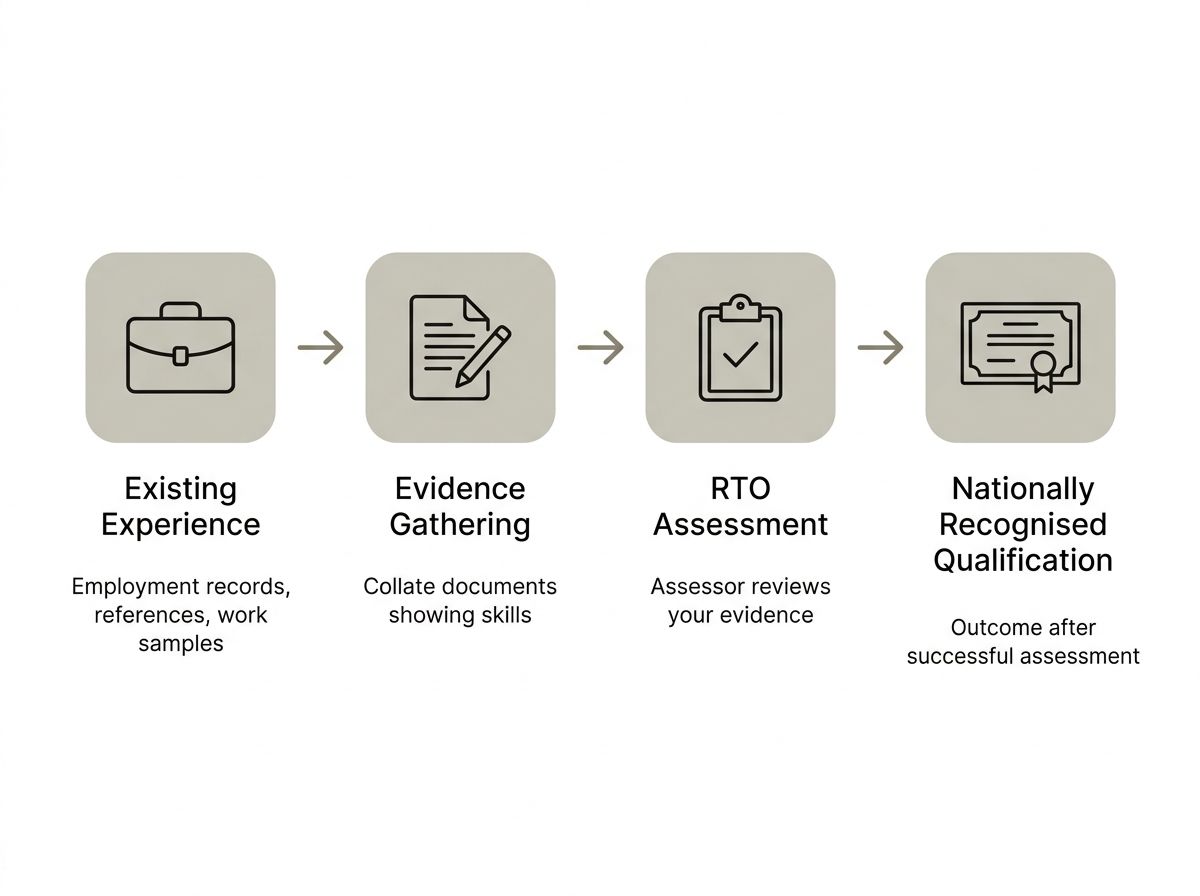
According to the Australian Skills Quality Authority (ASQA), RPL is an assessment-only process that evaluates the competency of an individual — competency which may have been acquired through formal, non-formal, or informal learning — to determine the extent to which that individual meets the requirements specified in a training package or VET accredited course. Formal learning includes structured programs leading to AQF qualifications. Non-formal learning includes structured programs that do not lead to formal credentials, such as in-house professional development. Informal learning results from work experience, life experience, or self-directed study.
Under the Standards for Registered Training Organisations, RTOs must offer RPL to individual students — unless the requirements of the training package or licensing requirements prevent this. An RPL certificate in Australia is issued by a Registered Training Organisation after a qualified assessor evaluates evidence of your existing competency against the units of a nationally recognised qualification. ASQA notes that RPL can grant part or all of a unit of competency.
The key distinction: RPL does not teach you what you already know. It translates what you already know into a format the new industry can formally recognise. That is the exchange rate mechanism.
ASQA's guidance on Recognition of Prior Learning confirms that RPL is a legitimate part of the VET sector and the Australian education system — an assessment pathway that evaluates existing competency against nationally recognised qualification standards, not a training program.
It is worth noting that RPL it guides candidates through this process — helping them document their experience as evidence and navigate formal assessment. The assessment itself is conducted by a qualified assessor from the delivering RTO. The qualification, if competency is demonstrated, is issued by that RTO. Gap training may be required where evidence does not fully cover certain units, and this is a normal part of a rigorous assessment process, not a failure.
How an RPL certificate translates invisible experience into formal recognition is explored in detail for workers who have spent years building expertise that formal systems have failed to see.
What the Exchange Looks Like in Practice: Logistics to Construction
Return to the logistics operations manager. With RPL, the process looks different from starting over.
Working with an RPL guide, they would identify which units of the target construction qualification their existing experience is likely to cover. They would then gather evidence: employment records and position descriptions, project documentation, third-party reports from supervisors or colleagues, photographs or records of relevant work, and any prior training certificates. This evidence is assembled into a portfolio and submitted for assessment by a qualified RTO assessor.
The assessor evaluates the evidence against each unit of competency. ASQA's guidance is clear that evidence must be current, authentic, valid, and sufficient. Where the evidence demonstrates competency, the unit is recognised. Where gaps exist — units where the evidence does not fully meet the standard — gap training is provided. The outcome, where competency is demonstrated across the required units, is a nationally recognised qualification.
RPL outcomes depend on a range of factors, and no single factor guarantees recognition. Evidence quality, the specific qualification, and the assessor's professional judgement all play a role. What RPL does is give your existing experience a formal opportunity to be assessed — something that the standard job application process does not.
How transferable skills map to construction qualification units provides a concrete look at the competency alignment between industries — showing where experience from one field genuinely prepares a candidate for assessment in another.
The Experience Exchange Rate is not fixed. It is not zero just because the system cannot read your experience in its current form. Experience can be evidence. But first, it needs to be converted.
Your decade in logistics is not wasted. It is not irrelevant. It exists in a format that requires translation, not repetition. Recognition should not require starting over. The RPL pathway exists precisely because competence acquired through work — formal, non-formal, or informal — deserves to be assessed on its merits, not dismissed because it arrived through a different industry's front door.
The first step is finding out whether your specific experience is eligible for recognition. That is a question a Free Skills Review can answer — honestly, without obligation, and without requiring you to commit to anything before you know where you stand.
The first step is finding out whether your specific experience is eligible for recognition. That is a question a Free Skills Review can answer — honestly, without obligation, and without requiring you to commit to anything before you know where you stand.
Reframing your experience as assessable evidence — rather than defending credentials that don't translate — is the shift that makes the difference for career changers navigating the Australian qualification system.
General information only, current at the date shown. Licensing rules change, so check the current requirements with the relevant regulator before you rely on them. RPL it Australia is a student support service, not a Registered Training Organisation; qualifications are assessed and issued by our partner RTOs.