You Don't Need to 'Start From Scratch' to Become a Bricklayer: You Need to Translate
Changing industries does not make you a beginner. If your skills transfer, RPL for the Certificate III in Bricklaying and Blocklaying is your pathway.

The perspective holding you back
Career pivots are translation problems, not starting-over problems. That distinction is more important than it might first appear.
The common mental model for changing industries goes like this: you leave one field, become a beginner in the next, and work your way back up. It sounds logical, but it is incorrect. For skilled professionals considering a move into the construction trades, it costs real time, money, and professional dignity.
Your skills are not absent. The issue is that they speak the wrong language for the new system. Formal credentialling frameworks are built around industry-specific evidence. If your experience comes from logistics, project management, hospitality, or an adjacent trade, the system does not automatically recognise it. The competence exists, but it has not been presented in the format the system requires.
This is a translation problem, and translation problems have solutions.
What 'starting from scratch' actually means, and why it is usually false
When a formal system treats you as a beginner, it makes a claim about your credentials, not your competence. Those are different things.
Consider what a career pivoter into construction actually brings. A project manager who has coordinated builds, managed subcontractors, and interpreted structural drawings for a decade. A logistics supervisor who has managed materials handling, site deliveries, and safety compliance. A tiler or plasterer who has worked alongside bricklayers on every job for years, learning the trade through daily proximity. A tradesperson from an adjacent field who understands concrete, load-bearing principles, and the physical demands of masonry work.
None of these people are beginners. They are professionals whose competence exists in a format the credentialling system does not immediately recognise.
The Certificate III in Bricklaying and Blocklaying (CPC33020) is a nationally recognised qualification covering 28 units of competency: 20 core and 8 elective. These units assess skills like laying masonry walls and corners, constructing masonry arches, applying work health and safety practices, and reading plans and specifications. For someone with genuine construction or trades experience, many of these competencies are not new concepts. They represent existing capabilities waiting to be formally assessed.
The question is not whether you can learn this, but whether you can demonstrate what you already know.
The cross-industry translator model
Here is the shift in perspective: a career pivot is not a loss of identity. It is a translation problem. Your skills are real and they exist. The question is whether they can be presented in the language the new industry recognises.
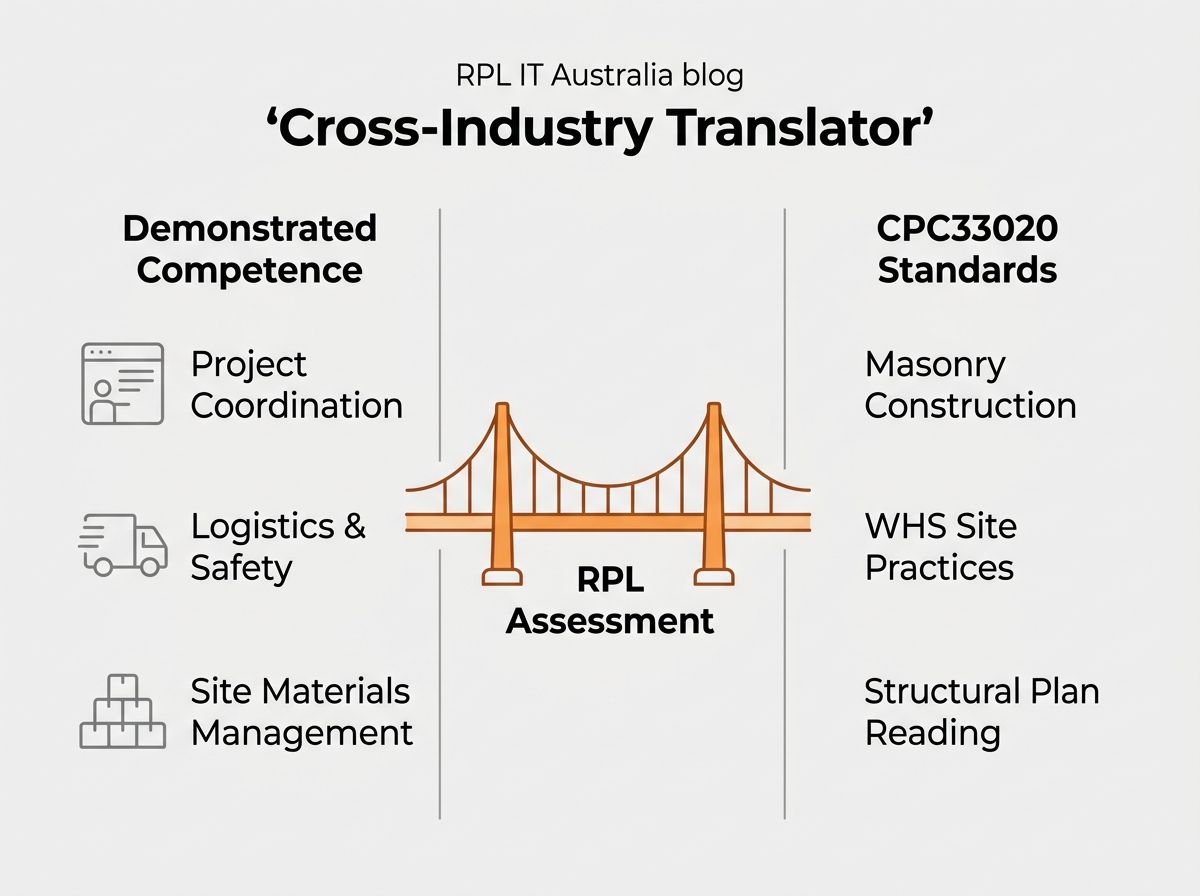
The cross-industry translator model works like this: you bring demonstrated competence from one field, and Recognition of Prior Learning (RPL) acts as the mechanism translating that competence into evidence against a formal standard. You are not a student enrolling in a course. You are a professional seeking recognition in a new system, and RPL is the pathway designed for this purpose.
RPL involves genuine assessment. A qualified assessor from a registered training organisation (RTO) evaluates whether you can demonstrate the required competencies. You will need to provide evidence rather than just claiming experience. The evidence you provide draws on what you have already done, not on what you are about to learn.
Your skills speak a different language, and RPL helps them be heard in the new one.
According to ASQA, the national regulator for vocational education and training, applicants undertaking RPL may provide work samples or portfolios, training records, and employer declarations as evidence of their skills.
Recognition instead of repetition is the core principle.
What this looks like for the Certificate III in Bricklaying and Blocklaying
The Certificate III in Bricklaying and Blocklaying (CPC33020) is the nationally recognised qualification for the trade in Australia. RPL for this qualification means working with a registered training organisation to gather and present evidence demonstrating your competency against the units, rather than sitting through unnecessary training.
Evidence for RPL in construction qualifications can take several forms. ASQA guidance indicates that applicants may provide work samples or portfolios, training records or certificates, and employer declarations or references. Some providers also use practical demonstrations or trade photos and videos to verify the authenticity of experience, though specific requirements vary by RTO and qualification.
For career pivoters, the evidence-gathering process is where the translation occurs. Your project management records, site supervision logs, safety compliance documentation, or references from construction industry employers become the raw material. A guided RPL process helps you identify which of your existing records and experiences map to specific competency units, and where actual gaps exist.
The context surrounding this qualification is important. According to a Master Builders Australia report, as cited by industry sources, 85% of builders reported difficulty finding qualified tradespeople in 2024, with bricklayers described as one of the most challenging trades to source. Industry estimates suggest a shortfall of around 90,000 construction workers in 2025, a figure projected to grow further. BuildSkills Australia, the national Jobs and Skills Council for the built environment, has estimated that additional workers will be needed to meet the National Housing Accord target of 1.2 million homes over five years. The Certificate III in Bricklaying and Blocklaying carries genuine weight in the labour market.
For those approaching from another industry, the starting point is the Certificate III in Bricklaying and Blocklaying (CPC33020) RPL pathway.
The question of professional dignity: you are not a beginner
The hardest part of a career pivot is rarely the learning. It is the professional cost of being treated as a beginner when you are not.
Being asked to start at entry level when you have managed teams, coordinated complex projects, or spent years working in and around the construction industry is a credentialling gap rather than a skills gap. Credentialling gaps are solvable without requiring you to pretend you know nothing.
RPL preserves professional dignity by treating your experience as evidence rather than as a gap to fill. This is not a shortcut; it is a rigorous assessment pathway that respects what you have already achieved. The qualification is nationally recognised because the assessment is genuine. An assessor evaluates your competency against the same standard as any other candidate, but your evidence comes from your professional history instead of a classroom.
Your work deserves to be recognised. This is the principle behind RPL, and it is why the pathway exists.
Is RPL the right pathway for you?
RPL is not suitable for everyone. Honest suitability guidance is more valuable than an easy promise.
If your experience is closely related to the competencies assessed in the Certificate III in Bricklaying and Blocklaying—such as working in construction, managing trades, supervising site work, or coming from a closely related trade—RPL may be the right pathway. If there are significant gaps between your experience and the required competencies, gap training may be required. That is not failure; it is an honest assessment and a standard part of the process.
The question of whether your experience translates deserves a clear answer before you commit to any process. That is exactly what the Free Skills Review is designed to provide.
The next steps in the translation process
For those whose experience genuinely transfers, the next step is not enrolment in a training program. It is starting the evidence-gathering process with guidance.
RPL it guides candidates through presenting their experience as evidence. We help identify which records, references, and demonstrations map to specific competency units, and we support you as you work with the registered training organisation conducting the assessment. The RTO assesses your competency and issues the qualification, while RPL it helps you navigate the process of getting there.
The qualification that results is nationally recognised because the assessment is genuine, rather than because the pathway was easier.
The decision is yours. If you are ready to find out whether your skills translate, the next step is straightforward.
You can explore the Certificate III in Bricklaying and Blocklaying RPL pathway and what it involves.
Ready to Get Recognised?
Start with a free skills review to find out if RPL is right for you.