The Transferable Skills Pattern: Why Your Experience Already Prepares You for the Certificate III in Bricklaying and Blocklaying
Hospitality, landscaping, manufacturing — your skills map directly to the Certificate III in Bricklaying. See the pattern that makes career changers say 'I already do that.'

The pattern nobody tells career changers about
There is a structural pattern hiding inside the Certificate III in Bricklaying and Blocklaying (CPC33020). Many of its competency units describe skills that workers from adjacent industries already perform — under different names, in different settings, with different tools. The problem most career changers face is not a skills gap. It is a labelling gap.
The Certificate III in Bricklaying and Blocklaying is a nationally recognised qualification comprising 28 units of competency — 20 core and 8 elective. It has no formal entry requirements. What it does require is demonstrated competency across those units. That is the key phrase: demonstrated competency. Not a certificate from a previous industry. Not a specific employer. Demonstrated competency.
Recognition of Prior Learning (RPL) is the formal mechanism that evaluates whether your existing skills meet those unit requirements — regardless of the industry in which you developed them. The three mappings below show exactly how that works for workers coming from hospitality management, landscaping, and manufacturing.
Mapping 1: Hospitality management → site coordination
A hospitality manager running a Friday night service coordinates multiple concurrent workflows under time pressure. They brief teams before service, manage supplier relationships, read and interpret operational plans, and maintain quality standards as conditions shift. These are not soft skills. They are specific, demonstrable competencies.
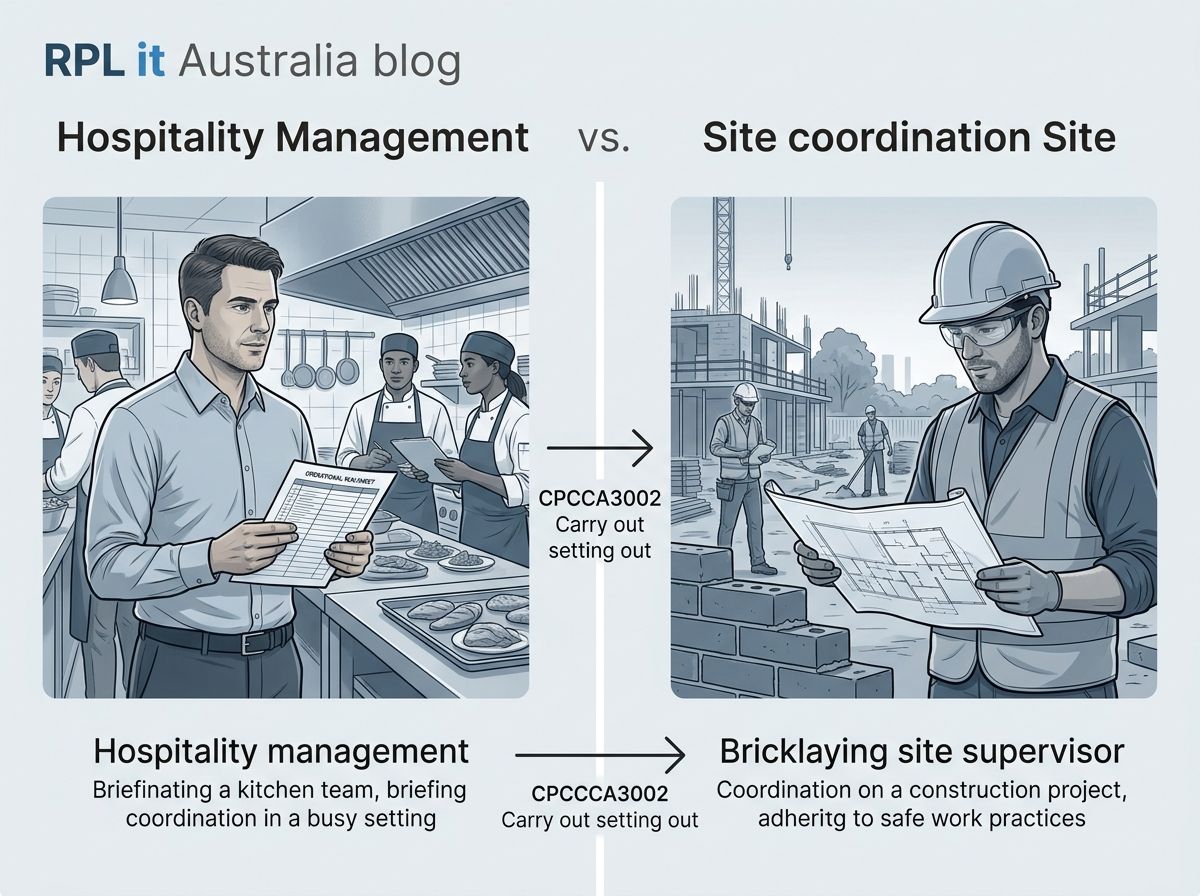
Inside CPC33020, the unit CPCCCA3002 'Carry out setting out' assesses the ability to establish accurate reference points, coordinate site layout, and work to precise specifications — the same disciplined coordination that a hospitality manager applies when sequencing a service. The unit CPCCCM2001 'Read and interpret plans and specifications' maps directly to the plan-reading and briefing skills that experienced hospitality managers use every shift.
The industry label is different. The underlying competency — coordinating people, reading specifications, managing concurrent tasks to a standard — is not. If you have managed a hospitality operation, you have been practising site coordination. The qualification assesses whether you can demonstrate it in a construction context.
Mapping 2: Landscaping → material handling and drainage
Landscapers work with bulk materials daily. They handle and prepare sand, aggregate, and mixed materials; they manage drainage and water flow across sites; they prepare sub-bases and lay surfaces to specification. These are not incidental skills — they are the core of the work.
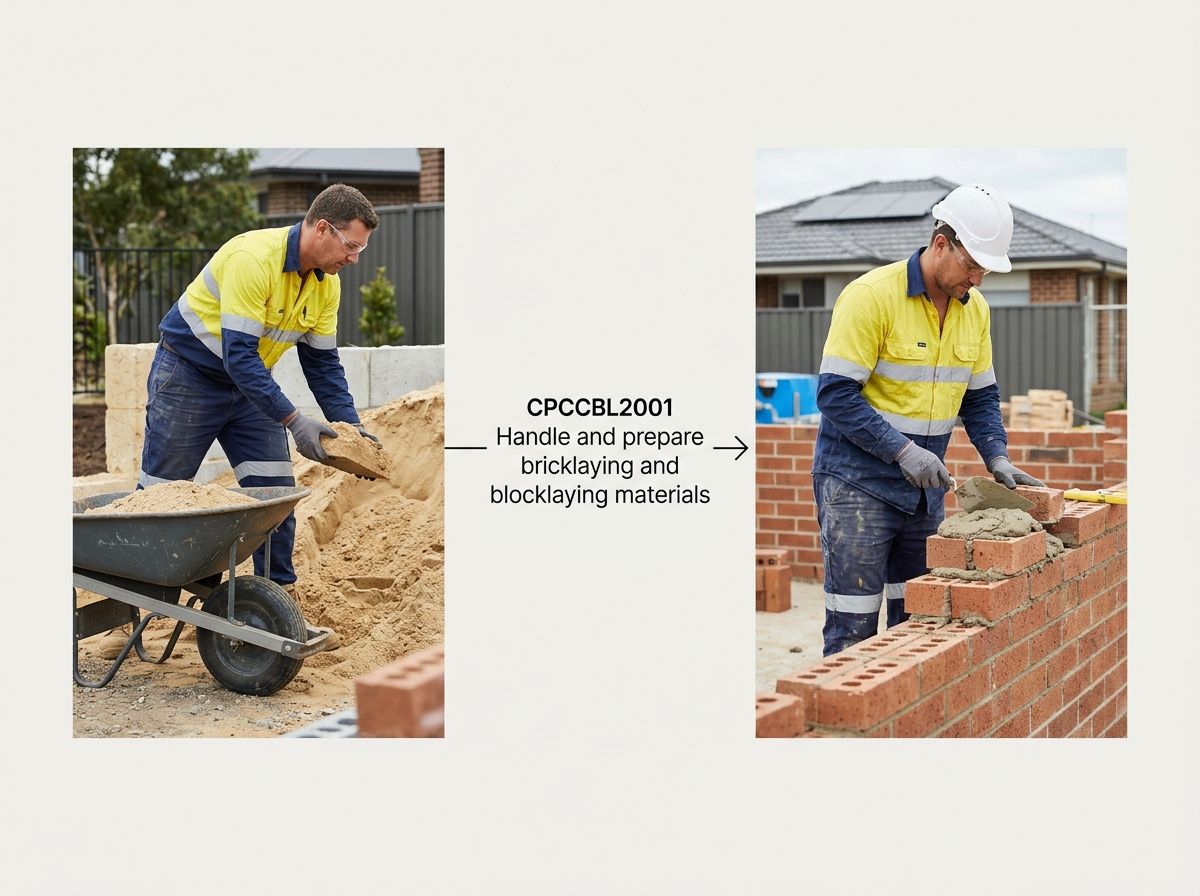
The CPC33020 core unit CPCCBL2001 'Handle and prepare bricklaying and blocklaying materials' assesses safe handling and preparation of materials — the same physical and procedural competency that landscapers apply when managing bulk aggregate or preparing mortar beds. The unit CPCCBL3009 'Install flashings and damp proof course' addresses moisture protection and drainage management at the wall interface — skills that experienced landscapers who have worked with drainage channels and water management systems will recognise immediately.
This is often the most surprising mapping for landscapers who have not thought of themselves as construction candidates. The vocabulary differs. The physical and technical competency overlaps significantly. If you have spent years managing drainage, handling bulk materials, and preparing surfaces to specification, you have been building the evidence base for several CPC33020 core units.
Mapping 3: Manufacturing → precision measurement and quality control
Manufacturing workers apply precision measurement as a matter of routine. They work to tolerances, verify dimensions, follow quality control processes, and maintain consistency across repetitive tasks. These disciplines are not peripheral to their work — they are the standard.
Bricklaying demands the same disciplines. Plumb, level, and square work requires consistent measurement and quality verification at every course. The CPC33020 core unit CPCCCM1015 'Carry out measurements and calculations' directly assesses the measurement and calculation skills that manufacturing workers apply in dimensional inspection and tolerance checking. The unit CPCCCM2006 'Apply basic levelling procedures' maps to the levelling and alignment verification that quality-focused manufacturing workers perform as standard practice.
Manufacturing workers often underestimate how directly their precision disciplines carry across to trades. The instruments differ — a spirit level rather than a calliper, a mortar joint rather than a machined surface — but the underlying competency is the same: measure accurately, verify against specification, maintain consistency.
Why the pattern exists: competence is competence
The three mappings above are not coincidences. They reflect a structural truth about how competency-based qualifications work in Australia's vocational education and training (VET) system. The Certificate III in Bricklaying and Blocklaying assesses whether you can demonstrate specific skills — not where you learned them.
RPL is a formal assessment pathway within the Australian VET system. As ASQA — the national VET regulator — explains, RPL recognises the skills you have gained through previous training, work, or life experience. Critically, ASQA's practice guidance requires that RPL policies, processes, and tools must be designed and applied with the same rigour as any other assessment. RPL is not a shortcut. It is a rigorous evaluation of demonstrated competency.
That rigour matters. An RPL assessment may identify gaps — areas where your existing evidence does not fully cover a unit's requirements. If gaps are identified, gap training may be required. This is not a failure; it is the system working as intended. The assessment is honest, and the outcome reflects what you can actually demonstrate.
ASQA also notes that RPL is a legitimate part of the Australian VET sector and that actual uptake may be higher than reported figures suggest — meaning more workers are using this pathway than official data captures. It is not a niche workaround. It is a standard feature of how nationally recognised qualifications work in Australia.
Competence is competence, regardless of the industry label. The pattern in the three mappings above exists because the Certificate III in Bricklaying and Blocklaying — like all competency-based VET qualifications — is built around what you can do, not where you learned to do it.
What happens next: formalising the recognition
Recognising the pattern is the first step. The next step is finding out whether your specific experience maps to the Certificate III in Bricklaying and Blocklaying — and that requires an honest look at your individual background, not a general article.
The qualification itself — CPC33020 — is the formal credential. You can review its structure and what the RPL pathway looks like on the
You can review the qualification structure and what the RPL pathway looks like on the Certificate III in Bricklaying and Blocklaying product page.
For those who want to understand what the career change journey looks like in practice — including what to expect from the process and what evidence matters — our article on
The decision is yours. If the pattern fits — if you recognised your experience in the hospitality, landscaping, or manufacturing mappings above — the Free Skills Review is the honest first step. It is free. It carries no obligation. It is simply the way to find out whether your specific background qualifies.
Ready to Get Recognised?
Start with a free skills review to find out if RPL is right for you.