Kicked Off a Commercial Site? The Cost of Working Without Your Electrical Ticket
Experienced sparkies are getting walked off commercial sites for lacking their ticket. Learn what it costs and how RPL can help.

The moment the site manager asks for your ticket
You have done this work for years. You know the trade inside out. You have wired commercial fit-outs, run conduit through concrete, and terminated complex switchboards. Then a site manager at a new commercial project asks for your electrical licence, and you do not have one.
That moment is a professional roadblock. It is not because anyone doubts your skills. The site manager is not saying you lack the ability to do the work. They are saying they cannot legally let you do it without proof. In that gap between your actual knowledge and what you can formally demonstrate, you risk your day's pay, your contract, your relationship with the builder, and your ability to keep working.
If you have faced that situation, or are concerned about it, this information is for you. It is also relevant for any experienced sparky on your crew who has done this work for a decade but still cannot legally sign off on their own installations.
Why commercial sites have tightened up on electrical licences
This is not about a single difficult site manager. It is a structural shift across the Australian building sector. Principal contractors running major commercial and government projects hold strict legal obligations under work health and safety legislation that make unlicensed subcontractors a direct liability.
Under Australia's work health and safety framework, principal contractors must prepare WHS management plans, set site rules, and coordinate with subcontractors to manage risks before and during the work. Each party, including the principal contractor, subcontractor, and client, is a person conducting a business or undertaking (PCBU) with strict duties to consult, coordinate, and cooperate.
Electrical work is highly regulated. Electrical contractors must be licensed in all Australian jurisdictions. The specific licensing requirements, such as required qualifications and the categories of work each licence covers, vary by state and territory. In practice, major commercial sites require proof of a current electrical work licence before any subcontractor can start work.
If you have worked mainly in residential or smaller commercial settings where compliance checks were less rigorous, moving to tier-one or government projects means encountering a standard that has always existed. You are simply meeting it for the first time.
The real costs of working without your electrical ticket
Being walked off a site is the immediate, visible cost. The less obvious financial and professional costs build up underneath it.
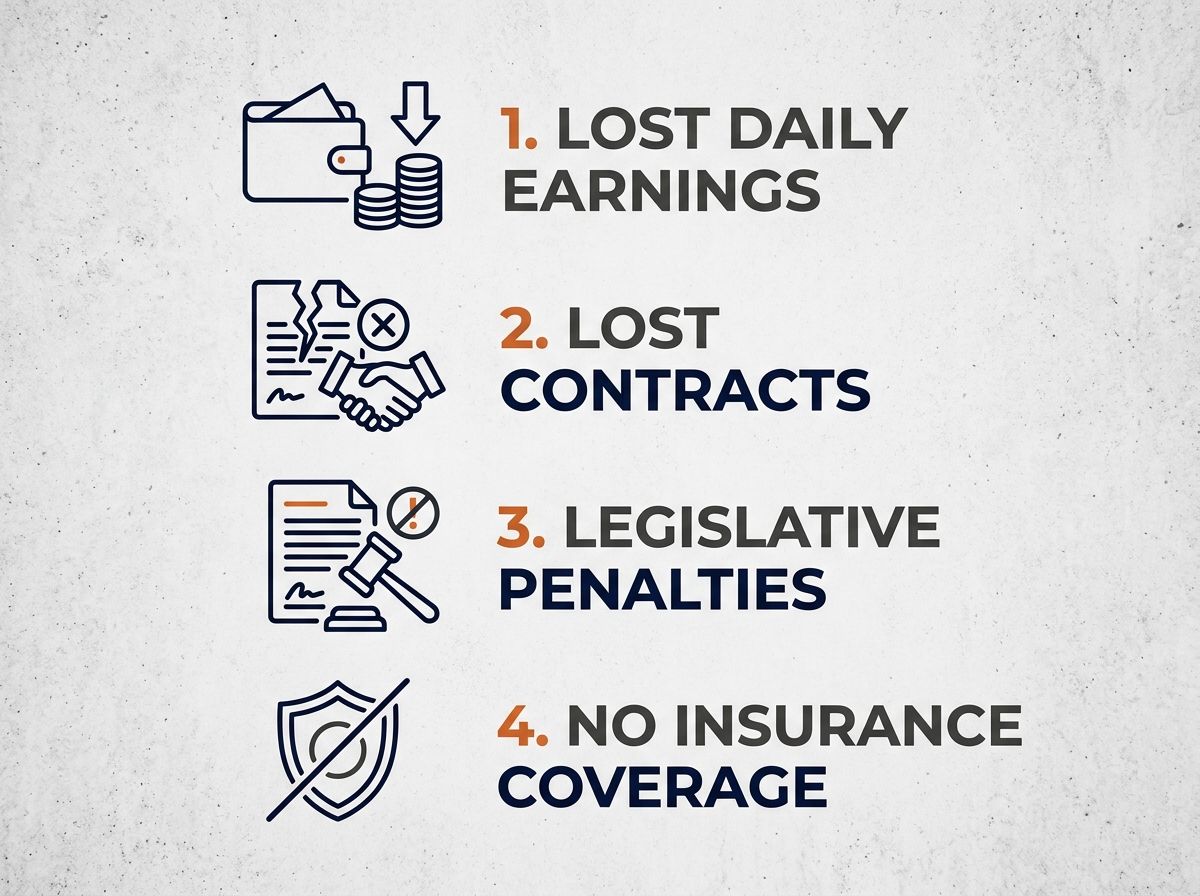
In Queensland, running an electrical contracting business without a licence carries a maximum penalty of 400 penalty units. A business that fails to ensure electrical work is performed or supervised by an appropriately licensed person faces the same maximum penalty. These are not minor administrative issues; they are serious statutory penalties.
The ACT and Northern Territory also enforce penalty provisions for electrical compliance offences, with maximum penalties of 50 penalty units for specific breaches. Penalty scales vary between states and territories, and you should check current local legislation for the exact amounts in your jurisdiction.
Beyond these penalties, there is the issue of insurance. Queensland's Electrical Safety Office is clear: licensed electrical contractors must hold at least $5 million in public liability insurance with a consumer protection component. Unlicensed and DIY electrical work does not provide these protections. Without a licence, you operate outside the insurance framework designed to protect your business.
Large organisations routinely require contractors to hold public liability insurance and show proof of their licences before starting work. The licence and the insurance are not separate requirements. They are directly linked.
- Lost daily earnings when you are walked off a site
- Lost contracts when builders cannot verify your licence
- Exposure to major legislative penalties for unlicensed electrical work
- Operating without the insurance protections that licensed contracting provides
- Inability to sign off legally on your own electrical installations
- A strict limit on the scale and type of projects you can win
Every day you work without your ticket, these risks remain active. The issue is not whether you can perform the work. The issue is what it costs you to operate without the credential that proves your competence.
The difference between your skills and your ticket
No one is questioning your technical ability. The site manager is not disputing whether you can wire a three-phase distribution board or terminate a cable. They simply require formal evidence that your skills have been assessed against national standards.
The Certificate III in Electrotechnology Electrician (UEE30820) is that standard. It is the nationally recognised qualification for electricians in Australia, and it covers the Electrical Regulatory Authority Council (ERAC) Essential Performance Capabilities for an Unrestricted Electrician's licence. Finishing this course is the academic requirement to apply for an electrical worker licence, which is issued by state and territory regulators rather than the training provider.
Recognition of Prior Learning (RPL) is an assessment process that measures your current skills and experience against the requirements of the Certificate III in Electrotechnology Electrician (UEE30820). It is not a training course. It determines whether you already meet the national standard based on the work you have already done.
Your skills are real. The licensing system simply requires them to be formally documented.
See the Certificate III in Electrotechnology Electrician (UEE30820) product page for more detail on the qualification.
What RPL for electricians actually involves
RPL is not a shortcut. It is a thorough assessment of your current skills against the units that make up the UEE30820 qualification. The assessor's job is to determine whether your prior experience, gained through work history or informal training, meets the performance criteria for each unit. All evidence must be current and match the formal training specifications.
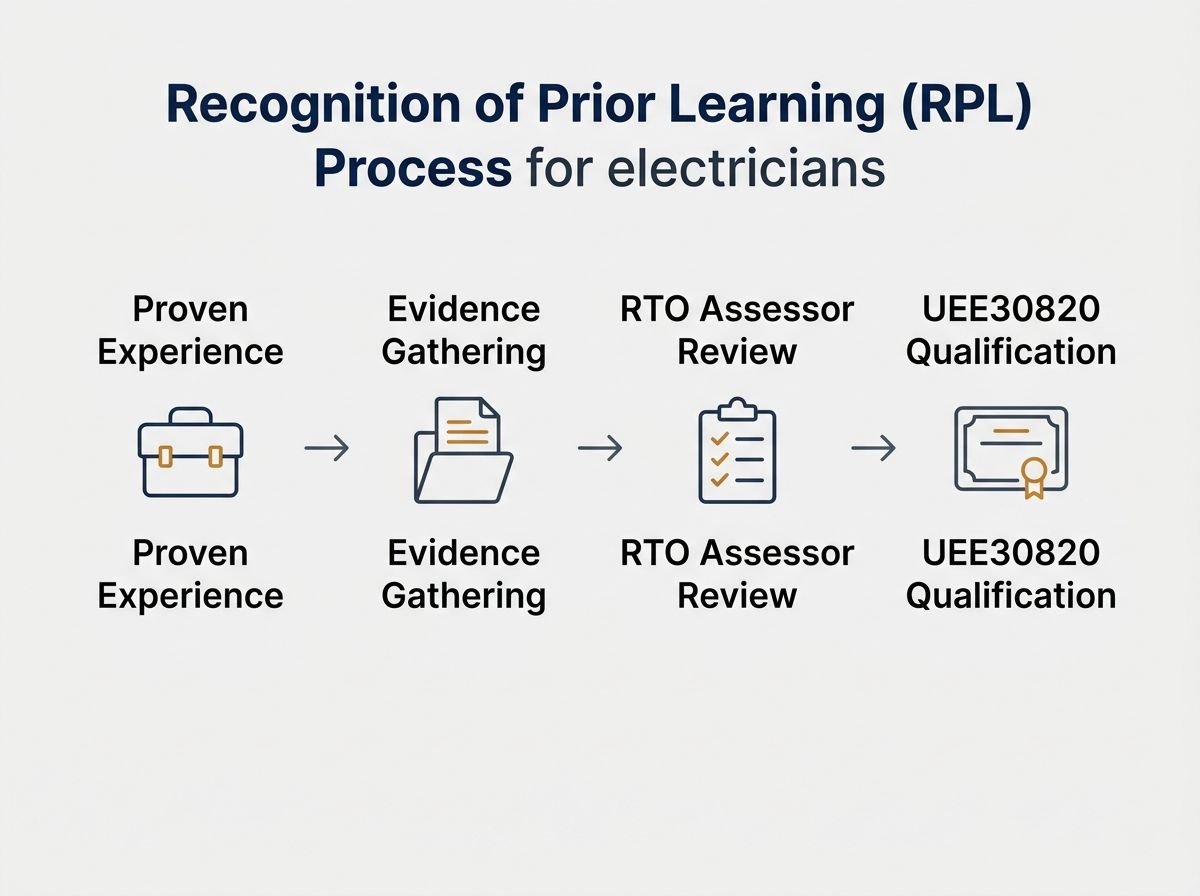
The assessment process evaluates evidence across several categories. Direct evidence may include workplace observations, practical skills assessments, or videos of you completing trade tasks. Indirect evidence includes work samples, employer references, detailed job descriptions, and records of prior training. To comply with assessment standards, all evidence must be sufficient, authentic, reliable, and current.
There is no classroom study. There is no sitting next to first-year apprentices. There is no repeating what you already know how to do. Instead, you follow a structured process to present your on-the-job experience as evidence. A qualified assessor from the delivering registered training organisation (RTO) evaluates this evidence. Where competency is demonstrated, you receive the same nationally recognised UEE30820 qualification that an apprentice would receive at the end of their training.
If gaps are identified during the assessment, you can complete targeted gap training. The qualification holds value because the assessment process is thorough. RTOs conduct the assessments and issue the qualifications; RPL it guides you through the process of presenting your experience clearly.
You must understand the difference between the qualification and the licence. The UEE30820 covers the academic qualification requirements. A separate occupational electrician's licence is required to work in Australia, and licensing requirements are set by each state and territory authority. RPL may lead to the qualification, but the licence application is a separate step.
Who is RPL for electricians suited to?
RPL for electricians is not for everyone. It is designed for experienced sparkies who have worked in the trade for a substantial period, can document their experience against the competency requirements of UEE30820, and are ready to undergo a genuine assessment process.
RTOs evaluate eligibility on a case-by-case basis. For example, one training provider requires at least 48 months of on-the-job experience under a licensed electrician for their blended pathway. This is a specific provider rule rather than a universal requirement. Rules differ depending on the RTO and the assessment pathway chosen.
Some RTOs state that candidates may apply for RPL or credit transfer for any unit where they can successfully demonstrate competency. This aligns with Australia's competency-based training system. The main question is not just how long you have been working, but whether you can provide clear evidence that you meet the requirements of each unit.
RPL is not suitable for individuals with minimal electrical experience or those who cannot provide clear evidence of their competency. Honest suitability advice matters here. If your experience does not map to the qualification requirements, a professional assessor will tell you directly. That honesty is far more valuable than enrolling in a process that leads nowhere.
If you are unsure whether your experience qualifies, the correct first step is a skills review, not a commitment to enrol.
Find out if your experience qualifies
You have the experience. The question is whether it matches what the UEE30820 requires. That is exactly what the Free Skills Review is designed to answer—honestly, at no cost, and with no obligation to proceed.
Getting turned away from a commercial job is a major setback. It demonstrates exactly what working without a licence costs your career. Fortunately, getting qualified does not require starting a four-year apprenticeship. It simply requires presenting your existing skills to an assessor who can formally recognise them.
The decision is yours, but the first step costs nothing.
Queensland's Electrical Safety Act 2002 sets out the licensing obligations for electrical contracting businesses and the penalties for non-compliance.
WorkSafe Queensland's guidance on principal contractors explains the WHS management obligations that apply to construction projects and the coordination duties between principal contractors and subcontractors.
Queensland's Electrical Safety Office explains the insurance protections attached to licensed electrical contracting and notes that unlicensed electrical work does not provide these protections.
Charles Darwin University's course page for UEE30820 explains the RPL assessment framework, the currency requirements for evidence, and the relationship between the qualification and electrical licensing.
Ready to Get Recognised?
Start with a free skills review to find out if RPL is right for you.