Why principal contractors are suddenly mandating formal qualifications
Understand the insurance, liability, and head contract forces driving strict qualification mandates, and how RPL construction pathways help.
The industry has changed — and most workers haven't been told why
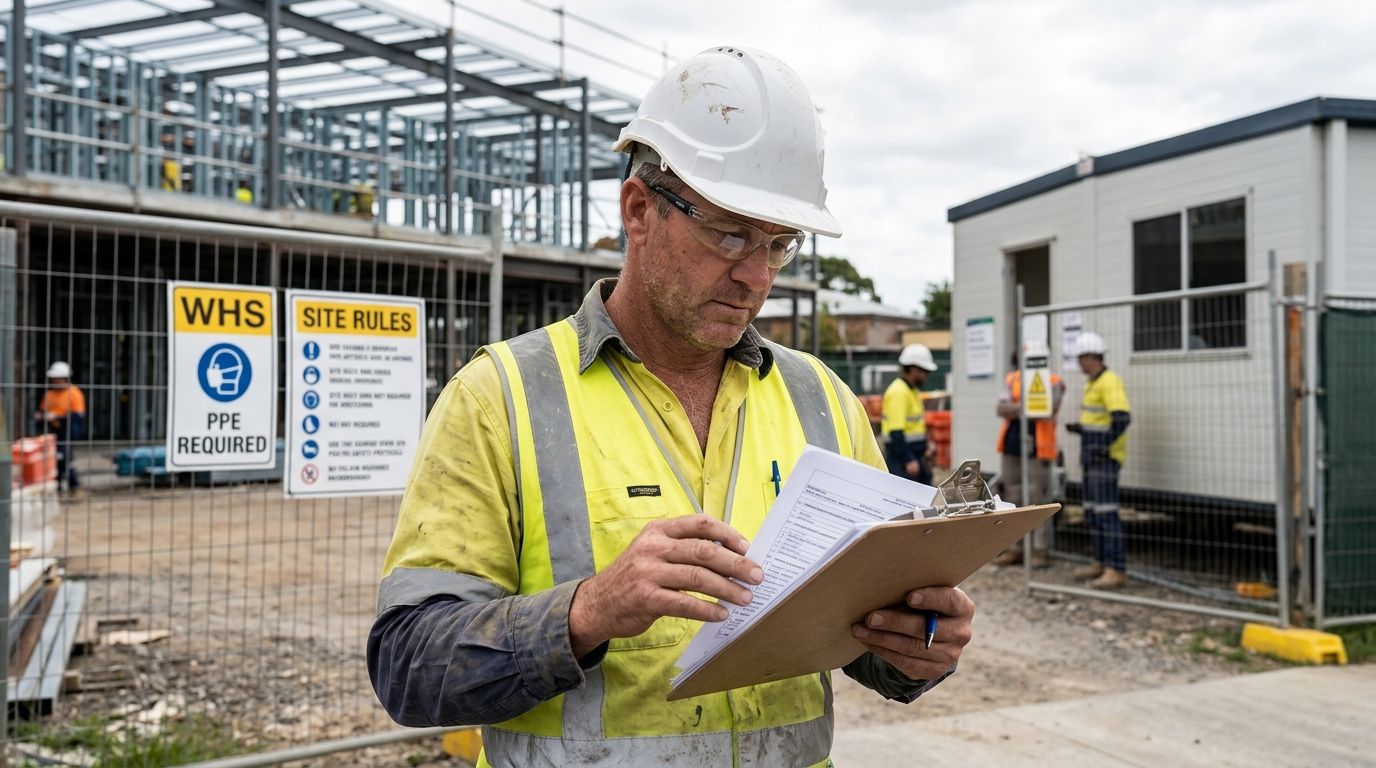
If you have worked in construction for years and recently received a notice from HR, a new condition in your induction paperwork, or a quiet conversation with your supervisor about needing a formal qualification, you are not alone. Across the industry, experienced workers and site supervisors are encountering requirements that did not exist a few years ago. The rules have not changed because you did something wrong. They have changed around you, driven by structural forces that most workers are never fully briefed on.
This article explains why those forces exist, how they flow down to affect every worker on a project, and what the most direct, legitimate pathway looks like for someone who already does the job. Understanding this mechanism matters because once you see why the mandate exists, the path forward is clearer.
What 'principal contractor' actually means, and why their rules become yours
In Australian construction law, a principal contractor is a person conducting a business or undertaking (a PCBU) who takes on the management or control of a construction workplace. Under the Work Health and Safety Regulation, each construction project must have a principal contractor, and there can only be one at any given time.
The PCBU who commissions a construction project is generally the principal contractor for that project, unless they engage another PCBU to take on that role for the duration of the work.
In Queensland, the Work Health and Safety Regulation defines a construction project as any project involving construction work costing $250,000 or more. The person who commissions that work is normally the principal contractor, but a client can appoint another PCBU as principal contractor by authorising them to manage or control the workplace.
Why does this matter? When a principal contractor sets workforce standards, including qualification requirements, those standards flow down to every subcontractor, labour hire agency, and individual worker on the project. If the principal contractor's WHS management plan or head contract specifies that site supervisors must hold formal qualifications, that requirement applies to everyone working under their management. It is not a preference. It is a contractual and regulatory condition of being on that site.
SafeWork NSW's Code of Practice for Construction Work outlines the principal contractor's duties, including preparing a WHS management plan and managing risks across the site.
The insurance and liability equation: Why experience without credentials is now a risk category
Here is the mechanism that most workers are never told about. Insurance in the construction industry, including public liability, workers' compensation, and professional indemnity, is priced and structured around demonstrable risk. Insurers assess the likelihood and potential cost of incidents using documented evidence to make those assessments.

Formal qualifications are a primary way workforce competency is documented. An experienced worker who holds a formal qualification has a verifiable, third-party-assessed record of competency. An experienced worker who does not, regardless of their actual skill level, represents a gap in that documentation. From an insurer's perspective, undocumented competency is not the same as demonstrated competency.
This is not a judgment of your ability. It is a structural feature of how risk is assessed and priced. Your experience is real, but in an insurance claim, documented evidence is what counts.
Standard construction contracts in Australia are routinely amended to reflect statutory compliance requirements. Research from the University of Melbourne's law school found that clauses dealing with relatively recent statutory requirements are added to approximately 60% of standard-form construction contracts, and project-specific requirements are added to approximately 68% of those contracts. Qualification and competency requirements are increasingly part of that compliance framework.
Research on standard contract forms in the Australian construction industry documents how frequently contracts are amended to reflect regulatory and project-specific compliance requirements.
How head contract clauses are changing what every subcontractor must prove
Tier 1 and Tier 2 builders increasingly embed workforce competency requirements directly into head contracts and tender prequalification criteria. Government-funded infrastructure projects, in particular, have formalised this approach through prequalification systems that assess contractor capability before a tender is considered.
Queensland's Department of Transport and Main Roads, for example, operates a National Prequalification System for Civil (Road and Bridge) Construction that sets staged minimum requirements for contractors, including company experience, project delivery history, and WHS accreditation. Under that system, accreditation under the Australian Government's Building and Construction WHS Accreditation Scheme is deemed to satisfy the WHS prequalification requirement at all levels.
The CPC40120 Certificate IV in Building and Construction is designed for builders, site managers, and managers of small to medium building businesses. It includes units on planning and supervising safe building and construction work, preparing and administering contracts, and applying quality principles to projects. It is the qualification most commonly aligned with site supervisor and builder roles, and it is the qualification that head contracts and prequalification criteria increasingly reference when specifying supervisor competency.
Builder and site supervisor licensing varies across Australian states and territories. Holding a Certificate IV does not automatically satisfy every state or territory licensing regime, and requirements additional to the qualification may apply depending on your location and the class of licence you are seeking.
Queensland's National Prequalification System for Civil (Road and Bridge) Construction shows how government infrastructure procurement embeds WHS and competency requirements into the tender process.
The workforce reality: Experienced workers caught in the compliance gap
National statistics do not directly quantify how many experienced construction workers and supervisors lack formal credentials. What they do show is that formal recognition in construction is closely tied to VET-level qualifications. According to the Australian Bureau of Statistics, in 2022-23, 69% of workers in the construction industry held a qualification below a bachelor degree level as the most relevant to their current job, making construction one of the most VET-dependent industries in Australia.

At the same time, nationally, around one in three Australians aged 15 to 74 had no non-school qualification at all in 2022-23. Many of those workers are in industries like construction, where on-the-job learning has historically been the main pathway to competency.
The result is a large group of experienced workers, people who have done the job for years, often in supervisory roles, who have never needed a formal credential to prove what they know. The industry is now asking for that proof. This is not a skills gap; it is a recognition gap.
The Australian Bureau of Statistics' Qualifications and Work survey provides national data on qualification attainment by industry, including the construction sector.
Why experience without credentials is a risk employers can no longer absorb
From your employer's perspective, retaining an uncredentialed supervisor, regardless of their actual competence, creates a documented gap in their compliance position. Under Australian WHS law, officers of a business have a duty to exercise due diligence to ensure the organisation complies with its WHS obligations. That includes verifying that workers have the competency to perform their roles safely.
Formal qualifications are the most defensible evidence of competency available. They represent a third-party assessment against nationally recognised standards. An employer who can point to a qualified supervisor has a documented compliance position. An employer who relies on informal competency assessment, such as 'we know they can do the job', has a much harder case to make if something goes wrong.
Your employer is not making this up. They are managing a risk that the regulatory and insurance environment has made impossible to ignore. The mandate is structural, not personal.
Recognition of prior learning: The pathway built for workers in this exact situation
Recognition of Prior Learning (RPL) is a formal assessment pathway under the Australian Qualifications Framework. It exists specifically for experienced workers who need to convert existing competence into a recognised qualification. Rather than repeating learning you have already demonstrated through years of work, RPL assesses your existing skills, knowledge, and experience against the units of competency in the qualification. Where gaps are identified, training is provided to cover them.
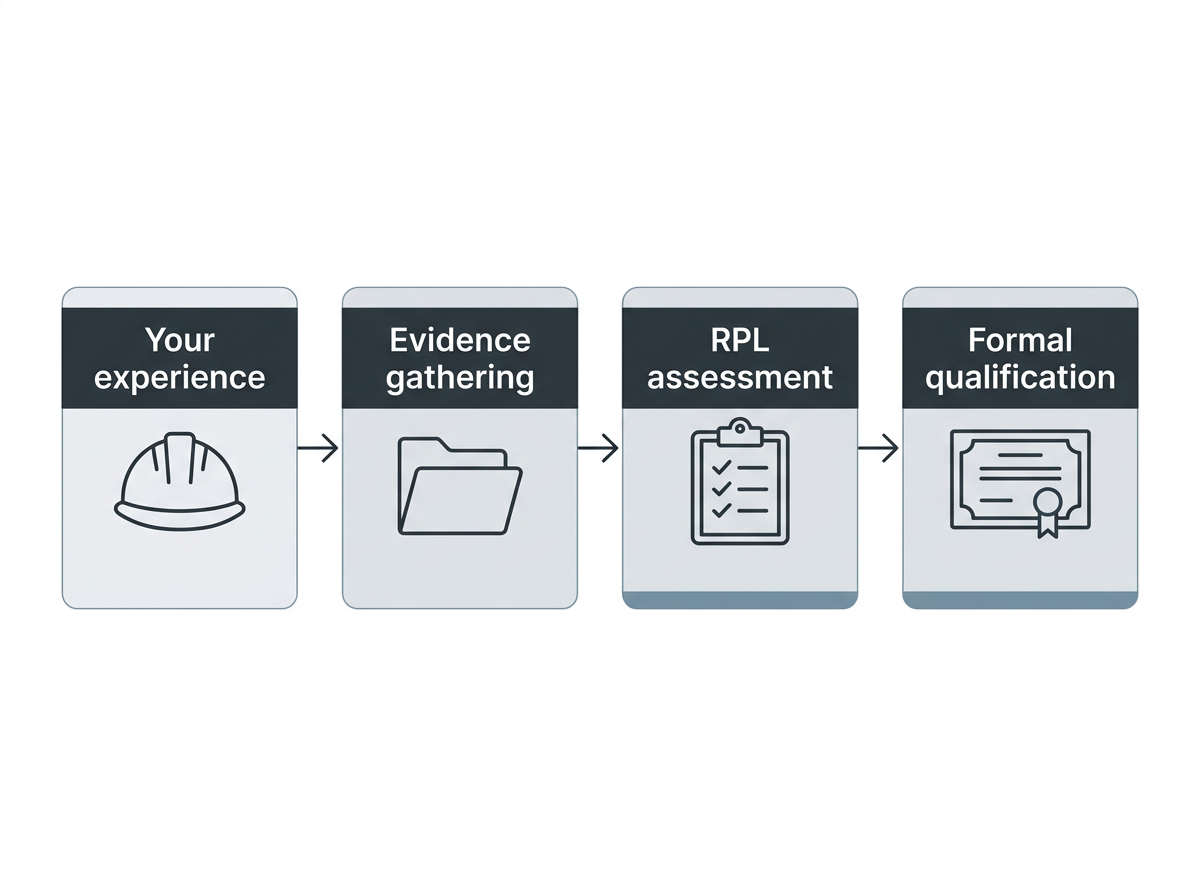
For the CPC40120 Certificate IV in Building and Construction, RPL can allow experienced workers to achieve the same nationally accredited qualification as those who completed it through traditional study. Some RTOs note that the certificate itself does not indicate it was completed via RPL; the qualification is identical.
RPL is not a shortcut or a rubber stamp. It is a thorough assessment of genuine competency. The assessor, employed by the Registered Training Organisation conducting the assessment, will evaluate your evidence against the qualification's requirements. If gaps are identified, you will need to address them. The process is demanding because the qualification is genuine.
Indicative timeframes vary considerably by provider and individual circumstances. One provider, Master Builders NSW, designs its CPC40120 RPL program to be completed within six months, with knowledge-based assessment due within two months and all evidence due within five months, recommending a commitment of around 10 to 15 hours per week. Another provider, Everthought Education, indicates its RPL pathway can be completed in two to eight weeks depending on experience and knowledge. These are indicative figures from individual RTOs; actual duration depends on the evidence you provide, any gap training required, and the assessor's workload.
To read more about what the CPC40120 Certificate IV in Building and Construction via RPL involves, visit the qualification page.
What experienced construction workers need to know before starting
RPL is the right pathway for many experienced construction workers, but it is not the right pathway for everyone. Suitability depends on the depth and breadth of your existing experience relative to the units of competency in the qualification.
One RTO says entry to its RPL program may require at least three years of experience, current employment in a supervisory role, and supervisory or management experience on at least one residential and two commercial building projects. Another RTO indicates entry criteria may include three to four years of demonstrated experience in a building or construction role and at least two work referrals from qualified builders. These are provider-specific requirements, not universal national standards, but they show the experience base that RPL assessors look for.
Evidence used in an RPL application can include video footage of tasks performed on site, photos, previously completed certificates, project management documentation, stakeholder communication records, and a valid White Card. Some providers may also require a competency conversation with an assessor to confirm your skills and experience against the qualification requirements.
You may also need to provide details of a current referee, such as a builder, supervisor, or manager, who can verify your employment history and work experience.
If gap training is identified during the assessment process, it is typically provided at no additional cost. This is part of what makes RPL a genuine assessment rather than a pass-through; the process is designed to identify and address any areas where your experience does not yet meet the qualification standard.
The decision is yours, but the window is narrowing
You have the experience, but the industry has changed what it accepts as proof. This mandate is not going away. The structural forces driving it, including insurance pricing, liability law, and head contract requirements, are accelerating.
The RPL pathway exists to convert existing competence into the formal recognition the system now requires. It is not a shortcut. It is a process designed for workers in exactly this situation, those who already do the job and need their experience formally assessed and acknowledged.
The decision is yours. But the longer the gap between your experience and your formal credential, the more projects, roles, and opportunities that gap may cost you.
Ready to Get Recognised?
Start with a free skills review to find out if RPL is right for you.