Can I use RPL for skill assessment? A practical guide for employer mandates
Yes. RPL is a nationally recognised skill assessment pathway. Get the document checklist you need when your employer requires formal qualifications.

Yes, you can use RPL for skill assessment: Here is what it means
If your employer has told you that you need a formal qualification or a skill assessment to keep working, Recognition of Prior Learning (RPL) is the nationally recognised pathway that lets your existing experience be formally assessed and documented. It is not a workaround, and it is not a shortcut. It is the official mechanism established by the Australian Qualifications Framework (AQF) to assess the practical skills you have already developed against the standards of a nationally recognised qualification.
You already have the necessary experience. The only question is whether the training system will recognise it, and RPL is the process that makes that happen.
RPL is delivered by Registered Training Organisations (RTOs), which are the same bodies that deliver traditional study. The qualification you receive at the end is completely identical. The assessment is real, the final decision is made by a qualified assessor, and the result is a nationally recognised credential. The only difference is the evidence you bring to that assessment, such as your work history, practical demonstrations, and references, rather than classroom hours and written assignments.
What employers actually mean by 'skill assessment'
The term 'skill assessment' is used in several different ways, and you need to be clear about what your employer is actually asking for. In most workplaces (including construction, mining, utilities, government contracting, and aged care), when a principal contractor or an HR department says you need a skill assessment or a ticket, they mean a nationally recognised qualification issued by an RTO. That is the exact outcome that RPL delivers.
This process is separate from a migration skills assessment, which is the procedure used by bodies like TRA or VETASSESS to assess overseas qualifications for visa applications. If your employer wants you to get qualified to remain on site or to meet a specific contract requirement, they are almost certainly looking for a nationally recognised vocational qualification, and RPL is designed to deliver that.
The shift toward employer mandates is clear and growing. According to analysis from Jobs and Skills Australia, a lack of formal qualifications or registration is one of the most common reasons employers consider construction trades applicants unsuitable. Furthermore, data from the National Skills Commission indicates that roughly one in three workers in the Australian construction industry do not hold post-school qualifications, meaning a large portion of the workforce now faces these compliance requirements.
The RPL skill assessment checklist: What you need to gather
This is the practical part of the process. An RPL assessment requires evidence showing your competency against the specific units in your qualification. The good news is that most of this evidence already exists, so it is just a matter of locating and organising it. RTOs structure their evidence requirements around specific units of competency and their own assessment guidelines, which means exact requirements can vary. The categories below show what is commonly requested by Australian RTOs.
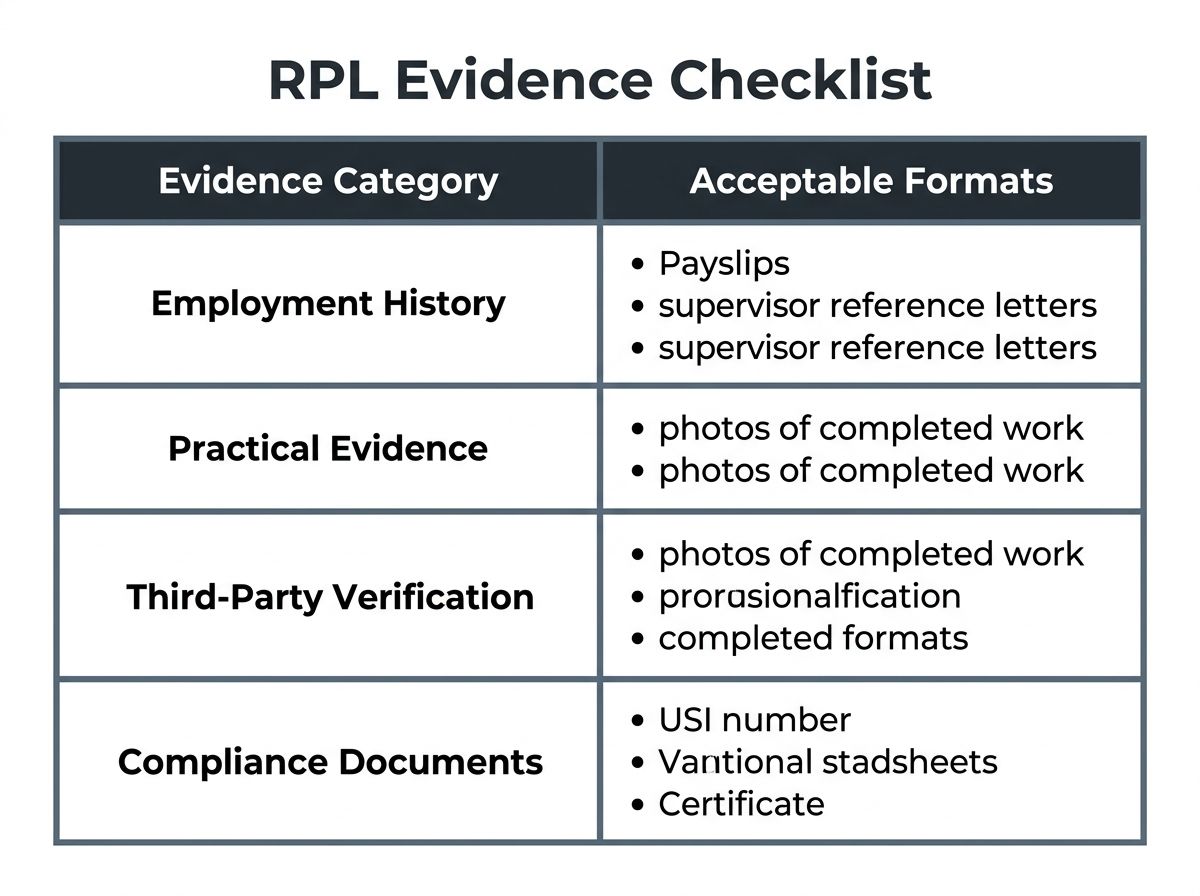
Employment history evidence (you likely already have this):
- Current and previous employment records, such as payslips, tax records, or a letter from your employer confirming your job role and employment dates.
- A detailed resume or CV outlining your relevant work history, job responsibilities, and your day-to-day tasks on the job.
- Official job descriptions or position statements that describe the specific work you performed.
- Superannuation statements or records that show continuous, active employment in your industry.
Practical evidence (what you have done on the job):
- Photos or short videos of work you have completed (footage taken on your phone is perfectly fine for most RTOs).
- Physical work samples, project documentation, or site records that you were personally responsible for managing.
- Safe Work Method Statements (SWMS), records of toolbox talks, or safety inspection reports you completed or signed.
- Trade logbooks, equipment maintenance records, or daily production logs relevant to your line of work.
Third-party verification (people who can confirm your skills):
- A written reference from a current or former employer, supervisor, or site manager, preferably someone who can describe the specific tasks you performed.
- A third-party report or a formal statutory declaration from a qualified trade professional who has observed you working.
- Current contact details for professional referees who can speak directly with the RTO assessor if needed.
Identity and compliance documents:
- Valid proof of identity, including a driver's licence, passport, or an equivalent document.
- Your Unique Student Identifier (USI), which is mandatory for enrolment with any Australian training provider.
- Any existing trade certificates, high-risk licences, or tickets (even expired ones can provide useful context for the assessor).
- Documented records of prior vocational training, short courses, or formal workplace inductions.
The specific assessment conditions for each unit of competency dictate the evidence you must provide. Some units require direct observation by a qualified assessor, while other units permit a wider range of document-based evidence. Your RTO will explain exactly what is required for the qualification you are pursuing.
How the RPL skill assessment process works
The RPL process follows a straightforward pathway. Here is what you can expect at each stage.
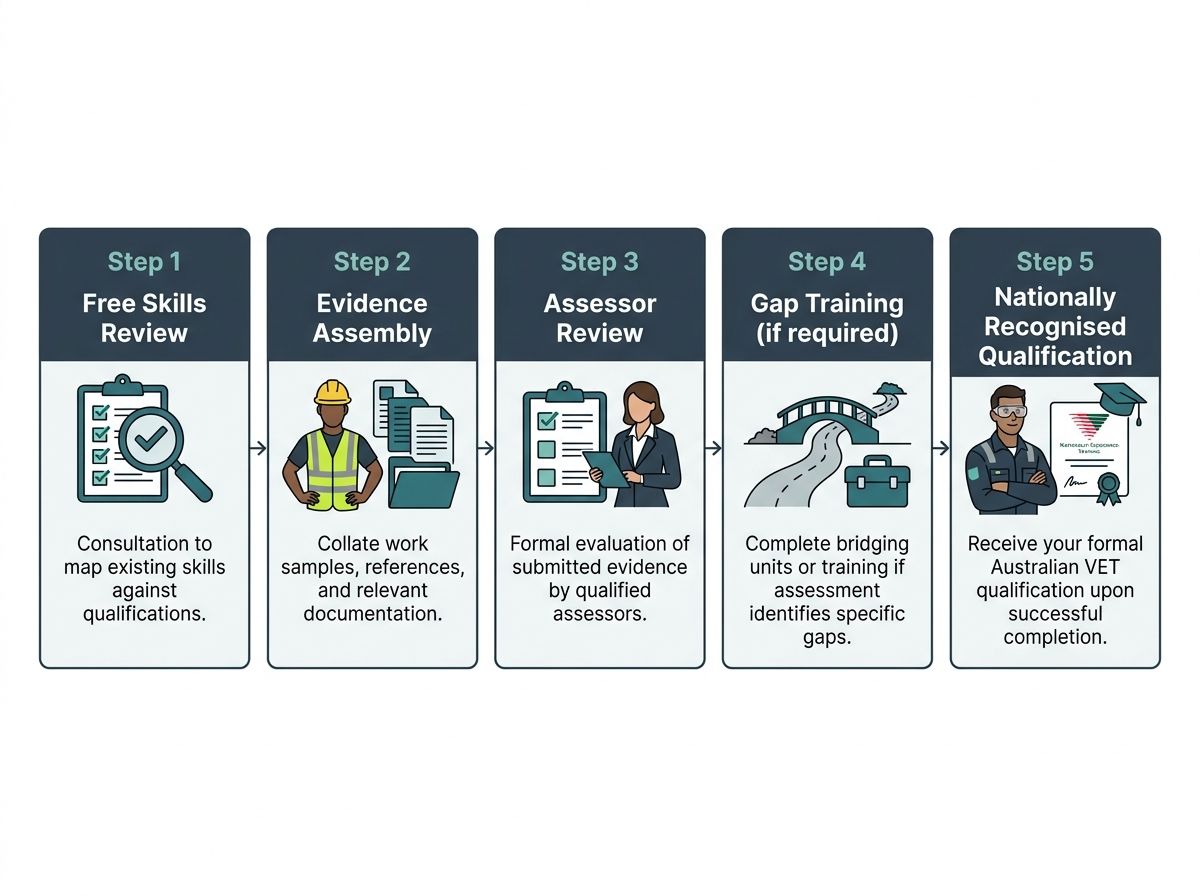
- Free Skills Review: Before committing to anything, you find out if your experience is sufficient for the qualification you require. This is a cost-free, no-obligation conversation about your work background and what the assessment involves.
- Evidence Gathering: You compile the documents, photographs, professional references, and job records that show your skills. Your representative helps you understand what to look for and how to arrange it.
- Assessor Review: A qualified assessor from the delivering RTO evaluates your evidence against the units of competency in the qualification. The assessor, not RPL it, makes the official determination of competency.
- Gap Training (if required): If the assessor finds areas where your evidence does not fully prove competency, you may need gap training. This is limited to the specific units needed rather than a full course, and can usually be completed while working.
- Qualification Issued: Once your competency is confirmed across all required units, the RTO issues your official, nationally recognised qualification.
Regarding timeframes, RTOs are required to structure their RPL processes to minimise the time and cost involved for applicants. There is no set national timeframe for completing an RPL assessment. The duration depends on the qualification, how quickly you gather your evidence, the RTO's internal schedules, and whether any gap training is required. You should ask your RTO for an estimated turnaround time and inform them of any employer or licensing deadlines early in the process.
RPL it helps guide you through these stages. The formal assessment is carried out by a qualified assessor from the registered RTO that issues your qualification, and they will arrange any necessary gap training as part of that process.
The national training framework confirms that the competencies you already hold can be formally assessed against the units of competency within a Training Package. These skills must be recognised regardless of how, when, or where you developed them, provided they remain relevant to the required outcomes.
Is RPL the right path for your employer mandate? A suitability check
RPL is a highly effective pathway for many experienced workers, but it is not the right choice for everyone. Honest advice about suitability is essential, because enrolling in the wrong program wastes both your time and your money. Here is a clear way to assess whether you are ready for RPL.
RPL is likely a good fit if:
- You are currently employed or active in the relevant trade or industry.
- You have substantial practical experience (RTOs typically look for several years of relevant full-time work, though this varies by qualification).
- Your trade experience is recent, and you can provide evidence from the last five years to prove your current skills.
- You can document your history through employment records, professional references, physical work samples, or photos.
- The specific qualification your employer requires is currently offered through RPL by a registered RTO.
RPL may not be suitable if:
- You are relatively new to the trade or industry and have not yet built up substantial hands-on experience.
- Your work history is in an unrelated field and does not match the competency units of the qualification you need.
- You are unable to provide any documented proof, work samples, or professional references to verify your trade experience.
- The qualification your employer has requested is not available through the RPL pathway, in which case we will help you find the correct training route.
The Free Skills Review is designed for this exact scenario. It is a cost-free, no-obligation discussion about your trade background and the qualification your employer is asking for. You will get a straightforward answer on whether RPL is a viable option for your situation before you make any commitment.
What happens after your RPL assessment: The qualification and its standing
Once your RPL assessment is complete and your competency is confirmed, the RTO issues your official qualification. This credential carries the exact same weight as one earned through classroom study, and it is fully recognised by employers, licensing boards, and regulators across Australia.
A common question is whether a qualification earned through RPL looks different, or if an employer or licensing body can tell how you obtained it. Training providers confirm that certificates issued via RPL are completely identical to those from conventional study. The certificate itself does not mention the assessment method used.
For trade licensing, requirements differ depending on your state or territory, and you should always confirm details with your local regulator. For example, the Queensland Building and Construction Commission (QBCC) lists a certificate from an RTO obtained through Recognition of Prior Learning as an accepted proof of technical qualifications for a builder's licence. Keep in mind that licensing bodies usually require separate evidence of your work experience; RPL satisfies the qualification requirement, not the practical experience requirement.
The QBCC licensing requirements confirm that an RPL certificate from an RTO is accepted as proof of technical qualifications for the builder-open licence class.
Your years on the job deserve to be counted. A qualification obtained through a genuine RPL assessment is not a compromise. It is an official recognition of your skills, evaluated against the same national standards that apply to every other holder of that qualification.
Your next step: Find out if your experience qualifies
You now understand the process, the documentation checklist, the suitability criteria, and the qualification outcome. The remaining step is finding out if your trade, your years of experience, and your existing evidence meet the requirements for the qualification your employer is demanding.
This is precisely what the Free Skills Review is for. It is a cost-free conversation with absolutely no obligation to enrol. You will receive an honest assessment of your situation and a clear picture of how the RPL pathway works for you. The final decision is entirely yours.
Research from the NCVER confirms that Recognition of Prior Learning is formally accepted under the Australian Qualifications Framework, establishing RPL as an official pathway to AQF qualifications rather than an alternative or non-standard route.
Ready to Get Recognised?
Start with a free skills review to find out if RPL is right for you.