From construction to pest control: The skills you didn't realise you already had
If you work in construction, landscaping, or property maintenance, you already have core urban pest management skills. Here is what you didn't realise you knew.
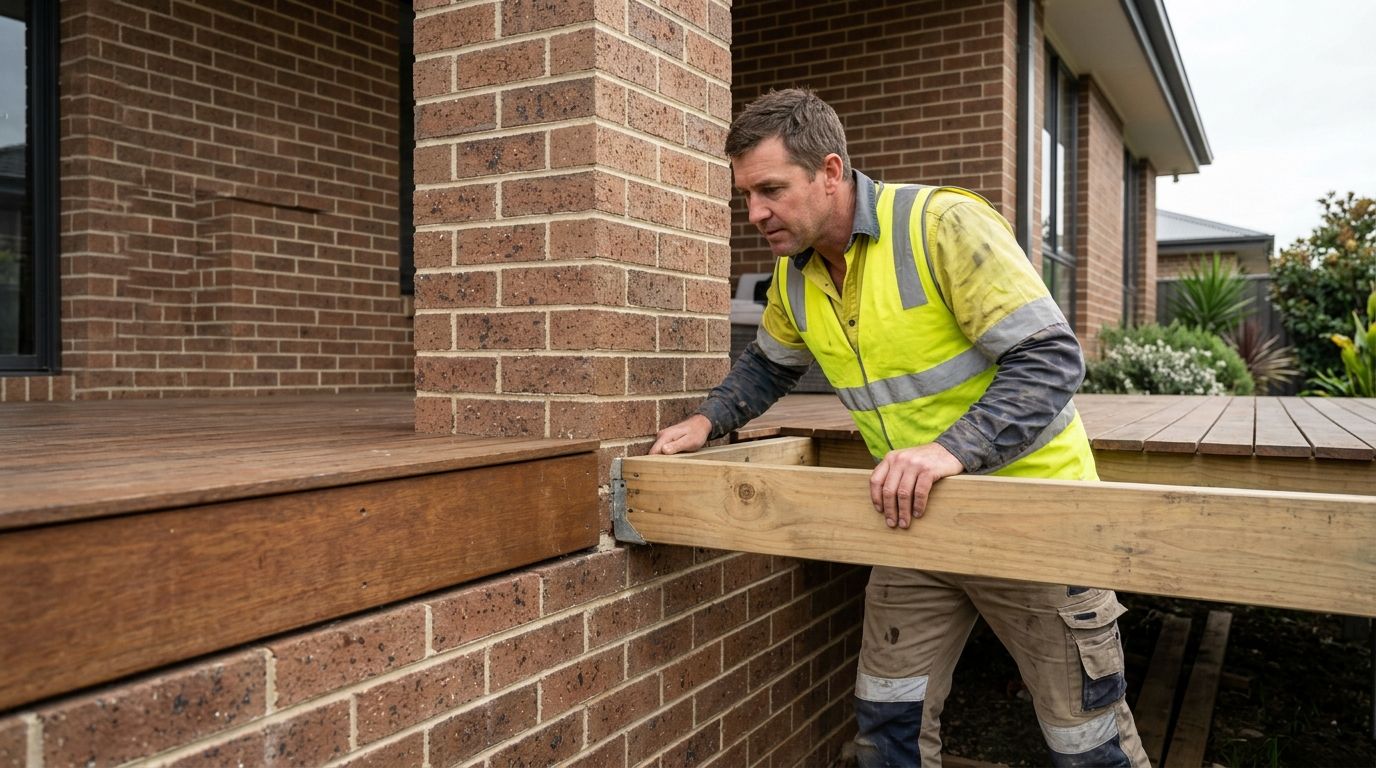
The assumption that keeps tradies out of pest control
You have the experience. You know how buildings go together. You know how water moves through a structure, where timber meets concrete, which materials attract moisture, and which resist it. You have worked in roof voids, crawl spaces, and wall cavities. You have read site conditions and made judgement calls that kept projects on track and people safe.
Yet if someone suggested you move into pest control, your first thought might be that you would have to start from scratch.
That assumption is the barrier. It is not your competency. It is the assumption itself.
Construction, landscaping, and property maintenance professionals routinely dismiss pest control as a career option because they believe it belongs to a completely different industry. It does not. The overlap is substantial, and for many tradies, it is closer to a lateral move than a career change.
What urban pest management actually requires
Urban pest management, the field covered by the Certificate III in Urban Pest Management (CPP30119), involves identifying, assessing, and managing pest activity in residential, commercial, and industrial environments. In plain terms, pest technicians inspect buildings, identify conditions that attract or harbour pests, apply management strategies, handle chemicals safely, and document their findings.
The CPP30119 qualification is made up of ten units of competency, including five core and five elective units. The core units cover areas including pest identification and management strategies, safe work practices, and the application of pest management treatments. Elective units allow candidates to specialise in areas such as termite management, fumigation, or specific pest types.
Read that list again. Site inspection. Hazard identification. Safe work practices. Chemical handling. Documentation. If you have spent time on a construction site, in a garden, or maintaining a commercial property, you have been doing versions of all of these, just under different names.
The skills you already have and what they are called in pest control
This is where the shift occurs. Below are six competency areas that appear in urban pest management, alongside their direct equivalents in construction, landscaping, and property maintenance work.
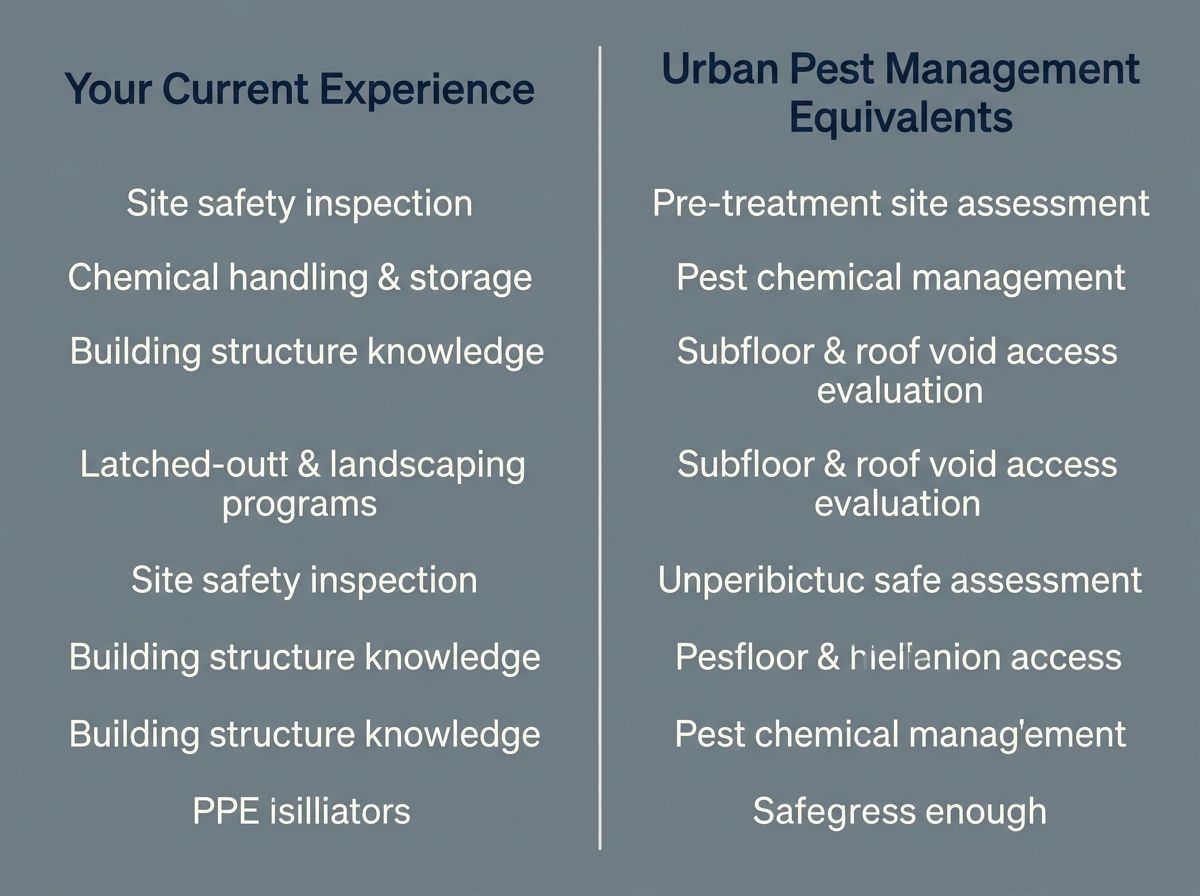
1. Site hazard assessment
In construction, you call it a site safety inspection or hazard identification. In pest control, it is a pre-treatment site assessment. The skill is identical. You walk a site, read the conditions, identify risks, and determine what needs to happen before work begins. Construction workers do this before every job. Pest technicians do it before every treatment.
2. WHS compliance and safe work practices
Both industries operate under Australia's Work Health and Safety framework. The construction unit CPCWHS1001 (Prepare to work safely in the construction industry) covers risk identification, PPE selection, and safe work method statements. CPP30119 includes equivalent WHS requirements. If you have held a White Card and worked to a SWMS, you already understand the compliance framework that pest control requires.
3. Chemical handling and storage
In construction and landscaping, chemical handling covers everything from solvents and adhesives to herbicides and fertilisers. You have read Safety Data Sheets, selected appropriate PPE, and stored chemicals according to regulations. In pest control, the same discipline applies to pesticides and treatments. The regulatory framework is different in its specifics, but the underlying competency of handling hazardous substances safely and responsibly is one you have already developed.
4. Building structure knowledge
This is where construction workers hold a genuine advantage over many new pest control entrants. Understanding how a building is constructed, such as how roof voids are accessed, how subfloor spaces are ventilated, where wall cavities run, and what materials are used in different building eras, is directly relevant to pest inspection. Termite management in particular requires an understanding of how buildings are built and where timber is vulnerable. A carpenter or builder who has framed hundreds of houses brings structural literacy that takes years to develop from scratch.
5. Site documentation and reporting
In construction, you document site conditions, defects, and variations. In property maintenance, you log inspection findings and maintenance records. In pest control, technicians produce treatment reports, inspection certificates, and client documentation. While the format differs, the discipline of accurate, accountable site recording does not.
6. Client communication on technical matters
Tradies routinely explain technical findings to clients, such as why a wall needs to be opened, what a drainage issue means for the structure, or what a roof inspection revealed. Pest technicians do the same by explaining what they found, what it means, and what the treatment involves. If you have ever talked a homeowner through a building defect, you have already practised the communication skills that pest control requires.
Why the pest control industry values your experience
Urban pest management is not a field for generalists. It requires people who can read a built environment. You need to understand how structures age, where moisture accumulates, how building materials behave, and what conditions create pest pressure. That knowledge is not taught in a classroom in a few weeks. It is developed over years of working in and around buildings.
Pest control companies operating in residential and commercial markets deal with complex environments. These include heritage buildings with inaccessible subfloors, new construction with integrated pest management requirements, and commercial properties with strict chemical use protocols. The technicians who perform well in these environments tend to be people who already understand the built environment, rather than those who are learning it from scratch alongside pest management.
Your background in construction, landscaping, or property maintenance is not a liability in this industry. It is a foundation that many entrants to the field spend years trying to build.
The gap between your experience and the qualification
Understanding that your skills are relevant is not the same as having them formally recognised. The Certificate III in Urban Pest Management (CPP30119) is a nationally recognised qualification. In most Australian states and territories, some form of licensing or qualification is required to work as a pest management technician. Licensing requirements vary by state, so it is worth checking the specific requirements where you intend to work.
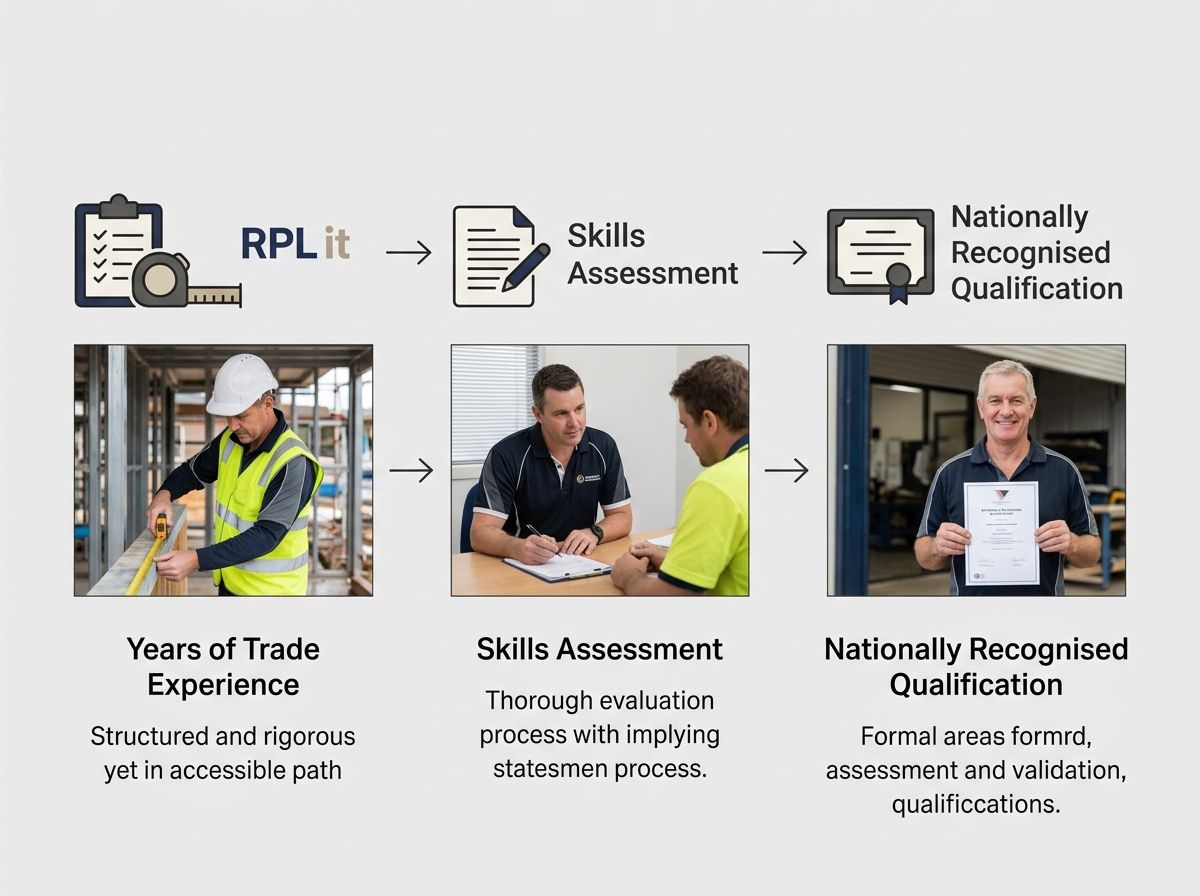
Recognition of Prior Learning (RPL) is the formal process through which your existing skills and experience are assessed against the units of competency in CPP30119. It is not a shortcut. It is an assessment, conducted by a qualified assessor from a registered training organisation, that determines whether your demonstrated competency meets the national standard.
What RPL does is remove the requirement to re-learn what you already know. If your experience maps to the units, you may not need to complete the full course. If there are gaps, meaning areas where your background does not cover what the qualification requires, those gaps can be addressed through targeted training. Gap training is typically provided as part of the RPL process.
The starting point is not enrolment. It is a clear assessment of where your experience sits relative to what the qualification requires.
You can learn more about the Certificate III in Urban Pest Management (CPP30119) and what the qualification covers.
Your experience speaks. The question is whether it has been heard.
The pest control industry does not need more people who have memorised a textbook. It needs people who can read a site, work safely with chemicals, understand how buildings are constructed, and communicate findings clearly to clients. You have already been doing all of that.
The qualification exists to formally confirm what your experience already demonstrates. Recognition should not require starting over, and in this case, it may not have to.
Your skills are real. Your experience counts. Whether it meets the formal standard is a question worth answering, and the only way to find out is to have it assessed.
Ready to Get Recognised?
Start with a free skills review to find out if RPL is right for you.