Why Your Security and Military Experience Translates to Private Investigation
Ex-military or security professional? Your surveillance, threat assessment, and evidence skills map directly to the Certificate III in Investigative Services.

The civilian career that actually uses your skills
You have spent years doing work that most people cannot do. You watch, document, and assess threats before they become incidents. You have written reports that hold up under scrutiny and conducted interviews where the stakes were real. When you transition out, however, the civilian world often hands you an entry-level job description.
Private investigation is different. It is one of the few civilian career pathways where the core competencies are identical to military and security work, operating under a different name and licensing framework. The Certificate III in Investigative Services (CPP30619) is the nationally recognised qualification that formally assesses those competencies. If your background includes surveillance, intelligence gathering, evidence handling, or operational reporting, this qualification was built around skills you already use daily.
The frustration is real. Thousands of ADF personnel separate from service each year. According to Parliamentary Library reporting on Defence data, around 6,600 separations occurred in a recent reporting period. Many of these veterans find that civilian employers struggle to translate what they actually did into language the job market recognises. Private investigation does not have that problem. The industry speaks your language.
What private investigation actually demands
Private investigators conduct surveillance operations, gather and document evidence, interview subjects and witnesses, write detailed operational reports, assess risk, and plan and execute covert operations. These are the core functions of the role. They are not peripheral tasks; they are the daily work of a licensed investigator.
The CPP30619 Certificate III in Investigative Services is structured around these functions. The qualification includes five core units and eleven elective units. These cover areas such as conducting surveillance, gathering and handling evidence, interviewing, preparing investigation reports, and managing safety in operational contexts. It is the entry credential for licensed private investigators in most Australian states and territories, though licensing requirements vary by jurisdiction.
This qualification is not designed for people who want to learn investigation from scratch. It is a competency-based assessment of whether you can already do the work. This distinction is vital for anyone coming from a military or security background.
The skill-by-skill translation: what you already know
Your military and security experience maps directly to the CPP30619 core units. Here is how those skills translate in practice.
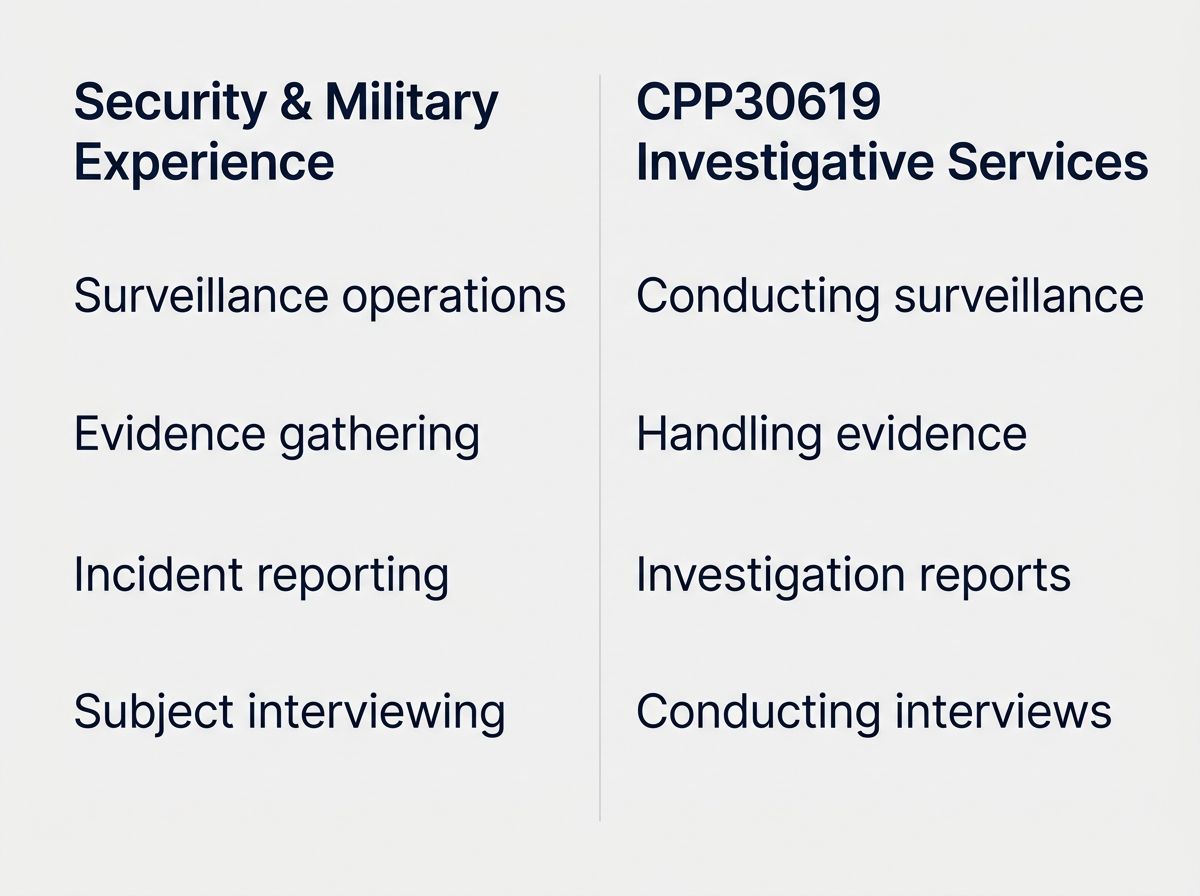
Surveillance operations. If you have conducted static or mobile surveillance by monitoring a location, tracking movement, and documenting activity without detection, you have been doing what investigators call 'conducting surveillance operations.' The techniques, discipline, and documentation requirements are the same. The ADF's Combat and Security category includes roles such as Electronic Warfare Operator, Security Forces Officer, and Air Force Security, which all involve protecting assets and monitoring environments. Submariner roles, as described in ADF recruitment materials, explicitly involve gathering intelligence on operational missions. These are surveillance competencies by any definition.
Evidence gathering and handling. If your role required you to collect, preserve, and document physical, digital, or testimonial evidence in a way that could withstand review, you have been practising evidence management. Military Police, intelligence roles, and corporate security functions all involve chain-of-custody thinking, even when it is not called that. The CPP30619 assesses your ability to gather evidence lawfully and document it accurately. If you have done this under operational pressure, the assessment standard is within your reach.
Report writing and documentation. Both the ADF and private security industries run on written documentation like operational reports, incident reports, intelligence summaries, and situation reports. The CPP30619 requires investigators to prepare clear, accurate, and legally defensible investigation reports. If you have written reports that were read by commanders, reviewed by legal teams, or used to inform operational decisions, you understand what that standard requires.
Interview and information-gathering techniques. Skills like structured interviews, witness statements, and subject questioning are developed through military police work, intelligence roles, and corporate security investigations. The CPP30619 assesses the ability to conduct interviews that yield reliable information. If you have interviewed people in high-stakes environments, you already have the discipline this requires.
Threat and risk assessment. Assessing a situation before acting, identifying risk factors, and making judgements about when to escalate or hold are forms of operational thinking that military and security professionals develop through experience. Private investigation requires the same judgement. You must know when a surveillance operation is compromised, when evidence collection must stop, and when personal safety protocols override the operational objective.
The ADF groups its roles into named career streams. The Communications, IT and Intelligence stream alone covers 40 full-time and 7 part-time roles. The Combat and Security stream covers 50 full-time and 13 part-time roles. These are the operational core of the ADF, and they develop the exact competencies the CPP30619 assesses.
Why the system does not see it yet
The skills are real. The problem is the form they exist in. Formal qualification systems require evidence in a specific structure, and military or security experience, however deep, was not acquired through a registered training organisation delivering CPP30619 units. That is not a skills deficit; it is a translation problem.
Recognition of Prior Learning (RPL) is the formal pathway that bridges this gap. RPL is a genuine assessment process, not a shortcut, where a qualified assessor from a registered training organisation evaluates your existing evidence against the qualification's competency standards. If your evidence demonstrates that you can already perform the required tasks to the required standard, the qualification is awarded. If gaps are identified, targeted gap training addresses them.
The challenge for military and security professionals is that their evidence exists in employment records, service documentation, operational reports, and referee statements, not in training certificates. Translating that evidence into a format an assessor can evaluate is what RPL guidance supports. It is not about proving you are competent; it is about presenting the proof you already have in a form the system can recognise.
If you are working through what evidence you already hold, this article on why your career pivot needs an evidence audit is worth reading before you go further.
What the recognition pathway actually looks like
The RPL pathway for the Certificate III in Investigative Services (CPP30619) begins with a skills review. This is an honest assessment of your background against the qualification's requirements. This stage is where you find out whether your experience is likely to be sufficient and where any potential gaps are identified before you commit to the process.
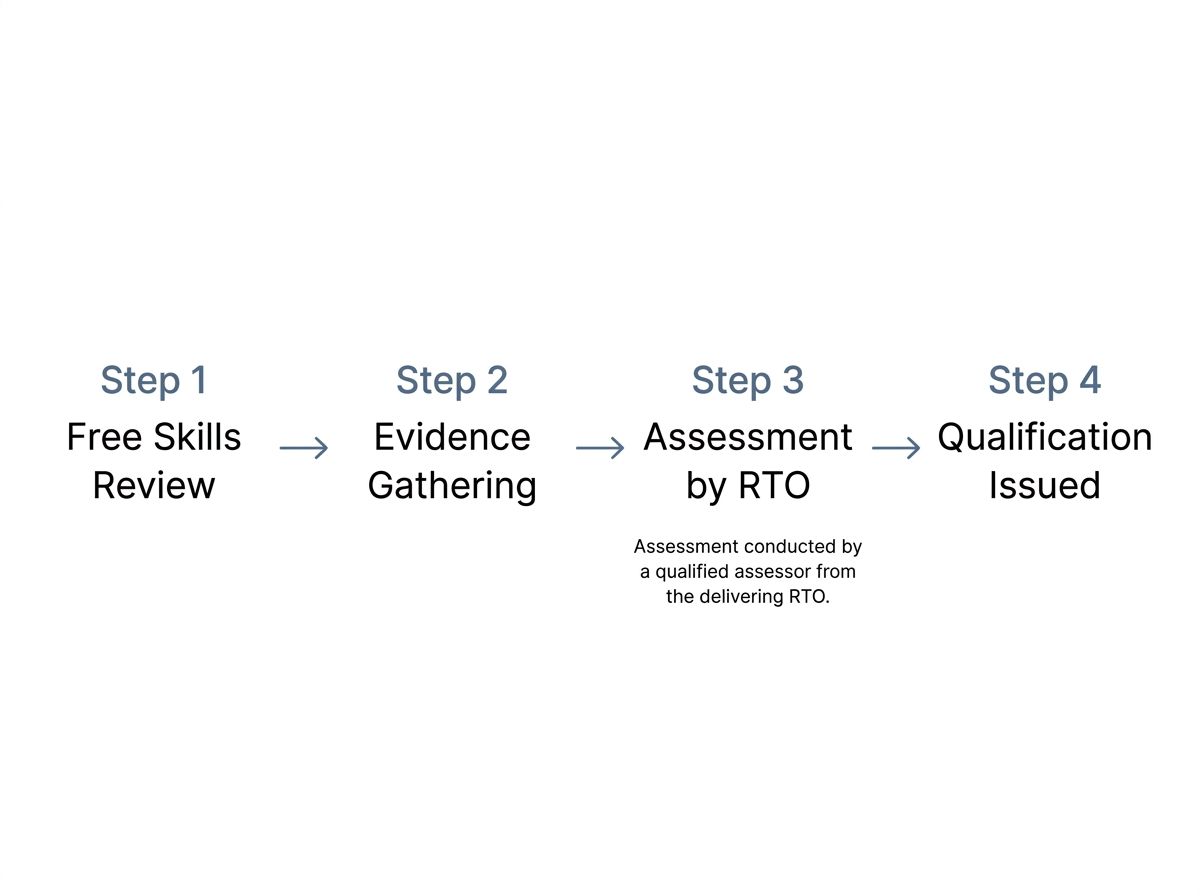
If the skills review indicates suitability, the next stage is evidence gathering. This involves compiling documentation that demonstrates your competency, including employment records, service documentation, operational reports, referee statements from supervisors or colleagues who can verify your work, and potentially work samples. The evidence does not need to be perfect. It must be authentic, relevant, and sufficient to allow an assessor to make a determination.
The assessment itself is conducted by a qualified assessor from the delivering registered training organisation (RTO). RPL it guides candidates through the process and supports evidence preparation, but the assessment and the qualification are issued by the RTO. The qualification is nationally recognised because the assessment is genuine, conducted by a qualified professional against the national standard.
If gaps are identified during assessment, indicating areas where your evidence does not fully demonstrate the required competency, gap training is provided. This training is targeted and specific, rather than a full course. The goal is to address the identified gap without repeating learning you have already done.
Once the qualification is awarded, licensing requirements vary by state and territory. In most Australian jurisdictions, CPP30619 is the required qualification for a private investigator licence, but additional steps like background checks and character assessments are also required. You should confirm the specific requirements in your state with the relevant licensing authority before you begin.
The CPP30619 qualification is listed on the national training register, which confirms its structure, units, and current status.
Is this the right move for you?
Not every military or security background maps cleanly to the CPP30619. The assessment is genuine, and it requires demonstrable competency across specific units. Before committing to the process, it is worth asking yourself a few direct questions.
- Have you conducted static, mobile, or electronic surveillance operations in a professional context?
- Have you gathered, handled, or documented evidence in a way that was subject to review or used to inform decisions?
- Have you written operational reports, incident reports, or intelligence summaries that were read and acted upon by others?
- Have you conducted structured interviews or information-gathering conversations in a professional context?
- Have you assessed risk or threat in an operational environment and made judgements based on that assessment?
If you answered yes to most of these, your background is likely to have significant overlap with the CPP30619 competency requirements. If your role was primarily administrative, focused on physical security without an investigative component, or operational in ways that did not involve documentation, the overlap may be more limited. The Free Skills Review is the right place to find out honestly.
Roles that tend to have strong overlap include military police, intelligence and signals roles, corporate security and investigations, loss prevention with an investigative function, and close protection with operational reporting responsibilities. Roles with partial overlap include general security operations, crowd control, and physical protection without an investigative component.
Your experience has always been evidence
The work you did in uniform, intelligence, or corporate security was always evidence of competency. The CPP30619 is the formal mechanism to have that evidence assessed and recognised by a qualified assessor against a national standard. The qualification does not create the competency; it acknowledges what already exists.
Your skills speak for themselves. The question is whether they have been presented in a form the system can recognise. That is what the recognition pathway is for.
The decision is yours. If you want an honest answer about whether your background maps to the Certificate III in Investigative Services qualification before you commit to anything, the Free Skills Review is the place to start.
Ready to Get Recognised?
Start with a free skills review to find out if RPL is right for you.