Why Your Heavy Machinery Experience Makes You Overqualified for an Apprenticeship
Worked on mining equipment, marine engines, or aircraft? Your mechanical skills may exceed what a first-year automotive apprenticeship teaches. Here's why RPL exists for you.
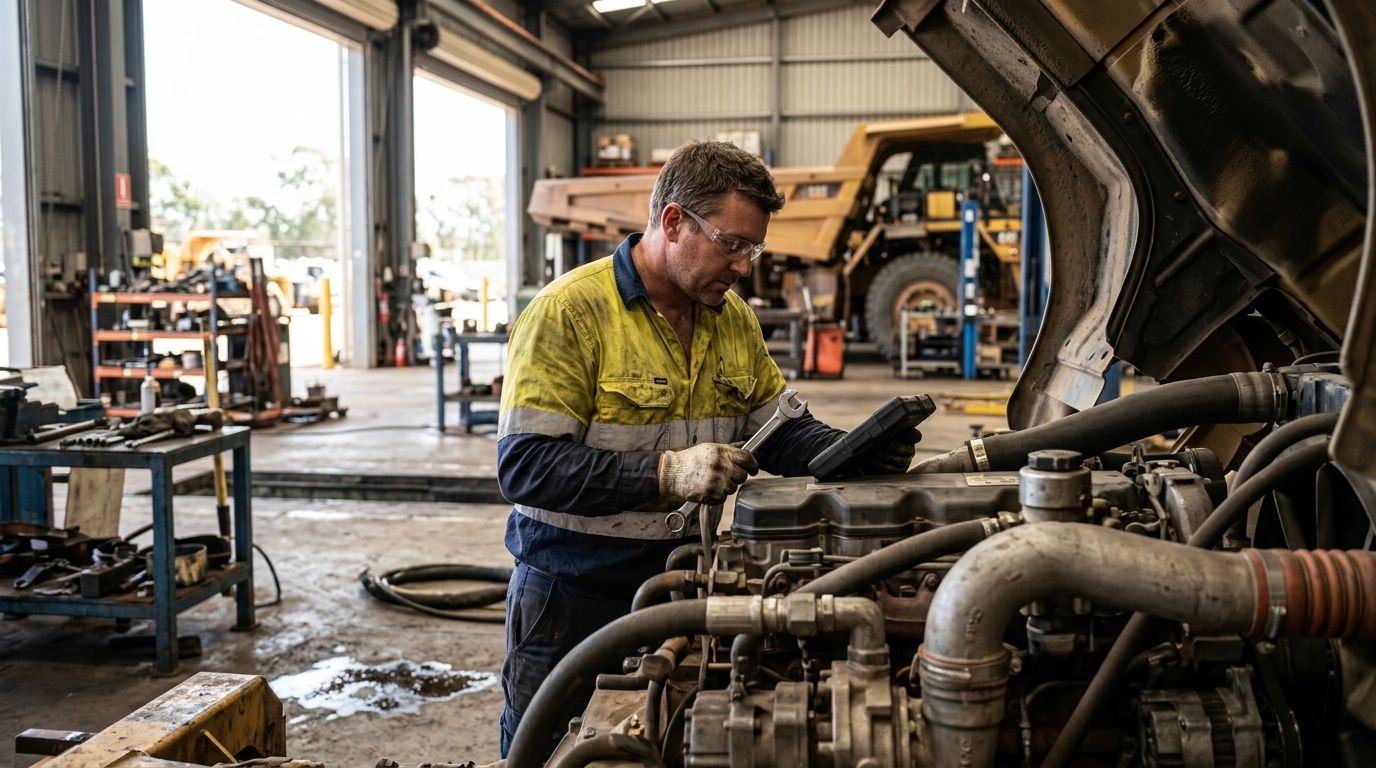
The apprenticeship paradox: the more experience you have, the worse the fit
You have the experience. Years of it. You have diagnosed hydraulic failures on 200-tonne haul trucks, rebuilt marine diesel engines in conditions that would challenge most workshops, or maintained aircraft systems where precision is not optional — it is regulatory. You understand fault-finding, fuel systems, electrical diagnostics, and the kind of safety discipline that comes from working in environments where mistakes have real consequences.
And then someone tells you that to work as an automotive mechanic, you need to start as a first-year apprentice.
The frustration is not just understandable — it is logical. The skills required to maintain a passenger car are, in most respects, a subset of what you already do. The apprenticeship system was designed for people entering the mechanical trades without prior experience. It was not designed for you.
This is the apprenticeship paradox: the more mechanical experience you bring from adjacent industries, the worse the standard entry pathway fits. Recognition of Prior Learning — the RPL mechanic pathway — exists precisely to resolve this.
What a first-year automotive apprentice actually learns
The Certificate III in Light Vehicle Mechanical Technology (AUR30620) is the nationally recognised qualification for automotive mechanics in Australia. It covers the full scope of light vehicle repair and maintenance — engine systems, braking, steering, suspension, electrical diagnostics, fuel systems, and more.
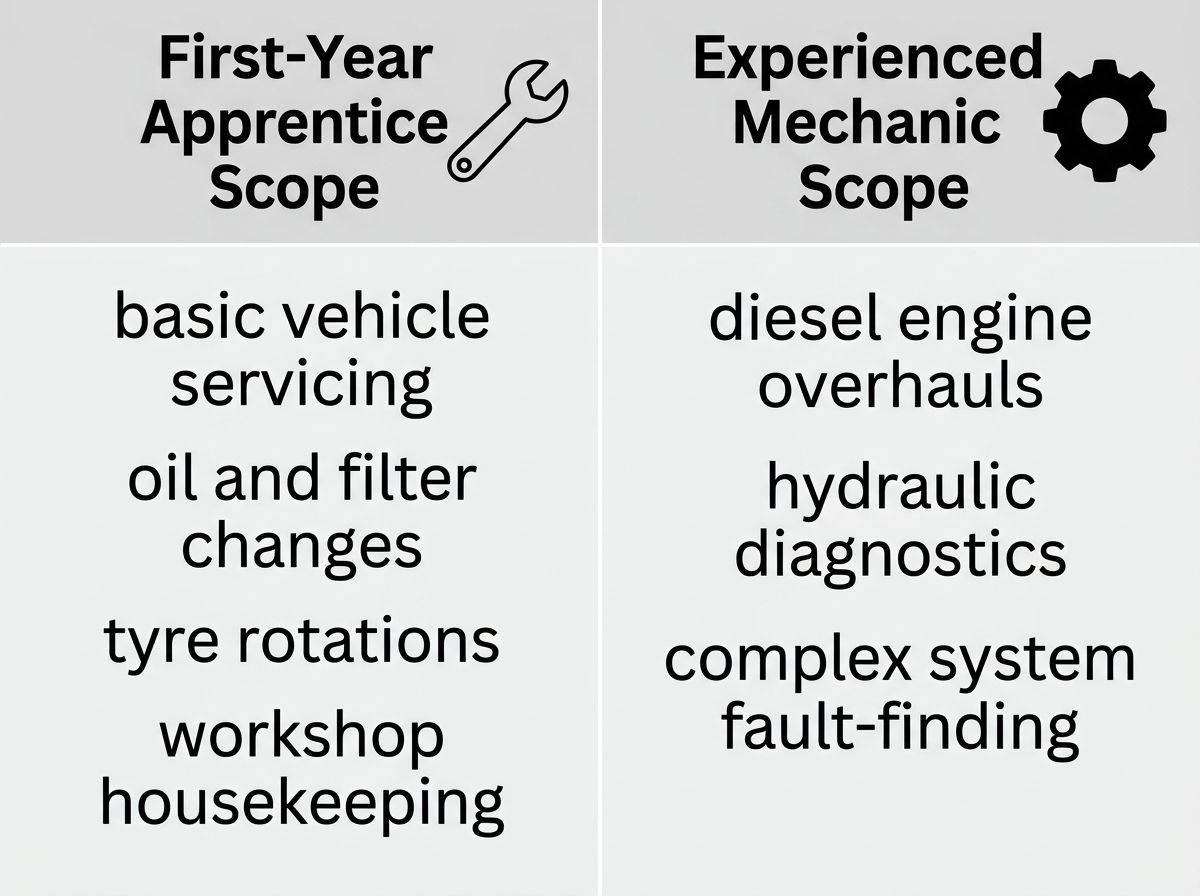
Apprenticeships combine on-the-job and off-the-job training, progressively building practical and theoretical skills over the course of the qualification. For someone entering the trade with no prior mechanical background, this structured exposure is genuinely valuable.
But the quality and scope of early apprenticeship work varies considerably. Research on Australian apprenticeships notes that learning outcomes depend substantially on the instruction, experience, and supervision provided in the workplace — and some apprentices report spending significant early periods on tasks well below the level of the qualification itself.
For a mechanic who has spent years working on complex industrial, marine, or aviation systems, the foundational units of an automotive apprenticeship cover ground that is already deeply familiar. The diagnostic reasoning, safety protocols, and mechanical fundamentals are not new knowledge — they are the daily language of your existing trade.
The skill overlap: what heavy machinery, marine, and aviation mechanics already know
The AUR30620 qualification covers competencies including engine systems, fuel systems, cooling systems, braking, steering, suspension, and electrical diagnostics. These are not exotic skills in the context of heavy diesel, marine, or aviation mechanical work — they are foundational to all of them.
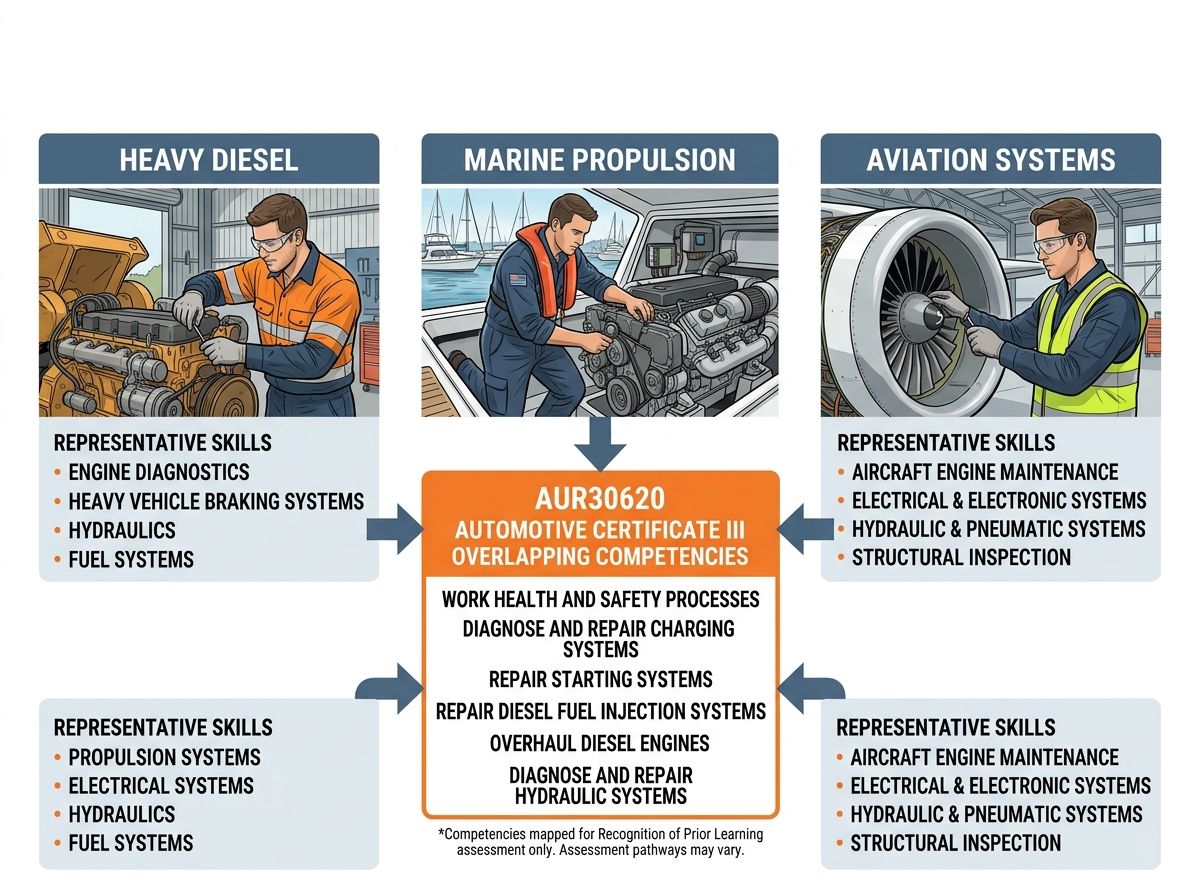
A heavy diesel mechanic working in mining or construction routinely diagnoses and repairs engine systems, transmission and driveline components, hydraulic systems, and electrical faults on vehicles and plant equipment. The Certificate III in Heavy Commercial Vehicle Mechanical Technology (AUR31120) — a closely related qualification — shares significant unit-level overlap with AUR30620, reflecting that the underlying mechanical knowledge is substantially the same across vehicle types.
A marine mechanic maintaining commercial vessel propulsion systems works with diesel engines, fuel systems, cooling circuits, and electrical diagnostics in environments that demand rigorous safety compliance and precise fault-finding. The Certificate III in Marine Mechanical Technology (AUR30520) sits within the same AUR Automotive Training Package as AUR30620, and the competency areas it covers — engine installation, electrical systems, diagnostics — map directly to the automotive qualification's core units.
Aviation maintenance engineers work to some of the most demanding technical and regulatory standards in any mechanical field. The MEA Aeroskills Training Package includes competency units covering quality standards, maintenance planning, safety practices, and systems certification — areas that require the kind of precision, documentation discipline, and diagnostic rigour that the automotive qualification also demands.
Aircraft Maintenance Engineers maintain and repair aircraft structures and mechanical systems, with reported skills including problem solving, planning and organising, and technical communication — all of which are directly relevant to automotive diagnostic and repair work.
The argument is not that these skills are identical to automotive work — the specific systems, regulatory frameworks, and vehicle types differ. The argument is that the underlying mechanical knowledge, diagnostic reasoning, and safety discipline are equivalent to, or exceed, what the AUR30620 qualification requires. RPL is not a test of what you know. It is a translation of what you already do.
That translation framing is worth understanding before you engage with any RPL process.
Why the system does not automatically see it
The Australian VET qualification framework organises competencies by industry training package. Automotive qualifications sit within the AUR package. Mining and resources qualifications sit within RII. Marine qualifications within MAR. Aviation within MEA. Each package is designed to reflect the specific regulatory and operational context of its industry.
This structure means that competencies developed in one training package are not automatically recognised in another. A heavy diesel mechanic's years of engine diagnostics do not appear on a transcript that an automotive employer or licensing body can read. The experience exists — but in the wrong form for the system to see it.
This is not a flaw in your experience. It is a structural gap in how formal systems categorise skills across industry boundaries. Employers are central to the apprenticeship system — they determine who commences and what on-the-job learning looks like — but they are not equipped to independently assess whether your mining or marine background satisfies the specific units of competency in an automotive qualification.
The RPL mechanic pathway is the formal mechanism that bridges this gap. It is the process by which a qualified assessor from a registered training organisation evaluates your existing experience against the units of competency — and issues a nationally recognised qualification when competency is demonstrated.
What the RPL mechanic pathway actually involves
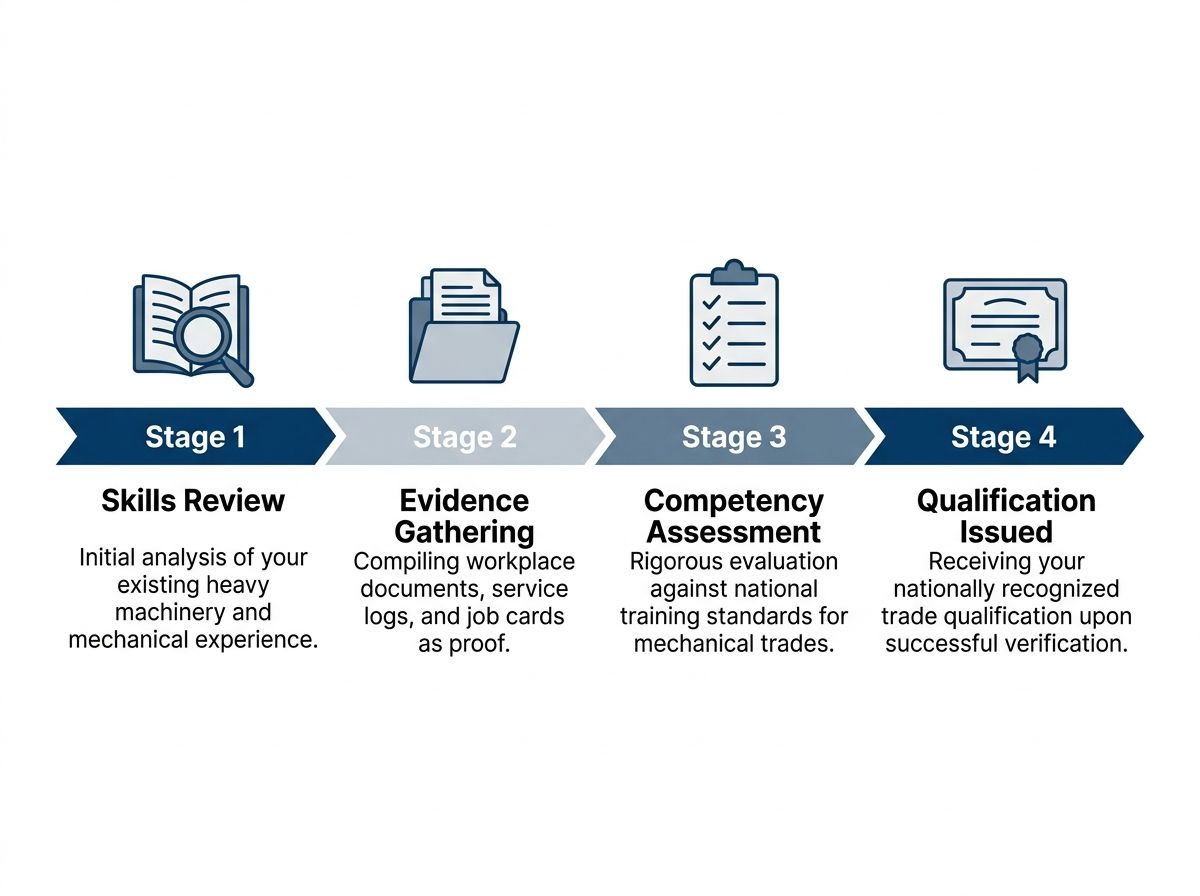
Recognition of Prior Learning is a form of assessment used to determine whether a person has acquired — through formal or informal learning — the skills and experience consistent with the competency standards that make up a qualification. For AUR30620, this means your existing mechanical experience is assessed against the qualification's units of competency.
RPL is not time-referenced. There is no fixed duration tied to the process — what matters is whether your current skills match the elements and performance criteria in each unit, not how long ago you acquired them.
The evidence you submit may include work experience records, employment history, job cards or service records, references from supervisors or employers, and practical demonstrations of competency. One RTO's published guidance for AUR30620 notes that RPL evidence can include work experience, life experience, previous study, and professional development programs — though requirements vary between RTOs and you should request your chosen provider's specific RPL candidate guide.
Assessment may involve both documentary evidence and practical tasks. RTOs delivering AUR30620 may use written questions, projects, simulations, and observations as part of their assessment approach — meaning RPL is not simply a paperwork exercise, but a genuine evaluation of your competence.
Evidence is submitted to a nominated assessor, who evaluates it against the required industry standard within the relevant training package unit of competency.
RPL applications generally take somewhere in the range of two to eight weeks, depending on how quickly you can compile your evidence and the assessor's capacity at the time.
If gaps are identified — units where your documented experience does not fully satisfy the competency criteria — gap training may be required. This is not a failure of the process; it is the process working as intended. A genuine RPL assessment identifies what you know and what, if anything, still needs to be demonstrated.
The qualification issued at the end is nationally recognised because the assessment is genuine. That is what makes it worth having.
Is the RPL mechanic pathway right for you?
RPL works well for mechanics with substantial, documented experience in adjacent mechanical fields. If you have years of hands-on work in heavy diesel, marine, or aviation maintenance — and you can provide evidence of that experience — the RPL pathway is worth exploring seriously.
It is less suited to situations where experience is limited, undocumented, or difficult to verify. An honest RPL assessment will tell you where your evidence is strong and where gaps exist. That honesty is the point — it is what makes the resulting qualification credible.
The right first step is a skills review — a no-obligation conversation that gives you an honest picture of how your experience maps to the qualification requirements before you commit to anything.
Your skills are real. The RPL mechanic pathway makes them visible.
You have the experience. The question is not whether you are capable — it is whether the formal system can see what you already know. Experience can be evidence. The RPL mechanic pathway is the guided process that makes that evidence visible.
You are not overqualified in the sense that disqualifies you. You are overqualified in the sense that the standard entry pathway was not built for someone at your level. The RPL pathway was.
If you have spent years working on systems that make a passenger car look straightforward, moving into the automotive trade is not a step down. It is a lateral move — and one that deserves formal recognition, not a first-year apprenticeship.
The decision is yours. But you do not have to make it without information.
The Australian apprenticeship system is designed to combine on-the-job and off-the-job training for those entering a trade — a structure that serves school leavers well but does not automatically account for experienced workers from adjacent industries.
Research from the National Centre for Vocational Education Research confirms that the quality of apprenticeship learning outcomes depends substantially on the instruction and supervision provided in the workplace — meaning early apprenticeship experiences vary considerably depending on the employer.
The MEA Aeroskills Training Package, which governs aviation maintenance qualifications in Australia, includes competency units covering quality standards, safety practices, and systems maintenance — areas that share significant conceptual overlap with the diagnostic and compliance requirements of automotive mechanical work.
Charles Darwin University's course information for AUR30620 notes that RPL is not time-referenced — assessment is based on whether current skills match the competency criteria, not on how long ago the skills were acquired.
Ready to Get Recognised?
Start with a free skills review to find out if RPL is right for you.