Stop thinking like an apprentice: Why your career pivot needs an evidence audit
If you're pivoting trades, you don't need more training: you need an evidence audit. Here's how RPL maps your existing skills to a trade certificate.

The apprentice mindset is the wrong starting point
You have the experience. That is not in question. What matters is whether you can demonstrate it in a way the formal training system recognises.
Most people approaching a career pivot default to the same mental model: what do I need to learn? They scan course listings, compare study durations, and start calculating how many years it will take to 'get qualified'. This is the apprentice mindset, and it starts from the wrong place.
The apprentice mindset assumes a deficit. It treats your existing knowledge as irrelevant, positioning you as someone who needs to be taught from scratch. If you have spent a decade diagnosing faults, rebuilding systems, and solving real-world problems under pressure, this framing is inaccurate and unhelpful.
The right question is not 'what do I need to learn?' It is 'what do I already know, and can I prove it?' Shifting from learner to evidence holder changes how you approach an RPL trade certificate.
What an evidence audit actually is
An evidence audit is a process that maps your existing work history and practical skills against the units of a national qualification. It shows what you already know, the proof you hold, and whether your experience meets the standard for formal recognition. This is not a test of what you can learn. It is a structured record of what you have already done.
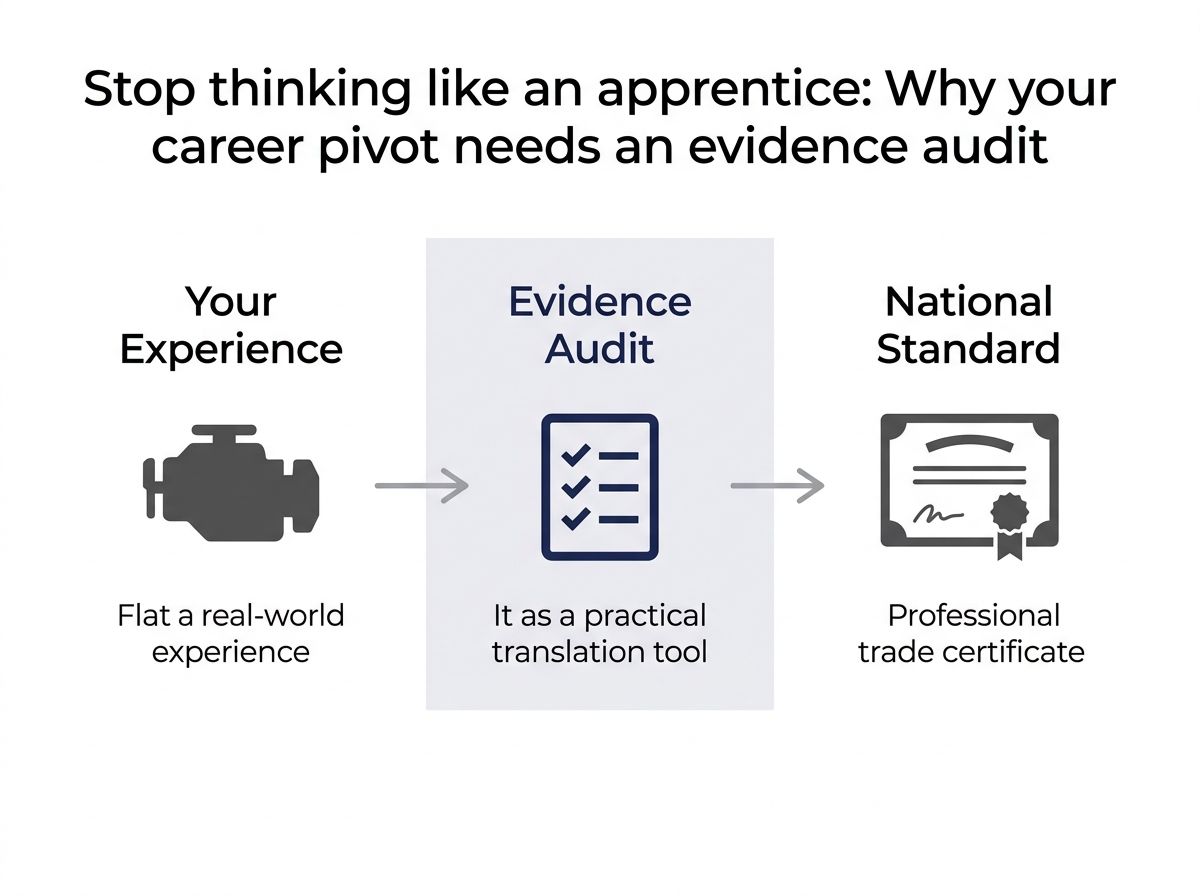
Recognition of Prior Learning (RPL) is the formal pathway for this audit. Under the Australian vocational education and training system, RPL allows a qualified assessor to evaluate your practical skills against qualification requirements. Where your evidence meets the standard, your skills are recognised. Where gaps exist, targeted training addresses them.
Think of it this way: your work history and your practical skills lead to your formal recognition. The evidence audit connects your practical experience to the official qualification.
According to ASQA, the national regulator for vocational education and training, RPL recognises skills gained through previous training, work, or life experience. Evidence can include work samples, training records, and employer references, which are compared against course requirements by a qualified assessor.
The outcome of an assessment is not predetermined. Depending on your evidence, you may receive full credit for the qualification, partial credit for specific units, or a recommendation for targeted training to fill gaps. You will not be asked to repeat learning you have already demonstrated.
Why the trades are particularly well-suited to RPL
The system was designed for this.
Trade qualifications in Australia, at the Certificate III and Certificate IV level, sit within the Australian Qualifications Framework. They are built around competency standards rather than academic grading. The VET system defines competency as the ability to perform tasks to the standard expected in the workplace. It is not about what you studied, but what you can actually do.
Academic qualifications test theory. Trade qualifications test practical skill. You have been doing the work for years.
This is why experienced tradespeople are well-suited for RPL. The evidence that assessors look for, such as practical performance, workplace application, and technical problem-solving, is the kind of proof that accumulates naturally over a working career. You have been building your RPL portfolio without realising it.
The Australian Qualifications Framework confirms that Certificate III and Certificate IV qualifications require graduates to demonstrate learning outcomes through knowledge, skills, and the practical application of those skills in real contexts.
The career pivot problem: When your skills speak a different language
The core challenge for career pivoters is not a skills gap. It is a translation gap.
Your competencies are real. Your diagnostic ability, your mechanical intuition, and your understanding of systems under load are all real. However, they are expressed in the vocabulary of a different industry. When you approach a new sector without formal credentials, the system cannot read your experience.
Consider someone who has spent eight years maintaining marine diesel engines. They understand compression ignition systems, fuel delivery, cooling circuits, and fault diagnosis under challenging conditions. Now they want to move into automotive. The skills are transferable, but the qualification is not automatically recognised.
The evidence audit is the translation process. It takes your years of maintaining marine diesel engines and maps them to the units of a Certificate III in Light Vehicle Mechanical Technology. It aligns what you have done with what the qualification requires, unit by unit.
Your skills are real, but the system does not speak your language yet. RPL acts as the translator.
How the RPL evidence audit maps your skills to the national standard
The RPL process works by comparing your documented experience against the specific units of competency in the target qualification. Each unit has defined performance criteria. Your evidence is assessed against these standards by a qualified assessor from a registered training organisation.
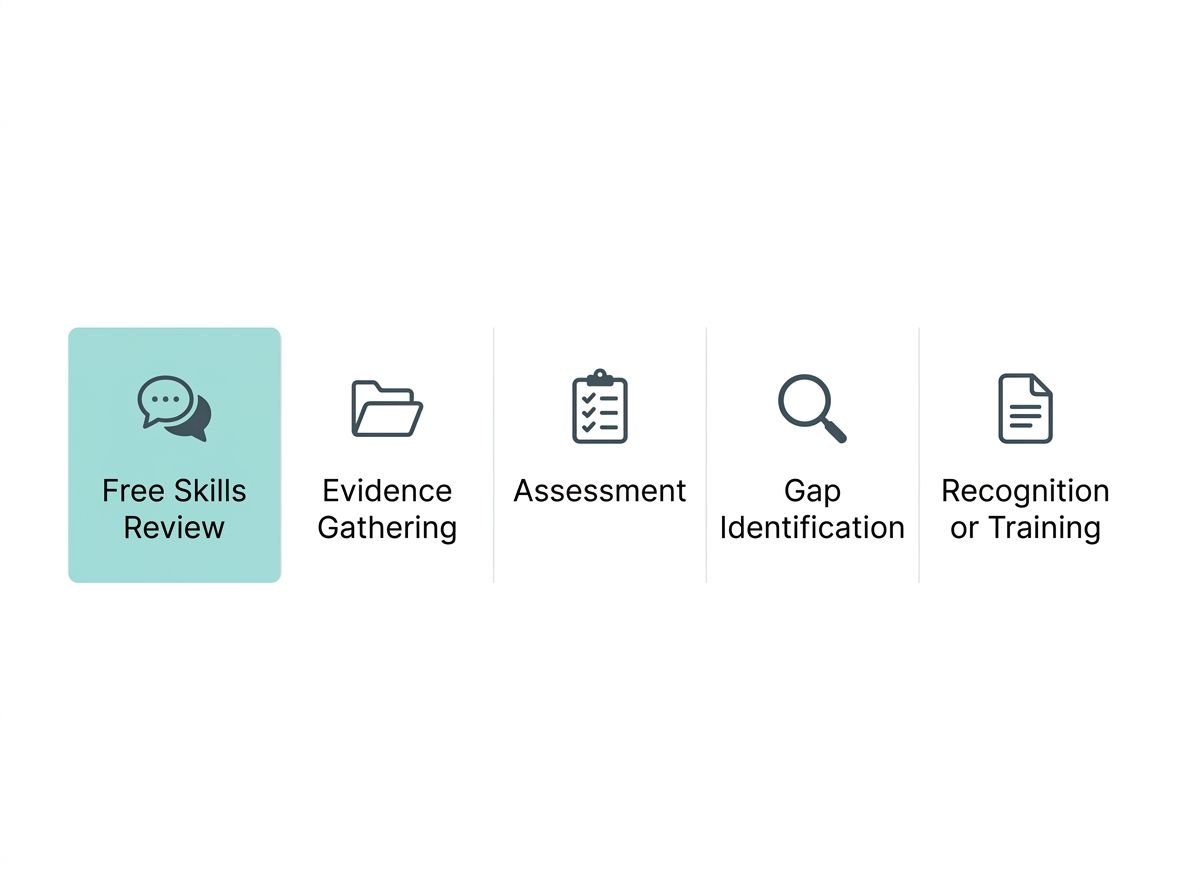
In practice, the process moves through several stages. First, a skills review establishes whether your background aligns with the qualification; this conversation happens before you commit to anything. Second, you gather evidence such as employment records, references, work samples, photographs, and logbooks. Third, this evidence is mapped against the units of competency in the qualification. Fourth, any gaps are identified, and the assessor determines if you receive recognition for the units demonstrated, outlining what is needed to address any outstanding areas.
If gaps are identified, the assessor may recommend collecting more evidence, targeted training for the missing units, or a partial qualification with a Statement of Attainment for the units already proven. Costs associated with gap training vary and are discussed transparently during the assessment process.
You will not be asked to repeat an entire qualification from scratch. The evidence audit is designed to recognise your existing skills, not ignore them.
What evidence actually counts in a trade RPL assessment
Many career pivoters underestimate how much evidence they already hold. The evidence audit is about organising what already exists, rather than creating new proof from scratch.
According to ASQA, evidence for RPL can include work samples, training records, and employer references. For trade qualifications, the relevant evidence typically includes:
- Employment records and payslips confirming your role and experience
- References or statements from supervisors, employers, or clients who can verify your work
- Photographs or videos of completed work, installations, or repairs
- Logbooks or maintenance records kept during your work
- Certificates, licences, or training records from previous qualifications or courses
- Third-party reports from colleagues or industry contacts who have observed your work
The required evidence depends on the qualification and the registered training organisation. For example, Master Builders Association of NSW describes its trade RPL program as requiring candidates to submit a list of previous employers, references, and a portfolio of photos, videos, and documents showing practical project work.
You probably have more evidence than you think. The challenge is not generating it, but organising and presenting it in a way that maps clearly to the qualification requirements. This is what the guided RPL process helps you do.
The honest truth about RPL suitability
RPL is not suitable for everyone. This is worth stating plainly.
If your experience is limited in the area covered by the qualification, RPL may not be the right pathway. If your skills are from a sector too distant from the qualification requirements, the evidence audit will show this, and formal training may be the better route.
RPL is a rigorous assessment process, not a shortcut. The qualification you receive through RPL carries the same national recognition as one earned through an apprenticeship because the assessment standard is identical. This rigour is what makes the outcome valuable.
A suitability assessment is the logical starting point before enrolment. The Free Skills Review answers the suitability question before you commit to anything. It is a straightforward conversation that tells you whether your experience aligns with the qualification, and what your options are.
Your next step: A Free Skills Review
The evidence audit begins with a conversation.
You have spent years building skills in your field. The question is whether those skills map to the qualification you want, and what evidence you have to prove it. A Free Skills Review is an honest, no-obligation way to find out.
It costs nothing and commits you to nothing. It provides a clear picture of whether your experience is likely to qualify, and what the pathway looks like. The decision is yours.
If you come from a mechanical or technical background, it is worth reading about how RPL works for mechanics and automotive tradespeople before your review.
Ready to Get Recognised?
Start with a free skills review to find out if RPL is right for you.